In the world of eCommerce, not every product on a website is treated equally. While a store may list dozens or even hundreds of items, only a select few are actively promoted at any given time. These promoted products are the ones the business is intentionally trying to sell faster—whether to increase revenue, clear inventory, test demand, or build brand recognition.
However, for an outside observer, identifying which products are being pushed is not always straightforward. Online stores rarely announce their promotional priorities directly. Instead, they communicate these priorities through subtle visual, structural, and behavioral signals across their website and marketing channels.
This creates an interesting challenge: how can you determine which products a store is actively promoting right now?
Understanding this is valuable for many reasons. It helps competitors analyze strategy, allows marketers to learn from successful stores, and enables entrepreneurs to identify trends and opportunities. More importantly, it reveals how businesses guide customer attention and influence purchasing decisions.
Let’s explore this in a structured and practical way.
Why Stores Promote Certain Products
Before identifying signals, it’s important to understand why stores promote specific products.
A business does not randomly push items. Promotion is always intentional and usually driven by one or more of the following goals:
- High-margin products: Items that generate more profit
- Bestsellers: Products already proven to convert well
- New arrivals: Items being introduced to the market
- Overstock inventory: Products that need to be cleared
- Seasonal items: Products tied to trends or events
- Strategic products: Items that define the brand
This means promoted products are often the most important part of a store’s current business strategy.
The Most Obvious Signal: Homepage Placement
The homepage is the most valuable space on any online store. What appears here is never accidental.
If a product is featured prominently on the homepage, it is almost certainly being promoted.
What to Look For
- Hero banners showcasing specific products
- Large images with call-to-action buttons
- Featured product sections
- “Trending” or “Top Picks” categories
Products placed at the top of the homepage receive maximum visibility. This is where stores guide first-time visitors.
If a product appears here, it is a strong indicator of active promotion.
Collection Positioning and Product Order
Another important signal lies within product collections.
Stores often organize collections in a way that prioritizes certain items.
Key Indicators
- Products listed at the top of a category
- Items marked as “Featured”
- Consistent positioning across multiple visits
Even if a collection contains many products, the order is rarely random. The first few items are usually the ones the store wants you to notice first.
This is a subtle but powerful merchandising technique.
Visual Emphasis and Design Cues
Promoted products often stand out visually compared to others.
Common Design Signals
- Larger images
- High-quality or lifestyle photography
- Bold colors or highlighted sections
- Unique backgrounds or frames
If a product looks more polished or visually appealing than others, it is likely receiving extra attention from the store.
Design is not just about aesthetics—it is a tool for directing user focus.
Labels and Badges
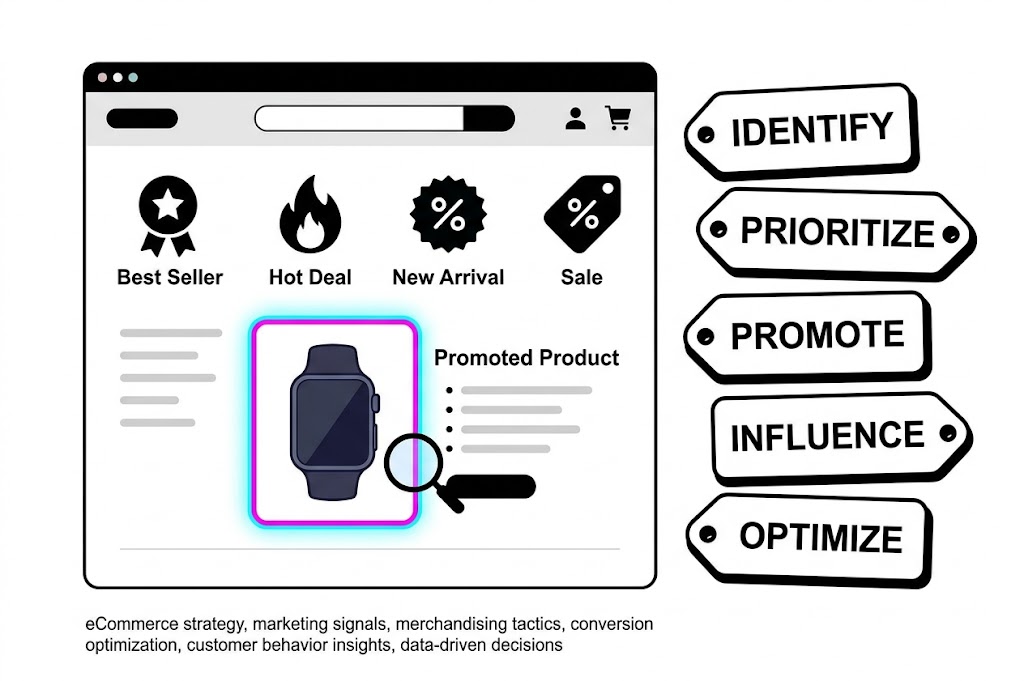
One of the clearest indicators of promotion is the use of labels.
Examples of Promotional Labels
- “Best Seller”
- “Hot Deal”
- “Limited Stock”
- “New Arrival”
- “Trending”
These labels create urgency and draw attention. They also signal that the store wants customers to prioritize these products.
While some labels reflect actual data (like bestsellers), others are used strategically to influence buying behavior.
Discounts and Pricing Signals
Pricing is one of the strongest promotional tools.
If a product has a discount, it is often being pushed more aggressively.
What to Watch
- Visible price reductions
- “Sale” tags
- Bundle offers
- Limited-time deals
Discounted products are usually part of a promotional strategy aimed at increasing conversions quickly.
However, not all promoted products are discounted—some are pushed based on value rather than price.
Repetition Across the Store
A highly promoted product often appears multiple times across the website.
Where You Might See It
- Homepage
- Collection pages
- Product recommendations
- Pop-ups or banners
If the same product keeps appearing in different sections, it is not a coincidence.
Repetition increases familiarity, and familiarity increases the likelihood of purchase.
Product Page Optimization
Promoted products usually have stronger and more detailed product pages.
Signs of Optimization
- Detailed descriptions
- Clear benefits and use cases
- Multiple images or videos
- Customer reviews
- Structured layout
Stores invest more effort into products they want to sell. If a product page feels more complete and persuasive than others, it is likely a priority item.
Cross-Selling and Upselling
Promoted products often appear in recommendations.
Examples
- “You may also like”
- “Frequently bought together”
- “Recommended for you”
If a product frequently shows up in these sections, it is being pushed indirectly.
This method integrates promotion into the shopping experience without making it obvious.
Marketing and External Signals
Promotion is not limited to the website. External marketing channels provide strong clues.
Indicators Outside the Store
- Social media posts featuring specific products
- Video content showcasing usage
- Influencer collaborations
- Email campaigns highlighting certain items
If a product appears frequently in marketing content, it is almost certainly being actively promoted.
Behavioral Clues: Urgency and Scarcity
Stores often use psychological triggers to promote products.
Common Tactics
- “Only a few left in stock”
- Countdown timers
- Flash sale messages
These tactics are rarely applied to all products. They are usually reserved for items the store wants to push.
Seasonal and Trend-Based Promotion
Promotion often aligns with timing.
Examples
- Winter products during colder months
- Gift items during holidays
- Trending gadgets during viral moments
If a product matches current trends or seasons and is visible across the store, it is likely being promoted.
Consistency Across Channels
The strongest indicator of promotion is consistency.
If a product is:
- On the homepage
- Featured in collections
- Highlighted in banners
- Appearing in recommendations
- Visible in marketing
Then it is clearly a priority product.
Promotion is rarely isolated—it is coordinated.
Why Identifying Promoted Products Matters
Understanding which products a store is pushing provides valuable insights.
For Competitors
- Learn what is working in the market
- Identify high-demand products
- Understand pricing strategies
For Entrepreneurs
- Discover product opportunities
- Analyze successful positioning
- Improve your own store strategy
For Marketers
- Study conversion tactics
- Learn how attention is directed
- Improve campaign effectiveness
Challenges in Identifying Promotion
Despite all these signals, identifying promoted products is not always simple.
Reasons
- Some stores rotate promotions frequently
- Others use subtle strategies
- Data-driven decisions are not always visible
This means you often need to combine multiple signals rather than rely on one.
A Practical Approach
To identify promoted products effectively, follow this process:
- Analyze the homepage
- Check top products in collections
- Look for labels and discounts
- Observe repetition across pages
- Study product page quality
- Review external marketing content
When multiple signals point to the same product, you can confidently assume it is being promoted.
Final Thought
Online stores are carefully designed environments where every element serves a purpose. Products do not gain visibility by chance—they are placed, highlighted, and repeated with intention.
By learning to recognize these patterns, you gain a deeper understanding of how eCommerce businesses operate. You begin to see beyond the surface and understand the strategy behind every click, image, and offer.
Conclusion
Identifying promoted products is not about finding a single clue—it is about observing a combination of signals across design, placement, pricing, and marketing.
From homepage banners to product labels, from discounts to repetition, each element contributes to a larger picture of what the store is trying to sell most actively.
The discussion may not have provided a clear answer, but the reality is that the answer exists within the structure of every store itself.
You just need to know where to look.
Because in eCommerce, what you see first is rarely accidental—
It is exactly what the store wants you to buy.