Running an online store and seeing only a few orders can feel frustrating, especially when you’ve already invested time into designing your website, adding products, and setting up basic features. Many store owners assume the issue is with traffic or product selection, but in most cases, the real problem lies deeper—in how customers perceive and experience your store.
From your situation, the issue is not a single technical problem. Instead, it is a combination of weak branding, low trust, unclear product communication, and an unoptimized shopping experience. These factors directly affect conversion—the ability to turn visitors into buyers.
Let’s break this down in a structured and practical way so you can understand exactly what needs improvement and how to fix it.
1. First Impression: Your Store Feels Like a Random Catalog
When a visitor lands on your website, they form an opinion within seconds. They don’t analyze your store deeply—they react instantly.
Right now, the biggest concern is that your homepage feels like a collection of random products rather than a focused brand.
This creates confusion.
Visitors ask themselves:
- What exactly does this store sell?
- Who is this brand for?
- Why should I trust this website?
- Why should I buy from here instead of a big platform?
If these questions are not answered immediately, most people leave.
What You Need to Do
You must clearly define your store identity.
Even if you are selling gaming accessories or cooling devices, your homepage should communicate:
- A clear niche or theme
- A strong headline explaining your purpose
- A short brand message
- A reason why customers should trust you
Instead of showing only products, your homepage should tell a story:
What you sell, who it is for, and why it matters.
Clarity builds confidence. Confusion kills conversions.
2. Positioning: Niche vs Mixed Products
There is some debate about whether your store should narrow its niche further or not. Some may argue that your focus on gaming accessories is already visible, while others may say your product mix still feels too broad.
The truth lies in how your store is perceived.
Even if you are targeting a niche, if your presentation is not consistent, it will still feel random.
What Matters More Than the Niche
It’s not just about what you sell—it’s about how clearly you present it.
If your store looks like:
- Gaming + random gadgets + unrelated items
It weakens trust.
If your store looks like:
- “A brand focused on enhancing gaming performance and experience”
It feels stronger and more professional.
Action Step
- Remove unrelated products
- Group products under clear categories
- Align everything with one core theme
A focused store builds authority faster than a general store.
3. Trust: The Biggest Missing Piece
Customers do not buy just because they like a product.
They buy when they feel safe and confident.
Right now, one of the biggest gaps is a lack of strong trust signals.
What Customers Look For
Before purchasing, customers want to know:
- How long will delivery take?
- Can I return the product?
- What if it doesn’t work?
- Is this website real?
- Have others bought from here?
If these answers are missing or unclear, they hesitate—and hesitation leads to exit.
Essential Trust Elements You Must Add
1. Shipping Information
Clearly mention:
- Delivery time
- Processing time
- Shipping regions
2. Return & Refund Policy
Make it simple and visible:
- Easy returns
- Clear refund conditions
3. Warranty or Guarantee
Even a basic guarantee increases confidence.
4. Reviews and Social Proof
Show:
- Customer reviews
- Ratings
- Testimonials
5. FAQ Section
Answer common questions upfront.
6. Contact Information
Add:
- Contact form
- Possibly WhatsApp or chat
7. Professional Design
Consistency in colors, fonts, and layout increases trust.
4. Product Pages: You Are Not Selling Enough
Many stores lose sales because their product pages are too basic.
Right now, your product pages likely describe what the product is—but not why someone should buy it.
Features vs Benefits
Customers don’t care about features alone.
They care about outcomes.
Example:
❌ Weak:
“Cooling fan for mobile device”
✅ Strong:
“Prevents overheating during long gaming sessions, ensuring smooth performance and better control”
What Your Product Pages Should Include
- Clear product benefits
- Real-life use cases
- Compatibility (especially for devices)
- High-quality images
- Demonstration videos
- Customer reviews
- FAQs specific to the product
Explain:
- What problem it solves
- How it works
- Who it is for
The more clarity you provide, the less doubt customers feel.
5. Shopping Experience: Friction Is Killing Sales
Even if a customer is interested, a poor shopping experience can stop them from completing the purchase.
One key issue mentioned is the cart flow.
Problem
Redirecting customers immediately after clicking “Add to Cart” can break the buying momentum.
Better Experience
- Use a slide-out cart
- Keep users on the same page
- Show added items smoothly
Additional Improvements
1. Sticky Add to Cart Button
Keeps the option visible while scrolling.
2. Cross-Sell Suggestions
Recommend related products.
3. Bundle Offers
Encourage customers to buy more.
4. Free Shipping Progress Bar
Example:
“Add ₹300 more to get free shipping”
These small changes can significantly increase conversions.
6. Visual Quality: You Need Stronger Content
Your visuals play a huge role in customer decisions.
Generic product images reduce trust.
Customers want to see:
- Real usage
- Lifestyle images
- Clear demonstrations
What to Improve
- Use high-quality images
- Add product videos
- Show the product in action
- Highlight benefits visually
Better visuals = higher perceived value.
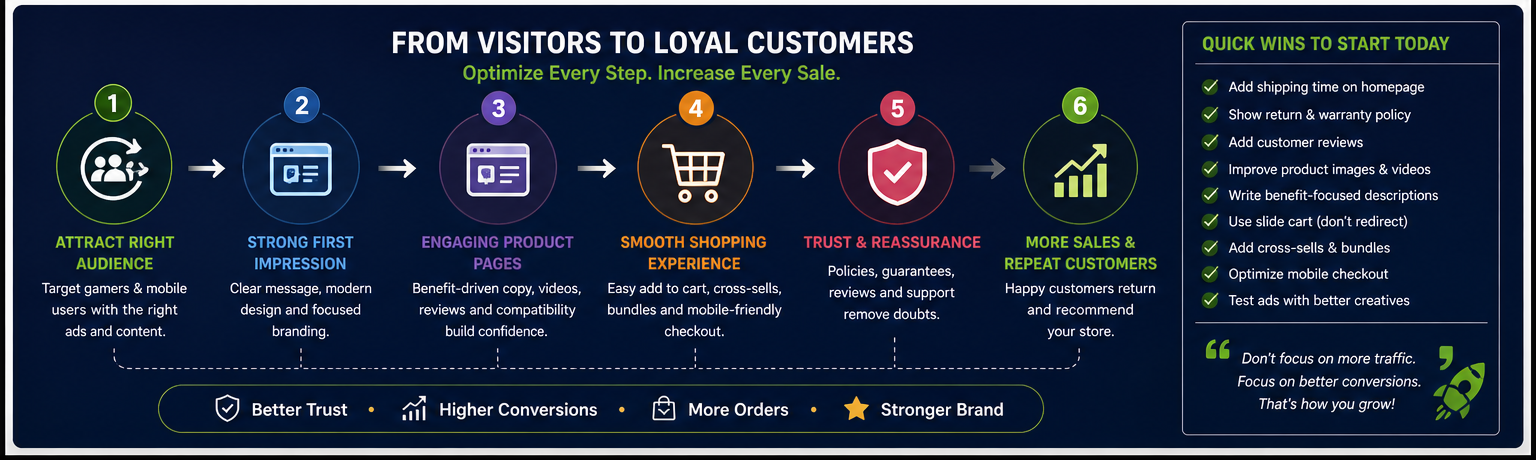
7. Marketing: Don’t Rush Into Ads
Many store owners try to fix low sales by running ads.
This is a mistake if your store is not optimized.
Why Ads Alone Won’t Work
Ads bring visitors.
But if your store:
- Looks confusing
- Lacks trust
- Has weak product pages
Visitors will leave without buying.
You will spend money without results.
Smart Approach
Before running ads:
- Fix homepage clarity
- Improve product pages
- Add trust signals
- Optimize shopping flow
Then test ads with a small budget.
8. Understand the Real Problem
There are only two main problems in eCommerce:
Problem 1: Low Traffic
Few visitors → focus on marketing
Problem 2: Low Conversion
Visitors but no sales → focus on store improvement
Your situation is clearly:
👉 Low conversion
This means:
- People visit
- But they don’t trust or understand enough to buy
So your priority is:
👉 Improve conversion, not traffic
9. Build a Real Brand, Not Just a Store
Long-term success depends on branding.
Right now, your store may feel like a reseller.
You need to make it feel like a brand.
Build Identity
Ask yourself:
- What does your brand stand for?
- Who is your target audience?
- What problem do you solve?
Create:
- Consistent messaging
- Unique positioning
- Strong identity
Customers remember brands, not random stores.
10. Practical Action Plan
Follow this step-by-step:
Step 1:
Improve homepage clarity and branding
Step 2:
Remove unrelated products and focus your niche
Step 3:
Upgrade product pages with benefits and details
Step 4:
Add trust elements (shipping, returns, reviews)
Step 5:
Fix cart and checkout experience
Step 6:
Improve visuals (images + videos)
Step 7:
Test marketing after optimization
Final Thought
Low orders do not always mean your products are bad.
It usually means:
👉 Customers are not fully convinced
Your job is to remove every doubt.
Your store should clearly communicate:
- What you sell
- Why it matters
- Why you are trustworthy
- Why customers should buy now
Conclusion
Your store does not need a complete rebuild. It needs clarity, trust, and better communication.
Focus on:
- Strong branding
- Clear product messaging
- Improved customer experience
Once these are in place, your conversions will improve naturally.
Because in eCommerce, people don’t buy when they are interested—
They buy when they feel confident.