In eCommerce, one of the biggest challenges store owners face is deciding what products to sell next. Finding winning products is already difficult, but identifying which complementary products are missing from an existing catalog is even more complex. Many merchants focus heavily on acquiring traffic, improving conversion rates, or optimizing operations, yet they often overlook a critical growth opportunity hiding inside their own product catalog.
This is where the proposed app idea becomes interesting.
The concept is simple but powerful:
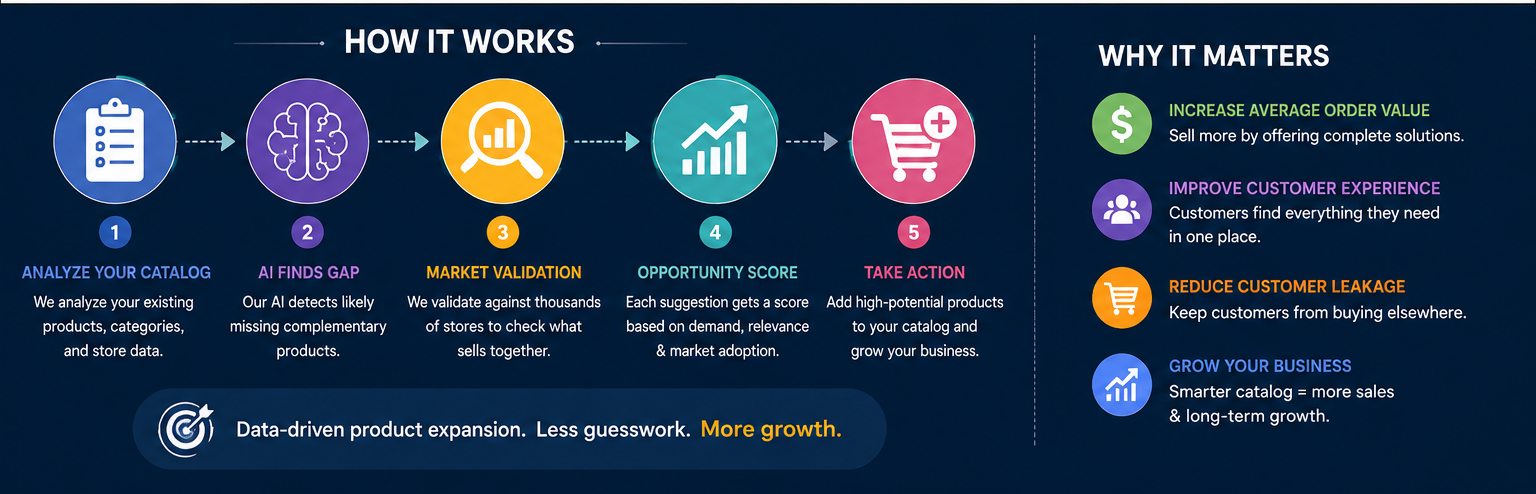
Analyze a store’s current catalog, identify likely missing products, and validate those opportunities by comparing them against broader product-selling patterns across other stores.
For example:
- A store sells shoes
- But does not sell socks
- The system identifies socks as a logical missing product
- Then confirms the opportunity by recognizing that many successful stores sell both together
At first glance, this may seem like a small optimization problem. However, when examined closely, it touches one of the most important areas in eCommerce growth:
product expansion strategy.
The key question is:
Is this a meaningful pain point worth solving?
The answer depends on how merchants currently make product decisions, how difficult catalog expansion really is, and whether stores genuinely struggle to identify missed opportunities.
Let’s explore this deeply.
Why Product Selection Is One of the Hardest Parts of eCommerce
Most people think running an online store is about marketing products.
In reality, choosing the right products is often more important than marketing itself.
A great product can survive average marketing.
A weak product usually fails regardless of advertising.
This creates constant pressure for merchants to:
- Add better products
- Expand strategically
- Increase average order value
- Improve customer retention
The challenge is that product expansion is rarely straightforward.
Store owners constantly ask:
- What should I add next?
- What products naturally fit my brand?
- What are customers expecting to buy together?
- What opportunities am I missing?
These are difficult questions because most merchants rely on guesswork, intuition, trends, or competitor observation.
That means product expansion decisions are often reactive instead of data-driven.
The Hidden Problem Most Stores Don’t Notice
Many online stores unknowingly leave revenue opportunities untapped.
Not because they lack traffic.
Not because their products are bad.
But because their catalog is incomplete.
For example:
- A fitness store sells resistance bands but not yoga mats
- A skincare store sells cleansers but not moisturizers
- A pet store sells dog food but not feeding bowls
Customers naturally expect certain product combinations.
When those complementary items are missing:
- Average order value decreases
- Cross-selling opportunities disappear
- Customers shop elsewhere for related items
This creates friction in the buying experience.
The proposed app idea directly targets this issue.
Why Complementary Products Matter So Much
Complementary products are extremely important in eCommerce because they increase both revenue and customer convenience.
When customers can purchase related items together:
- The shopping experience feels complete
- Customers spend more per order
- Repeat purchase potential increases
This is why successful brands often expand horizontally around customer needs instead of randomly adding unrelated products.
For example:
A customer buying running shoes may also need:
- Socks
- Insoles
- Shoe cleaners
- Athletic bags
These additions are logical, relevant, and high-converting.
The ability to identify these missing opportunities automatically could become very valuable.
How Merchants Currently Decide What to Add
One of the most important questions raised in the discussion is:
How do store owners currently decide what products to add?
In most cases, the process is surprisingly unstructured.
Common Methods Merchants Use Today
1. Competitor Observation
Store owners study competing websites and copy product expansion ideas.
2. Trend Research
They monitor social trends, marketplaces, or viral products.
3. Customer Requests
Customers frequently ask for related products.
4. Personal Assumptions
Many decisions are based on instinct rather than data.
5. Sales Data
Some merchants expand categories based on top-selling products.
While these methods can work, they are:
- Time-consuming
- Inconsistent
- Difficult to scale
Most importantly, they often miss hidden opportunities.
Why This Problem Is Bigger Than It Looks
At first, “missing products” may sound like a small optimization issue.
But in reality, it connects to several major business goals:
- Increasing average order value
- Improving customer retention
- Expanding product catalogs strategically
- Strengthening brand positioning
- Reducing customer leakage to competitors
For growing stores, these are critical priorities.
This suggests the pain point may be more significant than many initially realize.
The Real Value Is Not the Suggestion — It’s the Validation
One of the strongest parts of the proposed idea is not just suggesting missing products.
It’s validating them.
This is important because merchants do not simply want random recommendations.
They want confidence.
If the system can show:
- Other successful stores commonly sell these products together
- These combinations are market-proven
- Customers frequently purchase related items
Then the recommendation becomes much more valuable.
Validation transforms:
“Maybe you should sell this”
into
“There is strong evidence this product fits your catalog.”
That shift is powerful.
Why AI Makes This Idea More Interesting
Traditional product recommendation systems often rely on basic category matching.
But AI-based analysis introduces deeper possibilities.
For example:
- Understanding customer intent
- Recognizing behavioral patterns
- Detecting logical catalog gaps
- Identifying emerging combinations before trends become obvious
This creates the potential for smarter recommendations rather than simple keyword matching.
The real opportunity lies in helping merchants think strategically instead of reactively.
The Biggest Challenge: Relevance and Accuracy
While the idea is promising, the biggest risk is recommendation quality.
Poor suggestions would destroy trust quickly.
For example:
If a luxury fashion store receives irrelevant low-quality product suggestions, the recommendations lose credibility immediately.
The system must understand:
- Brand identity
- Store positioning
- Product category relationships
- Customer expectations
Without context, recommendations become noise instead of value.
Accuracy is everything.
Different Stores Have Different Needs
Not every merchant experiences this pain point equally.
Stores That Would Benefit Most
Growing Niche Stores
These stores actively expand their catalog and seek related products.
General Stores
They constantly search for complementary items to increase revenue.
New Merchants
Beginners often struggle most with product expansion decisions.
High-Volume Stores
Larger stores benefit from optimization at scale.
Stores That May Not Need It
Highly Specialized Brands
Luxury or minimal-product brands may intentionally limit catalog size.
Handmade or Unique Product Businesses
Some stores focus on exclusivity rather than expansion.
This means the problem exists—but its importance varies by business type.
Why This Could Become More Than a Product Discovery Tool
The idea has potential beyond simple recommendations.
It could evolve into:
- Catalog optimization guidance
- Revenue opportunity analysis
- Cross-sell strategy planning
- Inventory expansion insights
- Brand positioning recommendations
This makes the concept strategically interesting.
The Psychological Side of the Problem
Many merchants fear adding the wrong products.
Why?
Because:
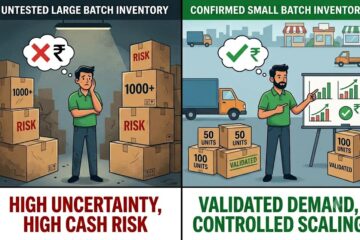
- Inventory costs money
- Poor product choices hurt branding
- Unsold inventory creates financial pressure
As a result, product expansion decisions feel risky.
A system that reduces uncertainty could provide strong psychological value—not just business value.
Confidence itself becomes part of the product.
Why Validation Matters Before Building
The discussion correctly remains in the idea-validation stage because not every interesting concept becomes a real business opportunity.
Important questions still need answers:
- Do merchants actively struggle with this problem?
- Would they pay to solve it?
- Are current methods frustrating enough?
- How accurate do recommendations need to be?
- Is the pain strong enough to create long-term usage?
These questions matter more than the technology itself.
Potential Competitive Advantage
One reason this idea stands out is that most eCommerce tools focus on:
- Marketing
- Conversion
- Operations
Very few focus deeply on:
Strategic product expansion intelligence
That creates room for differentiation.
Especially if recommendations become highly accurate and actionable.
Final Thought
The idea of identifying missing products inside a catalog may sound simple on the surface, but it touches a surprisingly important area of eCommerce strategy.
Many merchants struggle to know:
- What to add next
- What customers expect together
- What opportunities they are missing
Most decisions today rely on guesswork, trends, or competitor observation.
A system that intelligently identifies and validates catalog gaps could reduce uncertainty, improve revenue opportunities, and help merchants expand more strategically.
Conclusion
So, is “What products am I missing from my catalog?” a real pain point worth solving?
The answer is:
Potentially yes—but only if the recommendations are accurate, relevant, and genuinely actionable.
The real value is not simply suggesting products.
It is helping merchants make smarter expansion decisions with confidence.
Because in eCommerce, growth is not only about selling more—
It is also about selling the right products together.