Starting a women’s fashion dropshipping business in the United Kingdom can be an exciting opportunity. Fashion remains one of the largest online shopping categories, and many customers appreciate having access to trendy clothing without visiting physical stores. However, success in this industry depends heavily on one critical factor: finding reliable suppliers.
Unlike businesses that manufacture their own products or hold inventory, dropshipping businesses rely on suppliers to store products, package orders, and ship them directly to customers. This means the supplier’s performance directly affects the customer’s experience. If products arrive late, sizing is inconsistent, or quality falls below expectations, customers typically hold the retailer responsible rather than the supplier.
The discussion focuses on entrepreneurs searching for trustworthy UK-based suppliers for women’s fashion. Instead of identifying one universally recommended supplier, the responses consistently emphasize a careful due-diligence process. Merchants are encouraged to research suppliers thoroughly, verify customer reviews, order samples, communicate directly with manufacturers and wholesalers, participate in industry communities, and attend fashion trade events whenever possible.
The conversation also highlights that women’s fashion presents unique challenges, particularly regarding sizing, returns, and customer expectations. As a result, choosing suppliers requires much more than comparing product prices alone.
Why Supplier Choice Is So Important
In a dropshipping business, the supplier becomes an invisible extension of the retailer’s brand.
Customers usually interact with:
- The online store
- Product pages
- Customer support
- Marketing
However, they experience the supplier through:
- Product quality
- Packaging
- Shipping speed
- Delivery accuracy
A customer rarely separates these experiences.
If the supplier performs poorly, the retailer’s reputation suffers.
This is why supplier selection deserves careful attention before launching a fashion business.
Why UK-Based Suppliers Can Offer Advantages
Many entrepreneurs specifically look for UK-based suppliers because they may provide advantages over distant international suppliers.
Possible benefits include:
- Faster delivery times
- Easier communication
- Simpler returns
- Better customer satisfaction
- Lower shipping uncertainty
- Greater familiarity with local fashion trends
For UK customers, receiving products quickly can become an important competitive advantage.
While overseas suppliers sometimes offer lower prices, longer shipping times may reduce customer satisfaction.
Businesses must balance cost with customer experience.
Start with Research
The strongest recommendation throughout the discussion is to begin with careful supplier research.
Rather than choosing the first supplier found online, merchants should evaluate multiple options.
Useful research includes:
- Company background
- Customer reviews
- Business history
- Product categories
- Contact information
- Return policies
- Shipping information
A supplier that appears attractive initially may reveal warning signs after deeper investigation.
Taking time to research can prevent costly mistakes later.
Read Independent Customer Reviews
Reviews provide valuable insight into real customer experiences.
Instead of relying only on supplier marketing materials, merchants should look for independent feedback.
Reviews may reveal patterns involving:
- Shipping delays
- Product quality
- Customer service
- Refund experiences
- Communication
- Packaging
No supplier will necessarily receive perfect reviews.
However, repeated complaints about the same issues deserve attention.
Consistent patterns often provide more useful information than isolated negative experiences.
Order Product Samples
One of the most practical recommendations is ordering samples before listing products for sale.
This allows merchants to evaluate products firsthand.
A sample order can reveal:
- Fabric quality
- Stitching
- Color accuracy
- Packaging
- Delivery speed
- Product sizing
- Overall presentation
Seeing products personally provides much more confidence than relying solely on supplier photographs.
Sample orders also help businesses create more authentic product content.
Why Samples Matter Even More in Fashion
Women’s fashion involves higher customer expectations than many other product categories.
Customers often evaluate:
- Fabric feel
- Fit
- Color accuracy
- Comfort
- Construction quality
Small differences can significantly affect satisfaction.
For example, a product photograph may appear luxurious, while the actual fabric feels inexpensive.
Ordering samples helps identify these differences before customers experience disappointment.
Understanding Sizing Challenges
Sizing is one of the biggest challenges in online fashion retail.
Different manufacturers may use different sizing standards.
A medium-sized garment from one supplier may fit differently from another supplier’s medium.
Businesses should carefully review:
- Size charts
- Measurements
- Fit descriptions
- Product specifications
Whenever possible, merchants should verify sizing through sample orders.
Clear sizing information also helps reduce returns.
Why Returns Are Especially Important
Fashion businesses typically experience higher return rates than many other ecommerce categories.
Customers may return products because:
- The size does not fit.
- The color looks different.
- The fabric feels unexpected.
- The style differs from expectations.
Because returns are common, merchants should understand supplier return policies before partnering with them.
Important questions include:
- Who accepts returns?
- Who pays return shipping?
- What happens with damaged products?
- How long is the return window?
- How are refunds handled?
Clear policies reduce future confusion.
Building Direct Relationships with Suppliers
Another valuable recommendation is communicating directly with suppliers.
Instead of relying entirely on online listings, merchants can contact suppliers to ask practical questions.
Topics may include:
- Product availability
- Shipping times
- Wholesale pricing
- Packaging
- Custom branding
- Inventory updates
- Future collections
Direct communication also helps evaluate how responsive the supplier is.
Fast, professional communication often becomes especially important when customer issues arise later.
Working with Manufacturers and Wholesalers
Some businesses focus only on traditional dropshipping suppliers.
However, manufacturers and wholesalers may also offer valuable opportunities.
Working directly with product creators can provide advantages such as:
- Better pricing
- Stronger relationships
- Greater product knowledge
- Access to new collections
- Potential customization opportunities
These relationships may require additional negotiation but can create long-term business advantages.
Networking with Other Merchants
The discussion also recommends joining business communities.
Networking allows merchants to learn from people with practical experience.
Conversations with other business owners may reveal:
- Reliable suppliers
- Common problems
- Shipping expectations
- Fashion trends
- Business advice
Industry communities often provide insights that formal supplier websites do not.
However, merchants should still verify recommendations independently.
Attending Fashion Trade Events
Meeting suppliers in person can provide valuable information.
Trade events allow merchants to:
- Inspect products directly
- Compare multiple suppliers
- Discuss partnerships
- Evaluate professionalism
- Discover new brands
- Understand market trends
Although attending events requires time and travel, face-to-face conversations often build stronger business relationships.
Evaluating Product Quality
Fashion quality involves many details beyond appearance.
Merchants should examine:
- Fabric consistency
- Stitch quality
- Button attachment
- Zippers
- Printing quality
- Color durability
- Overall construction
Customers paying premium prices expect products that justify those prices.
Consistent quality helps encourage repeat purchases.
Packaging Matters
Packaging becomes part of the customer experience.
Even high-quality clothing can feel disappointing if packaging appears careless.
Businesses should evaluate whether suppliers provide:
- Clean packaging
- Product protection
- Professional presentation
- Appropriate labeling
Well-presented deliveries strengthen customer confidence.
Shipping Speed Can Influence Sales
Modern ecommerce customers often expect fast delivery.
Long delivery times may reduce conversion rates.
Before choosing a supplier, merchants should understand:
- Processing time
- Shipping time
- Tracking availability
- Weekend dispatch policies
- Delivery consistency
Reliable delivery often becomes more valuable than the lowest possible product price.
Managing Customer Expectations
Even reliable suppliers may occasionally experience delays.
Businesses should communicate realistic delivery estimates rather than overly optimistic promises.
Clear communication helps reduce customer frustration.
Customers generally appreciate transparency more than unrealistic guarantees.
Avoid Choosing Suppliers Only by Price
One common mistake among beginners is selecting the cheapest supplier.
Low prices may appear attractive initially.
However, poor quality, slow shipping, or inconsistent inventory can become much more expensive later.
Businesses should evaluate the total value offered.
Important factors include:
- Product quality
- Shipping reliability
- Communication
- Returns
- Customer satisfaction
- Inventory accuracy
The lowest product price does not always produce the highest long-term profit.
Build a Consistent Product Catalog
A focused catalog often performs better than an overwhelming collection of unrelated products.
Merchants should consider building collections around:
- Dresses
- Casual wear
- Formal wear
- Seasonal collections
- Accessories
- Lifestyle themes
A well-organized catalog improves navigation while strengthening brand identity.
Monitor Supplier Performance
Choosing a supplier is not the end of the evaluation process.
Businesses should continue monitoring performance after launching.
Useful indicators include:
- Delivery speed
- Customer complaints
- Return rates
- Product quality
- Inventory accuracy
- Communication speed
Regular monitoring helps identify problems before they become widespread.
Building Customer Trust
Customers buying fashion online often hesitate because they cannot try products before purchasing.
Trust can be strengthened through:
- Honest product descriptions
- Accurate sizing information
- Realistic product images
- Transparent policies
- Responsive customer support
Strong supplier performance makes these promises easier to keep.
Planning for Business Growth
As sales increase, supplier relationships become even more important.
Businesses should discuss future scalability with suppliers.
Questions include:
- Can larger order volumes be handled?
- How are stock shortages managed?
- How are seasonal collections introduced?
- Can branding be customized later?
Planning ahead supports smoother business growth.
Creating a Long-Term Partnership
The strongest supplier relationships often develop over time.
Merchants who communicate professionally and consistently may benefit from:
- Better support
- Faster responses
- Improved cooperation
- Access to new products
- Stronger business relationships
Treating suppliers as long-term partners rather than temporary vendors often creates mutual benefits.
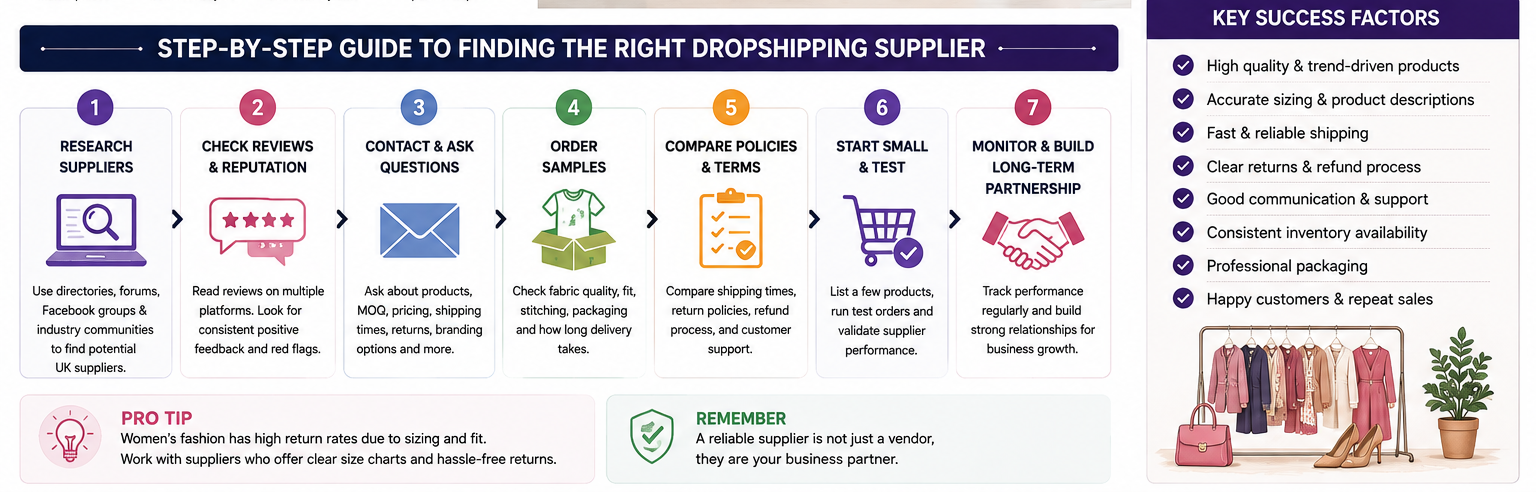
A Practical Supplier Selection Process
A structured approach can make supplier selection easier.
Step 1: Research Multiple Suppliers
Avoid relying on a single option immediately.
Step 2: Verify Reputation
Look for independent customer feedback and business history.
Step 3: Contact Suppliers Directly
Ask practical questions about operations and fulfillment.
Step 4: Order Samples
Evaluate quality, packaging, and delivery firsthand.
Step 5: Compare Policies
Review shipping, returns, and communication standards.
Step 6: Test Before Scaling
Launch with a smaller selection before expanding.
Step 7: Monitor Performance
Continue evaluating supplier reliability after launch.
Conclusion
Finding reliable UK-based dropshipping suppliers for women’s fashion requires much more than searching for the lowest prices or choosing the first supplier that appears online. The discussion shows that successful supplier selection depends on careful research, independent review verification, direct communication, sample testing, and ongoing performance monitoring.
Women’s fashion presents unique challenges because customers expect accurate sizing, quality fabrics, attractive packaging, and reliable delivery. These expectations make supplier reliability even more important than in many other product categories. Businesses should therefore pay close attention to return policies, shipping performance, inventory consistency, and overall product quality before committing to a long-term partnership.
Rather than searching for a single perfect supplier, entrepreneurs are better served by combining multiple evaluation methods. Researching business backgrounds, reading genuine customer experiences, ordering product samples, networking with experienced merchants, communicating directly with manufacturers and wholesalers, and attending industry events all contribute to making better-informed decisions.
Ultimately, a successful women’s fashion dropshipping business is built on trust. Customers trust the retailer to deliver products that match their expectations, and the retailer depends on suppliers to fulfill that promise consistently. By prioritizing quality, transparency, reliable fulfillment, and careful supplier selection, merchants create a stronger foundation for long-term growth, customer satisfaction, and sustainable success in the competitive online fashion market.