Summary
Product photography plays an important role in the success of an ecommerce store. Since customers cannot physically examine products before purchasing, images help them understand product quality, appearance, features, and possible uses.
The Shopify Community discussion titled “Do you use lifestyle photos or only product shots?” explores two different approaches to ecommerce photography: clean product shots and lifestyle images. Clean product shots focus on the product itself, while lifestyle photographs show products being used in real-world situations.
Both approaches offer different advantages. Product shots help customers examine specific details, while lifestyle images help them imagine how a product fits into their daily lives.
The discussion raises an important question for store owners: which type of photography creates better customer engagement and conversion rates? Since the conversation does not provide a shared conclusion or supporting performance data, the answer remains open to individual business experiences and product requirements.
Introduction
Running a successful ecommerce business involves more than offering quality products at competitive prices. Businesses must also present their products in a way that attracts customers, communicates value, and builds purchasing confidence.
When customers visit a physical store, they can touch products, examine their materials, compare different options, and understand their size and appearance. Online shopping is different because customers depend on product descriptions, photographs, videos, and other visual information to make purchasing decisions.
This makes product photography one of the most important elements of an online shopping experience.
However, ecommerce businesses often face an interesting decision when preparing product images. Should they focus entirely on clean product photographs that display items against simple backgrounds, or should they use lifestyle photographs that show products in real-world environments?
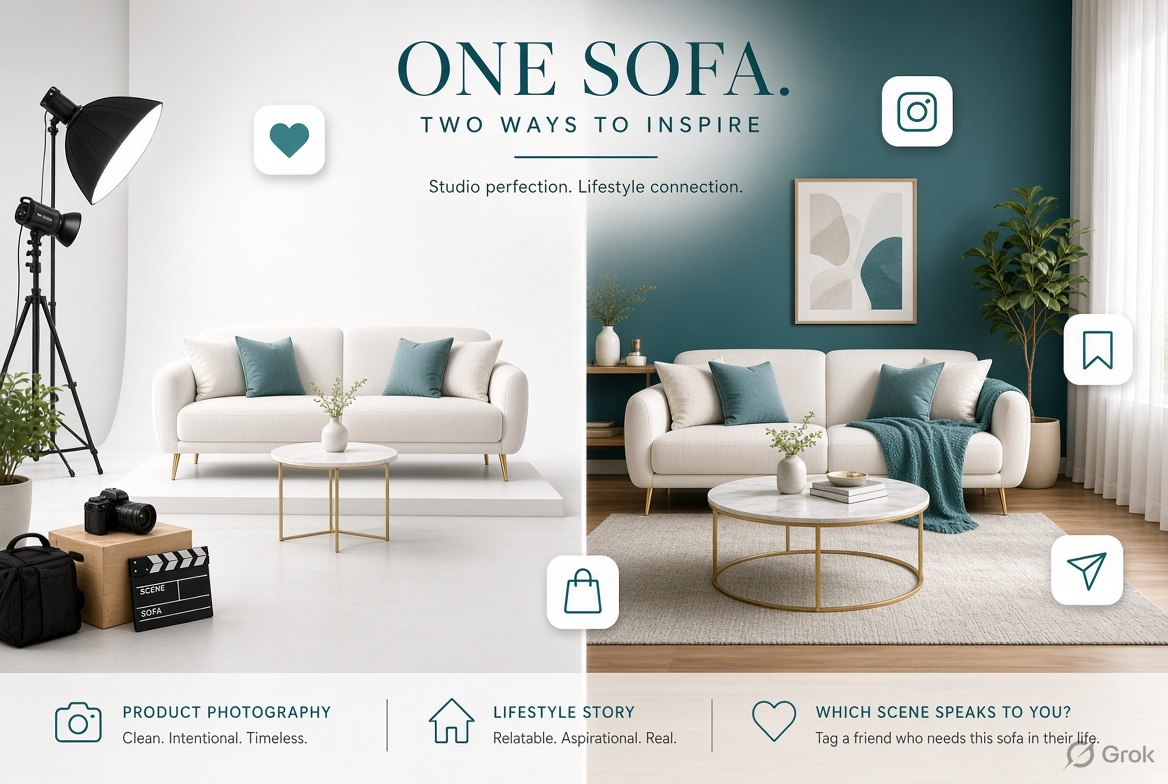
For example, a furniture store could display a sofa against a plain white background. This allows customers to examine its shape, colour, and design. Alternatively, the store could show the same sofa inside a beautifully decorated living room, helping customers imagine how it might look in their own homes.
Both photographs communicate something valuable, but they do so differently.
The Shopify Community discussion explores this exact question. Store owners are interested in understanding whether clean product shots or lifestyle images work better for ecommerce businesses.
There is no universal conclusion in the discussion. Instead, the conversation introduces an opportunity to understand the strengths of both approaches and consider how businesses can choose an appropriate photography strategy.
1. Understanding Clean Product Photography
Clean product photography focuses on presenting the product itself without unnecessary distractions.
These photographs usually feature simple backgrounds, balanced lighting, and carefully positioned products.
The main objective is to make the product clearly visible so customers can examine its appearance and important details.
For example, an electronics store may display headphones against a white background. Customers can easily see the product’s shape, buttons, design, and physical structure.
Similarly, a cosmetics brand may photograph skincare bottles against a clean background to highlight the packaging, label, and product presentation.
Clean product photography is particularly useful for businesses that want customers to focus on the actual item rather than its surroundings.
Benefits of Clean Product Shots
- Clear Product Visibility
One of the biggest advantages of clean product photography is that it removes unnecessary distractions.
Customers can focus on the product and examine its important features.
For example, someone purchasing a wristwatch may want to see the dial, strap, finishing, and overall design. A simple background makes these details easier to notice.
- Better Product Comparison
When products are photographed using similar backgrounds, lighting, and angles, customers can compare different items more easily.
This is especially useful for stores offering multiple variations of the same product.
A clothing business, for example, may sell the same shirt in different colours. Using a consistent photography style makes it easier for customers to compare those variations.
- Professional Store Appearance
Consistent product photographs can make an ecommerce store look organized and professional.
When all product images follow similar presentation standards, the website feels more visually connected.
This can help establish a recognizable brand identity.
- Greater Attention to Product Details
Clean product shots are useful when customers need to examine specific characteristics.
These may include:
- Product colour and finishing.
- Material and texture.
- Shape and dimensions.
- Packaging details.
- Buttons, controls, and accessories.
- Different product angles.
For products where physical appearance strongly influences purchasing decisions, these photographs provide important information.
2. Understanding Lifestyle Photography
Lifestyle photography takes a different approach.
Instead of showing only the product, it presents the product in an environment where customers might realistically use it.
The purpose is to communicate the experience associated with owning or using the product.
For example, a furniture company might show a sofa inside a modern living room with cushions, lighting, and other decorative elements.
A clothing brand might display a model wearing its products in an outdoor setting.
A kitchen equipment company could show someone preparing food using one of its appliances.
These photographs help customers understand how products fit into everyday situations.
Benefits of Lifestyle Photos
- Helps Customers Imagine Product Usage
One of the biggest advantages of lifestyle photography is that it gives customers context.
Instead of simply seeing a product, they can understand how it might be used.
For example, a customer looking at a coffee machine may find it useful to see the machine placed on a kitchen counter alongside cups and other kitchen accessories.
This creates a more relatable shopping experience.
- Creates an Emotional Connection
Lifestyle images can communicate feelings and experiences associated with products.
A travel accessories brand might show someone using a backpack during a mountain trip.
A home decor brand might display decorative products inside a comfortable living space.
These photographs help customers connect products with activities, environments, and personal interests.
- Communicates Brand Personality
Lifestyle photography can help businesses establish a distinct visual identity.
For example, a luxury brand may use elegant interiors, carefully selected lighting, and sophisticated settings.
An outdoor clothing brand may prefer natural environments, adventure settings, and active models.
The photographs communicate the type of experience the brand wants customers to associate with its products.
- Provides More Marketing Opportunities
Lifestyle photographs can be useful beyond product pages.
Businesses can use them for:
- Homepage banners.
- Social media campaigns.
- Promotional graphics.
- Email marketing.
- Seasonal advertisements.
- Brand storytelling.
- Product launch announcements.
This makes lifestyle photography valuable for businesses that want to develop a consistent marketing presence.
3. Clean Product Shots vs. Lifestyle Photos: Understanding the Difference
Although both approaches are used to present products, they serve different purposes.
Clean product photography focuses on product information, while lifestyle photography focuses on product experience.
Consider a business selling a pair of running shoes.
A clean product photograph can show the shoes from different angles, highlighting their shape, sole design, material, and colour.
A lifestyle photograph can show someone wearing the shoes while running outdoors.
The first image helps customers examine the product. The second helps them understand how the product might fit into their lifestyle.
The following comparison explains their main differences.
| Factor | Clean Product Shots | Lifestyle Photos |
| Main focus | Actual product | Product in use |
| Background | Simple and minimal | Real-world environment |
| Product details | Easy to examine | May be less prominent |
| Brand storytelling | Limited | Stronger visual context |
| Customer experience | Product understanding | Usage inspiration |
| Common purpose | Product listings | Marketing and promotion |
| Presentation | Clear and direct | Creative and contextual |
Neither approach is automatically better.
Their effectiveness depends on the product category, target audience, brand positioning, and the information customers need before making a purchase.
Signature: vOSvVzQ41B+co86aTfcUibjjelE5pkDjOtqn96t+NtI36Nd5Y04Zru7chy31U3dXNBDNPaNC3dGURL5LxtOsa7YKCqul6jwwRHWElW1TXoNHgNGfrdCZ0wbJJqm8Yu1WHVKsf/29F7ztwkjDrvL5PPkJK18oxxWJAtOBbOv7DksXANNha+ziw7NSZkzns/Xq2itR6I9jZ1EtQhpgofPc6GGcM2EgdlaxmUUcYJVCmgOnsuR3Z3M54GY9e9bvmZqv68bUYI69n8YDH2gyAXhoTfon803252borJi7GPL5Yi8WC6NcKhYJtq0oiarxt0t3lpfcYmqcTS2SVCRc+QIiQR1ZbHgAYzfK69epjXLqFYRuc5GZOzNWh7Llvs9zDoQ7rBIZjrxwB7JlL5yniZqOcUes296bmBWv545H2wQUCq9Q8FLaF6kR3LKUpECi+OBr34OdIGTRpW0N/Bj0Mut9ebovMfKWf8oOROnL9gGrBmIb8DQ/BbaXfBqQ6Yu7vcZPkAbxNOaVrKI1+27MMhU4UyGKJv7yu0DBo2BVM8d/G9fdm9EMxephPEb+aGvMQaPWZjXkD+r9ZxyRsRxfzAO71sI9o5PLNqX+IhOvAzIFSeAA4/vLydM51L2xX4IxrFD/s3s/nqy4fsAiAYYdN7C8pEhqIPRhNXFPdBD4AJLv3Sstj4gpjhx9AhrKqfal07wsEJ6lsEqz1WY33Ia3IBJ9a7I72636OdkTlrG1W45YCesaS2qVTmumIuGQXZhhkOQz6UUDq4mPJc8nORY1WD143NQO2y1oT5VeFLUd69uijKyGDaAz6OKE+aXxBRwCyMivYUpFF6YC6gbomhs4AbrBAtRQxD+gKdz6gSlg8ggPD8PPYVEsS3eSzVCiTM9k1g+uuEar8LZhYS+zbVzv3MvHLIZkshRnJ1k42Z9DSp7sJ16j7QS/BSgk//47yLFunVewYHsLK+4WLveL3AtU06/zXORH/ai4gvfzhXcP7uT+37k=
4. Which Photography Style Works Better for Different Ecommerce Industries?
The effectiveness of product photography depends heavily on the type of products a business sells.
A photography style that works well for one industry may not provide the same results for another.
Understanding the requirements of different product categories can help businesses select the right approach.
Fashion and Clothing
Fashion brands can benefit significantly from lifestyle photography.
Customers often want to understand how clothing looks when worn, how it fits, and how it can be styled.
Photographs featuring models wearing products can communicate these details more effectively than isolated product images.
However, clean product photographs are also important for showing fabric details, stitching, colours, and different clothing angles.
A combination of both approaches can provide customers with a more complete understanding.
Electronics and Technology
Electronics stores often benefit from clean product photography.
Customers usually want to examine the physical design, ports, buttons, screens, accessories, and other product details.
Lifestyle photographs can still be useful for demonstrating how products fit into everyday activities.
For example, a laptop shown on a professional desk can communicate its suitability for work environments.
However, the actual product should remain clearly visible.
Furniture and Home Decor
Furniture and home decor businesses can benefit greatly from lifestyle images.
Customers often want to understand how a product might look inside their homes.
A photograph of a dining table inside a decorated dining room provides more context than an isolated image.
However, clean product photographs are equally useful for showing the furniture’s shape, materials, finishing, and dimensions.
Beauty and Skincare
Beauty and skincare brands can use both photography styles.
Clean photographs help customers examine packaging, labels, and product appearance.
Lifestyle photographs can show products being used as part of a daily skincare or beauty routine.
For example, a skincare brand might display a moisturizer against a simple background and include another photograph showing someone applying it.
This provides both product information and usage context.
Jewellery and Accessories
Jewellery businesses often need high-quality close-up photographs to show fine details.
Customers may want to examine stones, metal finishing, patterns, and other design elements.
Lifestyle photographs can complement these images by showing jewellery being worn.
This helps customers understand how the product looks when used.
5. Why Using Only One Photography Style May Not Be Enough
Some ecommerce businesses choose to use only clean product photographs, while others prefer lifestyle imagery.
Both approaches can work, but relying entirely on one style may leave certain customer questions unanswered.
For example, a store that only displays isolated product photographs may provide excellent product details but fail to show how the products are used.
On the other hand, a store that only uses lifestyle photographs may look attractive but make it difficult for customers to examine important product characteristics.
Consider an online store selling backpacks.
If the store only displays lifestyle photographs of people carrying backpacks, customers may struggle to examine the actual compartments, zippers, straps, and internal storage space.
Similarly, if the store only displays isolated backpack photographs, customers may not understand how the bag looks when carried or how it fits into everyday activities.
This highlights the importance of providing different types of visual information.
Customers have different questions at different stages of their purchasing journey.
Some want to understand the product’s physical details, while others want to imagine owning and using it.
A balanced photography strategy can address both requirements.
6. The Hybrid Photography Strategy: Combining Product Shots and Lifestyle Images
A hybrid approach combines clean product photography with lifestyle images.
Instead of choosing one method exclusively, businesses can use both approaches to create a more complete product presentation.
For example, an online store selling handbags could organize its product images as follows:
Image 1: Main Product Photograph
Display the handbag against a clean background.
This gives customers a clear view of the actual product.
Image 2: Different Product Angle
Show the handbag from another angle to highlight its shape, handles, and overall structure.
Image 3: Close-Up Details
Display important details such as stitching, zippers, material, and internal compartments.
Image 4: Lifestyle Photograph
Show someone carrying the handbag in a realistic everyday setting.
Image 5: Product Usage Context
Display the handbag in a suitable environment that helps customers understand its practical use.
This approach gives customers both detailed product information and a visual understanding of the experience.
It can also make product pages more engaging without sacrificing clarity.
7. How AI Can Help Businesses Create Better Product Images
Preparing professional photographs for every product can require considerable time and resources.
This becomes particularly challenging for businesses managing large product catalogues or regularly introducing new products.
AI-assisted image creation and editing can help simplify certain parts of the process.
For example, a business may already have a clear photograph of a product against a simple background.
It can use AI-assisted editing to create additional lifestyle settings around the original product.
Some useful applications include:
Background Creation
Businesses can create suitable environments for presenting products without organizing a separate photoshoot for every background.
Lifestyle Scene Development
Products can be presented in different environments to demonstrate possible usage.
Image Enhancement
Existing photographs can be improved through adjustments to lighting, brightness, sharpness, and overall presentation.
Marketing Visuals
Businesses can create additional promotional compositions for homepage banners, social media, and advertising campaigns.
However, accuracy remains essential.
AI-generated visuals should not change important product characteristics such as colour, dimensions, materials, packaging, or design.
The final images should accurately represent what customers will receive.
8. How to Choose the Right Photography Strategy
Before selecting a photography style, ecommerce businesses should understand their products and customers.
A few important questions can help guide the decision.
What information do customers need before purchasing?
If customers need to examine product details carefully, clean photography should be a priority.
If understanding product usage is more important, lifestyle photography may deserve greater attention.
Who is the target audience?
Different customer groups may respond to different visual presentations.
A professional electronics buyer may prioritize technical details, while someone shopping for home decor may be more interested in visual inspiration.
What is the brand identity?
Businesses should select photography styles that match their overall brand positioning.
A premium fashion brand may prefer elegant lifestyle images, while a minimalist technology brand may prioritize clean product shots.
What resources are available?
Photography budgets, available equipment, editing resources, and product catalogue size can influence the final strategy.
Smaller businesses may begin with simple product photography and gradually introduce lifestyle images as their marketing requirements grow.
9. Practical Tips for Improving Ecommerce Product Photography
Regardless of the selected approach, businesses should follow certain practices to maintain image quality.
- Use consistent lighting across product photographs.
- Select backgrounds that complement the brand identity.
- Capture products from multiple useful angles.
- Ensure important product details are visible.
- Avoid excessive editing that changes product appearance.
- Maintain consistent image dimensions.
- Use high-resolution photographs.
- Optimize images for fast website loading.
- Include lifestyle images where they provide useful context.
- Review photographs on both desktop and mobile screens.
Businesses should also regularly review their product pages to identify missing photographs or images that no longer match their current branding.
A consistent photography process can make it easier to maintain quality as the product catalogue expands.
10. How to Understand Whether Product Shots or Lifestyle Images Perform Better
One important point in the Shopify Community discussion is that no shared conversion-rate data or final conclusion has been provided.
This means businesses should avoid assuming that one photography style will always generate better sales.
Instead, they can evaluate both approaches using their own store performance.
For example, a business could test two versions of a product page.
The first version could use a clean product photograph as its primary image.
The second version could use a lifestyle photograph as its primary image.
The business could then compare relevant performance indicators, such as:
- Product page engagement.
- Add-to-cart activity.
- Purchase conversion rates.
- Customer questions.
- Product return reasons.
- Customer feedback.
It is important to keep other major page elements as consistent as possible during testing.
For example, product pricing, descriptions, and promotional offers should not change at the same time if the business wants to understand the effect of photography.
The results can help identify which approach works better for a particular product and audience.
Different products may produce different results, so businesses should evaluate photography strategies at the product-category level rather than assuming one format will work everywhere.
11. Building a Consistent Visual Strategy for Long-Term Growth
Ecommerce businesses should think about product photography as part of their overall brand strategy.
A professional store needs more than attractive individual images. It needs a consistent visual experience across the entire website.
Businesses can establish a photography guideline that explains:
- Which background styles should be used.
- How products should be positioned.
- Which angles should be captured.
- When lifestyle images are required.
- How product colours should be represented.
- What image dimensions should be maintained.
- How photographs should be reviewed before publishing.
This makes the process easier for employees, photographers, and marketing teams.
It also ensures that new products can be introduced without making the store look visually inconsistent.
As the business grows, these guidelines can help maintain the same quality across hundreds or thousands of product listings.
Conclusion
The Shopify Community discussion raises an important question for ecommerce businesses: should online stores use clean product shots or lifestyle photographs?
Both approaches offer different benefits.
Clean product photography helps customers examine products, understand their physical details, and compare different options. Lifestyle photography provides context, communicates product usage, and helps customers imagine how products might fit into their everyday lives.
Neither approach is universally better. The right choice depends on the product category, target audience, brand identity, and customer expectations.
For many ecommerce businesses, combining both methods can provide a more complete visual experience.
A clean main product photograph can communicate essential details, while lifestyle images can demonstrate how the product looks and feels in real-world situations.
Businesses can also explore AI-assisted image creation to improve efficiency, provided that the actual product remains accurately represented.
Most importantly, store owners should evaluate their own customer behaviour instead of relying on assumptions. Testing different image styles and monitoring customer responses can help identify what works best for their particular products.
Ultimately, successful ecommerce photography is not simply about creating beautiful images. It is about helping customers understand products, imagine their benefits, and feel confident when making purchasing decisions.

0 Comments