Summary
Print-on-demand (POD) and dropshipping have become popular business models for entrepreneurs who want to sell products online without maintaining large inventories. However, managing multiple sales channels and ensuring that orders are processed correctly can become challenging, particularly when businesses operate across different countries and marketplaces.
A Shopify Community discussion in the Product Development & Sourcing category explores an important question: can print-on-demand providers successfully connect Shopify-based operations with Australian marketplace accounts such as eBay Australia, Etsy Australia, Amazon Australia, and potentially TikTok?
The seller has already connected Printify to Shopify and paid for an integration service to connect eBay and Etsy. However, uncertainty about regional marketplace support has created concerns about whether orders from Australian marketplace accounts will synchronize correctly.
The discussion also mentions other providers, including OGO and Gelato, as possible alternatives. However, no direct technical confirmation or definitive solution was provided.
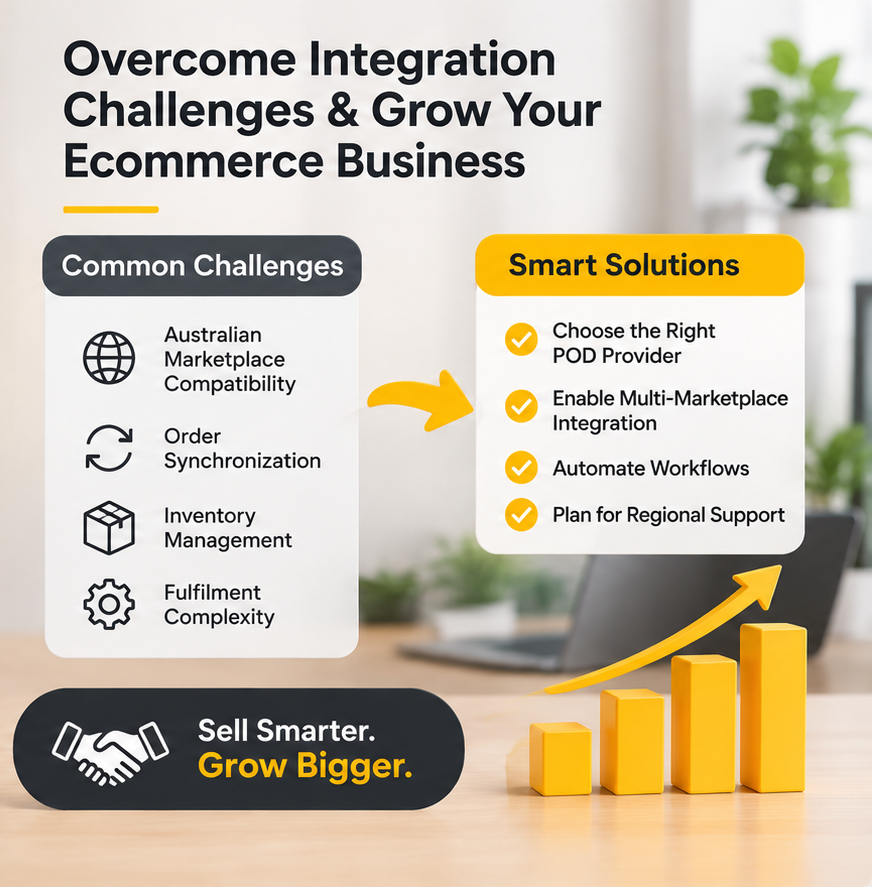
This topic highlights the importance of understanding regional marketplace compatibility, order synchronization, product management, and fulfilment processes before building a multi-channel ecommerce business.
Introduction
Starting an online business has become easier because entrepreneurs can sell products through multiple ecommerce platforms without necessarily owning a warehouse or maintaining large quantities of inventory.
Print-on-demand and dropshipping are two business models that make this possible.
Print-on-demand allows sellers to offer customized products that are produced after customers place orders. These products may include clothing, mugs, posters, phone cases, accessories, and other personalized items.
Dropshipping follows a similar inventory-free approach, where products are shipped directly from suppliers to customers rather than being stored by the seller.
Shopify provides an online storefront where businesses can manage products, customers, orders, and payments. Sellers can also connect their stores with external marketplaces to reach more customers.
However, operating across multiple marketplaces introduces additional complexity.
For example, an Australian seller may want to sell products through Shopify, eBay Australia, Etsy Australia, and Amazon Australia while using a single print-on-demand provider for production and fulfilment.
The main challenge is ensuring that all these platforms communicate correctly.
Product information, pricing, inventory availability, customer orders, and fulfilment updates need to move between different systems without unnecessary manual work.
The Shopify Community discussion explores these challenges and raises questions about whether popular print-on-demand providers support Australian marketplace integrations through Shopify.
1. Understanding Print-on-Demand and Dropshipping
Before exploring marketplace integrations, it is important to understand how print-on-demand and dropshipping work.
Both business models allow entrepreneurs to sell products without purchasing and storing large quantities of inventory in advance.
What Is Print-on-Demand?
Print-on-demand is a business model where products are manufactured or customized after a customer places an order.
For example, a seller may create a design for a T-shirt and list it in an online store.
When a customer purchases the T-shirt, the order is sent to a production provider. The provider prints the design, prepares the product, and ships it to the customer.
The seller does not need to maintain a stock of finished T-shirts.
Common print-on-demand products include:
- T-shirts and hoodies.
- Mugs and drinkware.
- Posters and wall art.
- Phone cases.
- Tote bags.
- Customized accessories.
- Home decor products.
This model is particularly useful for entrepreneurs who want to test product ideas without making large upfront inventory investments.
What Is Dropshipping?
Dropshipping allows sellers to offer products supplied by another business.
When customers place orders, the supplier receives the order details and ships the products directly to the customers.
The seller generally focuses on product selection, store management, marketing, and customer service.
Although print-on-demand is a specialized form of dropshipping, the two models have different operational requirements.
Print-on-demand usually involves customization or production after an order, while general dropshipping often involves products that are already manufactured.
A business may use both models within the same ecommerce operation.
2. Why Australian Sellers Want Multiple Marketplace Integrations
Selling through only one ecommerce channel can limit a business’s opportunities to reach potential customers.
This is why many entrepreneurs explore multiple marketplaces.
For an Australian seller, potential sales channels include Shopify, eBay Australia, Etsy Australia, Amazon Australia, and TikTok where suitable selling arrangements are available.
Each marketplace offers a different environment and customer audience.
Shopify
Shopify provides the seller with an independent online storefront.
Businesses can control their website design, product presentation, customer experience, and store branding.
eBay Australia
eBay provides access to an established marketplace where customers search for products across different categories.
It can help sellers reach shoppers who already use the marketplace for online purchases.
Etsy Australia
Etsy is particularly relevant to businesses selling handmade, personalized, creative, and customized products.
Print-on-demand sellers may consider it when their products meet the marketplace’s applicable seller and product requirements.
Amazon Australia
Amazon offers another marketplace opportunity for sellers interested in reaching customers through an established shopping environment.
However, sellers need to consider marketplace policies, fulfilment requirements, product restrictions, and integration compatibility.
TikTok
TikTok provides opportunities to discover products through short-form videos and social content. Selling arrangements and available commerce integrations can depend on regional availability and account eligibility.
For a business using multiple channels, the main objective is to manage these sales activities efficiently instead of handling every marketplace separately.
3. The Role of Shopify in a Multi-Channel POD Business
Shopify can act as the central ecommerce storefront for a business that wants to manage different sales channels.
A seller may create product listings in Shopify and connect additional marketplaces through suitable integrations.
The idea is to reduce repetitive work and make product and order management easier.
For example, imagine an Australian business selling customized mugs.
The seller creates a mug design and adds the product to the Shopify store.
The same product may also be offered through other supported marketplaces.
When a customer places an order through a connected sales channel, the integration should transfer the necessary order information to the relevant ecommerce and fulfilment systems.
Ideally, the process would involve:
- Creating a product listing.
- Connecting the relevant sales channels.
- Synchronizing product information.
- Receiving customer orders.
- Sending orders to the fulfilment provider.
- Producing and shipping the products.
- Updating fulfilment and tracking information.
The seller wants this process to operate with minimal manual involvement.
However, successful integration depends on whether the selected services support the exact marketplaces, regional accounts, and order workflows involved.
4. Understanding the Printify Integration Concern
One of the main concerns raised in the Shopify Community discussion involves Printify and its marketplace compatibility.
The seller has already connected Printify to Shopify.
They have also paid CedCommerce to integrate eBay and Etsy.
However, they noticed that Printify appears to officially support only eBay US, creating uncertainty about whether the same integration will work with eBay Australia.
This raises an important technical question.
An integration that supports one regional marketplace does not automatically guarantee support for every other regional version.
For example, eBay US and eBay Australia may have different regional settings, account configurations, shipping requirements, and marketplace-specific processes.
Even when two marketplaces belong to the same international platform, their integrations may not work identically.
The seller therefore needs confirmation that the complete order workflow is supported.
This includes checking whether:
- Australian marketplace accounts can be connected.
- Products can be published or synchronized correctly.
- Orders can be transferred automatically.
- Shipping information is handled properly.
- Tracking updates can be returned.
- Product variations remain accurate.
- Order failures can be identified and managed.
The important point is that connecting two services does not necessarily confirm that every regional marketplace workflow is supported.
The discussion does not establish whether the existing setup works for eBay Australia.
Therefore, direct confirmation from the relevant integration providers would be necessary before relying on it for business operations.
5. Why Regional Marketplace Compatibility Matters
Regional compatibility is an important consideration for international ecommerce businesses.
Many marketplaces operate across multiple countries, but their selling environments can differ.
These differences may affect product listings, currencies, shipping arrangements, account settings, payment processing, and fulfilment.
For example, an Australian seller may need product prices displayed in Australian dollars and shipping arrangements suitable for Australian customers.
The seller may also need to comply with local marketplace policies and applicable consumer requirements.
If an integration has been designed or documented for a particular country, sellers should not assume that it will automatically support another country’s marketplace.
A successful integration should be evaluated based on the actual regional account being used.
This is especially important for print-on-demand businesses because orders need to reach the correct production and shipping workflow.
A problem with regional synchronization could result in delayed orders, incorrect product information, or additional manual work.
Before launching products across multiple marketplaces, sellers should test the complete process using the intended Australian accounts.
6. Exploring Different Print-on-Demand Providers
The discussion mentions three providers under consideration: Printify, OGO, and Gelato.
The seller wants to understand whether these providers can support a Shopify-based business selling through Australian marketplaces.
Each provider needs to be evaluated according to the seller’s actual requirements rather than simply comparing their general product catalogues.
Printify
Printify is one of the providers already being used in the seller’s existing setup.
The seller has connected it with Shopify and is exploring additional marketplace integrations.
The main concern is whether its marketplace support extends to the Australian versions of eBay and other intended sales channels.
Before proceeding, the seller should confirm regional compatibility, order synchronization, shipping arrangements, and fulfilment updates.
OGO
OGO is another provider mentioned as a possible option.
The seller is considering it as part of the search for a suitable print-on-demand solution.
However, the discussion does not provide technical information confirming its compatibility with Shopify, eBay Australia, Etsy Australia, or Amazon Australia.
Its integration capabilities would therefore need to be checked directly.
Gelato
Gelato is also being considered as an alternative.
For a business operating in Australia, it is important to understand its available production and shipping arrangements as well as the marketplace integrations relevant to the intended sales channels.
The seller should verify whether the required connections are supported directly or through an additional integration service.
The discussion does not provide a confirmed answer about Gelato’s compatibility with the complete Australian marketplace setup.
7. The Importance of Order Synchronization
Order synchronization is one of the most important parts of a multi-channel ecommerce operation.
When a business sells products through several marketplaces, orders can arrive from different locations.
Without a reliable synchronization process, sellers may need to manage orders manually.
This increases administrative work and creates opportunities for mistakes.
For example, imagine a seller receives three orders:
- One order through Shopify.
- One order through eBay Australia.
- One order through Etsy Australia.
All three customers have purchased customized products.
The seller needs to ensure that the correct product details, design information, shipping address, and order quantities reach the appropriate fulfilment provider.
If an integration fails to transfer an order, the seller may not realize that production has not started.
Similarly, incorrect synchronization of product variations could result in customers receiving the wrong item.
A reliable setup should ideally support:
Automatic order transfer: Orders from supported marketplaces should reach the correct fulfilment workflow.
Product synchronization: Product names, descriptions, variations, and other relevant information should remain consistent.
Order status updates: Sellers should be able to monitor whether orders are received, processed, produced, and shipped.
Tracking synchronization: Available tracking information should be transferred to the relevant sales channel.
Error notifications: Failed or incomplete synchronization should be visible so that sellers can take action.
These capabilities are important for maintaining an organized multi-channel business.
8. Challenges of Managing Multiple Sales Channels
Although selling through several marketplaces can create additional opportunities, it also introduces operational challenges.
Product Management
Each marketplace may have different listing requirements.
Sellers may need to adjust product titles, descriptions, images, categories, and other details according to individual marketplace requirements.
Managing these listings separately can become time-consuming.
Pricing and Currency
Australian sellers need to consider local currency, product costs, marketplace charges, shipping expenses, and profit margins.
Pricing should be reviewed carefully across different sales channels.
Shipping and Fulfilment
Different marketplaces may have different shipping expectations.
The fulfilment provider must be able to process orders and provide suitable delivery information for the intended destinations.
Inventory and Availability
Even businesses using print-on-demand need to monitor product availability, production limitations, and supplier changes.
If a particular product or variation becomes unavailable, the seller needs to avoid accepting orders that cannot be fulfilled.
Customer Service
Customers may contact sellers through different marketplaces.
The business needs a consistent process for answering questions, handling order issues, and managing returns.
Without proper organization, multi-channel operations can become difficult to maintain.
9. What Sellers Should Verify Before Choosing an Integration
Before committing to a particular provider or integration service, sellers should prepare a list of technical requirements.
This is especially important when they have already invested money in connecting different ecommerce platforms.
Some important questions include:
Marketplace compatibility
Does the integration support eBay Australia, Etsy Australia, and Amazon Australia specifically, or only selected regional marketplaces?
Shopify connection
Can the integration connect the existing Shopify store with the selected sales channels?
Product synchronization
Can product listings, variations, images, and descriptions be transferred correctly?
Order synchronization
Will orders from every supported marketplace reach the intended fulfilment provider automatically?
Shipping support
Can the provider handle the seller’s Australian shipping requirements and communicate tracking information?
Manual fulfilment
Can products that are not handled through the print-on-demand provider still be processed manually?
Customer support
Is technical assistance available when marketplace connections or synchronization processes fail?
Regional restrictions
Are there any country-specific limitations that could affect the seller’s intended business model?
Getting clear answers to these questions can help prevent unnecessary expenses and operational problems.
10. The Importance of Testing Before Launching
One of the most practical ways to evaluate an ecommerce integration is to test the complete order journey before launching products on every marketplace.
A seller should not rely only on a successful account connection.
An account may connect successfully while certain product or order functions remain unavailable.
A structured testing process could include the following steps:
- Connect the Shopify store with the intended marketplace account.
- Add a small number of test product listings.
- Check whether product information and variations synchronize correctly.
- Verify the order transfer process using an appropriate test or controlled order.
- Confirm that the fulfilment provider receives the correct order details.
- Check whether shipping and tracking information are updated.
- Review how errors or failed synchronization are reported.
- Confirm which steps still require manual handling.
Testing should cover each regional marketplace separately.
For example, successful testing with eBay US should not be treated as confirmation that eBay Australia will work.
Similarly, a successful Shopify-to-Etsy connection should not automatically be considered proof that every order and fulfilment feature is supported.
A small testing process can help identify problems before they affect actual customers.
11. Exploring Alternative POD Integration Solutions
The discussion also raises the possibility of using alternative print-on-demand providers that support the required Australian marketplaces through Shopify.
One response mentioned a service offering order and customization synchronization for Shopify, WooCommerce, and Etsy.
However, the discussion does not establish whether this suggestion supports the seller’s complete requirements, particularly eBay Australia and Amazon Australia.
This highlights an important distinction between general platform compatibility and complete marketplace fulfilment compatibility.
A service may support Shopify and Etsy individually without supporting every possible combination of regional accounts and order workflows.
Therefore, sellers should evaluate integrations based on their complete operational requirements.
They should also consider whether the connection is direct, requires an additional service, or involves manual processing.
The best solution is not necessarily the provider with the largest product catalogue. It is the one that reliably supports the business’s actual sales channels and fulfilment requirements.
12. Building a Scalable Australian Multi-Channel POD Business
A successful multi-channel business requires more than connecting several ecommerce platforms.
It needs an organized structure for product management, order processing, fulfilment, shipping, and customer communication.
An Australian POD business could begin with a smaller setup.
For example, the seller could first establish the Shopify store and connect one marketplace.
After confirming that product synchronization and fulfilment work correctly, the business could gradually introduce additional sales channels.
This approach makes it easier to identify problems and understand the operational requirements of each marketplace.
The business should also maintain clear records of:
- Products available on each marketplace.
- Supplier and fulfilment information.
- Product costs and selling prices.
- Order status and tracking details.
- Marketplace-related expenses.
- Manually processed orders.
- Customer support requests.
As the business grows, these processes can help reduce administrative work and improve order management.
A gradual expansion strategy is particularly useful when dealing with multiple regional marketplaces and different fulfilment providers.
Conclusion
The Shopify Community discussion highlights an important challenge for Australian entrepreneurs building print-on-demand and dropshipping businesses across multiple marketplaces.
The main question is whether providers such as Printify, OGO, and Gelato can successfully connect Shopify-based operations with eBay Australia, Etsy Australia, Amazon Australia, and potentially TikTok.
The seller has already connected Printify to Shopify and invested in an additional integration service for eBay and Etsy. However, uncertainty about regional marketplace support has created concerns about whether the complete setup will function as expected.
The discussion does not provide a confirmed technical answer or identify a single provider that supports all the required integrations.
This makes regional compatibility testing particularly important.
Before launching products across multiple sales channels, sellers should verify account compatibility, product synchronization, order transfer, fulfilment processing, shipping updates, and support for manual orders.
They should also evaluate alternative providers based on their actual operational requirements rather than assuming that general Shopify compatibility guarantees support for every marketplace.
Ultimately, building a successful Australian print-on-demand business requires a reliable connection between the online storefront, sales channels, suppliers, and fulfilment processes.
The most effective approach is to verify regional marketplace compatibility, test the complete order workflow, and expand gradually. A reliable integration system can help sellers reduce manual work, manage multiple sales channels, and build a more scalable ecommerce business.


0 Comments