Few business models have created as much excitement, confusion, and unrealistic expectations as dropshipping.
For years, social media content, online videos, and success stories have presented the idea that someone can launch an online store, upload products, run a few advertisements, and begin generating income almost immediately.
Because of these messages, many people ask the same question:
Is Shopify dropshipping legitimate, or is it just another internet trend?
The discussion above gives a balanced answer.
Dropshipping itself is legitimate.
It is a real business model used by individuals, small brands, and even larger businesses around the world.
However, the discussion also rejects one of the most common misconceptions:
dropshipping is not an automatic or effortless way to make money.
Like any business model, results depend on execution, systems, consistency, customer experience, and business decision-making.
Understanding that difference is important because many people judge dropshipping based on unrealistic expectations instead of business fundamentals.
Let’s explore what dropshipping actually is, why people misunderstand it, what separates successful stores from unsuccessful ones, and why long-term thinking matters more than short-term hype.
What Dropshipping Actually Means
At its core, dropshipping is a fulfillment model.
Instead of purchasing inventory upfront and storing products, the business sells products first and arranges fulfillment after receiving customer orders.
This changes how operations work.
Traditional retail often follows this sequence:
Buy inventory
Store inventory
Receive orders
Ship products
Dropshipping changes the order:
List products
Receive customer orders
Coordinate fulfillment
Deliver products
The difference mainly affects inventory ownership and operational structure.
The business still remains responsible for customer experience.
Why People Often Think Dropshipping Is a Scam
The business model itself is legitimate.
The confusion usually comes from marketing around it.
Many people are introduced to dropshipping through messages such as:
start instantly
earn quickly
work minimal hours
build passive income
These promises create unrealistic expectations.
When reality feels more difficult than expected, people conclude the entire model must be fake.
But the challenge usually comes from execution rather than legitimacy.
Why Business Fundamentals Still Apply
Dropshipping changes inventory handling.
It does not remove business responsibilities.
Store owners still need to manage:
customer acquisition
pricing
branding
marketing
customer support
returns
quality expectations
business strategy
Ignoring these fundamentals often leads to failure.
Product Selection Matters More Than Most Beginners Expect
One point emphasized in the discussion is product research.
Choosing products randomly rarely works.
Good product selection considers:
market demand
competition
customer interest
pricing flexibility
shipping practicality
profit margins
Not every product performs equally.
Success often comes from understanding customer behavior.
Why Supplier Quality Influences Reputation
Since fulfillment happens externally, supplier reliability becomes extremely important.
Customers do not separate the supplier from the store.
They judge the entire experience through the business they purchased from.
Poor fulfillment can create:
negative reviews
refund requests
customer frustration
lost trust
Reliable operations become a competitive advantage.
Why Delivery Expectations Have Changed
Modern customers expect fast and predictable fulfillment.
Long delays can damage customer confidence.
Businesses must communicate clearly.
Customers generally tolerate waiting better when expectations are realistic.
Unexpected delays create far more frustration.
Why Store Presentation Still Matters
Another idea discussed was creating a professional store experience.
Many beginners assume customers only care about products.
In reality, customers evaluate:
visual quality
clarity
trust signals
ease of navigation
purchase confidence
A professional presentation supports credibility.
Why Product Photography Influences Buying Decisions
Online customers cannot physically inspect products.
Visual presentation becomes essential.
Strong visuals help communicate:
quality
use cases
expectations
value
Poor visuals increase hesitation.
Why Building an Audience Creates Long-Term Stability
The discussion mentioned email list building.
This reflects a broader business principle.
Relying entirely on paid acquisition creates dependency.
Owned audiences create stronger long-term economics.
Audience assets may include:
email subscribers
repeat customers
community engagement
direct traffic
Building relationships improves resilience.
Why Marketing Is More Complex Than Running Ads
Advertising receives significant attention.
But ads alone rarely create success.
Effective marketing includes:
positioning
creative quality
messaging
offer design
audience targeting
testing
Businesses that understand customer psychology perform better.
Why Testing Is Essential
The discussion emphasized ongoing testing.
Testing matters because assumptions are often wrong.
Businesses continually test:
offers
pricing
content
landing experiences
creative approaches
Testing reduces guesswork.
Why Many Beginners Quit Too Early
A common pattern appears repeatedly.
People expect immediate success.
When early results disappoint, they stop.
Business growth often takes longer than expected.
Consistency matters.
Why Competition Is Not Automatically a Problem
Some people believe crowded markets mean opportunity no longer exists.
But competition often signals demand.
The challenge becomes differentiation.
Businesses compete through:
branding
customer experience
positioning
service quality
specialization
Why Pricing Strategy Requires Thought
Low pricing alone rarely creates sustainable businesses.
Strong pricing considers:
cost structure
perceived value
market expectations
customer experience
Profitability matters.
Why Customer Service Builds Reputation
Businesses sometimes underestimate support.
Customer experience continues after checkout.
Good support can transform difficult situations.
Areas include:
shipping communication
issue resolution
returns
expectation management
Trust compounds over time.
Why Ethics Matter in Long-Term Success
The discussion encouraged approaching the model seriously and ethically.
This is important.
Short-term thinking often creates problems.
Examples include:
misleading delivery times
poor product quality
hidden conditions
aggressive claims
Trust-driven businesses generally last longer.
Why Fast-Rich Narratives Cause Problems
One of the strongest themes in the discussion is skepticism toward overnight success promises.
Quick success stories often hide:
failed experiments
testing costs
learning curves
operational challenges
Business growth is rarely instant.
Why Skill Development Creates Better Outcomes
Dropshipping rewards business capability.
Important skills include:
copywriting
marketing
analysis
operations
customer communication
problem solving
These skills remain valuable across business models.
Why Real Expectations Improve Decisions
A realistic perspective reduces disappointment.
Early stages often involve:
learning
adjustments
small wins
experimentation
Growth tends to happen gradually.
Why Brand Building Matters More Today
Customers increasingly choose brands instead of generic stores.
Brand building includes:
consistent identity
clear positioning
memorable experiences
community
Brands reduce dependency on short-term tactics.
Why Retention Can Matter More Than Acquisition
Acquiring customers repeatedly becomes expensive.
Returning customers improve economics.
Retention strategies include:
better experiences
follow-up communication
customer loyalty
quality fulfillment
Long-term growth benefits from repeat business.
Why Operational Discipline Creates Stability
Business success often appears exciting externally.
Internally, strong businesses rely on:
organization
measurement
planning
continuous improvement
Operations support growth.
Why Results Vary Across Individuals
One important conclusion from the discussion is that profitability cannot be guaranteed.
Outcomes vary because businesses differ in:
effort
strategy
market
execution
learning speed
No single formula works for everyone.
Why Business Thinking Beats Trend Following
People attracted only by trends often struggle.
Businesses perform better when owners focus on:
customer problems
value creation
process improvement
long-term reputation
Sustainable thinking creates stronger foundations.
The Bigger Lesson About Dropshipping
The larger lesson goes beyond one business model.
Every business involves tradeoffs.
Dropshipping reduces inventory risk.
But it introduces challenges around:
fulfillment
customer expectations
supplier dependency
competition
Success comes from managing those tradeoffs well.
Final Thought
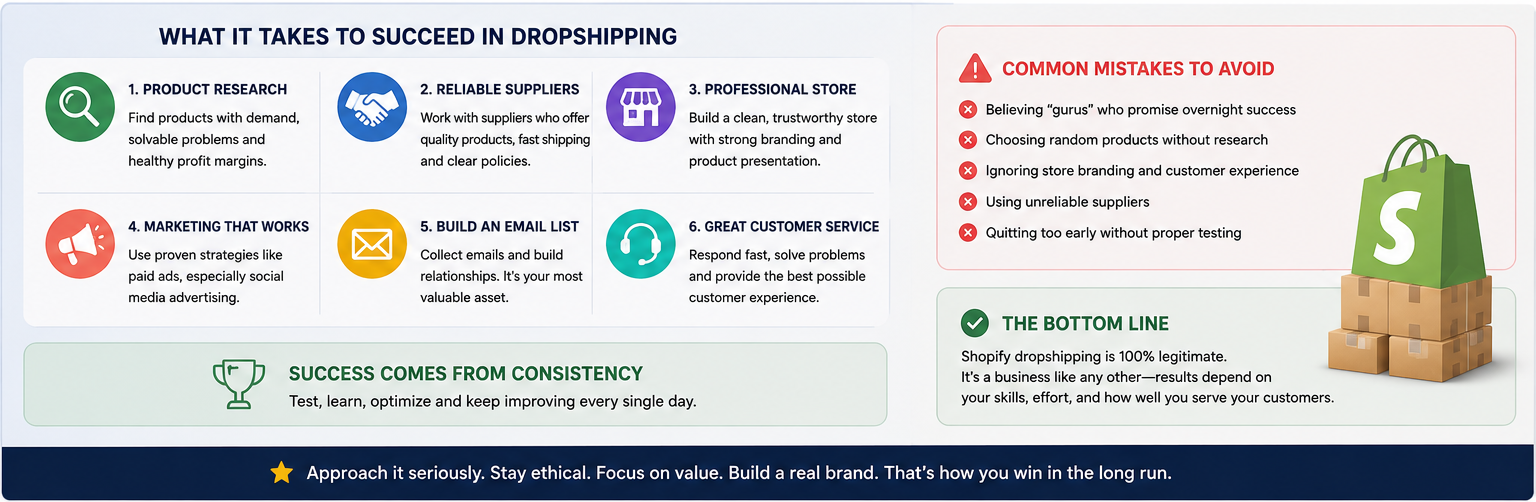
Shopify dropshipping is legitimate, but legitimacy does not guarantee success.
It is a business model—not a shortcut.
Businesses still need strategy, customer understanding, operational discipline, and continuous improvement.
People who approach it seriously, build trust, focus on quality, and stay consistent may create meaningful results over time.
People expecting effortless outcomes often become disappointed.
Because sustainable business growth rarely comes from finding an easy model—
it comes from executing a real business well.
Conclusion
The discussion reinforces an important perspective:
dropshipping is neither a scam nor a guaranteed opportunity.
It is simply one way to structure fulfillment.
Long-term success depends on:
product selection
supplier reliability
marketing quality
customer experience
continuous testing
ethical execution
Businesses that treat it seriously are more likely to build something sustainable.
And in modern commerce, trust and execution matter far more than hype.