Subscription-based ecommerce has transformed the way businesses generate recurring revenue. Instead of relying solely on one-time purchases, merchants can offer customers regular deliveries of products such as coffee, cosmetics, pet supplies, health products, meal kits, vitamins, personal care items, and many other goods. This business model creates predictable income, improves customer retention, and increases customer lifetime value.
However, running a subscription business also introduces operational challenges that traditional online stores may not experience. One of the biggest challenges is financial reconciliation—ensuring that every subscription payment, refund, renewal, and failed transaction is correctly recorded and understood. Another equally important challenge is monitoring failed subscription payments before they become a significant problem that affects revenue and customer satisfaction.
The discussion focuses on whether subscription-based businesses need a dedicated solution for monthly reconciliation and failed-payment monitoring. The primary concern is that recurring subscription revenue often becomes mixed with one-time purchases and refunds in financial reports, making it difficult to understand the true performance of the subscription business. Participants also highlight the difficulty of identifying sudden increases in failed renewal payments, which may only become noticeable after customers begin reporting problems or subscriptions start cancelling automatically.
This article explores why reconciliation matters, the common reporting challenges faced by subscription businesses, the importance of failed-payment monitoring, and practical strategies for maintaining financial accuracy without relying on complicated manual processes.
Why Subscription Businesses Require Different Financial Tracking
A traditional ecommerce business usually processes one payment for each customer order. Once the payment is complete and the product is delivered, the transaction is generally finished unless a refund or exchange occurs.
A subscription business works differently.
Customers may purchase once but continue paying every week, month, or year depending on the subscription schedule. Every renewal creates a new financial transaction that must be tracked accurately.
As subscriptions grow, businesses begin processing hundreds or even thousands of recurring payments every month. This creates a much larger volume of financial data that must be monitored carefully.
Unlike one-time sales, subscription businesses need to understand:
- New subscriptions
- Renewal payments
- Cancelled subscriptions
- Paused subscriptions
- Failed renewals
- Refunds
- Partial refunds
- Customer lifetime value
- Recurring monthly revenue
- Customer churn
Each of these figures contributes to understanding the health of the business.
What Financial Reconciliation Means
Financial reconciliation is the process of comparing business records with actual payment activity to ensure everything matches correctly.
The objective is to confirm that:
- Every successful payment has been recorded.
- Every refund is accounted for.
- Every renewal appears correctly.
- Revenue totals are accurate.
- Financial reports match payment records.
- Missing or duplicate transactions are identified.
Without proper reconciliation, businesses may believe revenue is higher or lower than it actually is.
Even small reporting mistakes can create significant accounting issues over time.
Separating Subscription Revenue from One-Time Orders
One of the biggest concerns raised in the discussion is separating recurring subscription revenue from normal retail sales.
Many ecommerce businesses operate both models simultaneously.
For example:
- A customer may purchase a product once as a gift.
- Another customer may subscribe for monthly deliveries.
- A third customer may buy additional products alongside an existing subscription.
If all these transactions appear together in reports, understanding subscription performance becomes difficult.
Business owners often want answers to questions such as:
- How much revenue came from subscriptions this month?
- How much came from one-time purchases?
- How many renewals succeeded?
- How many subscriptions were cancelled?
- What percentage of revenue is recurring?
Without separating these figures, business planning becomes much harder.
The Impact of Refunds on Reporting
Refunds add another layer of complexity.
Some refunds relate to subscription renewals.
Others relate to individual retail purchases.
A customer may also receive:
- A full refund
- A partial refund
- A replacement order
- Store credit
If refund data is mixed with subscription revenue, monthly performance reports may become misleading.
For example, subscription income may appear lower simply because several refunds were processed during the same reporting period.
Business owners need clear visibility into:
- Subscription revenue before refunds
- Refund totals
- Net subscription revenue
- One-time sales
- Net retail revenue
Keeping these categories separate creates much more accurate financial reporting.
Understanding Monthly Recurring Revenue
Recurring revenue is one of the most important measurements for subscription businesses.
Unlike traditional ecommerce, recurring income provides a predictable revenue stream.
Business owners monitor recurring revenue because it helps answer questions such as:
- Is the subscription business growing?
- Are more customers renewing?
- Is customer retention improving?
- Is future income becoming more stable?
Accurate recurring revenue figures are only possible when subscription transactions are clearly separated from one-time purchases.
Why Manual Reporting Becomes Difficult
Many smaller businesses initially rely on manual spreadsheets.
A typical monthly workflow may involve:
- Exporting order reports
- Exporting payment reports
- Exporting refund reports
- Filtering subscription transactions
- Creating pivot tables
- Comparing totals manually
This process may work for a small number of orders.
However, as subscription volume increases, manual reporting becomes increasingly time-consuming.
Human errors also become more likely.
Examples include:
- Missing transactions
- Incorrect filters
- Duplicate records
- Formula mistakes
- Incorrect refund allocation
Over time, these small errors can create significant discrepancies.
Failed Subscription Payments
The second major concern discussed is failed subscription payments.
A subscription renewal is expected to occur automatically.
However, payments may fail for many reasons.
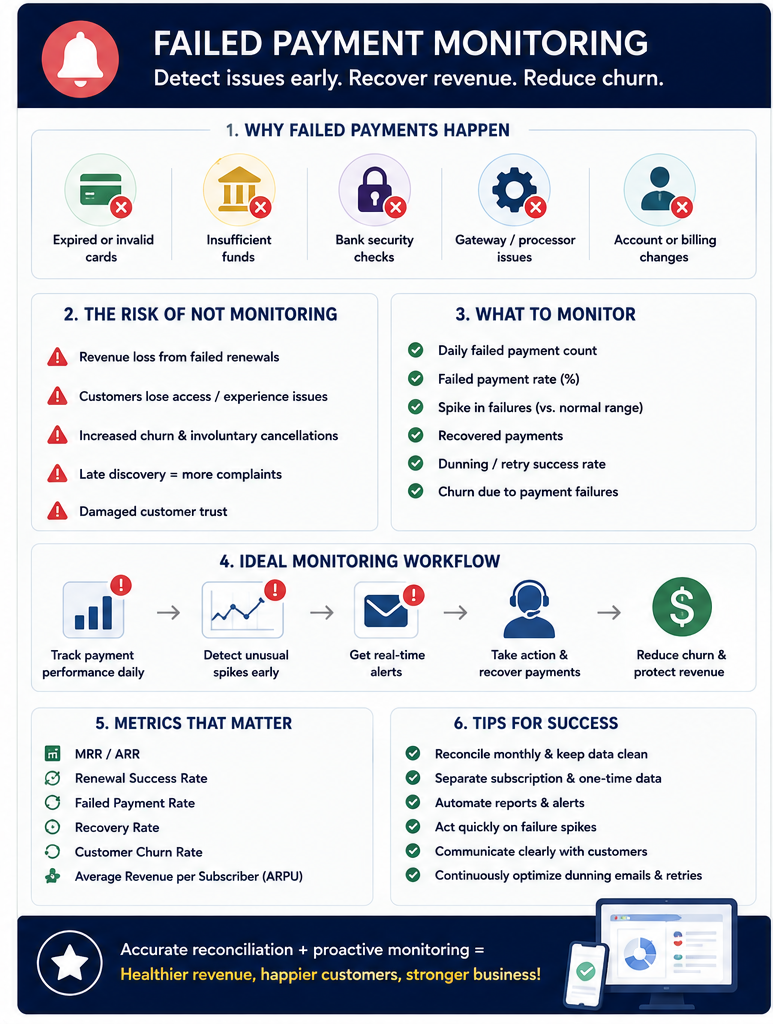
Common causes include:
- Expired payment cards
- Insufficient funds
- Bank security checks
- Payment gateway interruptions
- Technical processing errors
- Customer account changes
- Fraud prevention rules
Each failed payment represents revenue that the business expected to receive.
If failures increase suddenly, monthly revenue may decline without immediate explanation.
Why Failed Payments Matter
One failed payment may not be significant.
However, a large number of failed renewals can have serious consequences.
For example:
- Customers may lose access to products.
- Subscription schedules may be interrupted.
- Revenue declines unexpectedly.
- Customer satisfaction decreases.
- Cancellation rates increase.
- Customer lifetime value falls.
If merchants only discover these issues after customers complain, valuable time has already been lost.
Early detection is therefore extremely important.
Understanding Dunning Processes
Many subscription businesses use automated reminders when a payment fails.
Customers may receive emails asking them to:
- Update payment information
- Replace expired cards
- Retry payment
- Confirm billing details
These reminders help recover many failed renewals.
However, automated reminders alone do not solve every problem.
If there is a larger technical issue affecting many customers at the same time, merchants also need operational visibility.
Detecting Unusual Failure Spikes
A normal business may experience a small number of failed renewals every month.
This is expected.
However, a sudden increase may indicate a broader issue.
Possible causes include:
- Payment processing interruptions
- Banking system problems
- New security rules
- Configuration errors
- Subscription scheduling issues
- Technical platform changes
If business owners receive alerts quickly, they can investigate before revenue losses become severe.
Without monitoring, these problems may continue unnoticed for several days.
Customer Complaints Are Often Too Late
One concern raised in the discussion is that businesses sometimes discover payment issues only after customers begin contacting support.
Examples include:
- “Why didn’t my order arrive?”
- “Why was my subscription cancelled?”
- “My payment should have gone through.”
- “I haven’t received this month’s shipment.”
At this stage, multiple renewals may already have failed.
Businesses benefit from identifying these situations before customers experience inconvenience.
Revenue Forecasting
Accurate reconciliation supports better forecasting.
Subscription businesses often estimate future revenue based on:
- Active subscribers
- Average renewal rate
- Historical churn
- Seasonal trends
If payment failures are not tracked properly, forecasts become unreliable.
For example, a business expecting 5,000 successful renewals may actually receive only 4,400 because of unexpected payment issues.
Without understanding the cause, financial planning becomes inaccurate.
Understanding Customer Churn
Customer churn refers to subscribers who stop purchasing.
Some customers cancel intentionally.
Others leave because payments repeatedly fail.
These situations should be analysed separately.
Understanding why subscriptions end helps businesses improve retention strategies.
Merchants should monitor:
- Voluntary cancellations
- Failed renewals
- Payment recovery success
- Average subscription length
- Repeat customer behaviour
These insights provide a clearer picture of customer loyalty.
Building Better Financial Reports
An effective reconciliation process should organise financial information into separate categories.
For example:
Subscription Revenue
- New subscriptions
- Renewal income
- Subscription refunds
- Active subscribers
- Cancelled subscriptions
Retail Revenue
- One-time orders
- Product sales
- Retail refunds
Operational Metrics
- Failed renewals
- Payment recovery rate
- Customer churn
- Average order value
- Repeat purchase rate
Separating these areas makes monthly reporting much easier to understand.
Automating Routine Monitoring
As businesses grow, manual monitoring becomes less practical.
Routine processes that may benefit from automation include:
- Daily payment summaries
- Failed renewal notifications
- Revenue trend reports
- Refund summaries
- Subscription growth reports
- Renewal success percentages
Automation reduces repetitive work while helping staff focus on investigating unusual situations instead of manually collecting data.
Identifying Business Trends
Monthly reconciliation is not only about accounting.
It also helps identify operational trends.
For example:
- Are renewals improving?
- Are cancellations increasing?
- Are refunds becoming more frequent?
- Are payment failures seasonal?
- Is recurring revenue growing consistently?
Answering these questions supports better business decisions.
Supporting Finance Teams
Accurate reconciliation benefits finance teams by providing cleaner records.
Well-organised reports simplify:
- Month-end closing
- Tax preparation
- Financial statements
- Revenue analysis
- Audit preparation
- Budget planning
Instead of correcting reporting inconsistencies every month, finance teams can focus on analysing business performance.
Improving Customer Experience
Operational reporting also supports customer satisfaction.
When payment issues are detected early:
- Customers receive quicker assistance.
- Renewal problems are resolved faster.
- Subscription interruptions are reduced.
- Customer trust increases.
This creates a better long-term relationship between the business and its subscribers.
When a Dedicated Reconciliation Process Becomes Necessary
Small subscription businesses may initially manage reporting manually.
However, a more structured reconciliation process usually becomes valuable when:
- Subscription numbers increase significantly.
- Multiple subscription plans exist.
- Refund volume grows.
- Finance teams require detailed reporting.
- Revenue forecasting becomes important.
- Payment failures become more frequent.
- Monthly reporting consumes excessive time.
At this stage, businesses benefit from developing consistent reconciliation procedures.
Conclusion
Subscription businesses generate reliable recurring income, but they also introduce operational challenges that traditional ecommerce stores do not face. Monthly reconciliation is essential for separating recurring subscription revenue from one-time purchases, accurately tracking refunds, understanding customer behaviour, and producing dependable financial reports.
Failed-payment monitoring is equally important. While occasional payment failures are normal, sudden increases may indicate technical issues, banking problems, or processing disruptions that can significantly affect revenue and customer satisfaction. Detecting these issues early allows businesses to respond before customers experience service interruptions or cancel their subscriptions.
Rather than relying solely on manual exports and spreadsheets, growing subscription businesses benefit from structured reporting, automated monitoring where appropriate, and clear financial categorisation. By maintaining accurate reconciliation processes and proactively monitoring renewal performance, merchants can make better financial decisions, improve operational efficiency, strengthen customer relationships, and build a more sustainable subscription business over the long term.