After refining your Shopify store—improving collections, optimizing SEO, and setting up apps—you’ve already completed one of the most important phases of building an eCommerce business: creating a strong foundation. However, many store owners reach this exact stage and then feel stuck. The store looks better, loads faster, and feels more structured—but orders don’t increase as expected.
This is where the next phase begins: growth through strategic marketing and conversion optimization.
Your situation is very common, and your question is the right one:
Should you hire a marketing expert or agency to bring more traffic and improve conversions?
The answer is not simply “yes” or “no.” It depends on understanding your current bottleneck, choosing the right type of expert, and ensuring your store is truly ready to scale.
Let’s break this down in a structured and professional way.
Step 1: Diagnose Before You Scale
Before hiring anyone, you need clarity on one critical question:
Is your problem traffic or conversion?
These are two completely different issues, and solving the wrong one will waste time and money.
Scenario A: Low Traffic
If your store is not getting enough visitors, then the issue is visibility.
This means:
- Low daily visitors
- Weak ad performance
- Limited organic reach
- Minimal brand awareness
In this case, you need:
- Paid advertising strategy
- Audience targeting
- Content marketing
- Social media growth
Here, a marketing expert or agency focused on traffic acquisition is valuable.
Scenario B: Low Conversion
If your store gets visitors but very few purchases, the problem is conversion.
This means:
- Visitors leave quickly
- Low add-to-cart rate
- High bounce rate
- Checkout abandonment
In this case, traffic is not the solution.
You need:
- Stronger product pages
- Better trust signals
- Clear value propositions
- Improved user experience
Hiring an ads expert without fixing conversion issues will only increase costs without increasing sales.
Step 2: Understand What a Good Marketing Expert Actually Does
Many people think a marketing expert simply runs ads.
That is incomplete.
A real expert should:
- Analyze your current store performance
- Identify weak points in conversion
- Define your target audience
- Build a traffic strategy
- Optimize landing pages
- Set up retargeting systems
- Improve customer journey
If someone jumps straight into running ads without asking questions about your store, audience, or data, that is a red flag.
Good marketing starts with understanding—not spending.
Step 3: Paid Ads – Powerful but Risky Without Preparation
You mentioned interest in:
- Facebook Ads
- Instagram Ads
- Possibly search-based ads
These are powerful tools, but they are not magic solutions.
Paid ads work best when:
- Your product solves a clear problem
- Your offer is compelling
- Your store builds trust instantly
- Your messaging is clear
If these elements are weak, ads will only amplify the problem.
Common Mistake
Many beginners think:
“More ads = more sales”
Reality:
“Better conversion = profitable ads”
Ads bring people.
Your store converts them.
Step 4: Focus on Qualified Traffic, Not Just Traffic
Not all traffic is equal.
A successful strategy focuses on qualified traffic—people who are actually interested in your product.
For example:
- Random visitors → Low conversions
- Targeted audience → Higher sales
Qualified traffic depends on:
- Audience targeting
- Ad messaging
- Product-market fit
- Creative quality
A good expert does not aim for more clicks.
They aim for better customers.
Step 5: Conversion Strategy Is the Real Game Changer
Even the best ads cannot fix a weak store.
Your store must answer key customer questions instantly:
- What is this product?
- Why should I buy it?
- Can I trust this brand?
- What happens if I don’t like it?
If these are unclear, visitors leave.
Key Conversion Elements
- Product Benefits (Not Just Features)
Customers buy outcomes, not specifications. - Trust Signals
Reviews, testimonials, guarantees, and contact details build confidence. - Clear Policies
Shipping time, returns, and refunds must be visible and simple. - Strong Visuals
High-quality images and videos increase perceived value. - Simple Checkout Flow
Fewer steps = higher conversions.
Step 6: Email Marketing and Retargeting
Many stores ignore these, but they are extremely important.
Most visitors do not buy on their first visit.
That is normal.
You need systems to bring them back.
Email Marketing
Used for:
- Welcome sequences
- Abandoned cart recovery
- Repeat purchases
- Promotions
Retargeting
Used for:
- Showing ads to past visitors
- Reminding customers of viewed products
- Offering limited-time deals
These strategies turn lost visitors into future buyers.
Ignoring them means losing potential revenue.
Step 7: Agency vs Freelancer vs In-House Learning
You have three main options.
Option 1: Hire an Agency
Best for:
- Faster scaling
- Larger budgets
- Full-service strategy
Advantages:
- Professional team
- Structured systems
- Experience across industries
Challenges:
- Higher cost
- Quality varies
- Risk of generic strategies
Option 2: Hire a Freelancer
Best for:
- Moderate budgets
- Specific needs (ads, CRO, email)
Advantages:
- More affordable
- Flexible
- Direct communication
Challenges:
- Limited capacity
- Depends heavily on individual skill
Option 3: Learn In-House
Best for:
- Beginners
- Low budgets
- Long-term control
Advantages:
- Deep understanding of your business
- Cost-effective
- Better decision-making
Challenges:
- Time-consuming
- Trial and error
Step 8: Budget Matters More Than You Think
One important point raised in the discussion is:
“What is your monthly ad budget?”
This question is critical.
A strategy for a small budget is very different from a large budget.
Without knowing budget:
- Planning becomes unrealistic
- Expectations become unclear
- Results become inconsistent
A good expert will always ask this first.
Step 9: Why Diagnosing First Is the Smartest Approach
One perspective in the discussion was absolutely correct:
Do not scale ads before diagnosing the store.
You should first evaluate:
- Homepage clarity
- Product page strength
- Trust elements
- Customer experience
- Loading speed
- Mobile optimization
Fixing these first ensures that when traffic comes, it converts.
Otherwise, you are paying for visitors who leave.
Step 10: Store Data and Operations Must Be Clean
Marketing is not just about traffic.
It also depends on:
- Accurate inventory
- Correct pricing
- Reliable shipping
- Smooth order processing
If these are not stable, scaling marketing creates problems instead of growth.
Customers may:
- Receive wrong products
- Experience delays
- Lose trust
This damages your brand.
Step 11: What to Look for in a Good Expert or Agency
Before hiring, evaluate carefully.
Ask:
- Do they ask about your current data?
- Do they understand your niche?
- Do they talk about conversion, not just ads?
- Do they explain strategy clearly?
- Do they focus on long-term growth?
Avoid people who promise:
- “Guaranteed sales”
- “Instant results”
- “Viral success”
Real growth is strategic—not instant.
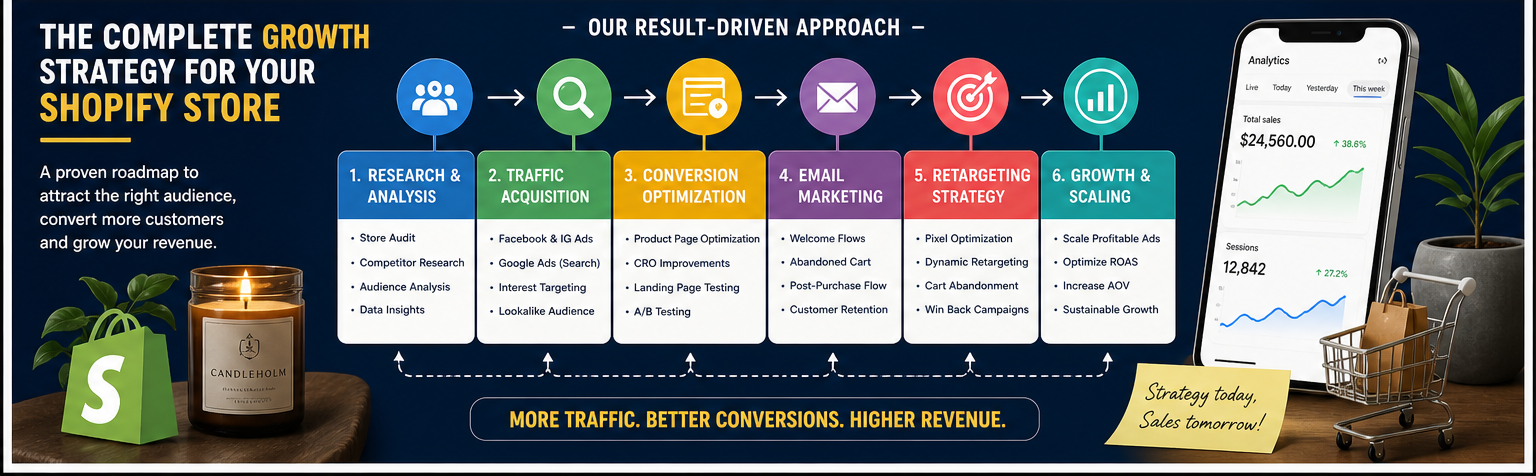
Step 12: Recommended Action Plan
Here is a clear path you should follow:
Step 1:
Analyze whether your problem is traffic or conversion
Step 2:
Improve product pages and trust signals
Step 3:
Ensure shipping, returns, and policies are clear
Step 4:
Set up email and retargeting basics
Step 5:
Then start paid ads gradually
Step 6:
Hire an expert only after understanding your needs
Final Insight
Your situation is not a problem—it is a transition stage.
You are moving from:
👉 Building the store
to
👉 Scaling the business
This is where most stores either grow or fail.
The difference is strategy.
Conclusion
Hiring a Shopify marketing expert or agency can significantly accelerate your growth—but only if your foundation is strong and your goals are clear.
Traffic alone does not create sales.
Conversion creates sales.
The smartest approach is to first understand your store’s real problem, improve the customer experience, and then bring in qualified traffic through strategic marketing.
Whether you choose an agency, a freelancer, or learn marketing yourself, the focus should always remain on one goal:
Turning visitors into confident buyers.
Because in eCommerce, success is not about how many people visit your store—
It is about how many people trust it enough to buy.