In the world of eCommerce, understanding which products an online store is actively promoting can provide valuable business insights. Whether you are a store owner studying competitors, a marketer analyzing successful campaigns, or a seller searching for profitable opportunities, identifying promoted products helps you make smarter strategic decisions.
Every online store does not treat all products equally. Some products receive more attention, better placement, stronger discounts, and heavier marketing efforts. These are usually the products the business wants customers to notice first and buy faster. They may be high-profit items, seasonal products, trending goods, new launches, or products designed to attract first-time buyers.
The challenge is simple: stores rarely say directly which products they are pushing the most. Instead, they reveal it through subtle signals across the website, pricing strategy, marketing content, and customer engagement.
The real question becomes:
How can you understand which products a store is actively promoting right now?
The answer lies in observing patterns carefully.
This article explains the most important indicators that help identify promoted products and how to use those signals strategically.
Why Stores Promote Certain Products More Than Others
Before identifying promoted products, it is important to understand why stores prioritize specific items.
Businesses usually promote products for reasons such as:
Higher profit margins
Seasonal demand
Clearing old inventory
Launching new products
Trend-based opportunities
Customer acquisition campaigns
Cross-selling opportunities
Brand positioning strategy
For example, a store may heavily promote one low-cost product because it attracts customers, while actual profits come from upsells or bundled offers.
This means the most visible product is not always the bestselling one—it is often the most strategic one.
Understanding this helps you analyze promotion with business logic, not just surface-level observation.
Homepage Placement Is the Strongest Signal
The homepage is the most valuable space in any online store.
Products placed there usually have the highest priority.
If a product appears in:
Main hero banners
Featured product sections
Homepage sliders
Best Seller sections
Trending Now blocks
Recommended collections
Top promotional sections
…it is a strong sign that the store is actively promoting it.
Stores carefully choose what appears on the homepage because this area receives the most traffic and first impressions matter.
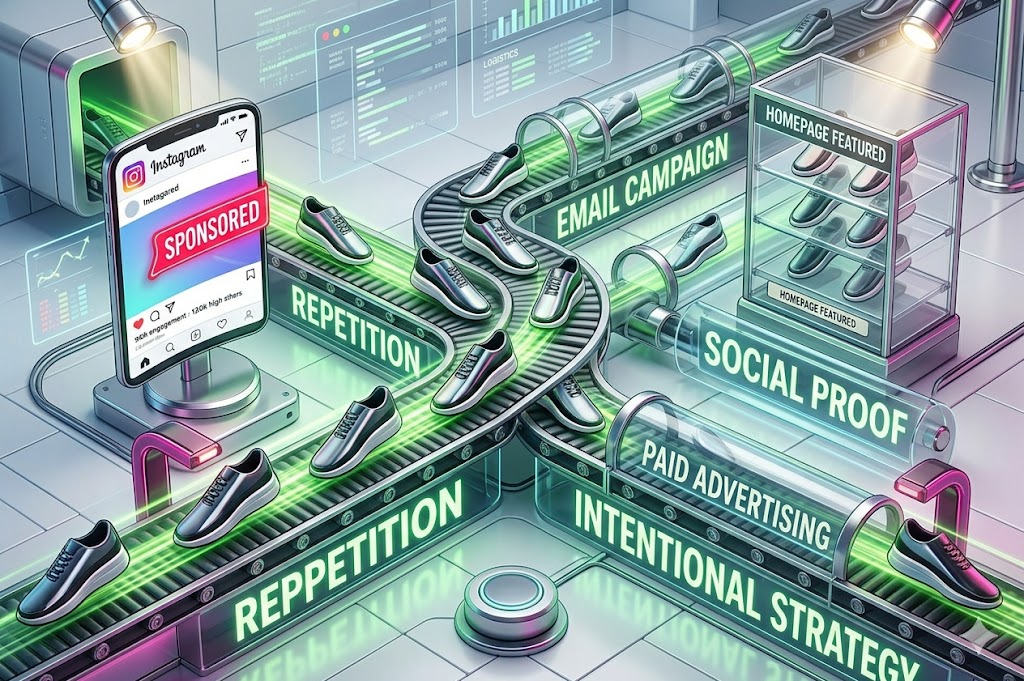
If the same product repeatedly appears across multiple homepage sections, it is almost certainly part of an active promotion strategy.
Visibility equals intention.
Featured Labels and Product Badges
Many stores use labels to direct customer attention.
Look for tags like:
Best Seller
Trending
New Arrival
Limited Edition
Most Popular
Staff Pick
Exclusive Offer
Recommended
Hot Deal
Editor’s Choice
These labels are not random decorations.
They are psychological triggers used to guide buyers toward priority products.
If a product carries multiple promotional labels, the store is likely pushing it aggressively.
Especially when those labels are placed near pricing or Add to Cart buttons, they are designed to influence faster buying decisions.
Discounts Reveal Promotion Strategy
Pricing often tells the truth faster than design.
Products receiving strong discounts are frequently part of active campaigns.
Watch for:
Large percentage discounts
Flash sales
Countdown offers
Buy One Get One deals
Bundle discounts
Free shipping thresholds
Limited-time offers
Cart-based upsells
For example:
“Today only – 30% Off”
This is rarely accidental.
Businesses use discounts strategically to increase product visibility and conversion speed.
If a product receives repeated promotional pricing, it is likely one of the store’s major focus products.
Discounts are strong commercial signals.
Navigation Menu Placement Matters
The menu structure also reveals product priorities.
Products included in:
Main navigation tabs
Top-level collections
Special landing pages
Seasonal campaign sections
Featured menu categories
Dedicated promotional pages
are usually considered important.
For example, if a store gives one product category its own direct menu link while others are hidden inside submenus, that category is likely receiving stronger promotional focus.
Stores reduce customer effort for products they want to sell faster.
Easy access means higher priority.
Repetition Across Multiple Pages
One product appearing everywhere is never a coincidence.
Check whether the same product appears across:
Homepage sections
Recommended product blocks
Product page suggestions
Blog articles
Email campaigns
Popup offers
Checkout recommendations
Exit-intent popups
Cross-sell bundles
Repeated exposure is a deliberate sales strategy.
Stores know that customers are more likely to buy products they see multiple times.
If one item keeps appearing across the customer journey, it is being promoted intentionally.
Repetition creates familiarity.
Familiarity drives conversion.
Social Media Activity Shows Real-Time Promotion
Social media often reveals what stores are pushing most actively.
Check platforms like:
TikTok
YouTube Shorts
Look for:
Repeated product posts
Video demonstrations
Influencer promotions
Sponsored content
Product-focused reels
Story promotions
Customer testimonials
Launch campaigns
If one product dominates social content, it is usually part of an active marketing push.
Sometimes social media shows promotional focus even before the website is updated.
Especially for fast-moving trends.
Paid Advertising Signals
Products receiving advertising investment are usually strategic priorities.
Look for signs like:
Sponsored posts
Search result advertisements
Dedicated landing pages
Paid social campaigns
High-conversion product pages
Retargeting offers
Urgency-driven sales messaging
Stores do not spend advertising budgets equally across all products.
They invest more in products that drive growth.
Products with stronger visuals, better testimonials, and optimized landing pages are often the ones supported by paid campaigns.
If it is being advertised, it matters.
Product Reviews and Engagement
Review activity can also reveal promotion strength.
Watch for:
High review volume
Recent review spikes
Customer photos
Video reviews
Frequent user-generated content
Highlighted testimonials
Popular question sections
Products receiving strong promotion often generate more engagement because more customers are being directed toward them.
A sudden increase in recent reviews may indicate a current campaign rather than old popularity.
Reviews show customer movement.
Customer movement often follows promotion.
Email Marketing Priorities
Email campaigns are highly intentional.
Businesses do not waste email space on low-priority products.
If you subscribe to a store’s newsletter, notice:
Which products appear repeatedly
Which items receive exclusive offers
Which launches get announcement emails
Which products are used in abandoned cart reminders
Which products trigger urgency messages
Frequent email exposure strongly suggests active promotion.
Email marketing reveals what the business wants customers to buy now.
Seasonal Campaigns and Timing
Some products become heavily promoted based on time of year.
Examples include:
Travel products during summer
Fitness products in January
Gift bundles during festivals
Winter wear during cold seasons
School supplies during back-to-school periods
Holiday products during festive sales
Seasonal timing explains why certain products suddenly become highly visible.
Sometimes the promotion is temporary, not permanent.
Understanding the season helps explain the strategy.
Context matters.
Product Bundles and Cross-Sells
Many stores use one product to sell several others.
Look for:
Frequently Bought Together sections
Complete the Look suggestions
Add-on recommendations
Bundle pricing offers
Checkout upsells
Cross-sell product pairings
If one product consistently appears at the center of these offers, it is likely a major revenue driver.
Sometimes the store promotes one hero product simply to trigger multiple supporting purchases.
The visible product becomes the entry point.
Blog Content and Educational Selling
Content marketing often supports product promotion quietly.
Look for blogs like:
Buying guides
Product comparisons
How-to articles
Problem-solving tutorials
Expert recommendations
Use-case examples
For example:
“How to Choose the Right Office Chair”
This likely supports chair sales.
Educational content often works as hidden selling.
Customers trust useful advice more than direct sales language.
This makes blog content a powerful promotion tool.
Inventory and Urgency Messaging
Urgency messages also indicate promotional focus.
Examples include:
Only 5 Left
Selling Fast
Back in Stock
Limited Quantity
Popular This Week
High Demand Alert
These messages create psychological urgency and encourage faster decisions.
While some are automated, repeated urgency around specific products often supports active campaigns.
Scarcity increases action.
Stores use urgency where they want faster movement.
Competitor Comparison Strategy
Some stores actively compare products against competitors.
You may see:
Comparison charts
Why Choose Us sections
Feature comparisons
Alternative brand positioning
Performance comparisons
Stores usually invest this effort only in products with strong strategic importance.
They do not create detailed comparison pages for low-priority items.
This often signals that the product is a major growth focus.
The Real Goal: Understand Why
The goal is not only to identify promoted products.
It is to understand why those products are being promoted.
Ask:
Is this a high-margin product?
Is it solving a strong customer problem?
Is it part of a seasonal campaign?
Is it used for customer acquisition?
Is it designed for upselling?
Is it important for brand identity?
This deeper understanding creates stronger business decisions.
Observation without interpretation is incomplete.
Conclusion
Identifying which products an online store is actively promoting requires careful observation, not assumptions.
Homepage placement, discounts, social media activity, repeated visibility, product labels, bundles, reviews, navigation placement, and urgency messages all reveal valuable clues.
Stores communicate priorities through patterns.
The products they push hardest are usually the products most important to their revenue strategy, customer acquisition, and long-term business growth.
The smartest approach is to combine multiple signals rather than relying on just one.
One clue may suggest interest.
Several clues together reveal certainty.
In eCommerce, visibility is rarely accidental.
It is strategy.
And once you learn how to read that strategy, you gain a powerful competitive advantage in understanding how successful stores really grow.