Choosing the right products is one of the biggest challenges for small e-commerce sellers. A product can appear highly promising based on demand, advertising activity, engagement, or sales estimates, yet still fail when a merchant actually launches it. This is one of the reasons product research has become such an important part of online retail.
The discussion behind this topic explores whether existing product-research systems are genuinely helping smaller sellers make better decisions or simply showing them products that already appear successful. The central idea is that a product being successful for someone else does not necessarily mean it is a good opportunity for another seller.
The seller and developer behind the discussion is considering a different approach. Instead of building another system that simply identifies “winning products,” the proposed concept would allow merchants to enter their actual business constraints before evaluating an opportunity. These constraints could include available budget, desired profit margin, shipping requirements, preferred sales channel, and tolerance for risk.
The proposed system would then classify products into three simple categories: TEST, WATCH, or PASS. More importantly, it would explain why a product received that recommendation.
The goal is to move product research away from excitement and toward realistic decision-making.
The Problem With the “Winning Product” Concept
The phrase “winning product” sounds attractive.
For a new seller, discovering a product that is already generating sales can feel like finding an opportunity waiting to be copied. Research platforms often highlight products based on indicators such as advertising activity, social engagement, sales estimates, or recent popularity.
But there is a fundamental problem.
A product that is already performing well may have attracted many competitors.
By the time a product becomes widely recognized as a successful opportunity, hundreds or thousands of other sellers may already be selling similar versions.
This creates a potential cycle:
Seller discovers popular product → seller launches product → many competitors already exist → advertising becomes expensive → differentiation becomes difficult.
The product may still have demand, but demand alone does not guarantee profitability.
Demand Does Not Equal Opportunity
One of the most important ideas in the discussion is the difference between demand and opportunity.
Suppose a product has thousands of monthly searches and many stores are selling it.
That proves there is demand.
However, it does not automatically answer:
- Can a new seller compete?
- Can the seller afford customer acquisition?
- Is there enough margin?
- Can the product be delivered quickly?
- Can the seller differentiate the offer?
- Are customers loyal to existing brands?
- How many competitors are already targeting the same audience?
A useful product-research system therefore needs to consider more than popularity.
The Importance of Seller-Specific Constraints
Every seller operates under different conditions.
A beginner with a $500 testing budget has completely different requirements from an established business with $20,000 available for advertising and inventory.
Similarly, one merchant may require delivery within three days, while another may accept two weeks.
One seller may need a 40% margin.
Another may be comfortable with a smaller margin because they have strong repeat purchases.
Therefore, evaluating the same product in exactly the same way for every merchant may produce poor recommendations.
Budget Should Influence Product Selection
Budget is one of the most important constraints.
A product might require significant advertising investment before enough data becomes available.
If a seller has limited capital, spending heavily on an uncertain product can create serious financial pressure.
A research system should therefore consider questions such as:
- How much can the seller afford to test?
- How many advertising experiments can they run?
- How much inventory can they purchase?
- What happens if the first campaign fails?
A product that requires a large testing budget may deserve a PASS recommendation for a beginner but a TEST recommendation for a well-funded seller.
Target Margin Matters
Revenue alone is not enough.
A product can generate sales and still lose money.
For example, imagine a product sells for $40.
After product cost, shipping, transaction expenses, refunds, discounts, and advertising, perhaps only $5 remains.
That product may look attractive from a sales perspective but provide very little room for error.
A good research process should therefore consider the merchant’s target margin before recommending an opportunity.
Shipping Constraints Can Change the Decision
Shipping is another major factor.
A product may look profitable until delivery costs are considered.
International shipping can introduce:
- Higher costs
- Longer delivery times
- Customs complications
- Tracking problems
- Customer complaints
- Refund requests
A merchant selling primarily in one country may therefore prefer products that can be delivered locally or regionally.
A research system that ignores shipping conditions can produce unrealistic recommendations.
Risk Tolerance Is Different for Every Seller
Not every merchant is willing to take the same level of risk.
Some sellers prefer stable products with predictable demand.
Others are comfortable testing emerging trends.
A new product with limited historical data may represent a high-risk opportunity.
An established product with consistent demand may represent lower risk but also higher competition.
The proposed approach recognizes that risk tolerance should influence recommendations.
TEST, WATCH, or PASS
The three proposed classifications are intentionally simple.
TEST
A product receives TEST when the available evidence suggests that it deserves a small, controlled experiment.
This does not mean:
“Buy thousands of units immediately.”
Instead, it means:
“Gather enough evidence to justify a limited test.”
Testing might involve a small quantity, a controlled advertising campaign, or a limited launch.
WATCH
A WATCH recommendation means the product has interesting signals but not enough confidence to justify immediate action.
Perhaps demand is growing, but competition is increasing too.
Or perhaps margins appear attractive, but shipping information is uncertain.
Instead of ignoring the opportunity, the seller monitors it.
PASS
A PASS recommendation means the opportunity currently appears unattractive under the seller’s specific circumstances.
This does not necessarily mean the product is universally bad.
It may simply be a poor fit for that particular seller.
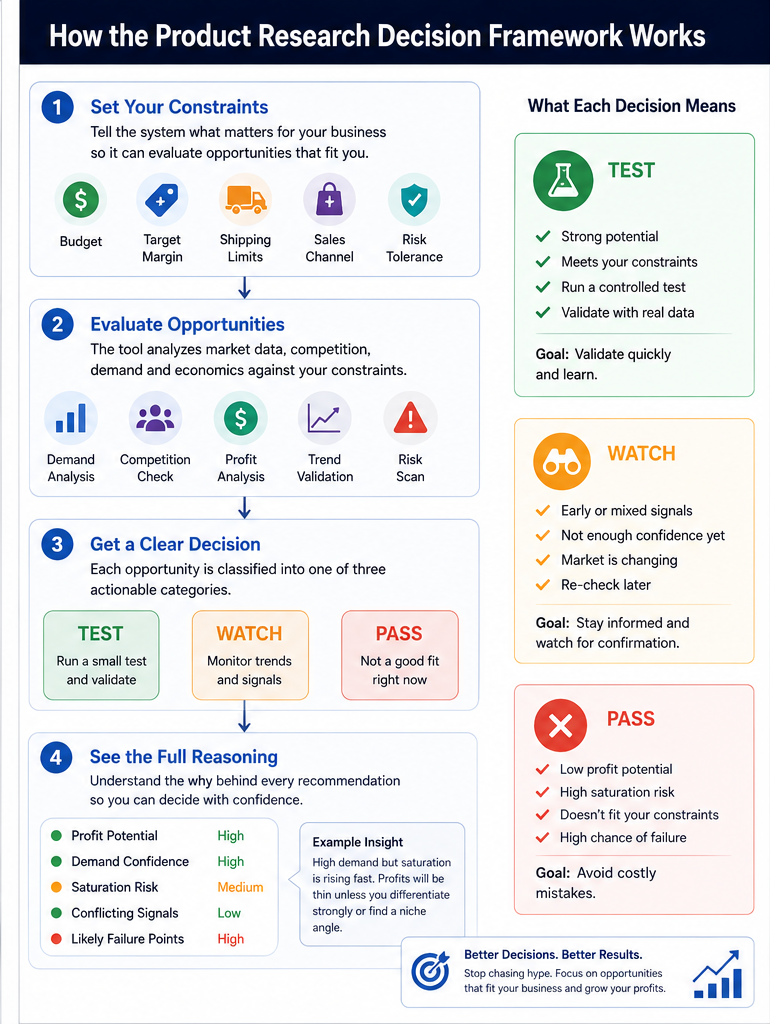
Explaining the Recommendation
One of the strongest ideas in the proposed concept is that the system should explain its decision.
Instead of simply saying:
TEST
it could explain:
- Demand confidence: High
- Profit potential: Medium
- Saturation risk: High
- Shipping risk: Low
- Competition: High
- Main concern: Limited differentiation
This makes the recommendation more useful.
The seller can then decide whether they agree with the assessment.
Profit Potential
Profit potential should include more than the difference between retail price and supplier price.
A realistic evaluation should consider:
- Product cost
- Shipping
- Advertising
- Transaction costs
- Discounts
- Refunds
- Returns
- Customer support
- Packaging
- Other operating expenses
A product with a cheap purchase price is not necessarily profitable.
Demand Confidence
Demand confidence is another important factor.
Some products have stable, long-term demand.
Others experience short-lived spikes.
A sudden increase in interest could be caused by:
- A viral video
- Seasonal demand
- A temporary trend
- A celebrity mention
- A short-term event
The seller needs to understand whether demand is likely to continue.
Saturation Risk
Saturation is one of the central concerns behind the discussion.
If dozens of merchants are already promoting the same product with nearly identical advertising and product pages, a new seller may struggle to stand out.
High saturation can result in:
- Higher advertising costs
- Lower click-through rates
- Price competition
- Lower margins
- Customer fatigue
A product-research system should therefore distinguish between popular and overcrowded.
Conflicting Signals
Real-world product research rarely produces perfectly positive or negative signals.
A product may have strong demand but terrible margins.
Another may have excellent margins but weak demand.
A third may have growing interest but significant shipping problems.
These conflicting signals are important.
Rather than hiding uncertainty, the proposed system would make it visible.
That can help sellers make more informed decisions.
Identifying Likely Failure Points
Perhaps the most valuable part of the proposed concept is identifying how a product could fail.
For example:
Product: Portable kitchen organizer
Positive signals:
- Strong demand
- Low product cost
- Easy shipping
Potential failure points:
- Many established competitors
- Limited differentiation
- Low average selling price
- Advertising may be expensive
This gives the seller a much more realistic picture.
Why Smaller Sellers Need This Approach
Large businesses often have enough capital to experiment extensively.
Small sellers cannot always afford repeated failures.
For a smaller merchant, choosing the wrong product can consume:
- Advertising budget
- Inventory budget
- Time
- Cash flow
- Emotional energy
Therefore, smaller sellers need research that accounts for constraints rather than simply highlighting popular products.
Product Research Should Be a Decision Process
The discussion suggests a broader change in how product research should work.
Instead of asking:
“What products are winning?”
the seller should ask:
“Which opportunities make sense for my business?”
That is a much more useful question.
The answer depends on the merchant’s:
- Budget
- Audience
- Location
- Sales channel
- Margins
- Shipping capabilities
- Risk tolerance
- Competitive advantage
Validation Is Still Necessary
Even the best research system cannot guarantee that a product will succeed.
Market conditions change.
Customer behavior changes.
Advertising costs change.
Competitors respond.
Therefore, research should reduce uncertainty rather than promise certainty.
A TEST recommendation should lead to controlled validation rather than immediate large-scale investment.
The Value of Small Experiments
Small tests can provide valuable information.
A merchant can evaluate:
- Customer interest
- Click-through behavior
- Add-to-cart activity
- Conversion rate
- Customer questions
- Advertising costs
- Refund patterns
The purpose is to learn before committing significant capital.
Why Existing Data Can Be Misleading
Historical data is useful, but it has limitations.
A product that performed well six months ago may not perform the same way today.
Competitors may have entered the market.
Prices may have changed.
Advertising costs may have increased.
Consumer interest may have declined.
Therefore, product research should ideally consider both historical evidence and current market conditions.
What Would Make a New System Worth Paying For?
This is one of the central questions being asked in the discussion.
Sellers are not necessarily interested in paying for another list of products.
They want better decisions.
For a new system to justify payment, it would need to provide information that saves sellers time, money, or failed experiments.
Potentially valuable capabilities include:
- Personalized recommendations
- Clear explanations
- Competition analysis
- Margin analysis
- Risk scoring
- Shipping considerations
- Demand confidence
- Failure-point analysis
- Testing suggestions
The more directly the information helps a merchant make a decision, the greater its potential value.
Simplicity Could Be an Advantage
Another strength of the proposed approach is its simplicity.
TEST.
WATCH.
PASS.
These categories are easy to understand.
The complexity can remain behind the recommendation while the seller receives a clear decision.
This is particularly useful for beginners who may become overwhelmed by dozens of metrics.
Transparency Builds Trust
A research system becomes more credible when sellers can understand why it made a recommendation.
If a product receives a PASS rating, the seller should be able to see the reasons.
For example:
PASS
Because:
- Estimated margin is below target.
- Competition is high.
- Shipping exceeds your maximum acceptable time.
- Demand is uncertain.
The seller can then decide whether the assumptions are correct.
No Product Has Been Built Yet
An important detail is that the proposed system is still at the idea and feedback stage.
There is no finished product to evaluate.
The developer is collecting opinions from sellers who already perform product research.
This is valuable because experienced merchants can identify problems that developers may not see from the outside.
The Importance of Seller Feedback
Actual sellers can explain what research systems consistently get wrong.
For example, they may discover that:
- Sales estimates are unreliable.
- Competition data is outdated.
- Trends are already saturated.
- Profit calculations ignore shipping.
- Recommendations are too generic.
- Product suggestions lack context.
- Data looks impressive but does not translate into sales.
This feedback can help shape a more useful research system.
Conclusion
The discussion about ecommerce product-research tools raises an important question: Are sellers really discovering opportunities, or are they simply being shown products that are already popular?
Popularity is valuable evidence, but it is not enough to determine whether a product is a good business opportunity.
A product can have strong demand and still be difficult to sell profitably because of competition, advertising costs, shipping limitations, weak margins, or lack of differentiation.
The proposed approach attempts to solve this problem by evaluating products according to the seller’s actual circumstances. Instead of assuming that every merchant should pursue the same “winning products,” it would consider budget, target margin, shipping requirements, sales channel, and risk tolerance.
The simple TEST, WATCH, or PASS framework could make research easier to understand while still providing detailed reasoning underneath. A seller would not simply receive a product recommendation; they would understand the strengths, weaknesses, risks, conflicting signals, and potential failure points behind that recommendation.
Perhaps the most important principle is that product research should not promise certainty. No system can guarantee that a product will succeed. Instead, good research should help merchants make better decisions with incomplete information.
For smaller ecommerce businesses, this can be especially valuable. Limited budgets mean that every failed experiment carries a cost. A research process that identifies risks before money is spent can help sellers avoid obvious mistakes and focus their resources on opportunities that genuinely fit their business.
Ultimately, the future of product research may be less about finding a mythical “winning product” and more about finding the right product for the right seller at the right time. That shift—from generic popularity toward personalized, evidence-based decision-making—is the central idea behind the discussion and the proposed direction for a new generation of ecommerce research.