Product research is one of the most important parts of running an ecommerce business. Before investing money in inventory, advertising, packaging, content, and fulfillment, sellers need to understand whether a product has a realistic chance of generating profitable demand.
Because product research can be time-consuming, many ecommerce sellers rely on software and automated research systems to identify potentially successful products. These systems can analyze large amounts of information and highlight products based on factors such as sales activity, popularity, competition, pricing, reviews, and market trends.
However, an important question is often overlooked:
How accurate are these research systems when it comes to predicting what will actually work for a specific store?
A product may appear to be a strong opportunity based on available data but perform poorly after being launched. At the same time, a product that looks average according to general market data may become highly successful when positioned correctly for a particular audience.
This is why many experienced ecommerce sellers question what product-research systems repeatedly get wrong.
The Difference Between Popularity and Opportunity
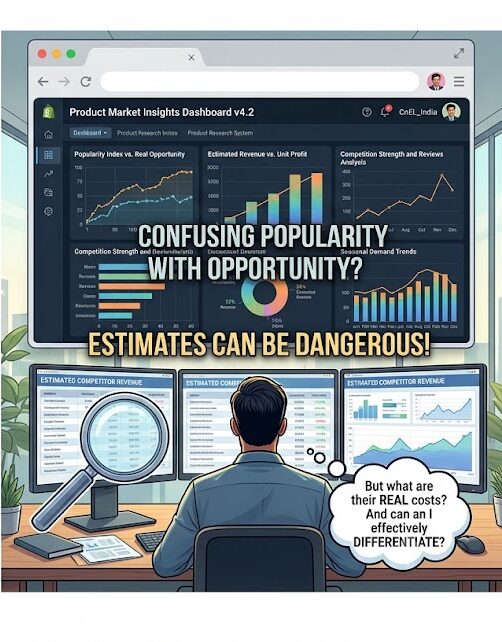
One of the biggest problems with automated product research is confusing popularity with opportunity.
If a product is selling well across the market, it may look attractive. Strong sales numbers can indicate that customers want the product.
But popularity also attracts competition.
When hundreds of sellers are already promoting the same item, a new seller may struggle to compete on price, advertising, branding, delivery speed, or customer trust.
A product can therefore be highly popular while still being a poor opportunity for a new seller.
True product research should go beyond asking:
“Is this product selling?”
It should also ask:
“Why is it selling, who is buying it, how crowded is the market, and can I realistically compete?”
That difference is extremely important.
Sales Data Does Not Explain Everything
Research systems often rely heavily on observable market signals.
Sales volume, estimated revenue, product rankings, review counts, and pricing can provide useful information.
However, these numbers do not always explain why a product is successful.
A product might be performing well because the seller has a powerful brand.
Another product may be successful because the business has a large existing customer base.
A third product may be selling because the seller has exceptionally good advertising.
A new seller looking at the product from the outside may see the sales numbers without understanding the underlying advantage.
This creates a dangerous assumption:
If another seller is making money from the product, I should be able to make money from it too.
That is not necessarily true.
The Problem With Estimated Data
Another major issue is that much ecommerce research depends on estimates rather than complete internal business data.
External systems cannot see every part of another company’s operation.
They may estimate sales based on visible activity, traffic, rankings, reviews, advertising signals, or other indicators.
These estimates can be useful for identifying possibilities, but they should not be treated as exact financial statements.
For example, a product may appear to generate substantial revenue.
But revenue is not profit.
The seller may be spending heavily on advertising, offering discounts, paying high shipping costs, dealing with returns, or accepting low margins to increase sales volume.
A product with high estimated revenue could therefore produce less profit than a product with much smaller sales volume.
This is why sellers should avoid making product decisions based on revenue estimates alone.
Revenue Is Not the Same as Profit
A product-research system may identify an item selling for $40.
At first glance, the price looks attractive.
But the actual economics could look very different.
Suppose the product costs $15.
Shipping costs $7.
Payment and transaction costs take another amount.
Advertising costs may consume a significant portion of the sale.
There may also be refunds, replacements, customer support expenses, packaging, taxes, and other operational costs.
After everything is included, the actual profit could be much smaller than expected.
Therefore, product research should focus on unit economics, not just sales potential.
Before launching a product, sellers should estimate:
- Product cost
- Shipping cost
- Packaging cost
- Payment fees
- Advertising cost
- Expected return rate
- Discounts
- Taxes
- Customer support costs
- Expected selling price
- Realistic profit per order
A product with moderate demand and healthy margins can be more attractive than a viral product with extremely thin margins.
Competition Is More Complicated Than Counting Sellers
Another weakness in product research is measuring competition too simply.
A system may show that many stores sell a particular product.
That does not automatically tell a seller whether competition is difficult.
Competition should be evaluated based on several factors.
For example, are competitors established brands?
Do they have strong customer reviews?
Do they have better product photography?
Do they offer faster delivery?
Do they have exclusive designs?
Do they have strong social media audiences?
Are they competing primarily on price?
Can a new seller offer something meaningfully different?
Two markets can have the same number of competitors but completely different levels of difficulty.
A crowded market may still have an opportunity if customer needs are poorly served.
On the other hand, a market with relatively few competitors may be difficult if those competitors are extremely strong.
Customer Intent Matters
Another area that automated research can struggle with is customer intent.
A product can receive substantial attention without generating equally strong buying intent.
People may watch videos about a product because it is interesting.
They may share it because it is entertaining.
They may search for it because they are curious.
But curiosity does not always become a purchase.
This is especially important for products that become popular through social media.
High engagement can create the impression of strong demand, but sellers need to determine whether that attention translates into actual purchases.
A product should therefore be evaluated based on commercial intent, not only visibility.
Viral Products Can Be Dangerous
Viral products often look attractive because they appear to provide immediate evidence of demand.
But viral demand can disappear quickly.
A seller may discover a product after it has already become popular.
By the time inventory is purchased, the store is built, advertisements are created, and campaigns are launched, consumer interest may already be declining.
This creates a timing problem.
Product research needs to consider whether demand is:
- Growing
- Stable
- Seasonal
- Declining
- Temporary
- Connected to a short-lived trend
A product that was highly successful several months ago may no longer provide the same opportunity today.
Historical performance should therefore be treated as context rather than a guarantee.
Seasonality Can Distort Product Research
Some products perform exceptionally well during specific periods.
Examples include holiday decorations, summer accessories, winter products, school supplies, gifting products, and event-related items.
If research is performed during peak demand, the product can appear stronger than it actually is throughout the year.
Sellers should ask whether the demand is consistent.
A product generating strong sales for three months may not be a good year-round business.
Seasonality also affects inventory decisions.
Ordering too much inventory immediately before demand falls can create significant financial risk.
Reviews Do Not Tell the Whole Story
Product reviews are useful because they reveal customer experiences.
However, simply counting reviews is not enough.
A large number of reviews can indicate strong demand, but sellers should also examine what customers are saying.
Repeated complaints may reveal opportunities.
Customers may complain about poor packaging, slow delivery, weak instructions, poor sizing, limited product choices, or quality issues.
These complaints can be more valuable than the overall rating.
For example, if customers consistently complain that an existing product is difficult to use, a new seller could potentially create a better version or provide better instructions.
This turns customer dissatisfaction into a potential product opportunity.
Product Differentiation Is Often Missing
Another common weakness is identifying products without asking how the seller will differentiate them.
Finding a product is only the beginning.
The real question is:
What will make customers choose my version instead of someone else’s?
Differentiation can come from:
- Better design
- Better quality
- Better packaging
- Faster delivery
- Better customer support
- More useful product bundles
- Better product education
- Stronger branding
- A more specific target audience
- Improved functionality
Without differentiation, sellers often end up competing primarily on price.
Price competition can quickly reduce margins.
Product-Market Fit Cannot Be Fully Automated
Product-market fit is another area where automated research has limitations.
A product may be successful in one market but fail in another.
Consumer preferences vary by country, culture, income level, climate, regulations, shipping expectations, and purchasing habits.
A product that performs well in the United States may not automatically work in India.
Similarly, a product popular among one customer group may have little demand among another.
Research systems can provide broad market signals, but sellers still need to understand the specific audience they are targeting.
Supplier Reliability Is Often Overlooked
A product can look excellent from a research perspective but become a business problem because of the supplier.
Sellers need to evaluate:
- Product consistency
- Quality control
- Production capacity
- Minimum order requirements
- Reorder speed
- Shipping reliability
- Packaging
- Communication
- Ability to handle increasing demand
Imagine finding a product that suddenly receives 500 orders.
If the supplier can only produce 50 units per week, the seller may face delays, cancellations, refunds, and unhappy customers.
Therefore, supplier capability should be part of product validation.
Shipping Can Change the Entire Business Case
Shipping is another factor that is easy to underestimate.
A product may have an attractive selling price and reasonable product cost, but if shipping is expensive or slow, the final offer may become uncompetitive.
Customers increasingly compare delivery speed and total purchase cost.
A product that takes several weeks to arrive may struggle against a similar product that can be delivered within a few days.
Research should therefore consider the complete customer offer rather than just the product itself.
The Best Product May Not Be the Most Obvious One
One of the most important lessons from the discussion is that sellers should not depend entirely on automated product lists.
Research systems are generally good at identifying patterns.
Humans are better at understanding context.
A seller might discover an opportunity by noticing an underserved customer group, a repeated complaint, an inefficient existing product, or an emerging need.
For example, instead of searching for the “next winning product,” a seller could look for problems customers repeatedly describe.
Problems can lead to better opportunities than popularity rankings.
Product Research Should Be a Starting Point
The most useful way to think about product-research systems is as a starting point rather than a final decision-maker.
Research data can help sellers create a shortlist.
After that, sellers should independently investigate each candidate.
They should study competitors, customer reviews, pricing, suppliers, shipping, margins, demand trends, and differentiation opportunities.
The final decision should come from combining data with business judgment.
A Better Product Validation Process
A practical validation process can be divided into several stages.
Step 1: Identify a Potential Product
Use market signals, customer problems, trends, competitor activity, or personal observations to identify potential products.
Step 2: Study the Customer
Understand who would buy the product and what problem it solves.
Step 3: Analyze Competition
Study competitors, their positioning, pricing, reviews, branding, delivery, and weaknesses.
Step 4: Calculate Real Costs
Estimate the complete cost of selling the product rather than focusing only on purchase price.
Step 5: Evaluate Suppliers
Confirm quality, availability, production capacity, delivery times, and reorder reliability.
Step 6: Test Demand
Instead of immediately purchasing a large amount of inventory, consider a controlled test.
A small launch can reveal whether real customers are willing to purchase.
Step 7: Measure Actual Results
Track conversion rate, advertising cost, average order value, refunds, customer feedback, delivery performance, and profit.
Step 8: Scale Carefully
If the numbers are healthy, increase inventory and marketing gradually.
This process reduces the risk of making a major investment based solely on estimated market data.
The Future of Product Research
Product research will likely become increasingly data-driven.
Large amounts of market information can help sellers identify patterns faster than manual research alone.
However, better data does not eliminate uncertainty.
The strongest ecommerce businesses will combine automated analysis with human judgment.
Data can tell sellers what appears to be happening.
Business judgment helps explain why it is happening.
That distinction is critical.
Final Takeaway
Product-research systems can save ecommerce sellers significant time, but they should not be treated as machines that predict guaranteed winners.
They can identify products with strong market signals, but they may not fully understand profitability, competition quality, customer intent, seasonality, supplier reliability, shipping challenges, or the unique positioning of a particular store.
The biggest mistake is assuming that a product is a good opportunity simply because someone else is selling it successfully.
Successful product research requires a deeper process.
Sellers should investigate the customer, competition, costs, supplier, fulfillment, demand stability, differentiation, and actual profitability before making a major investment.
The goal is not simply to find a product that sells.
The goal is to find a product that can be sold profitably, consistently, and sustainably by your particular business.
That is the difference between product discovery and genuine product validation.
0 Comments