For an ecommerce store, appearing in shopping results can be an important source of traffic and sales. However, getting products approved for shopping advertising requires more than simply uploading a product catalog.
Merchants also need to demonstrate that their business is legitimate, their product information is accurate, their policies are clear, and the products they sell do not create trademark or counterfeit concerns.
A recent Shopify Community discussion focused on a dropshipping store that had been suspended for Misrepresentation, with an additional concern related to Counterfeit products. The store owner had already provided business information, an EIN, an address, and store policies, yet the suspension remained.
The discussion highlights an important lesson: a merchant can have legitimate business documentation and still fail a platform’s trust and product-compliance checks.
To understand why, it is useful to separate the two major issues: product authenticity and business misrepresentation.
Understanding the Two Different Problems
Counterfeit concerns and misrepresentation concerns can sometimes appear together, but they are not necessarily the same problem.
A counterfeit issue generally relates to the products themselves.
The platform may be concerned that a merchant is selling:
- Fake branded products
- Unauthorized replicas
- Products using protected logos without permission
- Products that imitate another company’s branded goods
- Products with copied branding or packaging
- Products sourced from an unauthorized seller
- Products whose authenticity cannot be demonstrated
Misrepresentation is broader.
It can involve the way the business, products, pricing, shipping, policies, or customer experience are presented.
For example, a store may have a real business registration and still create a misleading impression if its website does not clearly explain who operates the business, how products are shipped, or what customers should expect after placing an order.
This distinction is important because fixing only one problem may not resolve the suspension.
Why Business Documents Alone May Not Be Enough
The store owner in the discussion had already provided important business information, including an EIN and business address.
These are useful indicators of legitimacy, but they do not automatically prove that every product listed on the website is legitimate.
There are actually two separate questions:
Is this a real business?
and
Are the products and claims made by this business legitimate and accurately represented?
A merchant can answer the first question successfully while still having problems with the second.
For example, a legitimate registered business could unknowingly sell a product supplied by a third party that uses another company’s branding without authorization.
Therefore, business verification and product verification need to be treated separately.
Counterfeit Concerns in Dropshipping
Dropshipping creates a particular challenge because merchants often do not manufacture or physically inspect the products themselves.
A supplier may provide:
- Product images
- Product descriptions
- Brand names
- Product specifications
- Packaging information
The merchant may simply import this information into the store.
The problem is that the supplier’s listing does not necessarily prove that the merchant has the right to sell the product or use the associated brand assets.
This is particularly important for branded products.
A supplier might claim that a product is genuine, but the merchant may still need evidence supporting that claim.
Why Supplier Listings Are Not Always Enough
One of the strongest points in the discussion is that a supplier’s product listing should not automatically be treated as proof of authorization.
A product being publicly available from a supplier does not necessarily mean that:
- The product is authentic
- The supplier is an authorized distributor
- The merchant has permission to use brand assets
- The product description is accurate
- The images are legally usable
- The merchant can advertise the product under the stated brand
This is especially important when using dropshipping suppliers.
Before listing branded products, merchants should investigate the supplier and keep appropriate documentation.
Useful records can include:
- Supplier invoices
- Purchase records
- Supplier contact information
- Authorization documents
- Distribution agreements
- Product authenticity information
- Original product documentation
Not every merchant will have all of these documents, but the underlying principle is important: the merchant should be able to explain where products come from and why they are legitimate.
Product Images and Descriptions Can Also Create Problems
Counterfeit concerns are not limited to the physical product.
Product presentation can also raise questions.
For example, a merchant might copy a brand’s official product description or use branded photographs supplied by an unrelated third party.
Even if the physical product is legitimate, copied or unauthorized content can make the store appear less trustworthy.
A safer approach is to create original product descriptions and use images that the merchant has permission to use.
The store should also avoid making claims that cannot be supported.
Product information should accurately describe:
- Product identity
- Materials
- Size
- Quantity
- Features
- Compatibility
- Availability
- Delivery expectations
Accuracy is more important than making a product sound impressive.
Understanding Misrepresentation
Misrepresentation is a broader trust issue.
A shopping platform wants users to understand what they are buying, who they are buying from, and what will happen after they place an order.
If important information is missing or inconsistent, the store may appear unreliable.
Potential areas that can contribute to trust problems include:
- Missing business information
- Incomplete contact details
- Unclear shipping policies
- Missing return information
- Confusing refund policies
- Inconsistent pricing
- Products that appear available but are actually unavailable
- Checkout information that differs from the product page
- Unsupported claims
- Inconsistent business information
This means merchants should review the entire customer journey rather than focusing only on the Merchant Center account.
Business Information Should Be Consistent
A trustworthy ecommerce store should clearly identify the business behind it.
Important information can include:
- Business name
- Business address
- Contact email
- Customer support information
- Phone number where appropriate
- Registration details where relevant
More importantly, the information should be consistent.
For example, if the business name on the website differs significantly from the name provided during account verification, this can create unnecessary confusion.
The same principle applies to addresses and contact information.
Consistency helps establish a clear connection between the website, the business, and the shopping account.
Shipping Information Matters
Customers should be able to understand how and when their orders will arrive.
A store should clearly explain:
- Where products are shipped from
- Expected processing time
- Estimated delivery time
- Shipping charges
- Available shipping regions
- Potential international delivery conditions
- What happens when a shipment is delayed
This becomes particularly important in dropshipping.
If a store appears to be operating locally but products are actually shipped internationally with long delivery times, the website should not create a misleading impression.
Transparency is better than hiding the fulfillment model.
Return and Refund Policies
Return and refund information is another important part of ecommerce trust.
Customers should not have to search extensively to understand what happens if they want to return an item.
A clear policy should explain:
- Whether returns are accepted
- The return window
- Conditions for returns
- Who pays return shipping
- How refunds are issued
- What happens with damaged products
- What happens with incorrect products
The policy should also match the actual process.
A beautifully written return policy does not help if the business does something completely different when a customer requests a refund.
Product Availability Must Be Accurate
Another potential source of misrepresentation is product availability.
Suppose an advertisement promotes a product as available, but the product is actually out of stock.
A customer clicks the advertisement, visits the product page, and discovers that the product cannot be purchased.
Repeated situations like this can create a poor customer experience.
Merchants should therefore regularly check product availability and ensure that catalog information reflects the actual inventory situation.
This is particularly important in dropshipping because supplier inventory can change quickly.
Checkout Consistency Is Important
The customer journey should remain consistent from advertisement to checkout.
The information shown in an advertisement should match the information on the product page.
The product page should then match what the customer sees during checkout.
Important elements include:
- Product name
- Product price
- Product variant
- Shipping cost
- Availability
- Promotional claims
- Currency
Unexpected changes can reduce trust.
For example, if a customer sees one shipping price on the product page but a much higher amount during checkout without a clear explanation, the experience can appear misleading.
Why a Previous Reinstatement Does Not Guarantee Future Approval
The discussion also mentioned that an earlier store had been reinstated after the merchant simply indicated that the issue had been fixed.
This can create the impression that the same approach should work for a new store.
However, each account and website can be evaluated based on its own information and signals.
A previous reinstatement does not necessarily mean that a new store will receive the same result.
This is why merchants should avoid relying on a simple declaration that the problem has been fixed.
A stronger appeal is based on actual changes and supporting evidence.
Preparing a Strong Appeal
When requesting a review, merchants should focus on clarity rather than writing a very long explanation.
A useful appeal can include a concise changelog.
For example:
Business information updated:
The business name, address, and contact information were reviewed and made consistent across the website and account.
Policy information improved:
Shipping, returns, refunds, and customer support information were made clearer and easier to find.
Product information reviewed:
Product descriptions, images, availability, and brand claims were checked for accuracy.
Supplier documentation reviewed:
The merchant verified the source of products and retained relevant purchasing or authorization records.
Customer journey tested:
Product pages, cart, checkout, shipping information, and policies were checked from a customer’s perspective.
This type of explanation gives reviewers a clearer understanding of what was actually changed.
Prevention Is Better Than Repeated Appeals
The discussion eventually raised a broader question: are there better ways to identify compliance problems before a store is suspended?
This is an important direction for ecommerce merchants.
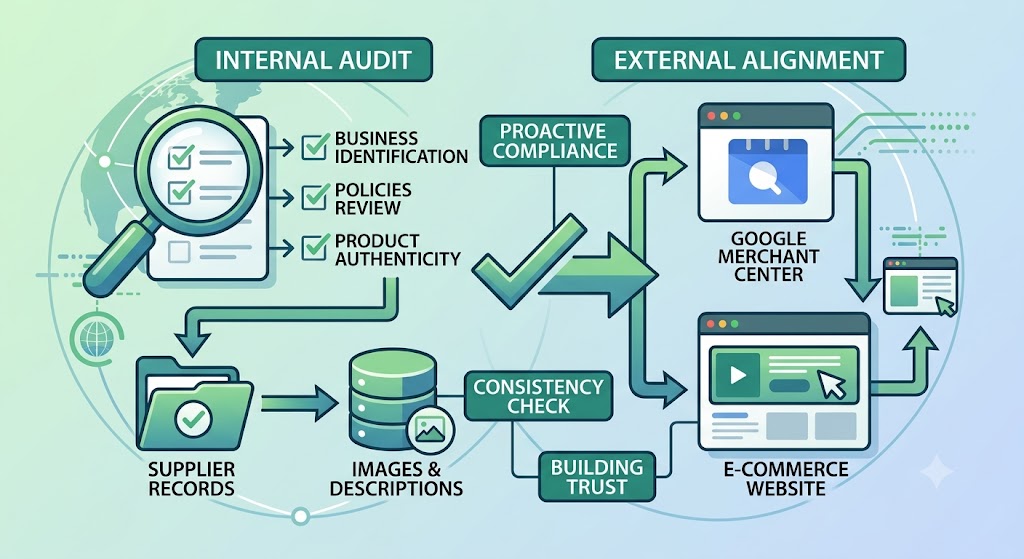
Instead of waiting for a suspension, businesses can create their own compliance checklist.
Before submitting products for shopping advertising, merchants can review:
Business identity
Is the business name clearly displayed?
Contact information
Can customers easily contact the company?
Policies
Are shipping, returns, refunds, privacy, and terms information available?
Product accuracy
Do product descriptions accurately reflect what customers receive?
Product authenticity
Can the merchant demonstrate where branded products come from?
Images
Does the merchant have the right to use product images?
Pricing
Does the advertised price match the actual store price?
Availability
Are products genuinely available for purchase?
Shipping
Are processing and delivery times clearly explained?
Checkout
Does the checkout experience match the information shown earlier?
Supplier records
Are invoices and sourcing documents retained?
A Better Long-Term Compliance Strategy
The most effective approach is to treat compliance as part of store management rather than something to address only after a suspension.
Merchants can regularly audit their stores.
A monthly or quarterly review can include:
- Checking business information
- Reviewing product descriptions
- Removing questionable products
- Checking supplier documentation
- Updating policies
- Testing checkout
- Reviewing shipping information
- Checking product availability
- Verifying advertising claims
- Confirming that pricing is accurate
This process becomes especially important for dropshipping stores because product catalogs and suppliers can change frequently.
Final Takeaway
The discussion about counterfeit and misrepresentation highlights a fundamental principle of ecommerce advertising: having a legitimate business is only one part of establishing trust.
A merchant also needs to demonstrate that the products are legitimate, the business information is accurate, the customer experience is transparent, and the claims made in advertising are supported by the actual store.
Counterfeit concerns should be handled through careful supplier verification and appropriate documentation. Merchants selling branded products should understand where those products come from and whether they have the necessary rights to sell and advertise them.
Misrepresentation requires a broader review.
Business details, contact information, shipping policies, return policies, product availability, pricing, product descriptions, images, and checkout information should all work together consistently.
For dropshipping stores, this becomes even more important because merchants often rely on third-party suppliers and may not physically inspect every product.
The safest strategy is therefore proactive.
Instead of waiting for a suspension and then trying to identify the problem, merchants can regularly audit their store, suppliers, product catalog, and customer journey.
If a suspension does occur, the appeal should focus on specific corrections and supporting evidence rather than simply stating that the problem has been fixed.
A trustworthy ecommerce store is not created by adding a few business details or policies at the last minute. It is created by making the entire shopping experience transparent, accurate, and consistent—from the product advertisement all the way through delivery and customer support.
That approach not only helps reduce compliance risks but also creates a stronger foundation for long-term ecommerce growth.


0 Comments