Building Structured Product Data for Global Inventory
Ecommerce platforms have traditionally been designed around relatively simple products. A customer sees a product, reads its description, looks at images, checks the price, and decides whether to purchase it.
Business-to-business commerce can be very different.
Industrial and commercial buyers often need to evaluate products based on detailed technical specifications before making a purchasing decision. They may need to compare voltage, capacity, dimensions, material, phase, enclosure rating, operating conditions, certifications, and many other attributes.
This creates a major challenge when multiple suppliers sell similar products through the same marketplace.
If every supplier describes products differently, buyers cannot easily search, filter, or compare them.
A recent proposal suggests that Shopify could evolve further into a B2B industrial and commercial marketplace by introducing category-based structured product attributes and building a stronger foundation for multi-supplier commerce.
The idea is particularly relevant for worldwide industrial inventory, where expensive equipment may be available in one country while buyers are searching from another.
Why Industrial Ecommerce Is Different
Selling industrial products online is fundamentally different from selling ordinary consumer goods.
A consumer purchasing a shirt may primarily care about size, color, material, and price.
An industrial buyer may need dozens of technical specifications.
Consider an electrical transformer.
A buyer might need to know:
- Voltage
- KVA rating
- Phase
- Frequency
- Cooling method
- Enclosure rating
- Dimensions
- Weight
- Manufacturer
- Manufacturing year
- Condition
- Certification
- Location
If this information is stored only inside a long product description, it becomes difficult to search and compare.
Two suppliers may describe essentially the same product using completely different wording.
One supplier might write “500 KVA transformer.”
Another might describe it as “500kVA three-phase electrical transformer.”
A third might use a completely different terminology.
A human buyer may understand that these products are related.
A marketplace search system may not.
This is where structured product data becomes important.
What Are Category-Based Structured Attributes?
The basic idea is that different product categories should have their own standardized fields.
Instead of giving every product the same generic fields, the marketplace would understand what information is important for each category.
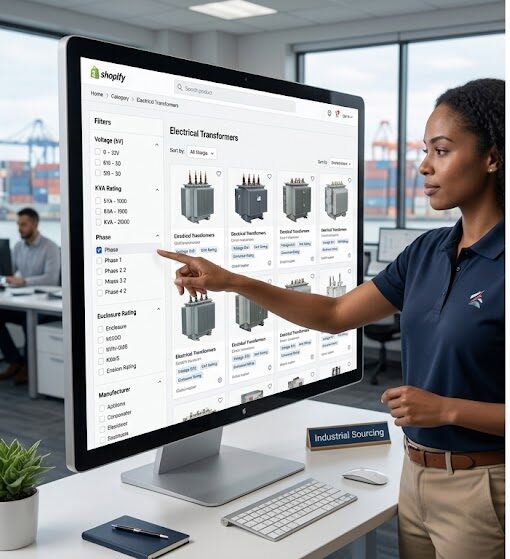
For example, a transformer category could contain fields for voltage, KVA rating, phase, frequency, and enclosure type.
A switchgear category could contain fields such as voltage rating, current rating, configuration, and protection characteristics.
Safety equipment could have fields for material, protection level, size, certification, and intended use.
Office equipment could have completely different attributes such as dimensions, capacity, connectivity, and material.
This creates a structured catalog where the meaning of each field is clear.
Why Standardization Matters
Standardization becomes especially important when multiple suppliers are involved.
Imagine ten suppliers selling industrial equipment.
Supplier A uses “Voltage Rating.”
Supplier B uses “Rated Voltage.”
Supplier C uses “Operating Voltage.”
Supplier D includes voltage only in the product description.
A buyer searching for a specific voltage range could miss several relevant products.
With standardized category attributes, all suppliers would enter information into the same appropriate field.
This makes the marketplace much easier to search.
It also creates consistency across the catalog.
Better Search and Discovery
One of the biggest advantages of structured attributes is improved product discovery.
Industrial buyers often know exactly what specifications they need.
They may not be searching for a particular brand.
Instead, they might be looking for something like:
“A three-phase transformer above a certain capacity with a specific voltage rating.”
A marketplace with structured attributes could allow the buyer to filter products based on those requirements.
Instead of opening dozens of product pages and reading descriptions manually, the buyer could narrow the catalog using technical specifications.
This could significantly reduce the time required to find suitable inventory.
Product Comparison Becomes Easier
Structured information also makes comparison easier.
Suppose three suppliers offer similar industrial equipment.
If the specifications are organized consistently, buyers can compare them side by side.
They can evaluate:
- Technical specifications
- Condition
- Price
- Location
- Availability
- Delivery options
- Manufacturer
- Lead time
This is particularly useful for B2B purchases because businesses often need to justify purchasing decisions internally.
A procurement manager may need to compare several alternatives before approving a purchase.
A structured marketplace can make that process much more efficient.
The Importance of a Shared Marketplace Catalog
The proposal goes beyond simply improving product pages.
A larger opportunity would be the creation of a shared marketplace catalog.
Such a catalog could establish common categories and attributes that multiple suppliers use.
The marketplace could then contain products from many businesses while maintaining a consistent data structure.
This would create a stronger network effect.
The more suppliers that participate, the more inventory becomes available.
The more inventory becomes available, the more useful the marketplace becomes to buyers.
This is particularly valuable for industrial products, where inventory is often fragmented across many suppliers and geographic locations.
Supplier Onboarding and Governance
A marketplace cannot depend entirely on suppliers entering perfect data themselves.
Supplier onboarding therefore becomes an important part of the proposed model.
Suppliers could be guided to provide the required information when listing products.
For example, when adding a transformer, the supplier could be required to complete the fields relevant to transformers.
This could reduce incomplete listings.
Governance would also be important.
The marketplace would need rules for:
- Product categorization
- Attribute definitions
- Required information
- Duplicate products
- Incorrect specifications
- Supplier verification
- Product condition
- Pricing
- Inventory status
Without governance, structured data can quickly become inconsistent again.
Inventory Synchronization Across Suppliers
Another major challenge is inventory.
Industrial inventory can change frequently.
A supplier may sell an item through another channel, move it between warehouses, reserve it for a customer, or update its availability.
If marketplace inventory is not synchronized, buyers could see products that are no longer available.
This creates a poor customer experience.
For industrial products, the problem can be even more serious because these products may be expensive and difficult to replace.
A reliable marketplace therefore needs mechanisms for keeping inventory information current.
Surplus Industrial Inventory as a Major Use Case
One of the most interesting applications of this idea is surplus industrial inventory.
Businesses around the world often have excess equipment sitting in warehouses.
This could include:
- Electrical equipment
- Manufacturing machinery
- Construction equipment
- Safety supplies
- Office equipment
- Spare parts
- Components
- Specialized industrial products
These products may still have significant value even though they are not needed by the original owner.
At the same time, another company somewhere in the world may be actively searching for the exact same item.
The challenge is connecting these two sides.
A structured global marketplace could make surplus inventory easier to discover.
Why Global Inventory Matters
Industrial equipment often has long manufacturing lead times.
A buyer may need a piece of equipment immediately but be told that a new unit will take several months to manufacture.
If the same or compatible equipment is sitting unused in another country, that existing inventory could provide a much faster solution.
This creates an important opportunity.
Instead of treating ecommerce as a way to sell newly manufactured products, the marketplace could also become a discovery system for existing industrial inventory.
Buyers could search worldwide for available equipment based on technical specifications.
Technical Specifications Become the Language of the Marketplace
For consumer ecommerce, product names often drive discovery.
For industrial ecommerce, technical specifications can be just as important as product names.
A buyer may not care whether the supplier’s listing uses a particular marketing title.
They care whether the equipment meets their technical requirements.
This means structured attributes could become the common language between buyers and suppliers.
The buyer describes what they need through specifications.
Suppliers provide products using those same specifications.
The marketplace connects the two.
Existing Product Customization as a Temporary Solution
The proposal recognizes that Shopify already provides ways to store additional product information.
Merchants can use custom product fields and structured categorization to add technical specifications.
This can provide a useful workaround today.
For example, a merchant could create fields for voltage, capacity, material, dimensions, or other category-specific information.
However, doing this manually across thousands of products and multiple suppliers can become difficult.
The larger request is therefore not simply for more custom fields.
It is for a standardized system where the marketplace itself understands the attributes associated with each category.
Automated Marketplace Commissions and Payouts
A true B2B marketplace also needs a reliable financial structure.
When multiple suppliers sell products through one marketplace, the platform must know who owns each product and how the money should be distributed.
For example, a buyer purchases an industrial product from Supplier A.
The marketplace may collect the payment, retain its commission, and distribute the remaining amount to Supplier A.
If an order contains products from multiple suppliers, the process becomes more complicated.
The marketplace may need to split revenue appropriately.
Automated commissions and payouts would therefore be an important part of making the model scalable.
The Role of Marketplace Governance
A large industrial marketplace cannot simply allow unlimited listings without controls.
There needs to be a system for maintaining catalog quality.
Suppliers should be encouraged or required to provide accurate specifications.
Products should be placed into the correct categories.
Duplicate listings should be managed.
Incorrect or misleading information should be addressed.
Inventory should be updated regularly.
This is especially important for expensive industrial equipment.
A buyer spending tens of thousands or hundreds of thousands of dollars needs confidence that the product information is accurate.
High-Value Products Create a Different Challenge
The proposal also raises a concern about advertising expensive products.
Industrial and construction equipment can have very high selling prices.
A product may legitimately cost more than $50,000.
If marketplace advertising or promotional systems impose a price ceiling around that level, sellers may be unable to promote high-value products through the marketplace’s advertising ecosystem.
This can become a serious limitation for businesses selling expensive equipment.
The problem is not that expensive products lack demand.
The issue is that the platform’s consumer-oriented advertising assumptions may not always fit industrial commerce.
Why B2B Marketplaces Need Different Thinking
B2B buyers behave differently from ordinary consumers.
A consumer may purchase an inexpensive product after seeing an advertisement and reading a few reviews.
A business buyer may spend weeks evaluating an industrial purchase.
They may need technical documentation, specifications, certifications, supplier information, shipping details, and internal approval.
Therefore, a B2B marketplace needs to prioritize structured information and professional procurement workflows.
The product catalog becomes more than a collection of product pages.
It becomes a database of business inventory.
A Possible Future Marketplace Model
A mature industrial marketplace could work through several connected layers.
First, suppliers would join the marketplace and complete their business profiles.
Second, they would add products according to standardized categories.
Third, each category would contain predefined technical attributes.
Fourth, inventory and availability would be synchronized.
Fifth, buyers would search and filter products using technical requirements.
Sixth, buyers could compare products from multiple suppliers.
Seventh, orders and payments could be processed through the marketplace.
Finally, commissions and supplier payouts could be handled automatically.
This would create an ecosystem rather than simply a traditional online store.
Benefits for Suppliers
Suppliers would gain access to a broader customer base.
Instead of relying entirely on their own websites or sales teams, they could expose surplus and available inventory to buyers actively searching for specific products.
Structured data could also make their products more discoverable.
A supplier with a warehouse full of equipment could potentially reach buyers in different countries without individually marketing every product.
Benefits for Buyers
Buyers would gain access to a larger inventory pool.
Instead of contacting many suppliers individually, they could search across multiple sellers in one marketplace.
Structured specifications would make comparison easier.
Worldwide inventory could also help buyers find products that are unavailable locally.
For equipment with long manufacturing lead times, finding existing inventory could save both time and money.
Challenges That Would Need to Be Solved
Building this type of marketplace would not be simple.
Several challenges would need to be addressed.
Product data quality would be critical.
Supplier verification would be necessary.
Inventory synchronization would need to be reliable.
International shipping would add complexity.
Taxes and duties would vary by country.
High-value transactions would require appropriate payment and fraud controls.
Returns could be difficult for large industrial equipment.
Warranty responsibilities would need to be clearly defined.
The marketplace would also need strong governance to maintain buyer confidence.
Final Takeaway
The proposal to expand Shopify toward a B2B industrial and commercial marketplace is fundamentally about turning product data into a structured marketplace language.
Industrial buyers need more than product names, images, and descriptions. They need technical specifications that allow them to search, filter, compare, and evaluate products accurately.
Category-based structured attributes could provide that foundation.
For categories such as transformers, switchgear, safety supplies, and office equipment, standardized fields could make products from different suppliers easier to discover and compare.
This becomes even more valuable when the marketplace contains worldwide inventory.
Surplus industrial equipment may already exist somewhere in the world while another business urgently needs it. A structured marketplace could connect these two sides by allowing buyers to search based on technical requirements rather than relying only on product names or supplier-specific terminology.
The existing custom-field and taxonomy capabilities can help merchants create structured catalogs today, but a larger marketplace model would require standardized categories, supplier onboarding, governance, inventory synchronization, buyer filters, and automated financial processes.
The issue of promoting high-value industrial products also shows why B2B marketplaces need to consider requirements beyond traditional consumer ecommerce.
Ultimately, the opportunity is much larger than simply adding more product fields.
It is about creating a reliable digital marketplace where industrial inventory can be described consistently, discovered globally, compared intelligently, and purchased efficiently.
If implemented effectively, this could make ecommerce much more useful for industries where product specifications, inventory availability, and supplier reliability matter as much as price.

0 Comments