Summary
Shopify can attract more customers and build stronger merchant relationships by making essential store-building features available on every subscription plan, or at least allowing users to test them before upgrading. New business owners should be able to explore important features, understand how the platform works, and build confidence before committing to a more expensive subscription.
A better entry-level experience, transparent feature limitations, and an easier way to submit feedback could help Shopify improve customer satisfaction, encourage business growth, and create more natural subscription upgrades.
Introduction
Starting an online business has become easier than ever, but choosing the right ecommerce platform remains an important decision for entrepreneurs. Business owners need a platform that allows them to create an online store, manage products, organize collections, customize their website, and provide a smooth shopping experience.
Shopify is a popular choice for businesses looking to establish and grow their online presence. It offers different subscription plans designed to support businesses at various stages. However, the availability of essential features across these plans can influence how new merchants experience the platform.
A new business owner usually wants to explore different features before investing a significant amount of money in a monthly subscription. If important options appear inside the store dashboard but cannot actually be used under the selected plan, the experience can become confusing.
This creates an important question: should essential ecommerce features be restricted to higher-priced plans, or should every merchant have an opportunity to use or test them?
The discussion in the Shopify Community highlights this concern and suggests that a more flexible entry-level plan, clearer feature availability, and easier customer feedback options could help attract more merchants.
The main idea is simple: Shopify should make it easier for new businesses to get started, experience the platform’s value, and upgrade naturally as their requirements increase.
1. Why Essential Features Matter for New Online Businesses
When someone starts an online store, they generally have limited experience with ecommerce platforms. They may understand their products and target customers but might not know how to organize an online store professionally.
Essential features such as product collections, navigation menus, homepage customization, and themes help create a complete shopping experience.
For example, imagine a small business selling clothing. The owner wants to organize products into categories such as:
- Men’s Clothing
- Women’s Clothing
- Accessories
- New Arrivals
- Best Sellers
Collections make it easier for customers to find products according to their interests. A properly organized navigation menu also helps visitors move between different sections of the website.
Without these features, creating a professional shopping experience becomes more difficult.
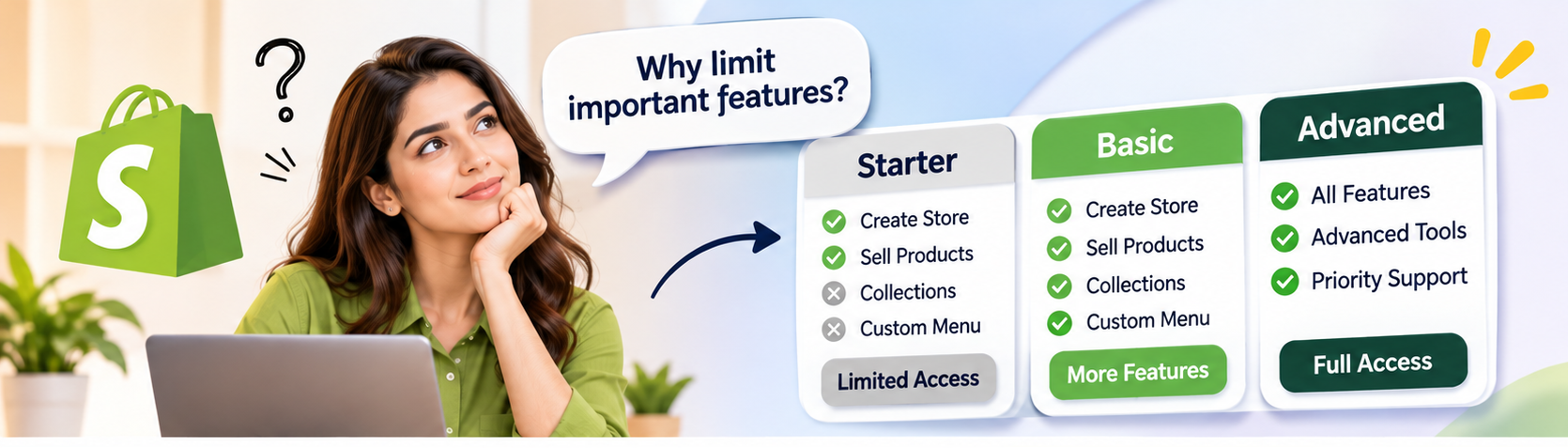
The Shopify Community discussion highlights that some options, such as Collections and Main Menu, may appear in the dashboard for Starter plan merchants even though they are not available for use under that plan.
This can create confusion, particularly for beginners who assume that an option displayed inside their dashboard is included in their subscription.
A merchant may spend time exploring an option, clicking through different settings, and trying to understand why it does not work.
This experience can negatively affect the customer’s first impression.
An ecommerce platform should make its available functionality easy to understand. New merchants should know what they can use before investing their time in building their stores.
2. The Problem With Showing Features That Cannot Be Used
One of the main concerns raised in the discussion is the difference between displaying a feature and actually allowing customers to use it.
When an option appears in the dashboard, users naturally expect it to work.
If they discover that the feature is restricted to another subscription plan only after clicking it, they may feel disappointed.
This creates several problems.
Unnecessary confusion: Beginners may assume that something is wrong with their account or that they have missed an important setup step.
Poor user experience: Repeatedly encountering unavailable features can make the dashboard feel complicated.
Loss of trust: Customers may question why the platform displays options that they cannot access.
Increased frustration: Instead of concentrating on building their business, merchants spend time understanding subscription restrictions.
One participant in the discussion suggested that Shopify should either hide unavailable features completely or display them in a disabled state with a clear explanation.
For example, if a feature is available only on a higher subscription, the dashboard could display a short message explaining the limitation and showing which plan includes it.
Another possibility is to allow users to try the feature before asking them to upgrade.
This would give customers a better understanding of what they are paying for.
The important point is not necessarily that every feature must be free. It is that customers should receive clear information and a predictable experience.
3. Make the Starter Plan More Useful
The original suggestion in the discussion focuses on improving the Starter plan.
The participant believes that the entry-level subscription should provide a more functional experience instead of restricting important store-building features.
One proposed approach is to limit the number of products rather than restricting essential functionality.
For example, Shopify could allow Starter plan users to access:
- Collections
- Main navigation menus
- Homepage customization
- Standard themes
- Basic product organization
- Essential storefront settings
However, the number of products listed could be limited to approximately 30.
This is an example suggested in the discussion, not an existing confirmed subscription rule.
Such an approach could benefit small businesses in several ways.
First, new merchants could build a more complete online store without immediately paying for a higher subscription.
Second, they could understand how different store features work before expanding their business.
Third, the platform would provide a natural upgrade opportunity when the business begins adding more products.
For example, a small handmade jewellery business may initially sell only 15 products.
It might not need a large product catalogue or advanced business features. However, it still needs collections, navigation, and a professional homepage.
If these basic features are unavailable, the merchant may struggle to create the store they originally imagined.
A more flexible entry-level plan could solve this problem.
The merchant could start small, establish an online presence, attract customers, and upgrade when the business grows.
4. Encourage Natural Upgrades Instead of Forcing Them
Subscription upgrades are an important part of any software business.
Companies need different pricing levels to support customers with different requirements and generate revenue as their businesses grow.
However, there is a difference between encouraging an upgrade and making customers feel forced to upgrade.
An upgrade feels natural when customers understand the additional value they will receive.
For example, a merchant may initially need only a basic online store. Later, the business may require:
- A larger product catalogue
- Additional staff accounts
- Advanced reporting
- More detailed business management
- Better operational capabilities
At that stage, upgrading makes sense because the business has developed new requirements.
The merchant can clearly understand why a higher subscription is useful.
On the other hand, if basic functionality is restricted before the merchant has even launched the store, the upgrade may feel like an unnecessary expense.
This can discourage new users.
The original discussion argues that merchant success should be an important part of Shopify’s growth strategy.
When merchants successfully build businesses on the platform, they are more likely to continue using it and consider higher subscription plans as their requirements increase.
Therefore, improving the entry-level experience could create better opportunities for long-term customer retention.
5. Understand Both Sides of Subscription-Based Pricing
The discussion also includes different opinions about Shopify’s pricing structure.
Some participants support the suggestion of making essential features available across all plans.
Others believe that higher-priced subscriptions should provide access to more functionality.
This is a reasonable concern because software companies have operating expenses, development costs, infrastructure requirements, and customer support responsibilities.
Not every feature can necessarily be provided without restrictions.
For example, advanced automation, complex business management features, and services that consume significant resources may reasonably belong to higher subscription levels.
A lower-priced plan is also not necessarily intended to provide every capability required to operate a large ecommerce business.
One participant pointed out that Starter was designed for simpler selling activities rather than complete online store management.
This highlights an important distinction.
The goal should not be to provide every advanced feature at the lowest price.
Instead, the platform should identify which features are essential for beginners and which features are intended for businesses with more advanced requirements.
A balanced subscription structure could include:
Entry-level plan: Essential storefront functionality for small businesses and beginners.
Mid-level plans: Additional management capabilities, more operational flexibility, and features for growing businesses.
Advanced plans: More sophisticated reporting, operational controls, and capabilities for larger businesses.
This approach would allow Shopify to maintain different subscription levels while providing a better starting experience.
6. Improve Communication About Subscription Limitations
Another important lesson from the discussion is that subscription restrictions should be communicated clearly.
Customers should not have to discover important limitations through trial and error.
When someone selects a subscription, the platform should explain which features are included, which features are restricted, and which capabilities require an upgrade.
For example, if a merchant tries to access a feature that is unavailable under their current plan, the platform could display:
- The name of the unavailable feature.
- A simple explanation of what it does.
- The subscription level required to access it.
- Whether a trial or preview is available.
- A clear comparison of available options.
This would help merchants make informed decisions.
It would also reduce unnecessary frustration because customers would understand that the limitation is related to their subscription rather than a technical problem.
One participant suggested displaying restricted features in a greyed-out state with a small explanation when users hover over them.
This could be a relatively simple improvement to the dashboard experience.
The overall objective should be to make subscription differences transparent without making the platform difficult to navigate.
7. Allow Merchants to Test Important Features Before Upgrading
Another suggestion is to provide trial access to important features.
Testing a feature is often more effective than simply reading its description.
For example, a merchant may not understand the value of advanced reporting until they see how it helps analyze sales, orders, and customer activity.
Similarly, someone starting an online business may not understand the importance of product collections until they experience how products can be organized into different categories.
Allowing merchants to explore selected features for a limited period could help them understand their benefits.
A practical approach could include:
- Limited-time access to selected higher-plan features.
- Preview modes for restricted functionality.
- Sample environments where users can explore features.
- Clear notifications before trial access expires.
- Easy subscription comparisons.
This would give customers a better understanding of the platform’s capabilities.
It could also help them decide whether upgrading is worth the additional expense.
However, trial access should be designed carefully. Features involving significant infrastructure costs or complex business operations may need different restrictions.
The objective is to provide enough experience for customers to evaluate the benefits without removing the value of higher subscription plans.
8. Make Customer Feedback Easier to Submit
The second major issue raised in the Shopify Community discussion concerns the process of submitting feedback.
Currently, the participant explains that submitting a feature suggestion requires merchants to create or use a separate community account, navigate to the relevant discussion area, and publish their ideas.
This process may discourage many users from sharing feedback.
Consider a merchant who regularly manages an online store.
While working inside the dashboard, they discover something that could be improved. They immediately have a suggestion based on their actual experience.
However, if submitting that suggestion requires navigating to another website and completing additional steps, they may simply ignore it.
As a result, the platform loses potentially valuable feedback.
The suggested solution is to introduce a simple Share Feedback option directly inside the store dashboard.
This option could allow merchants to:
- Click a feedback button.
- Select a category, such as a feature request or usability issue.
- Describe their suggestion.
- Submit it using their existing account.
- Receive confirmation that their feedback has been received.
This would make the process faster and more convenient.
It would also help collect feedback from merchants who actively use the platform every day.
9. Why Merchant Feedback Is Important for Platform Development
Customers interact with ecommerce platforms regularly, which means they often understand practical problems better than someone who only evaluates the platform from a general perspective.
For example, a merchant managing hundreds of products may notice that product organization could be improved.
Another business owner may discover that a particular dashboard option is confusing.
A growing store may request better reporting or more flexible inventory management.
These suggestions can help identify areas where improvements would make everyday operations easier.
A structured feedback system could help Shopify understand:
- Which features merchants use most frequently.
- Which dashboard options create confusion.
- What limitations affect new businesses.
- Which improvements are requested repeatedly.
- What additional capabilities growing merchants need.
However, collecting feedback is only the first step.
Businesses should also organize suggestions, identify recurring problems, and evaluate which improvements would benefit the largest number of users.
Not every suggestion can be implemented, but merchants should have a convenient way to communicate their experiences.
Making feedback accessible directly inside the dashboard could improve communication between the platform and its customers.
10. How These Changes Could Benefit Shopify and Its Merchants
The suggestions discussed in the article could create benefits for both sides.
For new merchants:
- Easier store setup.
- Better access to essential features.
- Less confusion about subscription limitations.
- More opportunities to explore the platform.
- Greater confidence when starting an online business.
For growing businesses:
- More predictable subscription upgrades.
- Better understanding of available capabilities.
- Easier access to useful business features.
- A more convenient way to share suggestions.
For Shopify:
- Improved first-time customer experience.
- Potentially stronger customer retention.
- Better understanding of merchant requirements.
- More opportunities to encourage natural upgrades.
- A stronger relationship with the merchant community.
For example, imagine a small business owner who starts with a limited product catalogue.
The owner can build a professional storefront, organize products into collections, and begin attracting customers.
After several months, the business expands and requires more advanced capabilities.
At this point, upgrading becomes a practical business decision rather than something the merchant feels forced to do just to access basic functionality.
This type of customer journey can create a more positive relationship with the platform.
11. A Practical Approach Shopify Could Follow
Shopify does not necessarily need to redesign its entire subscription structure immediately.
It could begin by introducing smaller improvements based on the concerns raised in the discussion.
A practical approach could include the following steps:
Step 1: Review entry-level restrictions. Identify which features are essential for creating a functional online storefront and which can reasonably remain restricted.
Step 2: Improve dashboard visibility. Clearly identify unavailable features instead of allowing customers to discover restrictions after clicking them.
Step 3: Introduce selected trial access. Allow merchants to explore important features before deciding whether to upgrade.
Step 4: Evaluate usage-based limitations. Consider limiting product quantities or certain usage levels instead of restricting essential storefront functionality.
Step 5: Add an in-dashboard feedback option. Make it easier for merchants to submit suggestions without navigating to another platform.
Step 6: Analyze merchant feedback. Identify repeated concerns and prioritize improvements that could benefit a large number of businesses.
Step 7: Monitor customer experience. Evaluate whether these changes improve onboarding, customer satisfaction, retention, and subscription upgrades.
These improvements could be introduced gradually, allowing Shopify to understand their impact before making larger pricing decisions.
Conclusion
Attracting new customers is not only about offering competitive subscription prices. It is also about providing an experience that helps people achieve their goals from the beginning.
The Shopify Community discussion highlights two important opportunities: making essential storefront features more accessible to Starter plan merchants and simplifying the process of submitting feedback.
A more functional entry-level subscription could help small businesses create professional online stores without immediately committing to higher monthly expenses. At the same time, clear feature restrictions and limited trial access could help customers understand the value of different subscription levels.
The suggestion to introduce a feedback option directly inside the dashboard is equally important. Merchants who use the platform every day can provide valuable insights into what works, what creates difficulties, and what improvements would make their operations easier.
There will always be differences between subscription plans, and advanced features may reasonably require higher payments. However, these differences should support business growth rather than create unnecessary obstacles for beginners.
Ultimately, Shopify can build a stronger merchant experience by making essential functionality accessible, communicating subscription limitations clearly, and listening to customer feedback.
The goal should be to help merchants succeed first, build trust through a positive experience, and make upgrading a natural part of business growth.
0 Comments