Introduction
Finding the right products to sell is one of the biggest challenges for small ecommerce businesses. Sellers constantly look for products that have strong demand, healthy profit margins, manageable shipping costs, and enough room to compete in the market.
Many product research tools promise to make this process easier. They display trending products, popular categories, competitor sales estimates, and market opportunities. However, there is a common problem: the same product recommendations are often presented to businesses with completely different budgets, goals, and operating conditions.
A product that works well for a large ecommerce company may be a poor choice for a small seller with limited capital. Similarly, a product that looks profitable at first may become unviable after considering shipping fees, discounts, advertising expenses, returns, and competition.
A product research tool should do more than identify products that are currently popular. It should help sellers understand whether a particular opportunity makes sense for their own business.
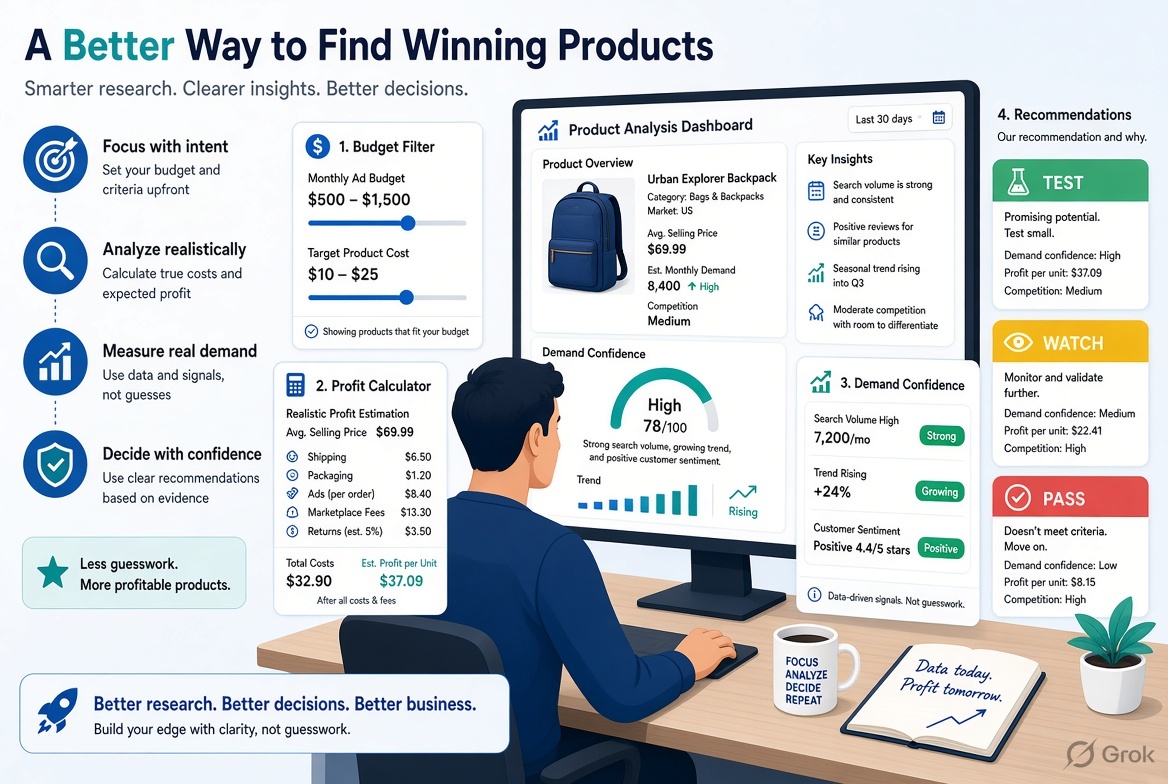
A proposed approach discussed by ecommerce sellers focuses on personalized recommendations based on budget, target profit margin, shipping requirements, sales channels, and risk tolerance. Instead of simply labeling products as winners, it would classify them as TEST, WATCH, or PASS and explain the evidence behind each recommendation.
This article explores what traditional product research tools often get wrong, why personalized product analysis matters, and how ecommerce sellers can make better product decisions.
1. The Problem With Generic Winning Product Lists
One of the most common features of product research platforms is a list of trending or winning products.
These lists may highlight products receiving attention on social media, products appearing frequently in advertisements, or items showing increased market interest.
Although this information can be useful, it does not automatically mean that every product is suitable for every seller.
Consider two businesses:
- Business A: A beginner with a budget of ₹20,000 who wants to test a few low-cost products.
- Business B: An established ecommerce business with a budget of ₹5 lakh and the ability to purchase inventory in bulk.
Both businesses may receive the same recommendation for a popular electronic product.
However, their requirements are completely different. Business A may struggle with minimum order quantities, product testing, and expensive shipping. Business B may have enough capital to negotiate better supplier prices and manage larger inventory.
A generic recommendation ignores these differences.
A useful research system should understand the seller’s situation before suggesting products. It should consider how much money the seller can invest, what profit they expect, which customers they want to reach, and how much risk they are willing to accept.
The objective should not be to find products that are popular everywhere. It should be to identify products that have realistic potential for a particular business.
2. Product Recommendations Should Match the Seller’s Budget
Budget is one of the most important factors in product selection.
A seller’s available investment determines the type of products they can test, the quantity they can purchase, and how much money they can spend on marketing.
For example, a beginner with a limited budget may prefer:
- Lightweight products with affordable shipping.
- Products with low minimum order quantities.
- Items that do not require expensive storage.
- Products with manageable return rates.
- Products that can be tested without purchasing large quantities.
An established seller may be more interested in products that require higher initial investment but offer better margins or opportunities for bulk purchasing.
A research tool should allow sellers to enter their available budget and filter opportunities accordingly.
It should also explain the expected financial commitment rather than displaying only the supplier’s product price.
For example, a product listed at ₹300 may require additional spending on packaging, shipping, advertising, payment processing, and returns. The actual investment could be considerably higher.
Without understanding these costs, sellers may select products that appear affordable but are difficult to sell profitably.
3. Profit Margin Is More Important Than the Selling Price
Another common weakness in product research is focusing too heavily on the difference between supplier cost and retail price.
A product purchased for ₹500 and sold for ₹1,000 appears to provide a 50% gross margin when calculated against the selling price. However, this does not represent the final profit.
The seller may also need to pay for:
- Shipping and delivery.
- Packaging.
- Advertising.
- Payment processing.
- Platform fees.
- Discounts and promotional offers.
- Returns and refunds.
- Product storage or fulfillment.
For example, consider a product with the following estimated costs:
| Expense | Amount |
| Selling price | ₹1,500 |
| Product cost | ₹600 |
| Shipping | ₹150 |
| Packaging | ₹50 |
| Advertising cost per order | ₹250 |
| Payment and other fees | ₹50 |
| Estimated profit | ₹400 |
<text> </text>
In this example, the estimated profit is ₹400 before any additional overheads or applicable taxes.
A product research system should help sellers understand these costs and calculate realistic profit potential.
It should also allow users to set their target margin. If a seller requires at least a 25% margin, the system should identify whether a product can realistically meet that requirement.
This is much more useful than simply showing products with high selling prices.
4. Competitor Research Should Show What Competitors Are Selling Now
Understanding competitors is another essential part of product research.
Some research platforms focus heavily on broad market trends and category-level information. However, sellers often need more specific information about individual competing stores.
For example, if someone wants to enter the home decoration market, they may want to understand:
- Which products are currently listed by successful competitors?
- Which products appear to be bestsellers?
- What new products have recently been introduced?
- How frequently do competitors update their collections?
- What price ranges are competitors using?
- Which products are being offered at discounted prices?
This information can help sellers understand how businesses are positioning themselves in the market.
A category-wide trend may show that home decoration products are popular, but it does not explain which specific products are performing well or how competitors are selling them.
A more useful competitor research system would allow sellers to examine individual stores and track changes over time.
However, it is important to distinguish between publicly visible information and estimated sales performance. A product appearing on a competitor’s website does not automatically prove that it is a bestseller.
Research platforms should clearly explain whether a ranking is based on verified sales information, visible product activity, engagement, or an estimate.
5. Product Research Needs Visible Evidence
One of the biggest problems with product recommendations is that some platforms provide conclusions without explaining how they reached them.
A product may be labeled as trending, profitable, or high-demand, but sellers may not know what information supports that claim.
For example, a recommendation might say that a product has strong demand. But what does that actually mean?
Is the recommendation based on:
- Search interest?
- Marketplace activity?
- Competitor listings?
- Customer reviews?
- Social media engagement?
- Advertising activity?
- Historical sales estimates?
These signals do not all provide the same level of confidence.
A product receiving many social media views may not necessarily generate purchases. Similarly, a product appearing in several online stores may indicate competition rather than strong demand.
A reliable research system should display the evidence behind every important conclusion.
It should explain where the information came from, when it was collected, and whether it represents verified data or an estimate.
This transparency allows sellers to judge the recommendation instead of accepting it without question.
6. Product Pricing Should Include Ranges and Discounts
Showing only the cheapest available product price can create a misleading impression.
The same product may be available from several suppliers at different prices depending on quality, quantity, packaging, shipping location, and delivery conditions.
For example, one supplier may offer a product for ₹250, while another charges ₹400 for a similar-looking item.
The cheaper option may have lower quality, slower delivery, or additional shipping charges. The more expensive option may provide better packaging or more reliable fulfillment.
A useful research platform should display:
- Minimum available price.
- Average or typical price range.
- Higher-end supplier prices.
- Bulk purchase pricing.
- Current discounts.
- Shipping charges, where available.
- Differences in product specifications.
Competitor pricing should also be examined carefully.
A competitor may list a product for ₹1,500 but regularly sell it at ₹999 through discounts. If a seller compares their own price with the original listed price, they may misunderstand the actual competitive market.
Pricing information should therefore show both regular and discounted prices whenever reliable data is available.
7. Understanding Demand Confidence and Market Saturation
A product can have good demand and still be a poor opportunity.
This often happens when too many sellers are already offering the same product. High competition can make it difficult for a new business to attract customers without spending heavily on advertising or reducing prices.
A product research system should evaluate two important factors: demand confidence and saturation risk.
Demand confidence
Demand confidence indicates how strongly the available evidence supports the idea that customers are interested in a product.
For example:
- Strong search interest may suggest that customers are actively looking for the product.
- Consistent customer reviews may indicate ongoing purchases.
- Repeated competitor promotions may suggest commercial interest.
- Short-term social media attention may indicate temporary curiosity rather than long-term demand.
The system should consider multiple signals rather than relying on one source.
Market saturation
Market saturation measures how crowded the competitive environment may be.
Useful indicators could include:
- Number of competing sellers.
- Similar products available in the market.
- Price competition.
- Advertising activity.
- Product differentiation opportunities.
- Presence of established brands.
A product with moderate demand and low competition may be more attractive to a small seller than a highly popular product dominated by established businesses.
8. The TEST, WATCH, and PASS Recommendation Model
One interesting idea in the discussion is to classify product opportunities into three simple categories: TEST, WATCH, and PASS.
This approach can make research results easier to understand and act upon.
TEST
A product receives a TEST recommendation when available information suggests that it may be suitable for the seller’s business.
For example, a lightweight home accessory may have reasonable demand, affordable shipping, manageable competition, and enough margin to meet the seller’s target.
The recommendation does not mean that success is guaranteed. It means the product appears suitable for a small-scale test.
The seller can begin with limited inventory or a controlled advertising campaign and measure actual customer response.
WATCH
A product receives a WATCH recommendation when there is potential, but some important information is missing or uncertain.
For example, a product may have growing market interest but inconsistent supplier availability.
Instead of recommending immediate investment, the system can suggest monitoring the product until stronger evidence becomes available.
This prevents sellers from rushing into opportunities based on temporary trends.
PASS
A product receives a PASS recommendation when it appears unsuitable for the seller’s current requirements.
Possible reasons include:
- Profit margins below the seller’s target.
- High shipping costs.
- Excessive competition.
- Unreliable suppliers.
- High return or damage risk.
- Investment requirements beyond the available budget.
A PASS recommendation does not mean the product is universally bad. It means that the product may not be a sensible choice for that particular seller under their current conditions.
This distinction is important because business requirements can change over time.
9. The Tool Should Explain How Products Could Fail
Good product research should not only highlight opportunities. It should also explain the risks.
Every product has possible failure points.
For example, a fragile home decoration product may have strong demand but a high chance of shipping damage. An electronic accessory may offer an attractive selling price but require warranty support. A fashion product may look profitable but experience frequent size-related returns.
A useful research report should identify these risks before the seller invests money.
It should also highlight conflicting signals.
For instance, a product may have growing search interest but declining competitor prices. This could mean demand is increasing, but competition is becoming more aggressive.
Instead of hiding this information, the research system should explain both sides.
This helps sellers make informed decisions and prepares them for problems that may arise after launching a product.
10. How Small Ecommerce Sellers Can Use Better Product Research
Even without a personalized research platform, sellers can improve their product selection process by following a structured method.
Step 1: Define your business requirements
Decide your investment budget, target profit margin, preferred product categories, sales channel, and risk tolerance.
Step 2: Identify potential products
Explore customer needs, competitor stores, marketplaces, product reviews, and industry trends.
Step 3: Study individual competitors
Check what competing businesses are selling, their pricing strategies, product launches, and visible promotional activity.
Step 4: Compare suppliers
Evaluate product quality, minimum order quantities, shipping costs, delivery times, and return conditions.
Step 5: Calculate actual profitability
Include all major expenses instead of comparing only supplier prices with retail prices.
Step 6: Evaluate demand and competition
Look for multiple indicators of customer interest and understand how crowded the market is.
Step 7: Identify risks
Consider shipping damage, product quality, returns, supplier reliability, and possible price changes.
Step 8: Test before scaling
Start with a small investment, monitor real customer behavior, and expand only when results support the decision.
This process reduces guesswork and helps sellers avoid investing heavily in products that may not suit their business.
11. What Would Make a Product Research Platform Worth Paying For?
The discussion also raises an important question: would ecommerce sellers actually pay for a product research platform built around personalized recommendations?
The answer depends on whether the platform provides meaningful value beyond information that sellers can already find elsewhere.
A paid service should help sellers save time, reduce avoidable mistakes, and make better investment decisions.
Features that could make such a platform valuable include:
- Personalized product recommendations based on budget.
- Profit calculations based on the seller’s target margin.
- Competitor product tracking.
- Best-seller and new-launch monitoring with clear evidence.
- Supplier and shipping cost comparisons.
- Demand confidence indicators.
- Market saturation analysis.
- Pricing ranges and discount tracking.
- Clear TEST, WATCH, and PASS recommendations.
- Explanations of possible product failure points.
The platform should also avoid making unrealistic promises about guaranteed winning products.
Sellers are more likely to trust a service that explains uncertainty and limitations than one that claims every recommendation will generate profits.
A simple, transparent product report may be more valuable than a complicated dashboard filled with numbers that are difficult to interpret.
Conclusion
Product research tools can help ecommerce sellers discover opportunities, understand competitors, and evaluate market trends. However, generic winning-product lists and unsupported recommendations are not enough to make good business decisions.
Small sellers need research that considers their actual circumstances, including available budget, target profit margin, shipping requirements, sales channels, and risk tolerance.
A better product research approach should also provide detailed competitor information, realistic pricing ranges, visible supporting evidence, demand confidence, and market saturation analysis.
The TEST, WATCH, and PASS model offers a practical way to turn research into clear decisions. It helps sellers understand which products deserve a small experiment, which opportunities require more observation, and which products should be avoided under their current business conditions.
Most importantly, product research should explain not only why a product might succeed but also why it could fail.
There is no guaranteed winning product. Every opportunity involves uncertainty, competition, and operational challenges. However, when sellers have access to transparent evidence and recommendations based on their own business requirements, they can make more confident decisions.
The future of product research should not be about showing sellers what is trending everywhere. It should be about helping each seller understand what is realistically worth testing for their own business.


0 Comments