How to Decide When an Order Is Truly Ready for Fulfillment
As an ecommerce business grows, fulfilling orders becomes far more complex than simply receiving a purchase and shipping it immediately. Modern online stores often rely on multiple connected systems to handle different parts of the order process, including inventory management, fraud checks, address validation, subscription management, warehouse operations, shipping, and post-purchase services. Each system performs an important role, but together they create a new challenge: Who decides when an order is actually ready for fulfillment?
The discussion centers on this architectural question. The goal is to determine whether there is a single solution that can act as the ultimate authority for releasing orders to fulfillment after every required check has passed. The consensus is that there is generally no standard solution that automatically owns this decision across every connected system. Instead, businesses often distribute release logic across multiple platforms, or they intentionally choose one operational system to become the decision-maker.
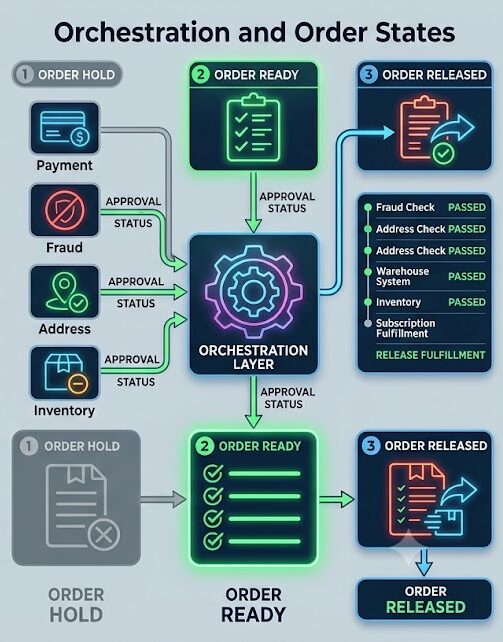
Several participants propose a more reliable approach: creating a separate orchestration layer that tracks a single fulfillment state for every order, such as HOLD, READY, or RELEASED. Rather than allowing each connected system to trigger fulfillment independently, every system reports its own approval status, and fulfillment occurs only after every required condition has been satisfied.
This discussion highlights an important lesson for growing ecommerce businesses: successful fulfillment depends not only on shipping products quickly but also on coordinating multiple business processes into one dependable workflow.
Why Fulfillment Becomes More Complex as Businesses Grow
In the early stages of an online business, fulfillment is often straightforward.
A customer places an order.
The merchant verifies the purchase.
The product is shipped.
However, as businesses expand, additional checks become necessary before shipping can begin.
For example, businesses may need to verify:
- Payment approval
- Fraud screening
- Address accuracy
- Inventory availability
- Subscription eligibility
- Warehouse readiness
- Customer-specific rules
- Special approval requirements
Each new process increases complexity.
Without coordination, different systems may make conflicting decisions about the same order.
The Problem of Multiple Decision Makers
One of the biggest challenges discussed is that many systems want to influence fulfillment.
Each one focuses on its own responsibility.
For example:
- Payment systems verify transactions.
- Fraud systems evaluate risk.
- Inventory systems check stock.
- Warehouses prepare shipments.
- Shipping systems generate labels.
Individually, each system works correctly.
Collectively, they may create inconsistent release decisions if no single authority coordinates them.
Why Distributed Logic Creates Problems
When fulfillment rules are spread across multiple systems, businesses can encounter several problems.
Examples include:
- Orders shipping before fraud checks finish.
- Inventory being allocated too early.
- Duplicate fulfillment requests.
- Missed approval steps.
- Difficult troubleshooting.
- Inconsistent order states.
These problems become more common as integrations increase.
The more connected systems involved, the greater the need for coordinated decision-making.
What Is an Orchestration Layer?
One of the strongest recommendations from the discussion is introducing an orchestration layer.
Rather than replacing existing systems, this layer becomes the coordinator.
Its job is simple:
Every connected system reports its status.
The orchestrator decides when fulfillment may proceed.
Instead of multiple independent release decisions, only one final release decision exists.
This creates a much more predictable workflow.
The Three Core Order States
A practical recommendation is using three primary fulfillment states.
HOLD
The order remains blocked.
One or more required conditions have not yet passed.
Examples include:
- Fraud review pending
- Address verification incomplete
- Inventory unavailable
- Payment not finalized
Nothing moves to fulfillment while the order remains on hold.
READY
Every required check has succeeded.
The order is now eligible for fulfillment.
No additional approval is needed.
The order simply waits for release into warehouse processing.
RELEASED
The order has officially entered fulfillment.
Warehouse processing, picking, packing, and shipping can begin.
Having one clearly defined released state prevents confusion about whether fulfillment has actually started.
Why Separate States Improve Visibility
Many businesses struggle because different systems describe the same order differently.
One system may consider the order approved.
Another may still consider it pending.
Using one shared release state provides much clearer visibility.
Everyone can understand the order’s current position.
This improves communication across teams.
Let Each System Handle Its Own Expertise
An important principle from the discussion is that each connected system should continue handling its own specialized responsibility.
For example:
- Fraud systems evaluate fraud.
- Inventory systems manage stock.
- Address systems verify addresses.
- Warehouse systems manage shipping.
The orchestration layer does not replace these functions.
Instead, it collects their results.
This separation keeps responsibilities clear.
The Green-Light Approach
One practical concept discussed is requiring every required check to become green before fulfillment begins.
Imagine an order with five required checks.
- Payment approved
- Fraud cleared
- Address verified
- Inventory confirmed
- Subscription validated
Only after all five succeed does the order move from HOLD to READY.
This creates a much safer fulfillment process.
Why Simple Automation Is Not Always Enough
Basic automation works well for straightforward situations.
For example:
“If payment succeeds, fulfill the order.”
However, real businesses rarely remain that simple.
More complicated scenarios include:
- Delayed fraud reviews
- Inventory changes
- Address corrections
- Customer edits
- Subscription updates
These events may happen at different times.
Simple rule-based automation may struggle with these asynchronous situations.
Understanding Asynchronous Events
Asynchronous events occur when different processes finish independently.
For example:
Payment finishes immediately.
Address verification finishes thirty seconds later.
Fraud review finishes two minutes later.
Inventory confirmation finishes after another update.
The orchestration layer patiently waits for every required event before releasing fulfillment.
This prevents premature shipping.
Handling Retries Safely
The discussion also mentions retries as an important consideration.
Sometimes systems send information more than once.
A reliable workflow should handle repeated updates without creating duplicate actions.
For example:
A payment confirmation may arrive twice.
The workflow should recognize that the payment already succeeded rather than restarting fulfillment.
This prevents unnecessary errors.
Why Duplicate Events Matter
Duplicate events become surprisingly common in connected systems.
Without protection, duplicate messages can create problems such as:
- Duplicate shipments
- Duplicate warehouse requests
- Multiple notifications
- Inventory inconsistencies
A reliable workflow should recognize previously processed events.
Each event should produce the correct result only once.
Logging Every Decision
Another valuable recommendation is maintaining detailed logs.
Every fulfillment decision should leave a clear record.
Examples include:
- Payment approved
- Fraud cleared
- Inventory confirmed
- Address verified
- Order released
Good logging makes troubleshooting much easier.
Instead of guessing what happened, businesses can review the complete decision history.
Why Audit Trails Matter
Audit trails become increasingly valuable as businesses grow.
They help answer questions like:
- Why was this order delayed?
- Who approved it?
- Which system blocked it?
- When was it released?
- Which checks passed?
Clear records reduce confusion during customer support and internal investigations.
Designing for Exceptions
Not every order follows the standard process.
Some situations require human review.
Examples include:
- High-value purchases
- Suspicious activity
- Special customer requests
- Manual inventory adjustments
A good fulfillment workflow should allow exceptions without disrupting ordinary orders.
Human Approval Still Has Value
Although automation improves efficiency, human approval remains valuable for unusual situations.
Businesses may choose to require manual review for:
- Large orders
- High-risk transactions
- First-time wholesale customers
- Special shipping requests
This creates a balanced workflow.
Routine orders remain automated.
Exceptional cases receive human attention.
Avoid Letting Every System Release Orders
One of the strongest architectural lessons is avoiding multiple release triggers.
If every connected system can independently release fulfillment, coordination becomes much harder.
Instead:
Every system reports status.
Only one authority releases fulfillment.
This significantly reduces operational complexity.
Warehouse Coordination
Warehouse teams also benefit from clear release rules.
Instead of receiving uncertain orders, they receive only orders that have completed every required approval.
This reduces interruptions.
Warehouse staff can focus on:
- Picking
- Packing
- Shipping
without constantly checking other systems.
Customer Experience Improves Too
Customers benefit indirectly from better fulfillment coordination.
Accurate release decisions reduce:
- Shipping mistakes
- Canceled orders
- Fraud-related issues
- Inventory problems
- Address errors
Reliable fulfillment creates greater customer confidence.
Scalability Matters
The discussion emphasizes that fulfillment workflows should be designed for growth.
A workflow that handles fifty orders per month may struggle with five thousand.
Planning early makes future expansion easier.
Scalable workflows should support:
- More products
- More warehouses
- More payment methods
- More integrations
- More shipping rules
Good architecture prevents expensive redesigns later.
Avoiding Operational Bottlenecks
Ironically, poor automation can create new bottlenecks.
If businesses automate every process independently without coordination, employees may spend more time resolving conflicts.
A centralized release decision reduces these bottlenecks.
Everyone knows where the final fulfillment decision occurs.
Building a Clear Decision Framework
A practical decision framework might include:
Step 1: Receive Order
Create the order.
Assign HOLD status.
Step 2: Begin Required Checks
Each connected system performs its own responsibility.
Step 3: Record Every Result
Each system reports:
- Pass
- Fail
- Pending
Step 4: Evaluate Overall Readiness
The orchestrator checks whether every required condition has passed.
Step 5: Move to READY
All required approvals are complete.
Step 6: Release Fulfillment
The warehouse receives the order.
Step 7: Log Every Action
Maintain a complete decision history.
This framework creates predictable operations.
Why Architecture Matters More Than Individual Features
One important takeaway from the discussion is that fulfillment problems often involve architecture rather than individual features.
Businesses sometimes search for one application that solves everything.
In reality, success often comes from designing how multiple systems work together.
Good architecture emphasizes:
- Clear responsibilities
- Shared states
- Reliable communication
- Safe retries
- Strong logging
- Centralized release decisions
These principles remain valuable regardless of which software ecosystem a business uses.
Preparing for Future Integrations
As ecommerce businesses grow, new integrations become inevitable.
Future additions may include:
- New warehouses
- Additional payment methods
- Loyalty programs
- International shipping
- New fraud checks
A centralized fulfillment workflow makes these additions easier.
Instead of rewriting every existing integration, businesses simply connect the new system to the shared release process.
Conclusion
Determining when an order is truly ready for fulfillment is one of the most important operational challenges facing growing ecommerce businesses. While many connected systems perform essential tasks such as payment approval, fraud evaluation, inventory management, address verification, subscription handling, and warehouse coordination, the discussion makes it clear that there is generally no single built-in solution that automatically becomes the final authority across all of them.
The strongest architectural recommendation is to introduce a centralized orchestration layer that tracks one shared fulfillment state for every order. By using simple statuses such as HOLD, READY, and RELEASED, businesses create a clear and consistent decision-making process. Each connected system continues performing its specialized role, but fulfillment begins only after every required condition has successfully passed.
The discussion also highlights the importance of handling asynchronous events, preventing duplicate processing, maintaining detailed logs, supporting human approval for exceptions, and designing workflows that can scale alongside business growth. Rather than allowing multiple systems to release orders independently, a single coordinated release decision reduces operational complexity, improves warehouse efficiency, strengthens customer confidence, and creates a more reliable fulfillment process.
Ultimately, successful fulfillment is not simply about shipping orders quickly. It is about ensuring that every order moves through a predictable, transparent, and well-coordinated workflow that protects both the business and its customers while supporting long-term growth.