Automation has transformed ecommerce fulfillment. A customer places an order, the order information moves through connected systems, a shipping label is created, the package is handed to a carrier, and tracking information is sent back to the store.
When everything works correctly, this process can save merchants a significant amount of time.
But automation also creates a risk: a small data error can move through multiple systems without being noticed until the package fails to reach the customer.
A recent Shopify Community discussion highlights this problem through a reported fulfillment incident in which critical address information was allegedly missing from a shipping label even though the complete address was visible in the Shopify order.
According to the merchant, the missing information included the house number and postal code. The carrier later indicated that the address information was insufficient for delivery, and the package was eventually returned after remaining undelivered for several days.
The situation raises broader questions about address validation, responsibility between connected systems, carrier checks, tracking accuracy, customer communication, and the importance of testing automated fulfillment before launching large marketing campaigns.
Why Accurate Address Data Matters
A shipping address is one of the most important pieces of information in an ecommerce order.
It typically includes:
- Customer name
- Street or address line
- House or building number
- City
- State or region
- Postal code
- Country
- Additional delivery information where required
Every part of this information can affect whether a carrier can successfully deliver a package.
A missing apartment number can make delivery difficult.
A missing house number can make the destination impossible to identify.
A missing postal code can interfere with sorting.
An incorrect city can send the package to the wrong delivery region.
Because automated fulfillment depends on data being transferred between systems, merchants need confidence that the information leaving the store is the same information used to create the shipping label.
The Reported Problem
The merchant in the discussion reported that the Shopify order contained the customer’s complete address.
However, the shipping label allegedly did not contain all of that information.
Specifically, the merchant reported that important fields such as the house number and postal code were missing.
This created a serious problem.
The store had the correct customer information, but the downstream fulfillment process apparently generated an incomplete shipping label.
The carrier later indicated that the address was insufficient for delivery.
This illustrates an important ecommerce principle:
Having correct information in the store does not necessarily mean that every connected system is using the same information correctly.
Where Data Can Be Lost
An ecommerce order may pass through several stages.
A simplified process looks like this:
Customer → Online Store → Fulfillment System → Shipping Label → Carrier → Customer
At each stage, address information needs to remain accurate.
A field can potentially be:
- Removed
- Truncated
- Mapped incorrectly
- Placed in the wrong address field
- Reformatted incorrectly
- Ignored by a connected system
- Rejected because of formatting rules
For example, a complete address might contain:
House number: 125
Street: Main Street
Postal code: 1234 AB
If the fulfillment process only transfers “Main Street” and the city, the store may still show the complete address while the shipping label remains incomplete.
This creates a data-integrity problem between systems.
Why Address Validation Should Happen Before Shipment
One of the major concerns raised in the discussion is the lack of effective validation before shipment.
Address validation should ideally happen before a shipping label is finalized.
A fulfillment process should be able to identify obvious problems such as:
- Missing postal code
- Missing house number
- Missing city
- Invalid country format
- Incomplete street address
- Unsupported characters
- Inconsistent regional information
Validation does not need to guarantee that an address is perfect.
Its purpose is to catch obvious problems before they become expensive shipping failures.
A simple warning such as:
“Postal code is missing. Please review the address before creating the shipping label.”
could potentially prevent an entire failed delivery.
Why Carrier Acceptance Does Not Guarantee Delivery
Another important point in the discussion is that the carrier reportedly accepted the shipping label.
This might create the impression that everything was correct.
However, label acceptance does not necessarily mean that the address is fully deliverable.
A package can enter the carrier network and still fail later because the final delivery location cannot be identified.
This distinction is important.
There are several stages between label creation and successful delivery:
- Label generation
- Shipment acceptance
- Sorting
- Transportation
- Destination processing
- Local delivery
- Successful delivery
An address problem might not become obvious until one of the later stages.
Therefore, merchants should not treat an “accepted” or “in transit” status as proof that the delivery information is correct.
Tracking Status Can Create Confusion
The merchant also reported that tracking continued to show the package as being in transit.
This creates another operational problem.
Customers generally assume that tracking information reflects the real physical status of their package.
If a package cannot be delivered but the tracking information continues to suggest normal movement, both the merchant and customer can become confused.
A merchant may tell the customer:
“Your package is currently in transit.”
But if the package is actually being held because of an address problem, that communication is misleading even if the merchant is simply relying on the available tracking information.
Accurate exception reporting is therefore extremely important.
“Delivered” and “Actually Delivered” Are Different Things
The discussion also raises concerns about a reported delivery claim even though the customer apparently did not receive the package.
This highlights the difference between system status and real-world outcome.
A fulfillment system may rely on carrier events.
A carrier may report one status.
The fulfillment platform may interpret that status differently.
The merchant may see another status.
But the only outcome that ultimately matters to the customer is whether the package actually arrived at the correct destination.
For merchants, this means that unusual tracking events should be investigated rather than automatically treated as successful fulfillment.
The Merchant’s Investigation Burden
Another concern in the discussion is the amount of investigation the seller reportedly had to perform.
Ideally, merchants should not need to manually investigate every failed shipment.
If a fulfillment system creates the shipping label, merchants reasonably expect the process to identify obvious data problems and provide useful information when something goes wrong.
When a delivery fails, the merchant may otherwise need to investigate:
- The original customer order
- The address stored in the store
- The shipping label
- Carrier tracking
- Fulfillment records
- Shipment history
- Customer communication
This takes time and can be especially difficult when the merchant is processing many orders.
The Business Cost Is Bigger Than One Failed Shipment
A failed shipment creates more than a shipping problem.
Potential costs include:
- Replacement shipping
- Refunds
- Lost product
- Customer service time
- Additional fulfillment fees
- Marketing disruption
- Negative reviews
- Customer dissatisfaction
- Lost repeat purchases
For international businesses, the costs can be even higher.
A package may travel through multiple countries or carriers before the problem is discovered.
By the time it is returned, the merchant may have already paid substantial shipping and handling costs.
Marketing Can Be Affected
One of the strongest business impacts mentioned in the discussion is the merchant’s decision to pause international marketing campaigns.
This makes sense.
Imagine a business launches an advertising campaign and begins receiving hundreds of orders.
If the fulfillment process has an address-data problem, the business could suddenly generate hundreds of failed shipments.
Instead of scaling sales, the merchant may need to stop advertising to prevent additional losses.
This demonstrates why fulfillment reliability should be tested before aggressively increasing order volume.
Test Orders Are Extremely Important
One of the most practical lessons from the discussion is the recommendation to run test orders before launch.
A test order should not simply confirm that an order can be placed.
It should test the complete customer journey.
A merchant should verify:
- Customer enters an address.
- Order reaches the store.
- Full address appears correctly.
- Order reaches the fulfillment system.
- Shipping label contains the complete address.
- Tracking number is generated.
- Carrier receives the correct information.
- Package is actually shipped.
- Tracking updates correctly.
- Package reaches the intended destination.
Testing this process with different addresses can reveal problems that would otherwise remain hidden.
Test Different Address Formats
A single test address may not be enough.
International ecommerce businesses should consider testing:
- Apartment addresses
- House numbers
- Postal codes
- Long street names
- Addresses with unit numbers
- Different countries
- Different postal code formats
- Special characters
- Rural addresses
Address formats vary significantly between countries.
A system that works correctly for one country may mishandle another country’s address structure.
Data Mapping Is an Important Risk
Connected systems often use different field structures.
One system may store:
- Address Line 1
- Address Line 2
- City
- Postal Code
Another may use:
- Street
- House Number
- Apartment
- Postal Code
If these fields are mapped incorrectly, information may be lost.
For example, a house number stored separately in one system may not be transferred if the receiving system only reads the street field.
This is why integrations need proper field mapping and testing.
Responsibility Between Systems Can Be Complicated
The discussion also includes disagreement over who should be responsible for the issue.
One response reportedly argued that Shopify was not responsible and that the issue belonged to the app or fulfillment provider.
The original poster rejected that response.
This disagreement highlights a common challenge in ecommerce integrations.
A merchant may interact with several companies, but the customer sees only one store.
From the customer’s perspective, the merchant is responsible for the delivery experience.
Therefore, merchants need to understand the responsibilities of every connected service before relying on automated fulfillment at scale.
Merchants Need Clear Support Processes
When a fulfillment failure occurs, merchants need more than a generic support response.
A useful support process should help answer:
- What happened?
- Where did the data change?
- Was the original address correct?
- What address was sent to the carrier?
- Why was the information missing?
- Can the shipment be reshipped?
- Who pays the additional shipping?
- How will the problem be prevented in the future?
Without clear answers, merchants may lose confidence in the entire fulfillment process.
Build Internal Fulfillment Checks
Even when automation is available, merchants can introduce their own safeguards.
For example, before fulfillment, an order can be checked for required information:
- Customer name present
- Address line present
- House number present where applicable
- City present
- Postal code present
- Country present
- Phone number present where required
Orders failing these checks can be held for review.
This can be especially useful for international stores.
Monitor Failed Deliveries
Merchants should also track delivery exceptions.
Useful metrics include:
- Failed deliveries
- Returned shipments
- Address-related failures
- Damaged shipments
- Missing tracking
- Delivery delays
- Replacement shipments
If address-related failures suddenly increase, it may indicate a problem with the fulfillment integration rather than customer behavior.
Never Assume Automation Is Automatically Reliable
Automation is powerful because it reduces manual work.
But automation does not eliminate the need for monitoring.
A system can process thousands of orders correctly and still have a specific integration problem affecting one field.
The more orders a business processes, the more important monitoring becomes.
Merchants should periodically test the entire fulfillment process rather than assuming that a process that worked six months ago will always work correctly.
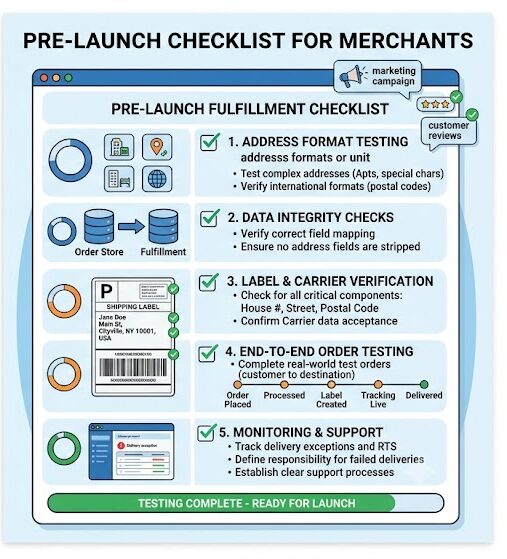
A Practical Pre-Launch Checklist
Before launching a major ecommerce campaign, merchants can review the following:
Order Data
- Is the complete customer address stored correctly?
- Are all required fields present?
- Are international formats supported?
Fulfillment
- Does the fulfillment system receive the complete address?
- Are address fields mapped correctly?
- Are missing fields flagged?
Shipping Label
- Does the label contain the complete delivery address?
- Are house numbers and postal codes visible?
- Does the carrier accept the address?
Tracking
- Is tracking generated correctly?
- Are shipment events accurate?
- Are delivery exceptions visible?
Returns
- What happens when an address error causes a failed delivery?
- Who pays for reshipping?
- How is the customer notified?
Testing
- Have real test orders been completed?
- Have multiple countries and address formats been tested?
- Has the complete delivery process been verified?
Conclusion
The reported fulfillment problem highlights an important weakness that can exist in automated ecommerce operations: correct information in the store does not guarantee correct information on the shipping label.
When an address passes through several connected systems, important fields can potentially be lost, incorrectly mapped, or reformatted.
A missing house number or postal code may look like a small data issue, but it can result in failed delivery, returned packages, refunds, replacement costs, customer complaints, and even paused marketing campaigns.
The best way to reduce this risk is to test the complete fulfillment process before scaling.
Merchants should verify that customer address information is transferred correctly, shipping labels contain all required details, tracking accurately reflects shipment progress, and delivery exceptions are identified quickly.
They should also understand which company is responsible for each stage of the fulfillment process and have a clear support path when something goes wrong.
Most importantly, merchants should never assume that an automated process is reliable simply because it works most of the time.
A single integration error can affect many orders when a business begins scaling.
Test orders, address validation, field mapping, exception monitoring, and clear responsibility between connected systems can help prevent small data problems from becoming expensive operational failures.
For ecommerce businesses, automation should reduce complexity—not hide problems until the customer discovers them.



0 Comments