Inventory synchronization is one of the most important operational systems in modern eCommerce. Customers expect product availability shown on a storefront to match actual purchasing capability during checkout. When inventory appears available on the product page but suddenly becomes unavailable during cart or checkout, trust breaks immediately.
The issue described above highlights a very common but frustrating challenge faced by many dropshipping businesses:
products appear fully stocked inside the supplier dashboard and even inside the store admin, yet customers still receive “out of stock” errors when attempting to purchase.
At first glance, this may seem like a simple technical syncing bug. However, the deeper issue reflects the growing complexity of modern inventory systems where:
- Supplier inventory
- Warehouse availability
- Shipping methods
- Product variants
- Platform inventory rules
- Fulfillment locations
all interact together behind the scenes.
When even one of these systems becomes misaligned, inventory visibility and purchasing behavior can break in ways that confuse both merchants and customers.
This situation becomes even more complicated in dropshipping environments because inventory is often distributed across multiple locations and managed through automated synchronization rather than physical stock owned directly by the seller.
The discussion above centers around a mismatch between displayed stock quantities and actual checkout availability. Although no final resolution was confirmed, the conversation reveals several important operational lessons about inventory synchronization, supplier-based fulfillment, and the hidden complexity of modern eCommerce infrastructure.
Let’s explore why these stock sync issues happen, why they damage customer experience so heavily, and why inventory visibility in dropshipping businesses is far more complicated than most new merchants realize.
The Growing Complexity of Inventory in Modern eCommerce
Traditional retail inventory was relatively simple.
A business either:
- Had products in stock
or - Did not have products in stock.
The store physically controlled inventory inside its own warehouse.
Modern eCommerce operates very differently.
Today’s online stores often rely on:
- Supplier inventory
- Third-party warehouses
- Cross-border fulfillment
- Print-on-demand production
- Marketplace sourcing
- Automated inventory syncing
This means inventory is no longer controlled by a single system.
Instead, inventory becomes a network of constantly changing data flowing between multiple platforms.
Every connected system must stay synchronized:
- Supplier inventory
- Storefront inventory
- Checkout validation
- Shipping eligibility
- Variant mapping
- Warehouse availability
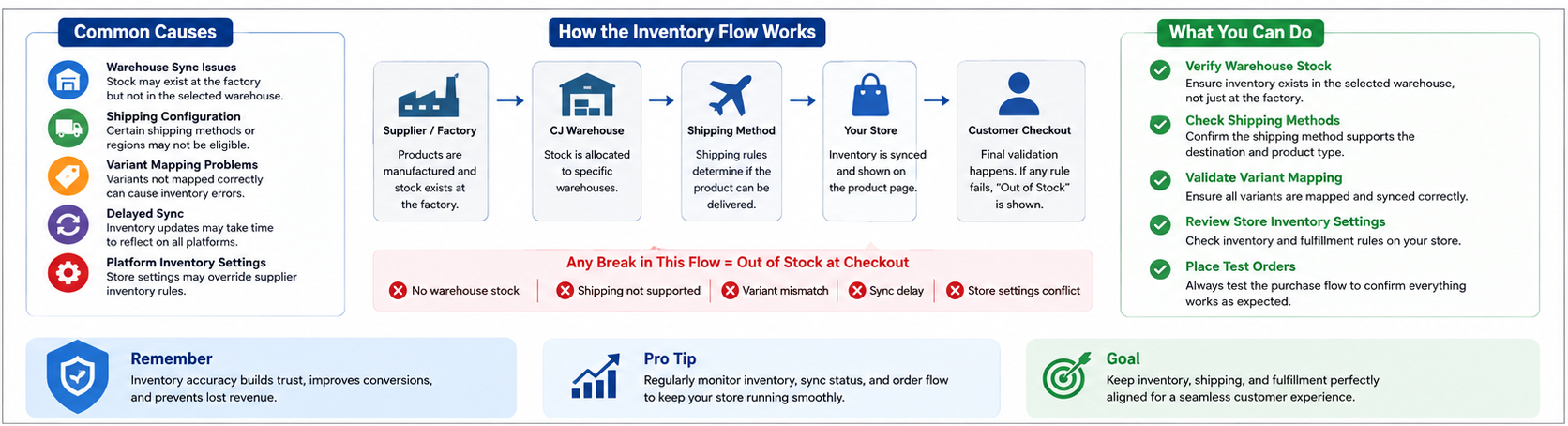
If synchronization fails at any point, customers may experience incorrect stock behavior.
Why Inventory Accuracy Is So Important
Inventory accuracy directly affects customer trust.
Customers expect:
- Product availability to be accurate
- Checkout behavior to match storefront messaging
- Orders to process smoothly
- Shipping timelines to feel predictable
When customers see:
“In Stock”
but later receive:
“Out of Stock”
during checkout, frustration increases quickly.
This creates several business problems:
- Abandoned carts
- Lost revenue
- Reduced trust
- Customer confusion
- Increased support tickets
- Negative brand perception
Inventory reliability is not just an operational concern —
it is a customer experience issue.
Why Dropshipping Inventory Is More Difficult
Dropshipping businesses face unique inventory challenges because they often do not physically control stock.
Instead, inventory depends on external suppliers.
This creates several layers of dependency:
- Supplier stock availability
- Warehouse allocation
- Shipping method compatibility
- Inventory sync timing
- Product variant mapping
Inventory may change constantly based on:
- Supplier sales
- Factory production
- Warehouse movement
- International shipping conditions
As a result, inventory data becomes more dynamic and less stable than traditional retail inventory.
Understanding the “Factory Inventory” Issue
One important detail in the discussion was this inventory structure:
“Inventory: 10077 (CJ: 0, Factory: 10077)”
This distinction matters significantly.
It suggests:
- No inventory is physically stored in the fulfillment warehouse
- Inventory exists only at the factory level
This creates an important operational difference.
Factory inventory does not always equal immediately fulfillable inventory.
Products may technically exist at the manufacturing level, but:
- Not be ready for instant shipping
- Not be allocated to the selected warehouse
- Not support the chosen shipping method
- Not be processed fast enough for checkout rules
This creates confusion because the storefront may display high inventory numbers while the fulfillment system still blocks purchases.
Why Warehouse Allocation Matters
Many dropshipping systems rely on warehouse-specific inventory.
A product may exist in:
- China warehouse
- US warehouse
- EU warehouse
- Factory stock
- Partner fulfillment centers
But checkout availability may depend on:
- Shipping region
- Delivery method
- Warehouse assignment
- Fulfillment eligibility
If the selected warehouse has:
Zero allocated stock
the checkout system may still reject orders even if factory inventory exists elsewhere.
This is one reason inventory synchronization can appear inconsistent.
The Hidden Role of Shipping Methods
The discussion also referenced shipping configuration and a specific shipping method.
This is extremely important because inventory availability is often tied directly to shipping eligibility.
A product may:
- Exist at factory level
- Exist inside supplier systems
- Show inventory in the store
but still become unavailable if:
- The selected shipping method cannot fulfill the destination
- Shipping lanes are restricted
- Warehouse routing fails
- Delivery rules block processing
From the customer perspective:
the product appears available.
But operationally:
the fulfillment system may reject the order due to logistics constraints.
Why Variant Mapping Problems Cause Inventory Errors
Another common cause of inventory sync problems is incorrect variant mapping.
In modern eCommerce, products often contain:
- Multiple sizes
- Colors
- Styles
- Materials
- Bundles
Each variant must connect correctly between:
- Supplier system
- Storefront
- Fulfillment platform
If even one variant becomes mismatched:
- Inventory may display incorrectly
- Orders may fail
- Checkout may block purchases
- Wrong products may sync
Variant mapping errors are especially common in large product catalogs.
Why Automated Inventory Sync Is Not Always Instant
Many store owners assume inventory synchronization happens instantly.
In reality, inventory updates often depend on:
- Sync intervals
- API refresh timing
- Queue processing
- Background tasks
- Platform authorization
This means inventory may temporarily display outdated information.
For example:
- Supplier inventory changes
- Storefront does not refresh immediately
- Customers attempt purchase
- Checkout validation detects mismatch
This creates temporary “out of stock” behavior even though product pages still appear active.
Why Inventory Visibility Creates False Confidence
One major issue highlighted in this discussion is that large inventory numbers create a false sense of operational security.
When merchants see:
“10,000 available units”
they assume inventory problems are impossible.
But large displayed inventory numbers may not reflect:
- Real warehouse allocation
- Immediate fulfillment capability
- Shipping eligibility
- Checkout validation rules
Operational inventory is more complex than a single number.
Why Checkout Validation Is Often Stricter Than Product Display
Product pages usually prioritize conversion.
Checkout systems prioritize fulfillment accuracy.
This creates an important distinction.
A storefront may display inventory optimistically to encourage purchases.
But checkout systems apply stricter validation:
- Shipping availability
- Warehouse stock
- Variant eligibility
- Regional restrictions
- Fulfillment rules
This explains why customers sometimes encounter out-of-stock errors only during cart or checkout.
The Customer Experience Problem
From the customer perspective, these technical distinctions are invisible.
Customers only experience:
- Product appeared available
- Checkout suddenly failed
This creates frustration because:
- Expectations were set incorrectly
- The buying journey was interrupted
- Trust decreases immediately
Even temporary inventory errors can damage:
- Conversion rates
- Brand credibility
- Advertising efficiency
Especially when traffic is paid traffic.
Why Inventory Problems Hurt Advertising Performance
Inventory sync problems become even more damaging during active advertising campaigns.
Businesses spend money driving traffic through:
- Social media ads
- Influencer campaigns
- Search advertising
- Email marketing
If customers reach checkout and encounter inventory errors:
- Advertising spend gets wasted
- Conversion rates collapse
- Campaign performance drops
- Customer acquisition cost rises
Operational reliability becomes directly connected to marketing efficiency.
Why Businesses Need Inventory Transparency
Modern eCommerce increasingly requires transparent inventory communication.
Businesses should understand:
- Where inventory exists
- Which warehouse controls fulfillment
- Whether shipping methods support checkout
- Which variants are synchronized correctly
Without inventory visibility, troubleshooting becomes extremely difficult.
Why Multi-System Automation Creates Fragility
Automation simplifies operations but also creates hidden dependencies.
Inventory synchronization may involve:
- Supplier APIs
- Storefront platforms
- Shipping systems
- Warehouse routing
- Variant databases
- Fulfillment logic
If one layer breaks:
the entire purchasing flow may fail.
This is why automated eCommerce systems often feel fragile despite appearing highly advanced.
The Operational Challenge of Dropshipping at Scale
Small stores may tolerate occasional sync issues.
But larger businesses face serious consequences when inventory systems become unreliable.
Scaling businesses need:
- Accurate synchronization
- Real-time inventory updates
- Stable fulfillment routing
- Reliable checkout validation
Because operational inconsistencies multiply quickly with scale.
Why Testing Orders Is Important
One hidden lesson from this discussion is the importance of test ordering.
Many businesses assume:
“If inventory appears correctly, the system works.”
But checkout validation may behave differently from storefront display.
Test orders help verify:
- Inventory flow
- Shipping compatibility
- Variant mapping
- Checkout behavior
- Fulfillment routing
Without testing, hidden operational problems may go unnoticed until customers encounter them first.
Why Inventory Reliability Builds Trust
Customers rarely think about inventory systems directly.
But they immediately notice when inventory feels unreliable.
Consistent purchasing experiences create:
- Higher trust
- Better conversion rates
- Lower support volume
- Improved customer satisfaction
Reliable inventory systems become part of brand credibility.
The Bigger Lesson About Modern eCommerce Infrastructure
This issue highlights a much larger truth about modern online commerce:
eCommerce systems are deeply interconnected.
Inventory is no longer just:
“A quantity number.”
It is tied to:
- Warehousing
- Shipping
- Supplier allocation
- Regional fulfillment
- Automation systems
- Checkout validation
The more automated a business becomes, the more important system synchronization becomes.
Final Thought
The stock synchronization issue described here reflects one of the most common operational challenges in modern dropshipping businesses:
the disconnect between displayed inventory and actual fulfillment eligibility.
Although products may appear available inside supplier systems and storefront dashboards, checkout systems often apply additional validation tied to:
- Warehouse allocation
- Shipping methods
- Variant synchronization
- Fulfillment rules
When these systems fall out of sync, customers experience frustrating “out of stock” errors despite seeing active inventory.
The discussion remains unresolved, but it highlights an increasingly important lesson for eCommerce businesses:
inventory visibility alone does not guarantee operational readiness.
Conclusion
Inventory synchronization problems between dropshipping suppliers and eCommerce storefronts reveal the growing complexity of modern online retail systems.
Today’s inventory management depends on far more than simple stock quantities. It involves:
- Warehouse allocation
- Supplier inventory
- Shipping compatibility
- Variant mapping
- Fulfillment validation
- Platform synchronization
When these systems become misaligned, customers may encounter confusing checkout failures even when products appear fully stocked.
For businesses, this creates operational risks that affect:
- Customer trust
- Conversion rates
- Advertising performance
- Brand credibility
As eCommerce automation continues evolving, reliable inventory synchronization is becoming one of the most important foundations of successful online selling.