Introduction
Product sourcing is one of the most important decisions any ecommerce business must make. The suppliers a business chooses directly affect product quality, pricing, shipping speed, customer satisfaction, profit margins, and long-term growth. Whether selling handmade products, fashion items, electronics, furniture, beauty products, or specialty goods, every business depends on a reliable supply chain to meet customer expectations.
One of the most common questions entrepreneurs face is whether to work with local suppliers or source products internationally. Both approaches have unique advantages and challenges, and there is no universal solution that fits every business. The discussion above explores this ongoing debate by comparing the strengths and weaknesses of local and international sourcing while emphasizing that the best choice often depends on a company’s goals, budget, product category, and stage of growth.
Although participants in the discussion generally favor local or regional suppliers for their convenience and reliability, they also recognize that international sourcing can provide significant cost savings and access to a wider range of products. The conversation ultimately concludes that supplier selection should be based on careful evaluation rather than following a fixed rule.
Why Supplier Selection Matters
Suppliers play a much larger role than simply providing products.
A good supplier influences nearly every part of a business, including:
- Product quality
- Inventory availability
- Shipping speed
- Customer satisfaction
- Business reputation
- Profitability
- Brand consistency
Poor supplier performance can lead to delayed deliveries, defective products, inventory shortages, customer complaints, and financial losses. For this reason, choosing the right sourcing strategy is one of the most important business decisions entrepreneurs make.
Understanding Local Sourcing
Local sourcing means purchasing products from manufacturers, wholesalers, or distributors located within the same country or nearby region.
Many businesses prefer local suppliers because they simplify communication and reduce logistical challenges.
Local sourcing often creates stronger business relationships because suppliers are easier to contact, visit, and evaluate in person.
This close connection can improve trust and long-term collaboration.
Advantages of Local Suppliers
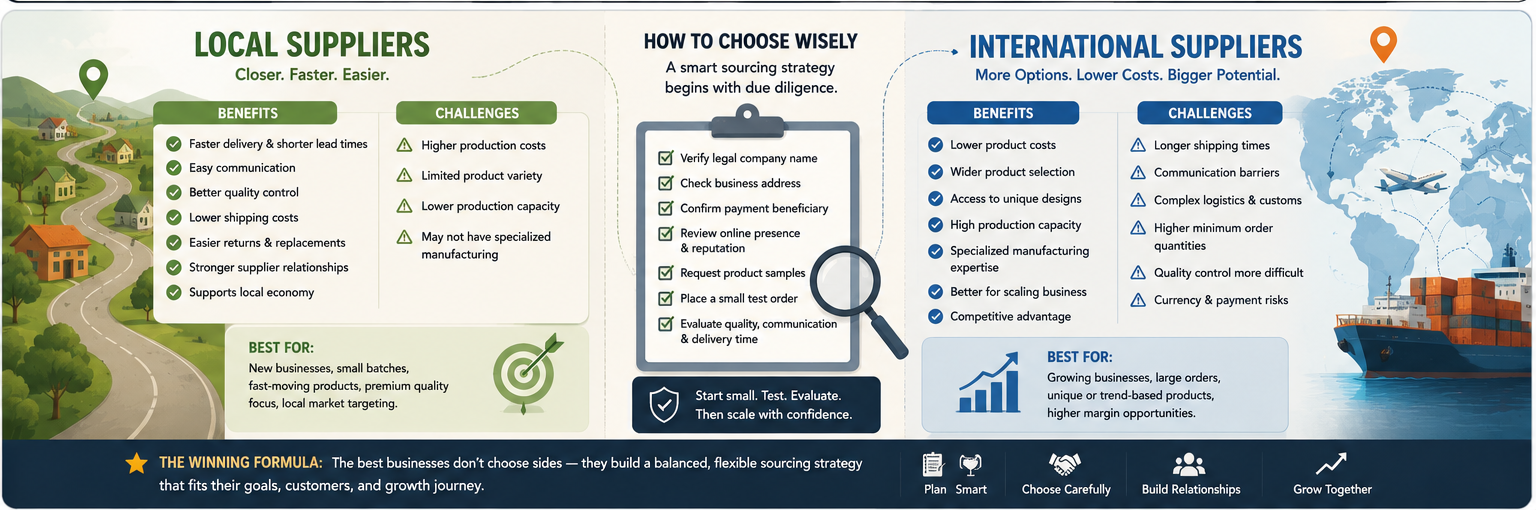
The discussion highlights several reasons why many merchants prefer local suppliers whenever possible.
Faster Shipping
One of the biggest advantages is shorter delivery times.
Since products travel shorter distances, businesses can replenish inventory more quickly and deliver customer orders faster.
Shorter shipping times improve customer satisfaction while reducing the risk of inventory shortages.
Easier Communication
Working within the same country often means fewer communication barriers.
Businesses typically share:
- Language
- Time zone
- Business culture
- Legal standards
This makes problem-solving much easier.
Questions can often be answered more quickly, and misunderstandings become less common.
Better Quality Control
Local suppliers make product inspections easier.
Businesses can often:
- Visit production facilities
- Inspect samples
- Review manufacturing processes
- Build stronger supplier relationships
These opportunities improve quality assurance and reduce uncertainty.
Simplified Returns and Replacements
If products arrive damaged or defective, local suppliers usually make replacement processes faster and less expensive.
Shipping products back internationally can be costly and time-consuming.
Local sourcing reduces these complications.
Supporting the Local Economy
Many businesses value supporting domestic manufacturers and regional businesses.
Buying locally may contribute to:
- Job creation
- Economic growth
- Community development
Some customers also appreciate businesses that prioritize local partnerships.
Challenges of Local Sourcing
Despite its advantages, local sourcing is not always the most practical solution.
Higher Costs
Labor and production costs are often higher in developed markets.
This typically results in higher wholesale prices.
Businesses may find it more difficult to compete on price alone.
Limited Product Selection
Some specialized products simply are not manufactured locally.
Entrepreneurs may struggle to find suppliers offering unique designs, innovative products, or specialized manufacturing capabilities.
Smaller Manufacturing Capacity
Certain local suppliers may have lower production capacity than large international manufacturers.
Rapidly growing businesses may eventually require suppliers capable of handling larger order volumes.
Understanding International Sourcing
International sourcing involves purchasing products from manufacturers or suppliers located in other countries.
Global sourcing has become increasingly popular because businesses can access products from virtually anywhere in the world.
Advances in logistics and digital communication have made international trade more accessible than ever before.
Advantages of International Suppliers
Many businesses choose international sourcing because of several important benefits.
Lower Manufacturing Costs
One of the strongest advantages is lower production expenses.
Many international manufacturers benefit from:
- Lower labor costs
- Large-scale production
- Established manufacturing infrastructure
These efficiencies often result in lower wholesale prices.
Lower purchasing costs can improve profit margins or allow businesses to offer more competitive retail pricing.
Greater Product Variety
International markets often provide access to a much broader range of products.
Businesses may discover:
- Unique designs
- Specialized materials
- Innovative technologies
- Emerging product trends
This wider selection helps brands differentiate themselves from competitors.
Higher Production Capacity
Large international manufacturers often possess substantial production capabilities.
Businesses planning rapid growth may benefit from suppliers capable of producing larger order volumes consistently.
Greater Manufacturing Expertise
Some regions specialize in particular industries.
For example:
- Electronics
- Furniture
- Textiles
- Home décor
- Consumer goods
Working with manufacturers that specialize in specific product categories may improve both quality and production efficiency.
Challenges of International Sourcing
The discussion also highlights several risks associated with international sourcing.
Longer Shipping Times
Products traveling across international borders generally require more time to reach customers or warehouses.
Long shipping times increase inventory planning complexity.
Businesses must forecast demand more accurately to avoid stock shortages.
Communication Barriers
International sourcing sometimes introduces:
- Language differences
- Cultural differences
- Time-zone challenges
These factors can slow communication and occasionally create misunderstandings.
More Complex Logistics
International shipping involves additional considerations, including:
- Customs procedures
- Import documentation
- Shipping regulations
- Taxes and duties
Managing these requirements requires careful planning.
Quality Verification Challenges
Inspecting overseas manufacturing facilities may not always be practical.
Businesses often rely on:
- Product samples
- Independent inspections
- Third-party verification
Without careful quality-control procedures, product consistency may become more difficult to maintain.
Regional Sourcing as a Middle Ground
An interesting point raised in the discussion is regional sourcing.
For example, businesses serving European customers may choose suppliers located within Europe rather than sourcing products from distant international markets.
Regional sourcing offers several benefits:
- Faster delivery
- Lower shipping costs
- Simplified customs procedures
- Better customer satisfaction
This balanced approach combines many advantages of both local and international sourcing.
Why Business Stage Matters
One of the most practical insights from the discussion is that sourcing decisions often depend on business maturity.
There is no single strategy suitable for every stage of growth.
Starting Small
New businesses frequently benefit from local suppliers because they offer:
- Lower operational risk
- Easier communication
- Faster issue resolution
- Better quality oversight
These advantages help entrepreneurs learn the sourcing process before managing more complex international relationships.
Scaling Operations
As businesses grow, priorities often shift.
Higher order volumes may justify exploring international suppliers to improve margins or expand product offerings.
Growth changes sourcing priorities.
The best supplier today may not be the best supplier five years later.
The Importance of Supplier Verification
Regardless of supplier location, proper verification is essential.
The discussion recommends confirming important supplier information before placing significant orders.
Businesses should verify:
- Legal company name
- Physical address
- Business registration
- Payment information
- Public business presence
These checks reduce the risk of fraud and improve confidence in supplier legitimacy.
Why Test Orders Are Important
Another valuable recommendation is placing a small test order before committing to larger purchases.
Test orders allow businesses to evaluate:
- Product quality
- Packaging
- Shipping reliability
- Communication
- Delivery timelines
This relatively small investment can prevent much larger problems later.
Building Long-Term Supplier Relationships
Successful sourcing depends on more than finding low prices.
Long-term supplier relationships often produce significant advantages, including:
- Better communication
- Consistent quality
- Improved pricing
- Priority production
- Greater flexibility
Strong relationships benefit both suppliers and retailers.
Balancing Cost and Quality
One recurring theme throughout the discussion is balancing cost with quality.
Lower prices are attractive.
However, poor quality products may lead to:
- Higher return rates
- Negative reviews
- Customer dissatisfaction
- Brand damage
The lowest-cost supplier is not always the most profitable choice.
Businesses should evaluate total value rather than focusing solely on purchase price.
Customer Expectations Continue to Evolve
Modern consumers increasingly expect:
- Fast shipping
- Reliable quality
- Transparent communication
- Consistent availability
These expectations directly influence sourcing decisions.
Businesses must choose suppliers capable of supporting the customer experience they want to deliver.
Risk Management in Product Sourcing
Every sourcing strategy involves risk.
Local sourcing may involve higher costs.
International sourcing may involve greater logistical complexity.
Businesses should identify risks early and develop contingency plans.
Working with multiple suppliers rather than relying on a single source can also improve supply-chain resilience.
Flexibility Creates Long-Term Success
Many successful businesses avoid depending entirely on either local or international sourcing.
Instead, they build flexible sourcing strategies.
For example, a company may:
- Use local suppliers for fast-moving products.
- Source specialty items internationally.
- Maintain backup suppliers.
- Diversify manufacturing locations.
Flexibility reduces operational risk while improving resilience during supply-chain disruptions.
The Bigger Lesson Behind the Discussion
Although the conversation focuses on local versus international sourcing, the deeper message is that supplier selection should be based on careful evaluation rather than assumptions.
Businesses should consider:
- Product quality
- Total costs
- Shipping performance
- Communication
- Reliability
- Growth potential
No supplier is perfect.
The goal is finding partners that align with the company’s long-term business objectives.
Conclusion
The discussion illustrates that choosing between local and international suppliers is not a simple decision with one correct answer. Local suppliers offer important advantages such as faster shipping, easier communication, stronger quality control, and closer business relationships. International suppliers often provide lower manufacturing costs, broader product selection, and greater production capacity, making them attractive for businesses seeking higher margins or expanded product ranges.
Rather than following a fixed sourcing strategy, businesses should evaluate suppliers based on their current stage of growth, operational needs, customer expectations, and long-term goals. Careful supplier verification, small test orders, and ongoing relationship building remain essential regardless of supplier location.
Ultimately, successful sourcing depends less on geography and more on choosing reliable partners who consistently deliver quality products, dependable service, and the flexibility needed to support sustainable business growth.