Understanding the Claims, Risks, and What Every Beginner Should Know
Starting an ecommerce business can feel overwhelming, especially for beginners who have little or no experience with online selling. Building an online store involves selecting products, designing a professional website, understanding marketing strategies, setting up payment methods, managing inventory, and attracting customers. Because of these challenges, many new entrepreneurs are naturally drawn to offers that promise to simplify the process.
One such offer discussed in the conversation is Adrian Morrison’s “free store build” promotion. The offer claims to help entrepreneurs launch an online store, often alongside training, resources, or additional business tools. For someone starting from scratch, this sounds like an attractive opportunity. After all, if an experienced ecommerce educator is willing to build a professional store for free, it appears to remove one of the biggest obstacles to starting an online business.
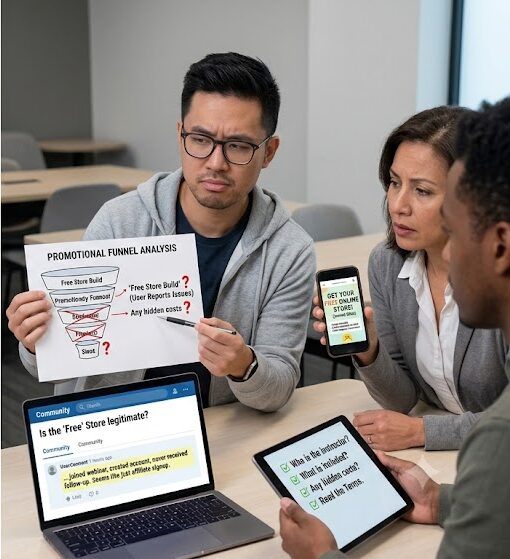
However, the discussion quickly raises questions about whether the offer works as advertised. The original poster specifically asks whether the promotion is legitimate and hopes for confirmation before investing time or money. A response from another participant shares a negative personal experience, claiming they completed all required steps but never received the promised store build or follow-up communication.
Importantly, no official confirmation or rejection is provided in the discussion. As a result, the conversation remains unresolved. Rather than proving that the offer is either legitimate or fraudulent, the discussion highlights the importance of carefully evaluating promotional offers before making financial commitments or sharing personal information.
Why Free Offers Attract New Entrepreneurs
Free offers are extremely common in online business education.
Many entrepreneurs searching for opportunities are attracted by offers such as:
- Free online stores
- Free business coaching
- Free product research
- Free ecommerce training
- Free website design
- Free marketing tools
These promotions appeal to beginners because they reduce the perceived cost of getting started.
Launching an online business normally requires investments of both time and money. When someone offers to remove one of those barriers, curiosity naturally increases.
However, free offers should always be evaluated carefully.
Understanding Marketing Funnels
Many online business promotions follow a marketing funnel.
A marketing funnel is a process designed to introduce potential customers to a business before offering additional products or services.
A typical funnel may include:
- Free webinar
- Free guide
- Free consultation
- Free template
- Free course
- Free trial
The goal is often to build trust before offering premium products or services.
There is nothing inherently wrong with this approach. Many legitimate businesses use it successfully.
The important question is whether the advertised promises are actually delivered.
Why Verification Matters
The original question specifically asks for verification before proceeding.
This reflects good decision-making.
Whenever evaluating business opportunities, entrepreneurs should verify:
- Who is making the offer
- What is actually included
- Any conditions attached
- Customer experiences
- Refund policies
- Terms of service
Careful research helps reduce unnecessary risk.
Examining the Reported Experience
The discussion includes one participant describing their personal experience.
According to their account, they:
- Attended the webinar.
- Followed the instructions.
- Created a new online store.
- Submitted proof as requested.
- Waited for further communication.
They claim they never received the promised follow-up or store-building assistance.
The individual concludes that the promotion may primarily encourage signups rather than providing the advertised service.
However, it is important to recognize that this represents one person’s reported experience.
Without independent verification, it cannot establish whether every participant receives the same outcome.
Why Individual Experiences Can Differ
Customer experiences often vary significantly.
Different participants may experience different results because of:
- Timing
- Eligibility requirements
- Geographic restrictions
- Technical issues
- Communication errors
- Changes to promotional terms
One positive or negative review alone rarely provides a complete picture.
Businesses should always evaluate multiple sources of information before reaching conclusions.
Understanding Affiliate Marketing
The discussion also mentions affiliate links.
Affiliate marketing is a common business practice in which individuals earn commissions for referring customers to products or services.
Under this model:
- A customer clicks a referral link.
- The customer makes a purchase or signs up.
- The referring individual receives a commission.
Affiliate marketing itself is a legitimate business model used by many companies.
Problems arise only if promotional claims are misleading or promised benefits are not delivered.
Why Webinar-Based Promotions Are Common
Webinars remain one of the most popular educational marketing methods.
They allow presenters to:
- Teach business concepts
- Demonstrate expertise
- Build trust
- Introduce products or services
Many webinar attendees receive genuine educational value.
Others may decide to purchase additional training afterward.
Again, the key issue is whether promotional claims accurately reflect what participants receive.
Managing Expectations
Many beginners assume that “free” means completely free.
In reality, promotional offers often include conditions.
Examples might include:
- Creating an account
- Purchasing a subscription
- Meeting eligibility requirements
- Completing specific steps
- Paying platform fees
Reading all terms carefully helps avoid misunderstandings.
Why Beginners Should Be Careful
New entrepreneurs are often enthusiastic.
Unfortunately, enthusiasm sometimes leads people to overlook warning signs.
Before committing to any business opportunity, beginners should ask:
- Is the offer clearly explained?
- Are all costs disclosed?
- Are customer reviews available?
- Can promises be verified?
- Is customer support responsive?
Taking time to investigate reduces risk.
The Importance of Independent Research
One discussion thread rarely provides enough evidence to determine whether a business opportunity is trustworthy.
Instead, entrepreneurs should gather information from multiple sources.
Useful research may include:
- Independent reviews
- Public business information
- Customer testimonials
- Community discussions
- Company history
Looking at several perspectives provides a more balanced understanding.
Understanding Business Models
Sometimes disappointment occurs because expectations differ from reality.
For example, a “store build” may involve:
- A basic template
- Standard product listings
- Limited customization
while participants expect:
- Fully branded websites
- Product research
- Marketing setup
- Ongoing coaching
Clarifying exactly what is included helps prevent disappointment.
Why Transparency Builds Trust
Successful businesses usually communicate clearly.
Customers should understand:
- What is included
- What is excluded
- Expected timelines
- Any additional costs
- Support availability
Transparent communication strengthens customer confidence.
Recognizing Red Flags
Although no definitive conclusion can be drawn from the discussion, entrepreneurs should remain aware of common warning signs when evaluating promotional offers.
Potential concerns may include:
- Unrealistic income promises
- Guaranteed success claims
- Pressure to act immediately
- Hidden fees
- Limited contact information
- Poor customer communication
The presence of one concern does not automatically indicate dishonesty, but multiple warning signs deserve careful attention.
Why Customer Support Matters
Reliable customer support often reflects the professionalism of a business.
Good support includes:
- Timely responses
- Clear communication
- Problem resolution
- Honest expectations
If communication becomes difficult before becoming a customer, it may become even more challenging afterward.
Building an Online Store Independently
One lesson from the discussion is that entrepreneurs should avoid depending entirely on promotional offers.
Learning how online stores operate provides valuable long-term benefits.
Business owners who understand:
- Product management
- Website customization
- Order processing
- Customer service
- Marketing
are generally better prepared to grow sustainable businesses.
Education remains valuable regardless of whether promotional offers succeed.
Evaluating Educational Programs
Before purchasing any ecommerce training, entrepreneurs should consider:
- Instructor experience
- Course content
- Student reviews
- Community reputation
- Ongoing support
- Realistic expectations
No course can guarantee business success.
Effective education provides knowledge, but execution remains the responsibility of the entrepreneur.
The Value of Patience
Launching an ecommerce business takes time.
Many beginners search for shortcuts.
While helpful guidance can accelerate learning, sustainable businesses still require:
- Research
- Product testing
- Marketing
- Customer service
- Continuous improvement
Free offers may reduce some startup work, but they cannot replace consistent effort.
Learning to Evaluate Opportunities
The discussion provides a valuable lesson beyond the specific promotion itself.
Every business opportunity should be evaluated objectively.
Entrepreneurs should ask:
- Does the offer make sense?
- Can claims be verified?
- Are expectations realistic?
- What risks are involved?
Critical thinking protects both time and money.
The Bigger Message Behind the Discussion
Although the conversation focuses on one promotional offer, the broader issue concerns trust in online business education.
The internet contains thousands of courses, webinars, mentorship programs, and business opportunities.
Some provide genuine value.
Others may not meet expectations.
The responsibility ultimately falls on entrepreneurs to conduct careful research before making commitments.
Conclusion
The discussion explores concerns about Adrian Morrison’s “free store build” offer but does not reach a definitive conclusion regarding its legitimacy. One participant reports completing all requested steps without receiving the promised assistance, while the original poster seeks independent verification before moving forward. No official confirmation or resolution appears in the conversation, leaving the question open.
Rather than proving whether the promotion is trustworthy or not, the discussion highlights the importance of carefully evaluating any online business opportunity. Entrepreneurs should verify promotional claims, read all terms and conditions, research multiple customer experiences, understand any associated costs, and maintain realistic expectations before participating.
Ultimately, building a successful ecommerce business depends less on finding a “free” shortcut and more on developing practical knowledge, making informed decisions, and consistently applying sound business principles. Promotional offers can sometimes provide valuable assistance, but they should always be approached with careful research, critical thinking, and a clear understanding of what is actually being offered.