Inventory management is one of the most critical aspects of running a retail business. Whether a company sells products online, operates physical stores, or manages multiple sales channels, maintaining accurate inventory records directly affects profitability, customer satisfaction, and operational efficiency.
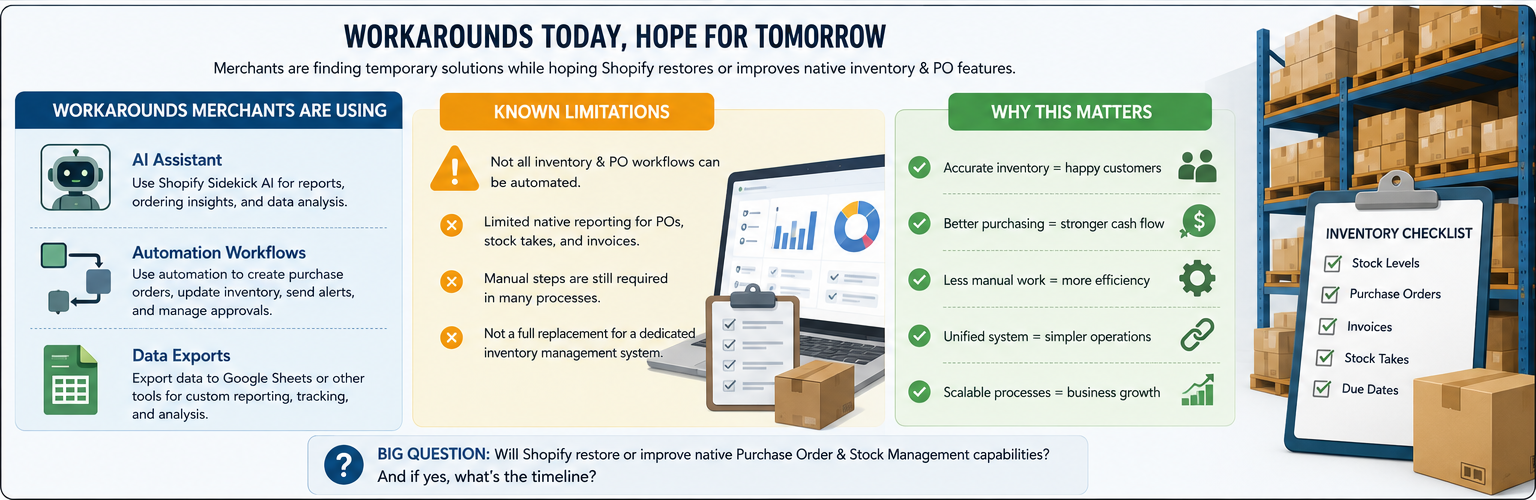
The discussion above centers on growing concerns from merchants regarding changes to Shopify’s inventory management capabilities. Specifically, users are expressing frustration over the removal or replacement of Stocky and the resulting loss of several inventory and purchase-order features that many businesses considered essential for daily operations.
For many merchants, the issue is not simply about losing a particular tool. Instead, the debate highlights broader concerns about how inventory management should function within an ecommerce and point-of-sale ecosystem, what features should be included as standard functionality, and whether merchants should be required to pay additional costs to replace capabilities they previously relied upon.
Although no final resolution has been announced, the discussion reveals important insights into the challenges merchants face when managing inventory and why inventory systems play such a central role in business success.
Why Inventory Management Matters
Inventory is often one of the largest assets a retail business owns.
Every product sitting in a warehouse, stockroom, or retail location represents money that has already been spent. If inventory is not managed properly, businesses may face:
- Stock shortages
- Overstocking
- Cash flow problems
- Lost sales
- Fulfillment delays
- Customer dissatisfaction
Because of these risks, inventory management systems are designed to help businesses maintain visibility into stock levels and purchasing decisions.
For many merchants, inventory management is not a secondary function. It is a core operational requirement.
The Role of Purchase Orders in Retail Operations
One of the most discussed concerns involves purchase-order functionality.
Purchase orders help businesses plan and track inventory replenishment.
A purchase order typically records:
- Products being ordered
- Quantities
- Supplier information
- Expected delivery dates
- Pricing details
- Payment status
Without organized purchase-order management, businesses may struggle to maintain consistent stock levels.
For growing retailers, purchase orders become increasingly important because inventory decisions affect both revenue and cash flow.
Why Merchants Value Purchase-Order Exports
One feature frequently mentioned in the discussion is purchase-order export capability.
Businesses often need to export inventory information for:
- Accounting purposes
- Supplier communication
- Financial analysis
- Inventory forecasting
- Internal reporting
Export functions provide flexibility and allow teams to analyze data outside the platform.
When such features disappear, merchants may need to create manual workarounds that consume valuable time.
The Importance of Stock Takes
Another concern raised involves stock-taking functionality.
Stock takes are physical inventory counts used to verify that actual inventory matches recorded inventory.
Even with modern inventory systems, discrepancies can occur because of:
- Human error
- Theft
- Damaged products
- Receiving mistakes
- Fulfillment issues
Regular stock takes help businesses maintain inventory accuracy.
For merchants managing large product catalogs, stock-counting processes are essential for operational control.
Why Invoice Tracking Matters
The discussion also highlights concerns regarding invoice tracking.
Businesses frequently need visibility into whether supplier invoices are:
- Paid
- Unpaid
- Overdue
- Pending approval
Invoice tracking helps maintain strong supplier relationships and supports accurate financial management.
Without this visibility, businesses may need separate processes to track purchasing obligations.
Understanding the Importance of Due Dates
Purchase-order due dates may seem like a small feature, but they often play a major role in inventory planning.
Due dates help merchants:
- Monitor incoming inventory
- Anticipate stock shortages
- Coordinate promotions
- Plan purchasing cycles
- Communicate with suppliers
Without clear due-date tracking, inventory planning becomes more difficult.
For businesses with multiple suppliers and hundreds or thousands of products, this challenge grows significantly.
Why Merchants View These Features as Core Functionality
A recurring theme throughout the discussion is the belief that inventory and purchasing functions should be considered core platform capabilities.
Many participants argue that these features are not advanced enterprise requirements.
Instead, they view them as fundamental tools necessary for running a retail business effectively.
From their perspective, inventory management should include:
- Purchase-order creation
- Supplier tracking
- Stock counting
- Reporting
- Receiving workflows
When these functions are absent, merchants feel that essential operational needs are not being fully addressed.
The Cost Concern
One of the strongest points raised in the conversation is cost.
Several participants note that replacement solutions often require additional monthly subscriptions.
This creates frustration because merchants believe they are being asked to pay extra for functionality they previously had access to.
The concern is not necessarily about the availability of alternatives.
Instead, the concern focuses on:
- Additional expenses
- Fragmented workflows
- Increased complexity
- Dependence on multiple systems
For smaller businesses, these costs can accumulate quickly.
The Challenge of Software Fragmentation
As businesses adopt multiple operational systems, complexity increases.
Instead of using a single integrated environment, merchants may need separate solutions for:
- Inventory management
- Purchasing
- Reporting
- Forecasting
- Supplier management
This fragmentation can create operational inefficiencies.
Businesses often prefer centralized systems because they reduce training requirements and simplify workflows.
Why Retailers Want Operational Simplicity
Many merchants choose unified commerce platforms because they want fewer systems to manage.
Ideally, a retailer can:
- Manage inventory
- Process orders
- Track customers
- Operate physical stores
- Analyze performance
all from a single environment.
When inventory functionality becomes fragmented, businesses may feel that operational simplicity is being lost.
The Perspective of Multi-Channel Retailers
The discussion includes feedback from merchants operating both online and physical retail channels.
These businesses face unique inventory challenges.
They must coordinate stock across:
- Ecommerce stores
- Retail locations
- Warehouses
- Supplier networks
Inventory accuracy becomes even more important because mistakes affect multiple sales channels simultaneously.
For these merchants, strong inventory management tools are often viewed as non-negotiable.
Why Businesses Compare Platforms
Some participants mention previous experiences with other retail systems.
This comparison reflects an important reality.
Merchants evaluate platforms not only based on ecommerce features but also on operational capabilities.
When choosing a commerce platform, businesses often consider:
- Inventory management
- Reporting
- Purchasing workflows
- Scalability
- Ease of use
Changes in any of these areas can influence long-term satisfaction.
The Impact on Growing Businesses
Inventory challenges become more noticeable as businesses grow.
A small store with ten products may manage inventory manually.
A business with:
- Hundreds of products
- Multiple suppliers
- Several locations
requires more sophisticated processes.
As complexity increases, inventory systems become increasingly important.
Why Reporting Is Critical
Inventory decisions depend heavily on reporting.
Businesses need visibility into:
- Best-selling products
- Slow-moving inventory
- Stock turnover
- Supplier performance
- Reorder timing
Without accurate reporting, purchasing decisions become more difficult.
This is why reporting functionality frequently appears in inventory-related discussions.
Forecasting and Inventory Planning
Modern retailers increasingly rely on forecasting to guide purchasing decisions.
Forecasting helps answer questions such as:
- How much inventory should be ordered?
- When should products be reordered?
- Which products are seasonal?
- Which products are growing in demand?
Inventory planning reduces both stockouts and excess inventory.
Many merchants view forecasting support as a natural extension of inventory management.
The Relationship Between Inventory and Cash Flow
Inventory decisions directly affect cash flow.
Excess inventory ties up capital.
Insufficient inventory leads to lost sales.
Strong inventory management helps businesses find the right balance.
This explains why merchants react strongly when inventory tools change.
The consequences extend beyond operations and into financial performance.
Why Operational Changes Create Frustration
Businesses often build processes around existing systems.
Over time, teams develop workflows based on familiar tools.
When those tools change, businesses may face:
- Retraining requirements
- Workflow redesign
- Additional expenses
- Productivity losses
Even small changes can create significant disruption.
This is particularly true for inventory management because it affects daily operations.
The Search for Alternatives
The discussion references several alternative inventory solutions.
This illustrates how merchants adapt when native functionality changes.
However, adopting alternatives often requires evaluating:
- Costs
- Features
- Integration complexity
- Learning curves
- Long-term scalability
The search for alternatives can become a project in itself.
The Desire for Native Solutions
A major theme throughout the conversation is the desire for native inventory functionality.
Merchants generally prefer built-in solutions because they offer:
- Simpler workflows
- Reduced costs
- Better integration
- Easier maintenance
The debate is not necessarily about whether alternatives exist.
The debate centers on whether inventory management should require those alternatives at all.
Balancing Innovation and Stability
Technology platforms constantly evolve.
New features are introduced.
Older systems are updated or replaced.
However, merchants often prioritize stability because operational processes depend on consistency.
Businesses need confidence that essential workflows will remain reliable over time.
Balancing innovation with stability remains a challenge for any commerce platform.
The Bigger Issue Behind the Discussion
Although the conversation focuses on inventory management features, the broader issue is merchant expectations.
Retailers increasingly expect commerce platforms to provide complete operational ecosystems.
They want solutions that support:
- Sales
- Inventory
- Purchasing
- Reporting
- Fulfillment
When any area feels incomplete, frustration naturally follows.
Conclusion
The discussion highlights the important role inventory management plays in modern retail operations. Merchants are expressing concerns that changes to inventory and purchasing workflows have removed capabilities they relied on for daily business management. Features such as purchase-order exports, stock counts, invoice tracking, and due-date management are viewed by many retailers as essential rather than optional.
While alternative solutions exist, many merchants object to the additional costs and complexity associated with replacing functionality they previously considered part of their standard operating environment. The conversation remains unresolved, with no confirmed timeline for future improvements.
Ultimately, the debate reflects a larger question facing modern commerce platforms: how much inventory management functionality should be included as a core offering, and how can platforms balance innovation, simplicity, and operational reliability for businesses of all sizes?