For many online retailers, growth does not come only from finding more customers. It can also come from finding the right business partners. When two compatible retailers work together, they can introduce their products to new audiences, create bundled offers, recommend each other’s products, and build stronger customer relationships.
This is especially valuable in focused niches such as maternity, baby products, parenting essentials, nursery items, and family lifestyle goods. Customers shopping for one product in these categories often need several related products. A parent purchasing maternity wear may also be interested in nursing products, baby clothing, nursery accessories, feeding items, or gifts for newborns. This makes cross-selling and promotional partnerships particularly useful for businesses serving similar audiences.
The discussion above focuses on a retailer selling maternity and baby products who wants to connect with other merchants using Shopify Collective. The goal is to find compatible businesses that may be open to cross-selling products, sharing promotional opportunities, or building mutually beneficial partnerships.
The challenge is that Shopify does not provide a public merchant directory for Collective users. This is likely connected to privacy concerns, since many merchants may not want their business information, product sourcing relationships, or commercial activity displayed publicly. While this protects merchants, it also makes partnership discovery more difficult.
As a result, retailers need to use networking, research, outreach, and community participation to find suitable partners.
Why Retailer Partnerships Matter
Retailer partnerships can create growth opportunities without requiring businesses to spend heavily on advertising.
When two compatible brands collaborate, they can share audiences that already have related interests. For example, a maternity clothing retailer may partner with a baby accessories brand. Both businesses serve parents or expecting parents, but they may not directly compete.
This type of partnership can benefit both sides.
Possible benefits include:
- Reaching new customers
- Increasing average order value
- Improving product discovery
- Creating bundled offers
- Building brand credibility
- Reducing dependence on paid advertising
For smaller businesses, partnerships can be especially valuable because they create opportunities that may otherwise require large marketing budgets.
Understanding Cross-Selling
Cross-selling means offering customers related products that complement what they are already purchasing.
For example, a customer buying maternity clothing may also be interested in:
- Nursing bras
- Baby blankets
- Pregnancy pillows
- Newborn clothing
- Nursery décor
- Baby care products
Cross-selling works best when the recommended products feel useful and relevant.
The goal is not simply to add more items to a customer’s cart. The goal is to make shopping easier by helping customers discover products they may already need.
Why the Maternity and Baby Niche Is Well Suited for Partnerships
The maternity and baby market includes many product categories that naturally connect with each other.
Customers often move through several stages:
- Pregnancy
- Preparing for birth
- Newborn care
- Infant development
- Toddler needs
Because customer needs change over time, businesses in this market can support each other by offering complementary products.
A retailer selling maternity products may connect with businesses selling baby clothing, feeding accessories, nursery items, postpartum products, or family gifts.
This creates a strong opportunity for cross-selling partnerships.
The Challenge of Finding Compatible Retailers
The main issue raised in the discussion is that there is no public directory showing which merchants use Shopify Collective.
Without a directory, retailers cannot simply search for businesses by category, location, or product type.
This creates several challenges:
- Limited visibility into potential partners
- Difficulty identifying niche-relevant retailers
- More time spent researching brands
- Uncertainty about whether a business is open to collaboration
However, the lack of a directory does not mean partnerships are impossible. It simply means merchants must take a more active approach.
Using Community Networking
One of the most practical ways to find other retailers is through online communities.
Communities bring together business owners who are already interested in ecommerce, product sourcing, retail growth, and partnerships.
Within these groups, merchants can ask questions, share experiences, and introduce their businesses.
The most useful communities are often those focused on:
- Ecommerce
- Parenting businesses
- Women-owned brands
- Baby product retailers
- Small business owners
- Online retail partnerships
These spaces can help merchants discover businesses with similar audiences.
Why Facebook Groups Can Be Useful
Facebook groups remain popular among small business owners.
Many groups focus on ecommerce, parenting businesses, women entrepreneurs, handmade products, and retail partnerships.
These groups can be useful because they often allow members to introduce their businesses and discuss collaboration opportunities.
However, merchants should approach these groups carefully.
Not every member will be a suitable partner. Some may be competitors, service providers, or businesses outside the target niche.
The goal should be to identify brands that serve similar customers but offer different products.
The Value of Professional Networking Platforms
Professional networking platforms can also help retailers find potential partners.
Business owners often use these platforms to share:
- Product launches
- Industry news
- Brand stories
- Partnership opportunities
- Retail insights
Searching relevant keywords and hashtags can help identify businesses operating in related product categories.
For example, merchants may search for terms connected to:
- Baby brands
- Parenting products
- Maternity retail
- Children’s products
- Family lifestyle brands
This approach can uncover potential partners that may not be visible through ecommerce communities alone.
Using Social Media for Brand Discovery
Social media platforms are valuable research tools.
Many small brands use social media to promote products, share customer stories, and connect with audiences.
Retailers can search for relevant hashtags, browse related accounts, and review the types of products brands sell.
This helps determine whether a potential partner is a good fit.
For example, a maternity retailer may look for brands selling:
- Baby essentials
- Nursing products
- Pregnancy wellness items
- Nursery accessories
- Newborn gifts
The best partnerships usually involve brands that share a customer base without selling identical products.
Why Direct Outreach Still Works
Direct outreach remains one of the most effective ways to create business partnerships.
A retailer does not need to wait for another business to discover them.
They can identify compatible brands and send a short, professional message explaining the opportunity.
A good outreach message should include:
- A brief introduction
- Information about the business
- Why the partnership could be beneficial
- A simple collaboration idea
- A friendly invitation to connect
The message should be specific and relevant.
Generic messages often receive fewer responses.
Building a Strong Partnership Pitch
When approaching another retailer, it helps to explain why the partnership makes sense.
For example, a maternity clothing brand might explain that its customers frequently ask for newborn accessories or nursing products.
This shows the potential partner that there is genuine customer overlap.
A strong partnership pitch focuses on mutual value.
Instead of saying, “Please promote my products,” a better approach is to say, “Our customers may benefit from each other’s products, and we could explore a way to introduce both brands to relevant audiences.”
Using Product Discovery Features
The discussion mentions using product discovery features inside Shopify Collective.
These features can help merchants identify products that may fit their store’s niche.
While they may not function as a full retailer directory, they can still reveal brands and products that align with a merchant’s audience.
For a maternity and baby retailer, searching related product categories may uncover:
- Baby clothing
- Parenting accessories
- Nursery products
- Pregnancy wellness items
- Gift products
Once relevant products are identified, merchants can research the brands behind them and explore whether partnership opportunities exist.
Evaluating Potential Partners
Not every retailer is a good partnership match.
Before reaching out, merchants should evaluate several factors.
Audience Alignment
The partner should serve a similar customer group.
For example, a baby accessories brand may be a better fit for a maternity retailer than an unrelated fashion retailer.
Product Compatibility
The products should complement each other.
A good partnership adds value without creating direct competition.
Brand Reputation
Retailers should review the potential partner’s:
- Product quality
- Customer reviews
- Brand presentation
- Shipping policies
- Customer service approach
A partnership with a poorly managed brand can affect customer trust.
Business Values
Partnerships work better when brands share similar values.
For example, businesses may prioritize:
- Sustainable products
- Premium quality
- Affordable pricing
- Family-friendly branding
- Ethical sourcing
Shared values create more natural collaborations.
Avoiding Unrelated Promotional Responses
The discussion includes examples of unrelated promotional messages from businesses outside the maternity and baby niche.
This is common in online communities.
Whenever someone posts about partnerships, service providers may respond with offers that do not match the request.
Merchants should stay focused on their original goal.
If the objective is to find maternity and baby retailers, unrelated offers should not distract from the search.
Clear communication helps reduce irrelevant responses.
For example, a retailer can state that they are looking specifically for non-competing brands serving expecting parents, new parents, or families with young children.
Why Geographic Location Can Matter
Location may influence partnership decisions.
A retailer selling primarily within the United Kingdom may prefer partners that also ship quickly within the same region.
Similarly, businesses serving the United States, Europe, Australia, or other markets may want partners with compatible delivery capabilities.
Geographic alignment can improve:
- Shipping speed
- Customer satisfaction
- Promotional relevance
- Return management
However, location should not be the only factor. A strong product and audience fit may still create value across regions.
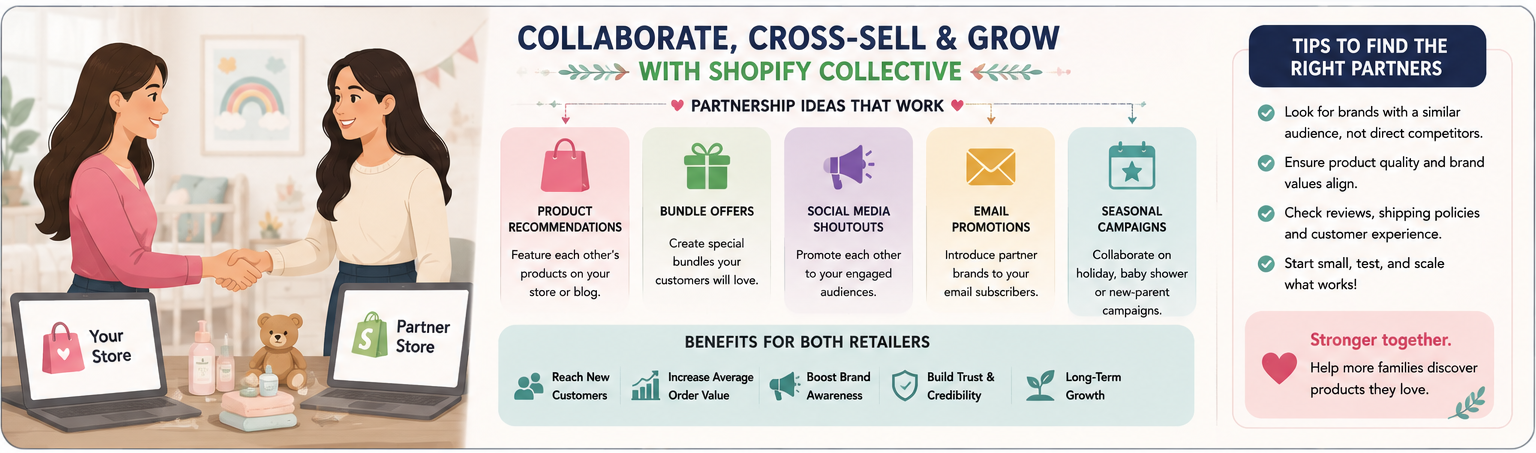
Creating Different Types of Partnerships
Retailer partnerships do not need to follow one format.
Businesses can collaborate in several ways.
Product Recommendations
One retailer can recommend another brand’s products to customers through product pages, email campaigns, or social media.
Bundled Offers
Two businesses can create a bundle that combines complementary products.
For example, maternity clothing and baby accessories could be sold together as a new-parent package.
Social Media Collaborations
Brands can share each other’s content, run joint giveaways, or create collaborative campaigns.
Email Promotions
Retailers can introduce partner brands to their email subscribers.
This can be effective when both businesses have engaged audiences.
Seasonal Campaigns
Partnerships can focus on specific periods such as baby showers, pregnancy announcements, holidays, or new-parent gift seasons.
Why Trust Is Essential
Partnerships involve sharing customer attention and brand reputation.
For this reason, trust is essential.
Before promoting another retailer, businesses should ensure that the partner provides:
- Reliable products
- Good customer service
- Clear shipping policies
- Consistent communication
A poor customer experience can harm both brands.
Tracking Partnership Results
Retailers should measure the results of partnerships.
Useful metrics may include:
- Referral traffic
- Sales generated
- Customer engagement
- Average order value
- Repeat purchases
Tracking results helps businesses identify which partnerships are worth continuing.
Building Long-Term Retailer Networks
The most successful partnerships often develop over time.
Instead of searching for one-time promotional opportunities, retailers can build a network of trusted brands.
This network may include businesses selling:
- Baby products
- Maternity products
- Parenting tools
- Family gifts
- Nursery products
- Wellness products
Over time, these relationships can create stronger growth opportunities.
Conclusion
The discussion highlights a common challenge for retailers seeking partnerships through Shopify Collective: finding compatible merchants without access to a public directory. While privacy protections make direct discovery more difficult, retailers can still find suitable partners through community networking, social media research, product discovery features, professional outreach, and niche-focused groups.
For maternity and baby product retailers, partnership opportunities are particularly strong because customers often need multiple related products throughout pregnancy and early parenthood. The best partnerships involve brands with similar audiences, complementary products, reliable reputations, and shared business values.
Although the discussion remains open, the key lesson is clear: retailer partnerships require proactive networking. Merchants should not wait for the perfect partner to appear. By researching compatible brands, joining relevant communities, and sending thoughtful outreach messages, retailers can build valuable connections that support cross-selling, customer discovery, and long-term business growth.