Split shipments can be useful for some ecommerce businesses, but they can also create unnecessary costs and confusion when customers purchase products that are available at different times. This becomes particularly challenging when an order contains a combination of in-stock products and items that are available for preorder or backorder.
The discussion behind this article focuses on a merchant who wants greater control over how mixed-inventory orders are fulfilled. The main request is simple: merchants should be able to decide whether an order is shipped in multiple parts or held until all products are available so everything can be delivered together.
The current behavior can automatically divide an order into separate shipments when some products are ready and others are not. While this may appear convenient from a fulfillment perspective, it does not always match the merchant’s preferred business model or the customer’s expectations.
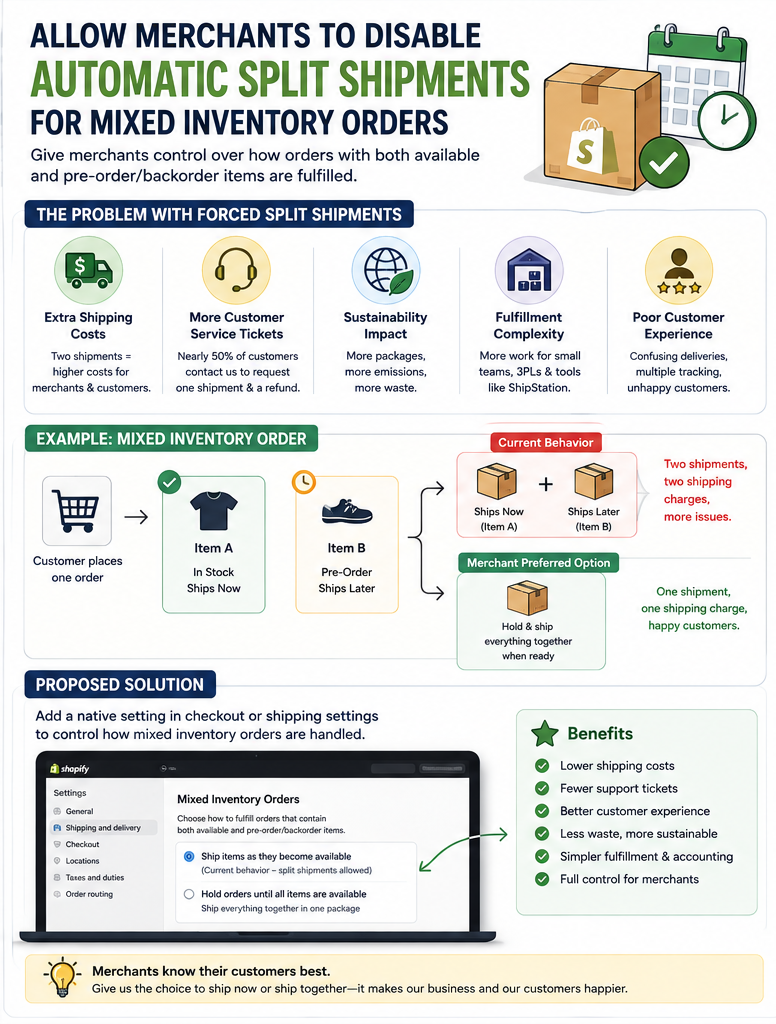
For smaller businesses, the consequences can include additional shipping charges, increased customer-service requests, more complicated fulfillment operations, and unnecessary packaging. The merchant in the discussion reports that nearly half of customers who are charged for split shipping contact the business asking for the order to be shipped together and for one of the shipping charges to be refunded.
This makes the issue more than a technical inconvenience. It can directly affect profitability, customer satisfaction, and operational efficiency.
What Is a Split Shipment?
A split shipment happens when products from a single customer order are shipped separately instead of arriving together.
Imagine a customer purchases two products:
- Product A is currently in stock.
- Product B is available for preorder and will arrive in two weeks.
Under a split-shipment model, Product A may be shipped immediately while Product B is shipped later.
The customer therefore receives two deliveries from the same order.
This can be useful when customers specifically want immediate access to available products. However, not every customer wants multiple deliveries.
Some customers would rather wait a short period and receive everything in one package.
That difference in preference is at the center of the discussion.
Why Mixed Inventory Creates Problems
Mixed inventory orders are common in ecommerce.
A store may have:
- Regular products
- Preorder products
- Backordered products
- Products temporarily out of stock
- Products stored at different locations
- Products fulfilled by different warehouses
When customers combine these products in one cart, the fulfillment system has to determine how the order should be handled.
From a purely logistical perspective, shipping available products immediately may seem logical.
But the business side is more complicated.
The retailer must consider:
- Shipping costs
- Customer expectations
- Packaging costs
- Warehouse workload
- Environmental impact
- Customer support
- Refund requests
- Delivery tracking
- Inventory availability
Therefore, automatically splitting every mixed order may not always be the best solution.
The Merchant’s Main Concern
The merchant requesting this change is not necessarily opposed to split shipments.
The concern is the lack of control.
The merchant wants the ability to choose the fulfillment strategy based on the needs of the business.
For example, the merchant could be given two options:
Option 1: Ship available items immediately
Products that are ready are shipped while unavailable products are sent later.
Option 2: Hold the order
The complete order remains on hold until all required products are available, after which everything is shipped together.
Both approaches are reasonable.
The important point is that merchants should be able to select the approach that works for their operation.
Why Customers May Prefer One Shipment
Customers do not always think about fulfillment in the same way as merchants.
When a customer sees one order confirmation, they may naturally expect one delivery.
If the order suddenly arrives in two or three packages, the customer may wonder:
- Was something missing?
- Did the order ship incorrectly?
- Was I charged twice?
- When will the remaining products arrive?
- Why did I receive multiple tracking numbers?
Even when everything is functioning correctly, the experience can create confusion.
This becomes particularly problematic when customers pay separate shipping charges for each shipment.
The Shipping Cost Problem
Shipping is one of the biggest concerns with split orders.
Suppose a customer pays $8 for shipping on an order containing three products.
If the products are shipped together, the merchant may pay approximately one shipping cost.
But if the order is split into two shipments, the actual fulfillment cost can increase significantly.
The merchant may have to pay:
- Shipping charge for the first package
- Shipping charge for the second package
- Additional packaging
- Additional handling
- Additional fulfillment labor
If the customer was originally charged only one shipping fee, the merchant may have to absorb the additional cost.
If the customer is charged for both shipments, they may complain about paying more than expected.
Neither situation is ideal.
Refund Requests Can Increase
The discussion highlights a particularly important operational problem: customers contacting support after being charged for split shipping.
According to the merchant, nearly 50% of customers charged for split shipping contact the business requesting a single shipment and a refund of one shipping fee.
That creates additional work.
A customer-service employee may need to:
- Review the order.
- Explain why it was split.
- Check whether the remaining item has shipped.
- Process a refund.
- Update the customer.
- Monitor the remaining shipment.
If this happens repeatedly, a seemingly small fulfillment decision becomes a significant customer-service burden.
The Hidden Cost of Customer Support
Customer support costs are not limited to employee salaries.
Every unnecessary ticket consumes time.
If employees spend several hours every week answering questions about split shipments, that time could otherwise be used for:
- Sales support
- Product questions
- Returns
- Marketing
- Customer retention
- Order management
For small businesses with limited staff, this matters considerably.
A fulfillment policy that creates fewer customer questions can therefore provide meaningful operational savings.
Sustainability Concerns
There is also an environmental argument against unnecessary split shipments.
Shipping one order in two packages can require:
- Additional packaging
- Additional transportation
- Additional labels
- Additional warehouse handling
If the customer is willing to wait and everything could have been delivered together, multiple shipments may create unnecessary environmental impact.
This does not mean split shipments are always environmentally harmful or should never be used.
Urgent deliveries can be valuable.
However, giving merchants the ability to consolidate shipments when appropriate would allow businesses to make more sustainable decisions.
The Importance of 3PL Operations
Third-party logistics providers can make the situation even more complicated.
A merchant may not personally handle every shipment.
Instead, orders may move through:
- Warehouses
- Fulfillment centers
- Logistics providers
- Shipping carriers
- Inventory locations
If an order is automatically divided, the fulfillment provider may process multiple shipments without the merchant actively choosing that outcome.
This can increase fulfillment costs and make inventory management more complicated.
Businesses using external fulfillment services therefore have a strong reason to control when orders are released.
Why Small Merchants Are Especially Affected
Large ecommerce businesses may have sophisticated logistics operations and negotiated shipping rates.
Small merchants often do not.
A small business may operate with:
- Limited inventory
- Small order volumes
- Narrow margins
- One or two employees
- A single warehouse
- External fulfillment providers
An additional shipment can therefore have a proportionally larger financial impact.
For a large company, an extra shipping charge may be insignificant.
For a small retailer, repeated additional shipping expenses can reduce margins substantially.
A Better Merchant-Controlled Approach
The proposed solution is relatively straightforward.
At the checkout or shipping-configuration level, merchants could have a setting such as:
Shipment Preference
- Ship items as they become available
- Hold orders until all items are available
This would give businesses control without requiring complicated customization.
The first option would preserve the current split-shipment experience.
The second would allow merchants who prioritize consolidated delivery to hold the order.
This would also make the store’s fulfillment policy more intentional.
Communication Is Still Important
Even if a merchant chooses to hold orders, customers should be informed.
For example, a store selling preorder products could clearly explain:
Orders containing preorder items will ship once all products are available.
Clear communication can prevent misunderstandings.
Customers who need an available item immediately can then make an informed decision.
This is better than allowing the customer to discover the fulfillment policy after completing checkout.
The Role of Shipping Profiles and Locations
Another important factor is how products are configured.
Shipping behavior can be influenced by:
- Product locations
- Inventory availability
- Shipping profiles
- Fulfillment locations
- Delivery settings
A merchant experiencing unexpected split shipments should therefore examine the structure of the store before assuming the issue is entirely caused by one setting.
Sometimes the behavior may be connected to how inventory is distributed across locations.
For example, if Product A is stored in Location 1 and Product B is stored in Location 2, the system may determine that separate fulfillment is appropriate.
This is a different problem from a simple preorder situation.
Possible Workarounds
Because the requested native setting has not been confirmed as available, merchants have considered several workarounds.
One approach is to use draft orders for special cases.
Another is to use fulfillment rules that prevent orders from being released until specific conditions are met.
Some merchants may also use automation to place orders on hold when a preorder or backorder item is present.
Preorder-specific solutions can provide another approach by controlling how mixed carts are handled.
However, these workarounds can introduce additional complexity.
Why a Native Setting Would Be Better
A native setting could simplify the entire process.
Instead of merchants creating custom workflows, they could simply define their preferred fulfillment policy.
This would reduce dependence on complicated workarounds.
It could also make the behavior easier for store owners to understand.
A merchant should not need extensive technical knowledge to answer a basic operational question:
“Do I want this order shipped now in multiple packages, or do I want to wait and ship everything together?”
That is fundamentally a business decision.
Not Every Merchant Needs the Same Strategy
There is no universally correct fulfillment model.
Consider a store selling electronics.
A customer ordering an available phone and a preorder accessory might prefer to receive the phone immediately.
In this situation, split shipping could be beneficial.
Now consider a store selling furniture or coordinated home products.
A customer may prefer everything to arrive together.
Similarly, a gift business may want a complete order delivered at once.
The right choice depends on the product category, customer expectations, margins, and fulfillment model.
This is why flexibility is more valuable than a single universal rule.
A Potential Hybrid Strategy
A useful future approach could also allow merchants to define rules.
For example:
- Hold orders containing preorder products.
- Ship immediately if the delayed item will take more than 30 days.
- Consolidate orders when the additional shipping cost exceeds a certain amount.
- Split shipments only when the customer explicitly chooses expedited delivery.
Such flexibility could support more sophisticated businesses while still keeping the basic setting simple.
What Merchants Should Evaluate Today
Until a universal native solution is available, merchants dealing with this issue should first analyze their order data.
They should determine:
- How many orders contain mixed inventory?
- How often are orders split?
- What does each additional shipment cost?
- How many customers contact support?
- How many refunds are issued?
- How long do customers wait for backordered items?
- Which products cause the most problems?
This information can reveal whether split shipping is genuinely helping the business.
Measure the Financial Impact
Suppose a store processes 1,000 orders per month.
If 100 orders are split and each additional shipment costs the merchant $6, the extra fulfillment expense could reach $600 per month.
Then add:
- Refunds
- Packaging
- Customer support
- Staff time
The true cost could be considerably higher.
This type of calculation helps merchants determine whether changing the fulfillment strategy is worthwhile.
The Customer Experience Should Be the Final Test
Ultimately, fulfillment decisions should be judged by customer experience as well as operational efficiency.
A merchant should ask:
Does the customer understand what will happen after placing the order?
If the answer is no, the business should improve communication.
Customers are generally more accepting of delays when they are clearly informed beforehand.
Surprise shipping behavior creates much more frustration.
Conclusion
The discussion around automatic split shipments highlights an important ecommerce principle: merchants need control over operational decisions that directly affect their costs and customer experience.
Automatically splitting orders containing available and preorder or backordered products can be useful in certain situations. Customers may appreciate receiving available items immediately, and merchants may benefit from faster delivery.
However, this approach is not ideal for every business.
For some retailers, shipping products separately creates unnecessary costs, additional packaging, greater fulfillment complexity, and more customer-service requests. The problem becomes especially significant when customers expect one shipment but receive several or are charged multiple shipping fees.
The merchant in this discussion reports that nearly half of customers who are charged for split shipping contact the business asking for the order to be consolidated and for one shipping fee to be refunded. That demonstrates how a fulfillment decision can quickly become a customer-service and profitability issue.
A simple merchant-controlled setting would address much of the problem. Businesses could choose between shipping available products immediately or holding mixed orders until everything is ready.
Additional controls could eventually allow merchants to create more advanced rules based on product type, inventory status, shipping cost, or customer preference.
Until such functionality is universally available, merchants can review their shipping configuration, inventory locations, fulfillment rules, and preorder processes to identify where unwanted splits originate. They can also measure the financial and customer-service impact of split shipments before choosing a workaround.
The larger lesson is that there is no single fulfillment strategy that works for every ecommerce business.
Some stores should ship immediately.
Others should consolidate.
The best solution is to give merchants the ability to decide based on their products, customers, margins, and operational capabilities. A flexible fulfillment system can reduce unnecessary shipping costs, minimize support requests, improve customer expectations, and give small businesses greater control over how their orders reach customers.