Building an online store around a single established brand can be a very different strategy from running a traditional dropshipping store with products from many suppliers. Instead of constantly searching for new products, the retailer focuses on one brand, develops a stronger identity around that partnership, and attempts to create a long-term relationship with the supplier.
The discussion behind this topic involves a new store owner who wants to sell products exclusively from The Organic Company, a Danish brand known for organic textile products. The merchant is interested in creating a professional arrangement with the brand and wants to understand how products, inventory, orders, and fulfillment can be managed efficiently.
The central question is not simply how to add another company’s products to an online store. It is about choosing the right commercial relationship and then creating a reliable technical workflow between the brand and retailer.
Several possibilities exist, including becoming an authorized reseller, purchasing wholesale inventory, holding products locally, or allowing the brand to fulfill customer orders directly. The best option depends on what the brand is willing to support and where both businesses are located.
Why Selling One Brand Can Be Attractive
Many new ecommerce businesses begin by offering products from numerous suppliers. This can provide variety, but it also creates operational complexity.
Working with one established brand can simplify the business in several ways.
The retailer can focus on:
- One product catalog
- One brand identity
- One supplier relationship
- One set of product standards
- One target customer group
- More consistent marketing
Instead of constantly searching for new products, the merchant can concentrate on building demand for the selected brand.
This can also make the store appear more specialized and trustworthy.
The Importance of Becoming an Authorized Retailer
Before selling another company’s products, the retailer should establish what type of relationship they actually have with the brand.
Several structures are possible.
The retailer might become:
- An authorized reseller
- A wholesale partner
- A retail partner
- A dropshipping partner
- A distributor
- Another type of approved sales partner
These arrangements are not necessarily interchangeable.
For example, a wholesale relationship may require the retailer to purchase inventory in advance. A dropshipping relationship may allow the retailer to sell products without physically holding stock.
Therefore, the first step should always be a direct discussion with the brand.
The retailer should ask what sales model the company supports.
Questions to Ask the Brand
Before setting up the store, the merchant should clarify several practical questions.
For example:
- Are online retailers officially allowed to sell the brand?
- Is there a minimum opening order?
- Does the brand support dropshipping?
- Can the retailer purchase wholesale?
- Who owns the customer relationship?
- Who handles returns?
- Who pays for shipping?
- Where are orders fulfilled from?
- How frequently is inventory updated?
- Is product information available electronically?
- Can images and descriptions be reused?
- Can orders be transmitted automatically?
- Which currencies and countries are supported?
These questions can prevent major problems later.
Wholesale Versus Dropshipping
One of the biggest decisions is whether the retailer should hold inventory.
Wholesale Model
Under a traditional wholesale arrangement, the retailer purchases products from the brand and stores them.
The retailer is responsible for:
- Inventory investment
- Storage
- Packing
- Shipping
- Stock management
- Unsold inventory
The advantage is greater control.
The disadvantage is higher financial risk.
If the retailer purchases 500 products and only sells 100, significant capital may remain tied up in unsold stock.
Dropshipping Model
With dropshipping, the retailer generally does not purchase large quantities in advance.
Instead, the customer places an order through the retailer’s website.
The brand or supplier then fulfills the order.
This can reduce:
- Inventory risk
- Storage requirements
- Upfront investment
- Packing workload
However, it also creates dependence on the supplier’s fulfillment process.
Why Supplier Fulfillment Quality Matters
If the brand fulfills orders directly, the retailer must understand how the process works.
Important questions include:
- How quickly are orders shipped?
- Which carrier is used?
- Is tracking provided?
- What happens when an item is out of stock?
- How are damaged products handled?
- Who handles returns?
- What happens if a customer receives the wrong product?
The retailer’s reputation can be affected by the supplier’s performance.
Even if the retailer does not physically ship the product, customers still consider the retailer responsible for their shopping experience.
The Importance of Product Data Synchronization
Once the commercial relationship is established, the next challenge is technical.
A retailer needs accurate product information.
This can include:
- Product names
- Descriptions
- Prices
- Images
- Sizes
- Colors
- Variants
- Product codes
- Inventory levels
Manually entering hundreds of products is possible, but it can become inefficient.
It also creates the possibility of mistakes.
For example, if the supplier changes a product price but the retailer does not update the store, the retailer may accidentally sell the product at an outdated price.
Inventory Synchronization
Inventory synchronization is especially important for a dropshipping arrangement.
Imagine that the supplier has only three units remaining.
The retailer’s website still shows ten available.
Five customers purchase the product.
The retailer may then discover that the supplier cannot fulfill all five orders.
This can lead to:
- Order cancellations
- Refunds
- Customer complaints
- Negative reviews
Therefore, the retailer needs a reliable method of keeping inventory information updated.
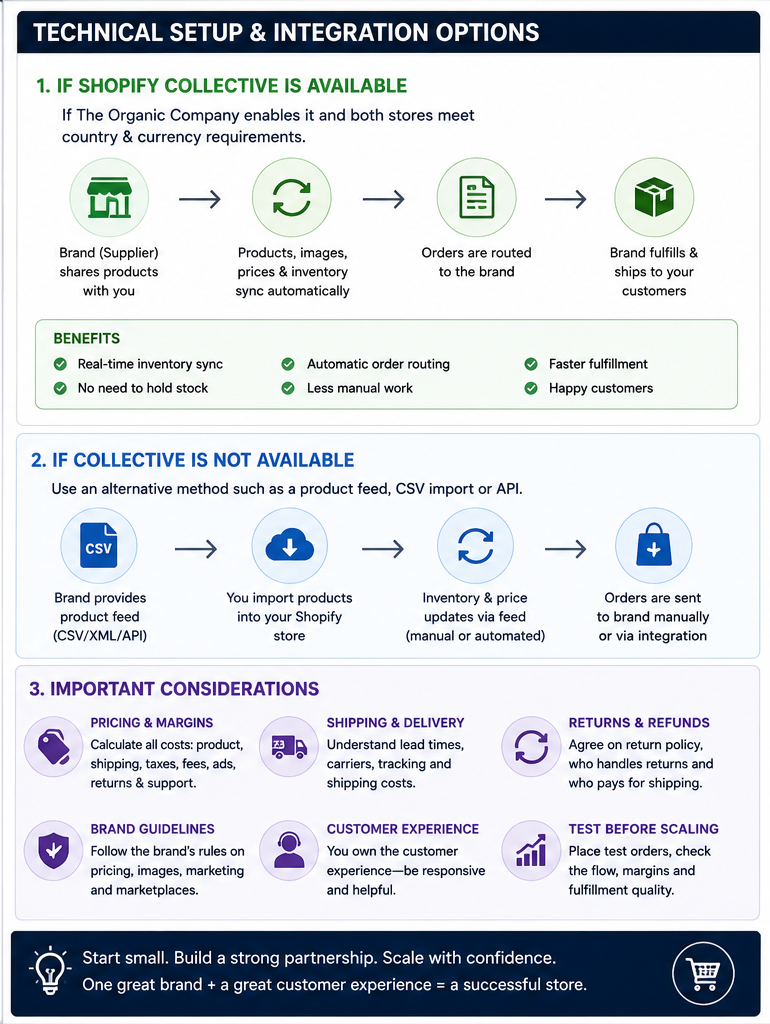
Why Shopify Collective May Be Relevant
The discussion focuses on Shopify Collective as a possible solution because the supplier appears to operate on Shopify.
The concept is relatively straightforward.
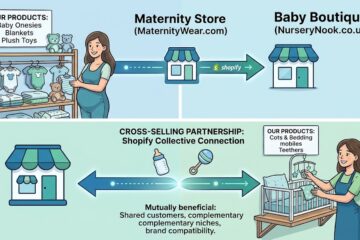
A supplier can share products with another Shopify store.
The retailer can then sell those products without necessarily purchasing and storing the inventory themselves.
Product information and inventory can be synchronized, while orders can be routed to the supplier for fulfillment.
This can significantly reduce manual work.
However, simply discovering that the supplier uses Shopify does not mean the connection will automatically work.
There are eligibility and configuration requirements that both businesses need to satisfy.
The Supplier Must Participate
One of the most important points is that the brand must actually participate in the system.
The retailer cannot simply connect to the supplier without the supplier’s involvement.
The brand would need to enable the appropriate supplier functionality and establish the retailer relationship.
This means the merchant should discuss the setup directly with The Organic Company rather than assuming that the technical connection is guaranteed.
Country and Currency Requirements
Another unresolved issue is geographic and currency compatibility.
The supplier is based in Denmark, while the retailer’s store may operate in another country.
The relevant system may have requirements concerning:
- Country
- Currency
- Store eligibility
- Supplier eligibility
- Payment arrangements
The fact that two businesses use the same ecommerce platform does not automatically mean they can connect through every available feature.
Therefore, the retailer should verify eligibility before building the entire business model around this option.
Why Currency Matters
Currency can become particularly important in international ecommerce.
Suppose the supplier operates primarily in Danish kroner while the retailer sells to customers using another currency.
The businesses need to understand:
- How wholesale prices are calculated
- Which currency is used for transactions
- How exchange rates affect margins
- Who absorbs currency fluctuations
- Whether taxes are included
- How international payments are handled
A technically successful connection may still be commercially unsuitable if margins are unclear.
Product Pricing Needs to Be Agreed
The retailer also needs a clear pricing structure.
For example, the supplier might provide a wholesale price of €30 while the retailer sells the product for €60.
But the retailer must also consider:
- Shipping
- Taxes
- Payment fees
- Advertising
- Returns
- Discounts
- Currency conversion
- Customer support
The difference between retail price and wholesale price is not the same as actual profit.
A proper margin calculation should be performed before launching the products.
Brand Control Is Another Consideration
Established brands often care about how their products are presented.
The retailer should determine whether the brand has guidelines regarding:
- Product photography
- Descriptions
- Pricing
- Logos
- Advertising
- Social media
- Promotions
- Marketplace selling
Some brands may want all authorized retailers to maintain a consistent presentation.
Following these rules can protect the relationship and create a more professional store.
Product Images and Descriptions
If the brand provides official images and descriptions, the retailer should ask for permission to use them.
This can save substantial time.
However, simply copying product descriptions may not always produce the strongest ecommerce experience.
The retailer may want to improve the presentation while keeping the brand’s approved information accurate.
For example, the store could provide:
- Clear product benefits
- Better organization
- Customer-focused descriptions
- Size information
- Care instructions
- Shipping details
This can make the shopping experience easier while preserving brand consistency.
Order Fulfillment Workflow
A successful arrangement needs a clear order flow.
Ideally, the process looks something like this:
Customer places order → Retailer receives order → Order is sent to supplier → Supplier prepares product → Supplier ships product → Tracking information is returned → Customer receives shipment
The fewer manual steps involved, the easier this becomes to scale.
Manual order forwarding may work for five orders per month.
It becomes much less practical at 100 orders per day.
Returns Need to Be Defined Early
Returns are often overlooked during partnership discussions.
The retailer should know exactly what happens when a customer wants to return something.
Questions include:
- Where does the customer send the product?
- Who pays return shipping?
- What is the return period?
- Who issues the refund?
- What happens with damaged goods?
- Are international returns accepted?
- Does the supplier inspect returned items?
A clear policy protects both the retailer and customer.
What If the Preferred Integration Does Not Work?
The discussion does not depend entirely on one technical solution.
If the preferred connection is unavailable, other approaches are possible.
For example, the brand could provide:
- Product feed
- CSV file
- Spreadsheet
- Inventory feed
- API access
- Manual order process
The retailer can then import product information and establish another method of sending orders.
Using a Product Feed
A product feed can contain information such as:
- Product code
- Product name
- Description
- Price
- Image URL
- Variant
- Inventory quantity
The retailer’s store can use this information to maintain the catalog.
The exact process depends on what the supplier provides.
Manual Processing Can Be Acceptable at First
Not every business needs complete automation from day one.
If the store receives only a few orders per week, manually forwarding orders may be perfectly reasonable.
The goal should be to avoid unnecessary complexity while the business is still small.
As order volume grows, automation can then be introduced.
Why a Single-Brand Store Needs a Strong Brand Story
Selling one established brand can create an advantage because the store can build its entire identity around that brand.
Instead of looking like a generic dropshipping store, the retailer can create a specialized shopping destination.
The website can focus on:
- Brand values
- Product quality
- Sustainability
- Materials
- Design philosophy
- Product use cases
- Customer education
This can make the store feel more authoritative.
The Retailer Still Needs to Add Value
Simply placing another company’s products on a website does not automatically create a successful business.
The retailer needs to provide value through:
- Better presentation
- Customer service
- Education
- Marketing
- Local market knowledge
- Faster communication
- Better shopping experience
The retailer’s role is more than simply displaying products.
Testing Before Scaling
The merchant should avoid investing heavily before confirming that the partnership actually works.
A small test can verify:
- Product synchronization
- Inventory updates
- Order processing
- Shipping
- Tracking
- Returns
- Customer communication
A single test order can reveal problems that may not be obvious during setup.
The Best Next Step
The most practical next step is to contact The Organic Company directly and confirm its preferred retailer arrangement.
The merchant should explain that they want to sell the brand’s products online and ask whether the company supports direct fulfillment or a retailer partnership.
If the brand supports the required Shopify-based connection, both parties can investigate whether their stores meet the relevant requirements.
If not, the merchant can request a product feed or another supported method.
Conclusion
The discussion illustrates that building a Shopify store around one established brand can be a strong ecommerce strategy, but the business needs both a solid commercial relationship and a dependable technical workflow.
The first priority should be obtaining permission to sell the brand’s products and determining whether the relationship will operate as wholesale, authorized retail, dropshipping, or another arrangement.
Once that is established, the retailer needs to solve the operational questions: product information, pricing, inventory, order transmission, fulfillment, shipping, returns, and customer support.
The fact that The Organic Company appears to use Shopify makes a Shopify-based connection an interesting possibility. It could potentially allow the supplier to share product information and inventory while fulfilling orders without requiring the retailer to hold physical stock.
However, this possibility is not automatic. The supplier must participate, both businesses must meet the relevant eligibility requirements, and country and currency compatibility must be confirmed.
If the preferred connection is unavailable, the business does not have to stop. A product feed, CSV, API-based connection, or another dropshipping arrangement can provide an alternative.
Ultimately, the best setup is the one that creates a reliable connection between customer order, product availability, supplier fulfillment, and delivery.
For a new retailer, the smartest approach is to start small, confirm the commercial relationship, test the complete order process, verify the economics, and only then invest heavily in marketing and expansion. This reduces operational risk while giving the retailer a strong foundation for building a specialized single-brand ecommerce business.