Running an online store that targets customers in the United States can be an attractive opportunity for entrepreneurs living outside the country. A non-US resident may want to establish a US-based business structure, open a US business bank account, work with suppliers, and operate an online store that primarily serves American customers.
However, setting up the business structure is only one part of the process. The more important question is whether the business can successfully pass identity, business, payment, and address verification when the owner does not physically live or operate in the United States.
This becomes particularly important when the business uses a US-registered limited liability company (LLC), a US bank account, a registered agent, and a US mailing address while the actual owner lives in another country and has no physical office, lease, or utility bills in the United States.
The central issue is therefore not simply whether a non-US resident can own a US company. In many circumstances, they can. The bigger challenge is making sure that every piece of business information is accurate, consistent, verifiable, and appropriate for the payment and commerce services being used.
Can a Non-US Resident Operate a US-Based Online Store?
A non-US resident can generally establish and own a US LLC, depending on the state and the nature of the business. Being a foreign resident does not automatically prevent someone from owning a US company.
For an online store, the business may have several US-based components:
- A legally registered US LLC
- An Employer Identification Number (EIN)
- A US business bank account
- A registered agent
- A business mailing address
- Supplier or fulfillment arrangements
- An online store targeting US customers
This structure can be legitimate even when the owner personally lives outside the United States.
However, having a US LLC does not automatically mean that the owner is considered a US resident or that every US financial service will treat the business in exactly the same way as a company owned by a US resident.
This distinction is extremely important.
A company may be legally incorporated in the United States while its owner, management, employees, and actual business operations remain outside the country. Payment providers and financial institutions may therefore ask additional questions about ownership, business activities, physical location, and tax status.
Why Verification Can Become Difficult
The biggest practical problem is usually verification.
When a business applies for payment processing or financial services, the company may be asked to prove several things:
- The business actually exists.
- The person controlling the business is genuine.
- The business information is accurate.
- The bank account belongs to the business.
- The business address can be appropriately verified.
- The ownership information matches official records.
- The nature of the business is legitimate.
- The business complies with applicable laws and tax obligations.
A non-US owner can encounter additional scrutiny because the business’s legal location and the owner’s residential location are different.
For example, imagine an entrepreneur living in Europe who owns a US LLC. The LLC has a US mailing address and a US bank account, but the entrepreneur has no US residence, utility bill, office lease, or employees in the country.
There is nothing inherently suspicious about this structure. Nevertheless, the company may be asked to provide additional information to establish what the US address represents and where the owner actually lives.
The important lesson is that a US mailing address should not be represented as a physical operating location if it is not one.
Accuracy is more important than trying to make the business appear more US-based than it actually is.
Documentation That Should Be Prepared
Before launching the store or applying for payment processing, a non-US business owner should organize all relevant documentation.
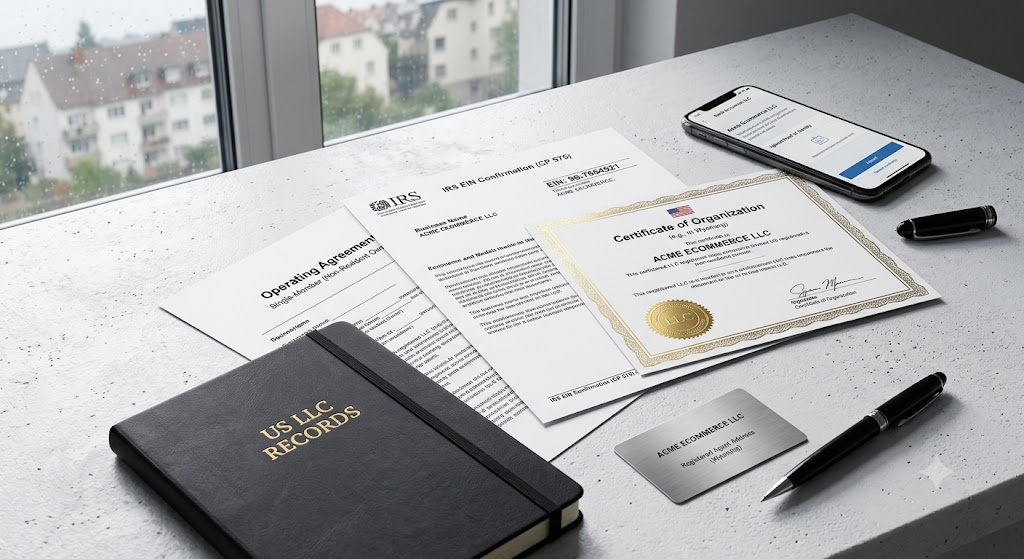
1. LLC Formation Documents
The company should maintain its official formation documents showing that the LLC was legally established.
These documents can help establish:
- Legal business name
- State of formation
- Company status
- Ownership or management information
- Date of formation
The business name should be used consistently wherever the company is referenced.
2. EIN Documentation
An EIN is the federal tax identification number associated with the business.
The EIN documentation should be kept safely and should match the legal company information.
If the legal name of the LLC is written one way on the formation documents and another way on banking or payment records, verification may become unnecessarily complicated.
Even small differences can create questions.
For example:
ABC Commerce LLC
and
ABC Commerce, LLC
may appear to be the same company to a human reviewer, but automated verification systems can sometimes treat differences in formatting or information as inconsistencies.
3. Operating Agreement
An operating agreement can provide additional evidence about the company’s ownership and management structure.
For a single-member LLC, it can help establish who owns and controls the business.
It is particularly useful when the owner is located outside the United States because the business structure may otherwise appear unusual to someone reviewing the application.
4. Business Address Information
The business should clearly distinguish between:
- Registered agent address
- Mailing address
- Business address
- Physical operating address
- Owner’s residential address
These addresses do not necessarily have to be the same.
A registered agent’s address is primarily used for receiving official legal correspondence. It should not automatically be presented as the physical location where the business operates.
Likewise, a mailing address should not be falsely described as an office.
The safest approach is to provide exactly what is requested and explain the structure honestly when clarification is required.
5. Business Bank Account Information
The company should maintain a business bank account that corresponds to the legal business entity.
The following information should be consistent:
- Business name
- Account ownership
- Company details
- Banking information
- Tax identification information
Payment providers may compare these details during verification.
A mismatch between the legal company name and the bank account information can result in delays or additional verification.
6. Supplier and Business Agreements
For a dropshipping or ecommerce business, supplier agreements, invoices, fulfillment arrangements, and other commercial documentation can help demonstrate that the company is operating a genuine business.
These documents may establish:
- What products the business sells
- Where products come from
- How orders are fulfilled
- Who the suppliers are
- How the business operates
This can become useful if a payment processor requests additional information about the company’s activities.
7. Licenses and Permits
Depending on the products being sold, business location, and applicable state or local requirements, certain licenses or permits may be necessary.
Not every online business requires the same licenses.
Therefore, the owner should determine whether the state and local jurisdictions relevant to the business require registration, sales tax permits, product-specific licenses, or other approvals.
Consistency Is More Important Than Having a Large Number of Documents
One of the most important lessons from the discussion is that verification problems are not always caused by missing documents.
Sometimes the problem is inconsistent information.
Consider a business where:
- The LLC uses one spelling of the company name.
- The bank uses another version.
- The tax records contain a different address.
- The online store shows another business address.
- The owner’s identification contains a different name format.
- The payment application uses yet another variation.
Individually, these differences may seem insignificant.
Together, they can create a verification problem.
Automated systems and compliance teams are designed to detect inconsistencies because financial accounts are subject to identity and business verification requirements.
Therefore, before submitting information, the owner should create a master record containing the company’s official information and use that information consistently.
What About the Lack of a US Office?
This is one of the most important concerns for a non-US resident.
A business does not necessarily need a traditional US office simply because it is incorporated in the United States. Many modern businesses operate remotely.
However, there is a major difference between:
“The company does not have a traditional physical office.”
and
“The company claims that a mailing address is its physical office when it is not.”
The first can be a legitimate business model.
The second can create compliance problems.
If a service asks for the company’s physical business location, the owner should provide the information that accurately describes the business.
If the business is operated remotely from outside the United States, that reality should not be hidden.
Payment Processing Is a Separate Consideration
Having a US LLC does not automatically guarantee approval for payment processing.
Payment providers have their own eligibility requirements, verification processes, risk controls, and documentation standards.
Therefore, business formation and payment processing should be treated as two related but separate issues.
The company may be legally established while still requiring additional verification before payment processing is approved.
For a US-focused ecommerce business, payment processing is especially important because customer payments, refunds, chargebacks, and payouts all depend on maintaining an active and compliant payment account.
A business should therefore avoid launching with the assumption that approval is guaranteed.
Instead, the owner should review the current eligibility and verification requirements before investing heavily in advertising, inventory, or customer acquisition.
Tax Compliance Should Not Be Ignored
Another major area of concern is taxation.
A non-US owner operating a US LLC may have tax filing or reporting responsibilities in the United States, the owner’s country of residence, or potentially both.
The exact requirements depend on factors such as:
- Business structure
- Ownership
- Type of income
- Where business activities occur
- State requirements
- Owner’s country of residence
- Applicable tax treaties
- Nature of the products and transactions
An ITIN or another tax-related identification number may be relevant in certain circumstances, but this should not be assumed for every business.
Tax obligations can be complicated for foreign-owned US companies, so professional tax advice is strongly recommended.
The important point is that establishing an LLC does not eliminate tax responsibilities.
What Should a Non-US Entrepreneur Do Before Applying?
A practical preparation process can significantly reduce verification problems.
Step 1: Establish the Legal Business
Complete the LLC formation process and maintain the official formation documents.
Step 2: Obtain the Appropriate Tax Identification
Ensure that the company has the appropriate federal identification and documentation.
Step 3: Organize Ownership Records
Keep the operating agreement and ownership information readily available.
Step 4: Establish Business Banking
Use an appropriate business bank account that matches the company’s legal information.
Step 5: Document the Business Model
Prepare supplier agreements, invoices, fulfillment information, website details, and product information.
Step 6: Review Addresses Carefully
Identify exactly which address is being used for:
- Registered agent purposes
- Mailing purposes
- Physical operations
- Owner residence
Do not interchange these categories simply to satisfy a form.
Step 7: Review All Information Before Submission
Compare the information across:
- LLC records
- Federal tax records
- Bank records
- Store records
- Payment applications
- Owner identification
- Business documentation
Step 8: Check Current Requirements
Requirements can change over time. The official requirements applicable to the US market should always be reviewed before submitting an application.
What Happens If Verification Fails?
A failed verification does not necessarily mean the business is illegal.
It may simply mean that the provider needs more information.
Possible reasons include:
- Address mismatch
- Name mismatch
- Incomplete ownership information
- Unclear business location
- Bank account mismatch
- Missing documentation
- Incorrect business classification
- Additional identity verification requirements
The appropriate response is to provide accurate supporting information rather than repeatedly submitting slightly different details.
Repeated inconsistencies can make the situation more difficult.
If an account is restricted or additional verification is requested, the business owner should carefully review the specific reason given and respond with relevant documentation.
The Bigger Lesson: Do Not Confuse a US Company With a US Resident
One of the biggest misunderstandings surrounding international ecommerce businesses is the idea that forming a US LLC automatically transforms a foreign entrepreneur into a US-based business owner for every purpose.
It does not.
There are several separate concepts:
The company is registered in the United States.
The owner lives outside the United States.
The company may have a US bank account.
The company may target US customers.
The actual business operations may occur outside the United States.
All of these facts can coexist.
The important requirement is that the business accurately represents each of them when completing legal, banking, tax, and payment documentation.
Final Takeaway
A non-US resident can potentially operate a US-focused ecommerce business through a US LLC, but successful operation depends on much more than simply obtaining a company registration and bank account.
The strongest approach is to build a consistent, transparent, and well-documented business structure.
The company should maintain its formation documents, federal tax records, ownership documentation, banking information, supplier records, address information, and applicable licenses. More importantly, all of these records should tell the same story.
A registered agent address should not be presented as a physical office if it is only a registered agent address. A foreign owner’s residential address should not be replaced with a US address simply to make an application look more acceptable. Business names should be entered consistently, and ownership information should accurately reflect who controls the company.
Payment processing should also be considered separately from company formation. Approval is not guaranteed simply because an LLC exists. Providers may conduct their own verification and may request additional evidence regarding the company, owner, business activities, and addresses.
Finally, tax compliance should be addressed from the beginning. Foreign-owned US businesses can have reporting and tax obligations that are easy to overlook, particularly when the owner lives in another country.
The discussion ultimately highlights a simple but important principle: the goal should not be to make a foreign-owned business appear to be a US-resident business. The goal should be to make the business structure accurate, legitimate, transparent, and properly documented.
When the LLC records, tax information, banking details, ownership information, addresses, store information, and payment records are aligned, the risk of unnecessary verification problems can be significantly reduced.
For anyone planning to establish this type of business, reviewing the current official requirements and obtaining professional legal or tax advice before launching is a much safer approach than relying on generic checklists or assumptions from other entrepreneurs.