How to Combine Self-Fulfilled Gift Baskets With Dropshipped Products
The traditional dropshipping model allows an online store to sell products without keeping physical inventory. When a customer places an order, the product is purchased from a supplier and shipped directly to the customer. This approach reduces inventory costs and makes it easier for businesses to offer a wide range of products.
However, not every ecommerce business fits perfectly into a pure dropshipping model. Some stores want to keep certain products in-house while sourcing other products from external suppliers. Gift basket businesses are a good example. A store may want to purchase and assemble gift baskets itself while also offering individual products that are shipped directly from suppliers.
This creates what is commonly called a hybrid fulfillment model.
A hybrid model combines self-fulfilled products with dropshipped products in the same online store. It can provide greater flexibility, but it also introduces additional inventory and fulfillment challenges.
The main concern is whether operating both models at the same time will become too complicated.
The answer is that it can work successfully, provided that products, inventory, and fulfillment responsibilities are clearly separated.
What Is a Hybrid Dropshipping Model?
A hybrid dropshipping model means that an ecommerce store uses more than one fulfillment method.
For example, imagine an online gift store selling:
- Handmade gift baskets
- Chocolates
- Candles
- Greeting cards
- Decorative items
- Personalized gifts
- Other products sourced from external suppliers
The business may keep the materials needed to create its own gift baskets in a warehouse or small storage area. When a customer orders a basket, the business assembles and ships it directly.
At the same time, the store may sell candles or other complementary products that it does not keep in stock. Those products can be shipped directly from suppliers.
This means one store can have two different fulfillment processes:
Self-fulfilled products: The store owns or maintains the inventory and ships the products itself.
Dropshipped products: The supplier maintains the inventory and ships the products directly to the customer.
The model becomes particularly useful when a business wants to maintain control over its unique products while expanding its catalog without purchasing large amounts of inventory.
Why Would a Store Use This Model?
There are several reasons why a hybrid approach can be attractive.
Better Control Over Unique Products
Gift baskets often require customization and assembly. A business may want complete control over how these products are prepared, packaged, and presented.
Keeping basket components in-house allows the business to:
- Assemble baskets according to customer preferences
- Add personalized messages
- Control packaging
- Maintain quality standards
- Inspect products before shipping
This level of control can be difficult when the entire product is outsourced.
Larger Product Catalog
Dropshipping can allow the business to offer products that it does not want to store.
For example, a gift store might sell 20 different types of gift baskets but also offer 100 complementary products from suppliers.
The business does not necessarily need to purchase and store all 100 additional products.
This makes it possible to expand the catalog without dramatically increasing inventory investment.
Reduced Inventory Investment
Holding physical inventory requires money, storage space, and inventory management.
With dropshipping, the supplier generally holds the product until an order is placed.
A hybrid model allows a business to invest inventory only where it provides the greatest value.
The company can maintain stock for products that require customization or assembly while using external fulfillment for standard products.
The Biggest Challenge: Inventory Management
The biggest operational challenge in a hybrid model is keeping inventory information accurate.
Gift baskets may contain multiple individual components.
For example, a basket might contain:
- One mug
- Two chocolates
- One candle
- One greeting card
- One decorative item
If the store sells ten baskets, it needs enough components to create those ten baskets.
This means inventory should not simply be treated as “ten gift baskets.”
The individual components should also be considered.
If the business has ten mugs but only five candles, it cannot realistically promise ten baskets if every basket requires one candle.
Therefore, the components used to assemble gift baskets should be treated as real inventory.
Why Component-Level Inventory Matters
Suppose a business has the following inventory:
- 15 mugs
- 20 candles
- 10 chocolate boxes
- 8 greeting cards
The business offers a gift basket that requires one of each item.
Although there are enough mugs, candles, and chocolates for several baskets, only eight complete baskets can be assembled because there are only eight greeting cards.
If the store’s system incorrectly shows 15 baskets available, customers may place orders that the business cannot fulfill.
This creates overselling.
Overselling can result in:
- Order cancellations
- Customer complaints
- Refunds
- Delayed shipments
- Negative reviews
- Additional customer support work
For a gift business, this can be particularly damaging because many gift orders are associated with birthdays, anniversaries, holidays, and other time-sensitive occasions.
Keeping Dropshipped Inventory Separate
Dropshipped products should be handled differently from products that the business physically controls.
The store generally does not have direct physical control over supplier inventory.
For that reason, it can use supplier inventory information where available or otherwise manage availability separately.
The key principle is that the business should know which products are:
Owned and fulfilled internally
and which products are:
Fulfilled by an external supplier
Mixing these two categories without a clear structure can create confusion.
For example, an employee might see an order containing a candle and assume it needs to be shipped from the company’s warehouse, even though the candle is actually a supplier-fulfilled product.
Clear product classification prevents this type of mistake.
Assigning Products to Specific Fulfillment Methods
One practical solution is to assign each product or SKU to a specific fulfillment method.
For example:
| Product | Fulfillment Method |
|---|---|
| Custom Gift Basket A | Self-fulfilled |
| Custom Gift Basket B | Self-fulfilled |
| Handmade Card | Self-fulfilled |
| Standard Candle | Supplier fulfilled |
| Decorative Vase | Supplier fulfilled |
| Gift Box | Self-fulfilled |
This makes responsibilities clear.
Employees can immediately identify which products require internal preparation and which products are handled externally.
The most important recommendation is to avoid ambiguity.
A product should not casually switch between self-fulfillment and dropshipping without a defined process.
Why SKU Structure Is Important
SKU management becomes especially important in a hybrid business.
Every product should have a clear and unique SKU.
For example:
- GB-001 — Gift Basket A
- GB-002 — Gift Basket B
- HB-001 — Handmade Card
- DS-001 — Supplier Candle
- DS-002 — Supplier Vase
The exact naming convention is not important as long as it is consistent.
A good SKU structure helps employees understand:
- What the product is
- Where it is fulfilled
- Whether it is physically stocked
- Which workflow should handle the order
This becomes increasingly important as the business grows.
A store with ten products might manage fulfillment manually.
A store with several hundred products needs a much more organized system.
Mixed Orders Create Another Challenge
One of the biggest complications with hybrid fulfillment occurs when a customer purchases both types of products in a single order.
For example, a customer might purchase:
- One gift basket from the store
- One candle fulfilled by a supplier
- One decorative item fulfilled by another supplier
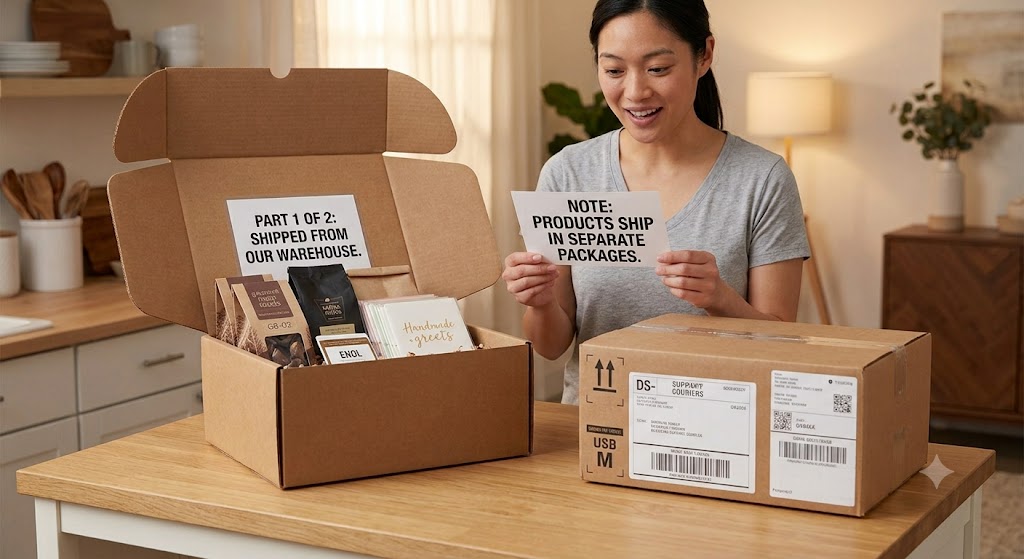
The customer may assume everything will arrive in one package.
However, the products may actually be shipped separately.
The gift basket may be dispatched by the store, while the other products are shipped by suppliers.
This is completely manageable, but customers should be informed clearly.
Communicating Separate Shipments
Customer expectations are extremely important.
If a customer receives one package and expects the remaining products to arrive together, they may assume something is missing.
A simple communication strategy can prevent this.
The store can explain that products from the same order may arrive in separate packages because different products are fulfilled from different locations.
The customer should ideally understand:
- Some products may ship immediately.
- Some products may take longer.
- Products may arrive in separate packages.
- Tracking information may be provided separately.
Clear communication reduces unnecessary customer support requests.
Different Delivery Timelines
Another issue is shipping speed.
A self-fulfilled gift basket might be shipped within one business day, while a supplier-fulfilled product could require several additional days.
If both products are purchased together, the customer may receive them at different times.
This becomes particularly important for gift-related purchases.
A customer buying a birthday gift may expect everything to arrive before a specific date.
Therefore, delivery estimates should be realistic.
The business should avoid promising a single delivery timeframe when different fulfillment methods have significantly different shipping schedules.
Separate Fulfillment Workflows
A hybrid model becomes easier to manage when the store has separate fulfillment workflows.
Orders can be identified according to their fulfillment requirements.
For example:
Internal fulfillment
Orders containing products that need to be assembled, packaged, or shipped from the business.
Supplier fulfillment
Orders containing products that are sent directly by external suppliers.
Mixed fulfillment
Orders containing both categories.
This classification helps staff understand what action needs to be taken.
A mixed order should not simply be treated as one ordinary order.
It may require coordination between internal fulfillment and supplier fulfillment.
Dedicated Locations and Internal Organization
Another useful approach is to separate inventory locations conceptually or physically.
The business can distinguish between:
- Internal inventory
- Supplier inventory
- Products awaiting assembly
- Finished gift baskets
- Packaging materials
This makes stock management easier.
For example, components may be stored in one area while completed baskets are kept in another.
The exact physical arrangement depends on the size of the business, but the principle remains the same: inventory should have a clear owner and purpose.
The Importance of Avoiding Dual Fulfillment
One of the strongest practical recommendations for a hybrid model is to avoid having the same SKU casually fulfilled through two different methods.
Suppose a store normally sells a candle through a supplier but also keeps five units of the same candle in its own warehouse.
This creates a question:
If a customer orders the candle, should the business ship its own stock or should the supplier ship it?
If there is no defined rule, fulfillment becomes unpredictable.
The business may accidentally:
- Ship the product twice
- Reduce the wrong inventory
- Send an order to the wrong location
- Create incorrect stock counts
- Cause fulfillment delays
A cleaner model is to assign each SKU a primary fulfillment method.
If the business wants to change that method, it should deliberately update the product’s fulfillment process rather than making ad-hoc decisions for individual orders.
Returns Can Also Become More Complicated
Returns are another consideration.
If a customer orders both self-fulfilled and supplier-fulfilled products, the return process may be different for each item.
The store should determine in advance:
- Where returns should be sent
- Who pays return shipping
- Whether supplier products can be returned
- How refunds are processed
- How damaged products are handled
- What happens when only part of an order is returned
These policies should be communicated clearly to customers.
A well-defined return policy becomes even more important when multiple fulfillment parties are involved.
Is a Hybrid Model Worth It?
For many ecommerce businesses, the answer can be yes.
A hybrid model can provide the best aspects of both approaches.
The business retains direct control over products that require customization, assembly, or special packaging while using external suppliers for products that are expensive or unnecessary to stock.
However, the model works best when the business treats fulfillment as an organized operational system rather than simply adding different shipping methods to the same catalog.
The goal is not to make every product work through every fulfillment method.
The goal is to clearly determine:
What does the business own?
What does the supplier own?
Who fulfills each SKU?
Where is inventory tracked?
What happens when an order contains both types of products?
Once these questions are answered, the model becomes much easier to manage.
A Practical Example
Consider a gift company that sells 50 gift baskets and 200 additional products.
The company keeps all gift basket components in its own inventory.
When an order for a gift basket arrives, employees assemble the basket, package it, and ship it.
The additional 200 products are supplied by external vendors.
Each SKU is assigned to either internal fulfillment or supplier fulfillment.
If a customer purchases only a gift basket, the company handles the entire order.
If the customer purchases only a supplier product, the supplier handles fulfillment.
If the customer purchases both, the order is divided into the appropriate fulfillment workflows.
The customer is informed that separate products may arrive in separate shipments.
This structure allows the business to maintain control without having to warehouse every product it sells.
Final Takeaway
A hybrid dropshipping model can be a practical and scalable approach for ecommerce businesses that want to combine self-fulfilled gift baskets with supplier-fulfilled products.
The model does introduce additional operational complexity, but that complexity can be controlled through proper organization.
The most important requirement is clear separation.
Gift basket components should be tracked as real inventory so the business knows how many complete baskets it can actually produce. Supplier-fulfilled products should be managed separately based on supplier availability and fulfillment arrangements.
Every SKU should have a clearly defined fulfillment method. Internal staff should be able to immediately identify whether a product needs to be picked and shipped from the business or handled by an external supplier.
Mixed orders should also be expected rather than treated as unusual. Customers should be informed that products from a single order may arrive in separate packages and on different timelines.
Most importantly, the business should avoid unclear situations where the same SKU can be fulfilled either internally or through a supplier without a defined process.
When inventory, SKUs, fulfillment responsibilities, shipping expectations, and returns are clearly organized, a hybrid model does not have to become unnecessarily complicated.
Instead, it can give an ecommerce business the flexibility to maintain control over its most important products while expanding its catalog without carrying large amounts of inventory.
In other words, the hybrid model is viable—not because it eliminates operational complexity, but because clear inventory and fulfillment rules make that complexity manageable.