Running a dropshipping store from the United Kingdom can be relatively simple when the business focuses only on UK customers. However, the situation becomes more complicated when a store owner wants to expand into international markets.
The main question is not simply whether international dropshipping is possible. It is whether the additional sales opportunities are worth the operational, tax, shipping, and fulfillment complexity that comes with selling to customers in different countries.
A recent Shopify Community discussion focused on this exact situation. The store owner was considering using an automated dropshipping system to manage orders and expand beyond the UK, but was concerned about tax obligations and the additional responsibilities that come with international sales.
The discussion provides a useful framework for understanding how a UK-based dropshipping business can approach international expansion.
Why Automation Matters in Dropshipping
Dropshipping already involves several moving parts. A customer places an order, the order needs to be forwarded to the supplier, the supplier prepares the product, shipping information needs to be returned to the store, and the customer needs to receive tracking information.
Doing these steps manually becomes increasingly difficult as order volume grows.
Automation can connect these stages into one workflow. When an order is received, the system can identify the relevant supplier and product, send the order details, process multiple orders together, and bring shipping information back into the store.
This becomes particularly useful when a business sells products from multiple suppliers.
Instead of manually copying customer information and product details from every order, the store owner can establish a more structured process.
Automation can also help with:
- Order synchronization
- Bulk order processing
- Product information updates
- Stock availability updates
- Price changes
- Fulfillment updates
- Tracking information
- Supplier coordination
- Customer order status updates
The purpose is not simply to save a few minutes per order. The larger benefit is reducing repetitive work and creating a fulfillment process that can handle increasing order volume.
Why International Dropshipping Is More Complicated
Selling only within the UK gives a business a relatively focused operating environment.
Once customers from other countries are added, several new questions appear.
For example:
- Where is the product being shipped from?
- Where is the customer located?
- Where is the supplier located?
- Does the destination country charge VAT or sales tax?
- Are import duties applicable?
- Who is responsible for collecting taxes?
- Are there special rules for low-value shipments?
- How will customers receive their orders?
- What happens if customs delays a shipment?
- What happens if a customer refuses to pay an unexpected import charge?
These questions become particularly important when expanding into Europe or the United States.
International growth therefore requires more than simply switching on additional countries in an online store.
The Difference Between Selling More and Operating Correctly
A common mistake in ecommerce is to look at international expansion only from a sales perspective.
A store owner might see a large market and think:
“If customers from this country can buy my product, why not sell there?”
The problem is that every additional market can introduce additional responsibilities.
A successful international strategy needs to consider both commercial opportunity and operational responsibility.
A country may have strong demand but also expensive shipping, complicated tax requirements, long delivery times, or difficult returns.
Therefore, the decision should not be based solely on population size or potential sales.
The business should evaluate the complete customer journey from purchase to delivery.
Understanding VAT and International Tax Responsibilities
One of the biggest concerns discussed by merchants is taxation.
VAT rules can become complicated when a UK-based business sells to customers in other countries, particularly within Europe.
The exact obligations depend on factors such as the seller’s business structure, where the goods are located, where the customer is located, the value of the shipment, and how the goods enter the destination market.
This means merchants should not assume that the tax treatment of a UK order will automatically apply to an international order.
For European customers, low-value imports can also be subject to specific procedures. Certain systems allow sellers to collect applicable VAT at the time of purchase for qualifying shipments rather than leaving customers to deal with taxes when the goods arrive.
For orders above relevant thresholds, different customs and tax processes may apply.
The important lesson is that international dropshipping should be designed around compliance from the beginning rather than trying to fix tax issues after the store has already expanded.
The Importance of Import Duties
Taxes are not the only consideration.
Customers may also face import duties or customs-related charges depending on the destination country, product type, shipment value, and shipping arrangement.
This creates an important customer-experience issue.
Imagine a customer sees a product priced at £30, purchases it, and later discovers that an additional charge is required before delivery.
Even if the charge is legally valid, the customer may feel that the store was not transparent.
Unexpected costs can lead to:
- Abandoned orders
- Delivery refusals
- Refund requests
- Negative reviews
- Customer complaints
- Higher support volume
A strong international store therefore needs to make the expected costs and delivery conditions as clear as possible.
Expanding Into the United States
The United States introduces another area of complexity.
Unlike a simple single-country tax structure, sales tax requirements can vary between states and, in some cases, depend on factors such as sales volume and the seller’s economic connection to a particular state.
A UK merchant selling into the US therefore needs to understand where tax collection may apply and whether the business has created a tax obligation in a particular jurisdiction.
The important point is that international ecommerce does not have one universal tax rule.
Each market needs to be evaluated individually.
The Advantages of Using UK Suppliers
One argument for keeping a dropshipping business focused on UK suppliers is simplicity.
When suppliers are located closer to the target market, delivery can often be easier to manage.
Potential advantages include:
- Faster delivery
- Easier communication
- More predictable shipping
- Fewer international customs complications
- Better customer expectations
- Easier returns
- Potentially simpler logistics
For a store that mainly serves UK customers, this can be a strong reason to remain focused on domestic suppliers.
However, there is another side to the decision.
The Limitations of a UK-Only Supplier Strategy
Restricting the business to UK suppliers can also create limitations.
The available product catalog may be smaller.
Some products may have higher wholesale prices compared with international suppliers.
Competition may also be stronger if many local stores are selling similar products.
Additionally, a store owner may find an attractive product from an overseas supplier but be unable to offer it efficiently to UK customers through a domestic source.
This creates a trade-off.
A UK-only strategy may provide operational simplicity, but it can limit product selection, supplier options, and potentially profit margins.
International supplier networks can offer more variety and flexibility, but they require stronger operational management.
Choosing a Balanced Approach
The discussion suggests that merchants do not necessarily need to choose between two extremes.
They do not have to remain permanently UK-only, nor do they need to immediately sell worldwide.
A better approach may be gradual expansion.
A merchant can begin with the UK, establish reliable fulfillment, and then select a small number of additional markets.
For example, instead of launching in twenty countries at once, the store could select two or three markets where:
- Customer demand appears strong
- Shipping is reasonably predictable
- Products are allowed
- Tax requirements are understood
- Delivery times are acceptable
- Returns can be managed
- Supplier availability is reliable
This creates a controlled testing environment.
If the results are positive, additional markets can be added later.
Testing Before Scaling
International expansion should be treated like a product test.
The merchant should not assume that a product that works in the UK will automatically work in another country.
Customer preferences can differ.
Shipping costs can change profitability.
Delivery expectations can be different.
A product may also face additional restrictions in certain markets.
Therefore, merchants should test a small number of products and markets before making major investments.
Useful metrics include:
- Conversion rate by country
- Average order value
- Shipping cost
- Delivery time
- Refund rate
- Return rate
- Customer support volume
- Import-related complaints
- Profit margin
- Successful delivery percentage
These metrics provide a much clearer picture of whether international expansion is actually working.
Choosing an Automation System
The discussion also highlights the importance of selecting the right automation system.
Different systems can provide different supplier networks and levels of automation.
A merchant should not select one simply because it is popular.
Instead, the system should be evaluated according to the store’s actual requirements.
Important questions include:
Does it support the required suppliers?
The most important question is whether the system works with the suppliers and products the store actually wants to sell.
A large catalog does not matter if the products do not fit the store’s niche.
Can orders be processed efficiently?
The system should reduce manual order handling and make it easier to process multiple orders.
Can stock and prices stay updated?
Supplier prices and inventory can change frequently.
If a product becomes unavailable but the store continues selling it, the merchant can end up with canceled orders and unhappy customers.
Can tracking information be synchronized?
Tracking should move smoothly from supplier to store and eventually to the customer.
This reduces manual work and makes the customer experience more professional.
Can multiple suppliers be managed?
A store using several suppliers needs a clear way to determine which supplier should fulfill each product.
This becomes increasingly important as the product catalog grows.
Automation Does Not Remove Responsibility
An important lesson from the discussion is that automation should not be confused with complete independence.
Automated fulfillment can reduce repetitive work, but the merchant remains responsible for the business.
Someone still needs to monitor:
- Supplier performance
- Product quality
- Shipping times
- Inventory accuracy
- Customer complaints
- Refunds
- Returns
- Tax obligations
- Profit margins
Automation should therefore be viewed as an operational support system rather than a replacement for business management.
The Importance of Supplier Reliability
International dropshipping makes supplier reliability even more important.
A supplier that takes several days to process an order may create a manageable problem in one market but a serious customer-service issue in another.
Before expanding, merchants should evaluate supplier performance.
Questions worth asking include:
- How quickly are orders processed?
- How accurate is the inventory?
- How often do products become unavailable?
- How reliable is tracking?
- How long does delivery normally take?
- What happens when an order is lost?
- How are damaged products handled?
- How are returns processed?
The cheapest supplier is not always the most profitable supplier.
A slightly higher product cost may be worthwhile if it produces fewer refunds, fewer complaints, and better customer satisfaction.
International Growth Should Follow Operational Readiness
The biggest takeaway from the discussion is that international expansion should follow operational readiness.
A store should first establish a reliable process in its primary market.
Once order processing, supplier communication, customer service, shipping, and inventory management are stable, the business can begin testing additional countries.
This reduces the risk of growing faster than the business can support.
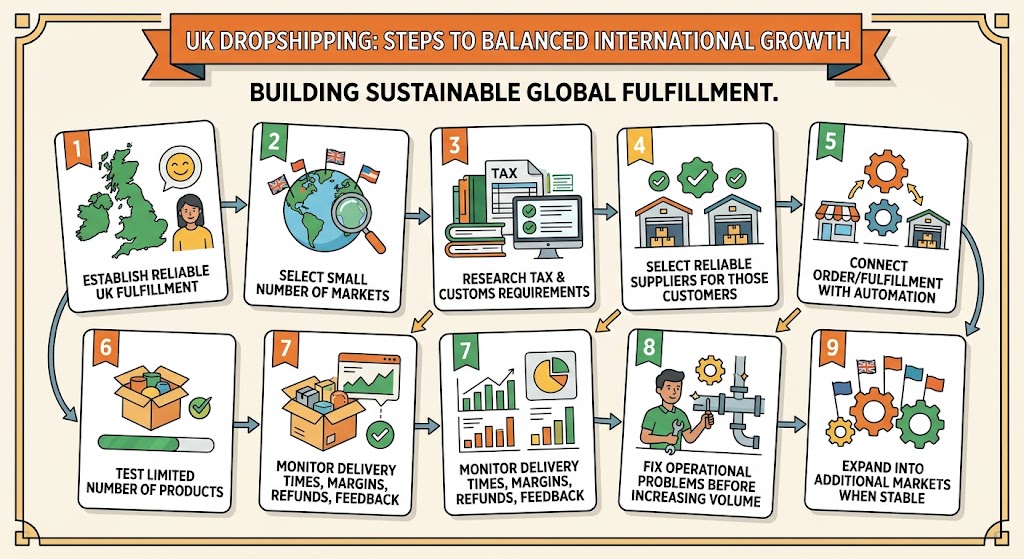
A practical expansion process could look like this:
Step 1: Establish a reliable UK fulfillment process.
Step 2: Select a small number of international markets.
Step 3: Research the tax and customs requirements for those markets.
Step 4: Select suppliers capable of serving those customers reliably.
Step 5: Connect order and fulfillment processes through automation.
Step 6: Test a limited number of products.
Step 7: Monitor delivery times, margins, refunds, and customer feedback.
Step 8: Fix operational problems before increasing order volume.
Step 9: Expand into additional markets only when the process is stable.
Final Takeaway
The decision to expand a UK dropshipping store internationally is not simply a question of whether an automated fulfillment system should be used.
Automation can make order processing, supplier coordination, stock updates, and tracking much easier. However, automation does not eliminate tax, customs, shipping, or customer-service responsibilities.
A UK-only supplier strategy can provide simplicity and potentially faster fulfillment, but it may limit product selection and growth opportunities. International suppliers can provide greater variety and potentially better pricing, but they introduce additional complexity.
The most practical approach is controlled expansion.
Rather than trying to sell everywhere immediately, merchants can start with a few carefully selected markets, understand the relevant tax and customs requirements, test supplier reliability, and measure actual profitability.
International dropshipping works best when growth is supported by reliable operations.
The goal should not simply be to receive more international orders. The goal should be to build a fulfillment system capable of handling those orders profitably, compliantly, and consistently.
When automation, supplier selection, tax planning, shipping, and customer experience are considered together, international expansion becomes much more manageable and can provide a sustainable path for a growing ecommerce business.


0 Comments