A Beginner’s Guide
Dropshipping is often presented as one of the easiest ways to enter ecommerce because the seller does not necessarily need to purchase and store large amounts of inventory before making sales. Instead, products are sourced from suppliers and shipped directly to customers after an order is placed.
While the basic concept is simple, starting a successful dropshipping business involves much more than creating an online store and adding products. A beginner needs to choose the right market, identify reliable suppliers, build a trustworthy storefront, understand costs and policies, and develop a practical marketing strategy.
A Shopify Community discussion about dropshipping brings together many of the common recommendations given to newcomers. Although the individual approaches vary, the overall path is quite consistent:
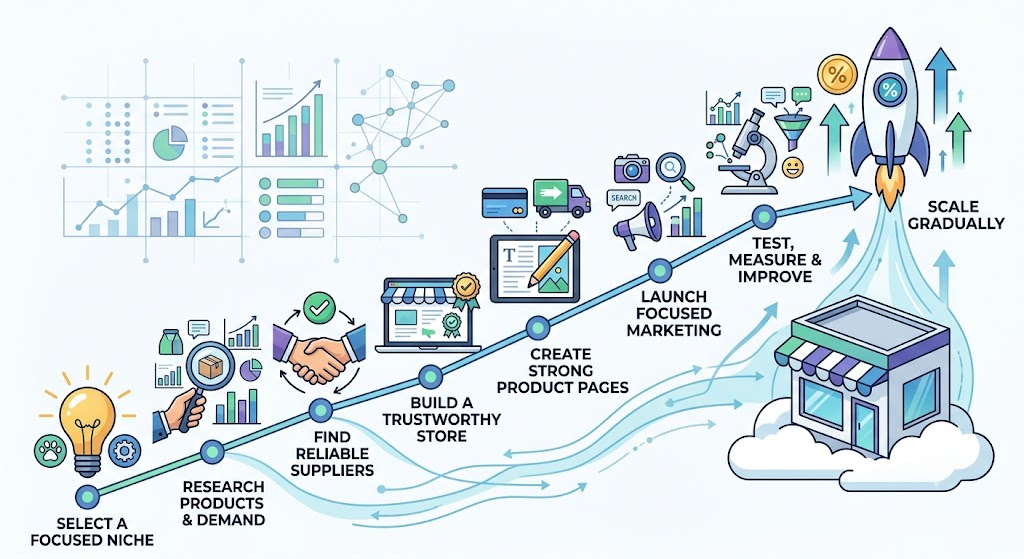
Choose a niche → Find products and suppliers → Build the store → Prepare product pages → Configure business settings → Launch marketing → Test → Improve → Scale
Understanding each step can help a beginner avoid common mistakes and build a stronger foundation.
What Is Dropshipping?
In a traditional retail business, a seller generally purchases inventory before selling it.
For example, a merchant might purchase 100 products from a supplier, store them in a warehouse, and then ship each product to customers after receiving orders.
Dropshipping changes this process.
With dropshipping, the merchant lists products in an online store without necessarily keeping the inventory at their own location. When a customer places an order, the supplier prepares and ships the product directly to the customer.
The basic process is:
Customer places an order → Merchant receives payment → Order is sent to supplier → Supplier ships the product → Customer receives the order
The merchant is responsible for the storefront, marketing, customer experience, pricing, and overall business operation.
The supplier is responsible for fulfilling the physical product order.
This arrangement can reduce the initial inventory investment, but it does not remove business risk. Product quality, shipping delays, returns, customer complaints, advertising expenses, and supplier reliability still affect the merchant.
Step 1: Choose a Focused Niche
One of the first decisions is choosing what type of products the store will sell.
A niche is a specific market or category that the business focuses on.
Instead of creating a store that sells completely unrelated products, a beginner can start with a focused category.
For example:
- Home organization
- Pet accessories
- Fitness products
- Travel accessories
- Kitchen products
- Beauty accessories
- Hobby-related products
- Personal accessories
A focused store can make it easier to create consistent branding and understand the target customer.
The niche should also provide enough products to build a useful catalog without becoming so broad that the store loses its identity.
Step 2: Research Product Demand
Choosing a niche is only the beginning.
The next step is finding products that people actually want to purchase.
A product may look interesting to the seller but have little demand in the market.
Research can involve examining:
- Customer problems
- Existing competitors
- Product reviews
- Search interest
- Social media discussions
- Pricing in the market
- Product quality
- Potential profit margins
- Shipping requirements
The objective is to identify products with a reasonable combination of customer demand, manageable competition, and attractive economics.
Beginners should avoid assuming that a product will sell simply because it looks popular.
Real market testing is still necessary.
Step 3: Find Reliable Suppliers
Supplier selection is one of the most important parts of dropshipping.
The supplier directly affects the customer’s experience.
A supplier can influence:
- Product quality
- Shipping speed
- Packaging
- Inventory availability
- Tracking information
- Return handling
- Order accuracy
A cheap supplier is not necessarily a good supplier.
Suppose a supplier offers a product for ₹300 but regularly ships late and provides inconsistent quality.
Another supplier may charge ₹350 but deliver more reliably and maintain better quality.
The second supplier may create a better overall business outcome even though the product price is higher.
Before committing to a supplier, beginners should investigate shipping times, customer feedback, product quality, communication, and return procedures.
Step 4: Order Samples When Possible
One useful way to evaluate a supplier is to order samples.
A sample allows the merchant to experience the product from the customer’s perspective.
Check:
- Product quality
- Packaging
- Delivery time
- Appearance
- Functionality
- Instructions
- Product dimensions
- Overall customer experience
This is particularly important when product quality is difficult to judge from photographs alone.
A merchant should ideally understand what customers will receive before investing heavily in marketing.
Step 5: Build the Online Store
Once the niche and initial products have been selected, the next step is creating the online store.
The store should look professional and make it easy for customers to understand:
- What the business sells
- Why the products are useful
- How much they cost
- How shipping works
- How returns work
- How customers can contact the business
A beginner does not necessarily need an extremely complicated website.
A clean, organized, mobile-friendly store can be more effective than a visually complicated website that is difficult to navigate.
Important pages generally include:
- Homepage
- Product pages
- Collection or category pages
- About page
- Contact page
- Shipping information
- Return and refund policy
- Privacy information
- Terms and conditions
These pages help customers understand the business and can increase confidence.
Step 6: Create Strong Product Pages
Product pages are where customers make purchasing decisions.
Simply copying a supplier’s product description is often not enough.
A good product page should explain:
What is the product?
What problem does it solve?
Who is it for?
What are its important features?
What does the customer receive?
How long will delivery take?
The product description should focus on customer benefits rather than simply listing technical specifications.
For example, instead of only saying that a storage product has multiple compartments, explain how those compartments help customers organize commonly used items.
Product images are also extremely important.
Use clear images that show the product from useful angles and, when appropriate, demonstrate how it is used.
Step 7: Make Pricing Decisions Carefully
Pricing should not be based only on supplier cost.
The merchant must consider the complete cost structure.
Potential costs include:
- Product cost
- Shipping
- Payment processing
- Advertising
- Returns
- Discounts
- Customer service
- Store expenses
- Taxes and other business expenses
For example, a product purchased for ₹400 and sold for ₹900 does not necessarily produce ₹500 in profit.
After advertising and other costs, the actual contribution may be considerably lower.
Understanding these numbers before scaling is essential.
Step 8: Configure Payments, Shipping, and Taxes
Before launching the store, the operational side needs to be configured correctly.
Customers need a clear way to pay.
Shipping rates and delivery expectations should be visible.
Tax requirements should also be understood and configured appropriately for the business and the locations being served.
The merchant should not wait until the first customer order to discover that shipping rates are incorrect or that an important payment method is unavailable.
The entire checkout process should be tested before launch.
Step 9: Be Transparent About Shipping
Dropshipping businesses sometimes face longer delivery times because products may be shipped from another country or region.
Customers should know approximately when they can expect their orders.
Avoid making unrealistic delivery promises.
Clear information about:
- Processing time
- Shipping time
- Delivery estimates
- Tracking
- Possible delays
can reduce customer complaints.
Transparency is especially important when the actual delivery time is longer than customers might expect.
Step 10: Build Trust
Trust is one of the biggest challenges for new ecommerce stores.
Customers may hesitate to purchase from a store they have never heard of.
Several elements can improve trust:
- Professional branding
- Clear product information
- Realistic delivery estimates
- Visible contact information
- Clear return policies
- Secure checkout
- Customer reviews
- High-quality images
- Consistent design
- Helpful customer support
A professional-looking store does not guarantee sales, but an unprofessional store can make customers hesitate before purchasing.
Step 11: Choose a Marketing Strategy
After the store is ready, customers need to discover it.
There are several possible marketing approaches.
Social Media
Social media can help introduce products to potential customers through videos, images, educational content, demonstrations, and customer-focused posts.
The best content usually does more than simply say, “Buy this product.”
It shows why the product matters.
Paid Advertising
Paid advertising can generate traffic more quickly, but it also introduces financial risk.
A beginner should start with controlled budgets and measure results carefully.
Important numbers include:
- Cost per visitor
- Cost per order
- Conversion rate
- Average order value
- Customer acquisition cost
- Return on advertising spend
- Profit after advertising
High traffic does not automatically mean a profitable business.
Search Optimization
Search-based traffic can provide long-term opportunities.
Useful content may include:
- Product guides
- Buying guides
- Comparisons
- Tutorials
- Answers to customer questions
- Helpful category pages
Search traffic can take time to develop, but it can become an important source of visitors.
Influencers and Creators
Creators with audiences that match the store’s target customer can help introduce products to relevant people.
However, follower count alone should not determine whether a creator is useful.
Audience relevance and engagement can be more important.
Step 12: Test Before Scaling
One of the most important lessons from the discussion is to start small.
A beginner should not necessarily spend a large amount of money on inventory and advertising before knowing whether customers are interested.
Instead, test:
- A small number of products
- A limited advertising budget
- Different product pages
- Different marketing messages
- Different customer segments
Then evaluate the results.
If one product consistently generates profitable sales, more resources can be directed toward it.
If another product receives little interest, the seller can investigate the problem or move on without losing a large amount of money.
Customer Service Is Part of the Product
Dropshipping does not remove responsibility from the merchant.
The customer purchased from the store, not directly from the supplier.
If an order is delayed, damaged, incorrect, or missing, the customer will generally contact the merchant.
Therefore, customer service needs to be taken seriously.
Important areas include:
- Order updates
- Delivery questions
- Returns
- Refunds
- Product questions
- Damaged products
- Address changes
Good communication can make a major difference in customer satisfaction.
Common Beginner Mistakes
New dropshipping sellers often make similar mistakes.
Choosing Products Only Because They Look Trendy
A trending product may have intense competition or short-lived demand.
Adding Too Many Products
A huge catalog can make a new store difficult to manage and can weaken the brand’s focus.
Copying Supplier Content
Generic descriptions and poor images can make the store look unprofessional.
Ignoring Shipping Times
Customers may become frustrated if delivery takes much longer than expected.
Spending Too Much on Advertising Too Early
Marketing should be tested gradually.
Ignoring Profit Margins
Revenue is not the same as profit.
Depending Entirely on One Supplier
Supplier problems can affect the entire business.
Scaling Before Understanding the Data
A few early sales do not necessarily prove that a product is a sustainable winner.
A Practical Beginner Roadmap
A simple starting roadmap looks like this:
- Select a niche.
Choose a focused category with a clear customer audience.
- Research products.
Look for products that solve real problems and have reasonable market potential.
- Evaluate suppliers.
Compare quality, pricing, delivery, reliability, and return procedures.
- Test products.
Order samples or begin with a small product selection.
- Build the store.
Create professional pages, clear navigation, and useful product information.
- Configure operations.
Set up payments, shipping, taxes, policies, and customer communication.
- Launch marketing.
Test relevant channels with controlled spending.
- Measure results.
Track sales, conversion, advertising costs, returns, and customer feedback.
- Improve.
Fix weak product pages, adjust pricing, improve content, and address supplier problems.
- Scale carefully.
Invest more in products and marketing only after the numbers show consistent potential.
Final Takeaway
Starting a dropshipping business can be relatively accessible because it does not always require a large inventory investment at the beginning. However, accessibility does not mean that success is automatic.
The foundation is still the same as any other ecommerce business:
Choose the right market, offer useful products, work with reliable suppliers, build customer trust, market effectively, and manage the numbers carefully.
A beginner should avoid trying to build a massive store immediately.
Starting with a focused niche and a small number of products makes it easier to learn what customers actually want.
The first objective should be validation rather than scale.
Test products, test marketing channels, monitor customer behavior, evaluate supplier performance, and understand the actual profit from each sale.
Once the store has reliable data showing which products, customers, and marketing approaches work, the business can gradually increase its investment.
Dropshipping is therefore best viewed not as a shortcut to easy money, but as a structured ecommerce model where careful testing, supplier management, customer service, and continuous improvement determine long-term potential.
0 Comments