Starting a business involves making hundreds of decisions. You need to think about products, customers, employees, suppliers, payments, technology, marketing, and daily operations. One decision that is often confusing for new business owners is insurance.
The problem is that business insurance is not a one-size-fits-all solution. Different businesses face different risks. A small online store, a consulting company, a manufacturing business, and a professional services firm may all need completely different types and levels of protection.
This creates a common question for new business owners: How do you know what insurance you actually need?
The most practical answer is to start with your risks rather than starting with insurance policy names.
Instead of asking, “Which insurance policy should I buy?” first ask, “What could go wrong in my business, and what financial damage could it cause?”
Once those risks are identified, you can determine which types of coverage may help protect the business.
Why Business Insurance Can Feel Confusing
Insurance terminology can make the process seem more complicated than it needs to be.
Business owners may hear terms such as professional liability, general liability, property coverage, cyber liability, business interruption, commercial vehicle coverage, workers’ compensation, and many others.
The problem is that not every business needs all of these.
Buying unnecessary coverage can increase business expenses, while failing to protect against an important risk can create a much bigger financial problem later.
The right approach is therefore to understand the business first.
Consider what the company sells, how it operates, what assets it owns, how it interacts with customers, what information it stores, and what could cause a major financial loss.
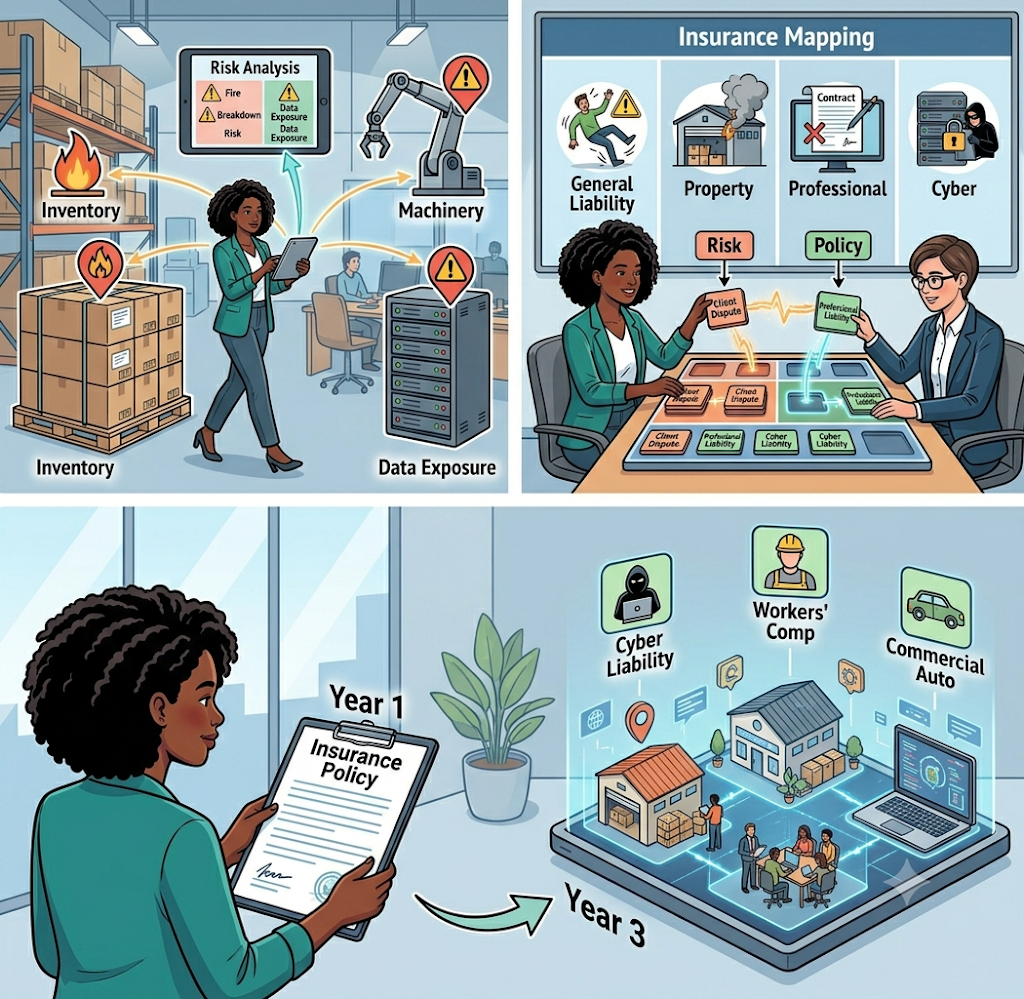
Start With a Simple Risk List
Before contacting an insurance professional, create a simple list of possible “what if” situations.
You do not need to understand insurance terminology at this stage.
Simply think about situations that could cause your business to lose money.
For example:
- What if a customer is injured because of something related to the business?
- What if a customer claims that the company caused property damage?
- What if a client says that a professional service caused them financial loss?
- What if inventory is damaged by fire, theft, or another event?
- What if business equipment is damaged?
- What if customer information is exposed?
- What if the business suffers a cyberattack?
- What if an employee is injured while working?
- What if a supplier dispute causes a financial loss?
- What if the business cannot operate temporarily?
- What if a contract requires specific insurance coverage?
This exercise helps transform a vague insurance question into a practical risk-management problem.
Professional Liability Insurance
Professional liability coverage is particularly relevant for businesses that provide advice, expertise, consulting, design, technical work, or other professional services.
Imagine that a customer hires a business to provide a professional service. The customer later claims that an error, omission, or failure in the service caused them financial damage.
The business could potentially face a dispute or claim.
Professional liability coverage is designed to address certain types of claims arising from professional services, depending on the policy terms.
This can be particularly important for businesses such as:
- Consultants
- Designers
- Developers
- Accountants
- Marketing professionals
- Advisors
- Agencies
- Other professional service providers
The important point is that professional liability is not simply about whether the business made an intentional mistake. Coverage depends on the specific circumstances and policy wording.
Therefore, businesses should understand what their policy actually covers rather than assuming every client dispute will automatically be covered.
General Liability Insurance
General liability coverage generally focuses on third-party claims involving bodily injury or property damage.
For example, imagine a customer visits a physical business location and gets injured because of a dangerous condition on the property.
Another example could involve a business accidentally damaging someone else’s property while performing a service.
These situations can result in claims for medical expenses, repairs, legal costs, or other damages.
General liability can therefore be particularly relevant to businesses that interact with customers, vendors, contractors, or members of the public in physical locations.
Even businesses that primarily operate online may have some exposure to liability risks depending on their activities.
The important thing is to consider how people interact with the business rather than assuming that an online business has no liability exposure.
Property Insurance
Businesses often have valuable physical assets.
These may include:
- Inventory
- Computers
- Machinery
- Furniture
- Tools
- Office equipment
- Storage equipment
- Business property
Damage or loss of these assets can create a significant financial burden.
Property coverage may help protect eligible business property against specified risks, depending on the policy.
For an ecommerce business, inventory can be particularly important.
Imagine a company holding a large amount of stock in a warehouse. If that inventory is damaged by a covered event, replacing everything could require substantial capital.
Similarly, a company that depends heavily on specialized equipment could face operational difficulties if that equipment is damaged.
This is why business owners should identify their most valuable physical assets and understand how they are protected.
Cyber Liability Insurance
Modern businesses increasingly depend on technology.
Even a small company may collect customer names, contact information, payment-related information, account details, business documents, or other sensitive data.
This creates another category of risk.
A business could experience:
- Data exposure
- Unauthorized access
- Cyberattacks
- Ransomware incidents
- Account compromise
- Business email compromise
- Loss of important digital information
- Disruption of online operations
Cyber liability coverage may help address certain costs associated with covered cyber incidents.
These costs can potentially include investigation, notification, recovery, legal assistance, and other expenses depending on the policy.
Cyber risk is particularly important for businesses that operate online or store significant amounts of customer and business information.
However, cyber insurance should not replace basic security practices. Strong access controls, employee awareness, backups, secure passwords, system updates, and other security measures remain important.
Your Business Model Determines Your Risks
One of the biggest mistakes a business owner can make is copying another company’s insurance package.
Two businesses operating in the same general industry may still have very different risks.
Consider two online businesses.
One sells inexpensive products through a supplier and never holds physical inventory.
Another purchases and stores thousands of products in its own warehouse.
The second company has much greater exposure to physical inventory risks.
Similarly, consider two consulting companies.
One provides general business advice.
Another handles sensitive customer information and provides specialized professional services.
Their risks may differ considerably.
This is why insurance decisions should begin with the actual business model.
Think About Your Assets
A useful part of the risk assessment is identifying everything the business could financially lose.
Create a simple list of assets such as:
- Cash
- Inventory
- Computers
- Equipment
- Vehicles
- Machinery
- Office property
- Business documents
- Digital information
- Intellectual property
Then ask what could happen to each asset.
Could it be stolen?
Could it be damaged?
Could it be destroyed?
Could someone gain unauthorized access to it?
Could losing it stop the business from operating?
These questions help identify where protection may be necessary.
Think About Your Customers
Customers are another major source of potential business risk.
Ask how customers interact with the business.
Do they visit your premises?
Do they use your products?
Do they rely on your professional advice?
Do you collect their personal information?
Do you deliver products directly to them?
Do you work inside their offices or properties?
The answers can reveal risks that may not be obvious when simply looking at the business category.
For example, a company providing professional services may face different liability concerns from a retailer selling physical products.
Consider Contracts and Client Requirements
Sometimes insurance requirements do not come only from your own risk assessment.
Customers, landlords, suppliers, partners, lenders, or other organizations may require certain coverage as part of a contract.
For example, a commercial lease may require a business to maintain liability coverage.
A large client may require a professional services provider to maintain a specific level of professional liability coverage.
A contract may also specify minimum limits or require proof of insurance.
Therefore, business owners should review important contracts before choosing coverage.
Ignoring these requirements can create contractual problems even if the business itself has not experienced a claim.
Choosing Coverage Limits
Choosing the type of insurance is only one part of the decision.
You also need to consider the appropriate coverage limits.
A very small limit may not provide enough protection for a serious claim.
A very high limit may increase premiums significantly.
The appropriate amount depends on factors such as:
- Business size
- Revenue
- Assets
- Industry
- Customer exposure
- Contract requirements
- Potential claim severity
- Geographic operations
- Number of employees
- Amount of data handled
There is no universal number that works for every business.
A business owner should discuss realistic worst-case scenarios with a qualified insurance professional rather than selecting limits based only on price.
Why an Independent Insurance Professional Can Help
Once you have identified your risks, speaking with an independent insurance agent or broker can make the process easier.
Instead of approaching them with a vague question such as, “What insurance should I buy?”, provide them with your risk list.
Explain:
- What your business does
- Who your customers are
- Where you operate
- What assets you own
- Whether you have employees
- What information you collect
- What contracts you have
- What risks concern you most
The professional can then help translate those risks into potential insurance policies and coverage levels.
This approach is generally more useful than selecting policies based purely on their names.
Don’t Buy Insurance Based Only on Price
Cost is obviously important for a new business.
However, choosing the cheapest policy without understanding its exclusions, limits, deductibles, and conditions can create problems later.
Two policies may have similar names but provide very different protection.
Business owners should therefore compare more than premiums.
Important points to understand include:
- What is covered?
- What is excluded?
- What are the coverage limits?
- What is the deductible?
- Are there special conditions?
- Does the policy cover the business’s actual activities?
- Are employees or contractors covered?
- Are certain locations excluded?
- What documentation is required after a claim?
The cheapest policy is not necessarily the most suitable policy.
Review Insurance as the Business Grows
Insurance needs can change over time.
A business that starts with one employee and a small amount of inventory may eventually have dozens of employees, larger facilities, more customers, and greater revenue.
Its risk profile will therefore change.
Business owners should periodically review their coverage, especially after major changes such as:
- Hiring employees
- Purchasing expensive equipment
- Opening a new location
- Expanding internationally
- Increasing inventory
- Launching a new product
- Collecting more customer data
- Signing larger contracts
- Offering new professional services
An old policy may not adequately reflect a growing business.
Common Mistakes to Avoid
Buying policies without understanding the risks
Insurance should solve actual business risks rather than simply checking boxes.
Assuming every business needs the same coverage
Different operations create different exposures.
Ignoring cyber risks
Even small online businesses can be targets for cyber incidents.
Forgetting physical assets
Inventory and equipment can represent a major portion of a company’s investment.
Ignoring contract requirements
Important agreements may contain specific insurance requirements.
Choosing coverage only by premium
A low price does not necessarily mean appropriate protection.
Never reviewing coverage
Business operations change, and insurance should be reviewed accordingly.
A Simple Process for New Business Owners
If you are starting a business and do not know where to begin, use this simple process.
Step 1: Understand your business.
Write down what you sell, who you serve, where you operate, and how the business works.
Step 2: List your assets.
Identify inventory, equipment, vehicles, property, technology, and important information.
Step 3: Create your “what if” list.
Think about injuries, property damage, professional mistakes, theft, equipment damage, cyber incidents, and business interruptions.
Step 4: Review contracts.
Check whether customers, landlords, suppliers, or partners require specific insurance.
Step 5: Speak with an insurance professional.
Give them your risk list and business details.
Step 6: Compare coverage carefully.
Look at limits, exclusions, deductibles, conditions, and premiums.
Step 7: Review regularly.
Update your coverage when the business changes.
Final Takeaway
There is no single insurance package that is perfect for every business.
The right starting point is not a list of policy names. It is an honest assessment of what could go wrong.
Think about customers, employees, property, inventory, equipment, professional services, contracts, data, and online operations. Identify the situations that could create serious financial losses.
Once those risks are clear, an independent insurance agent or broker can help translate them into appropriate coverage options and limits.
The goal is not to insure everything imaginable. The goal is to protect the business from risks that could seriously damage its finances or ability to operate.
A risk-first approach makes insurance decisions more practical, easier to understand, and better aligned with the actual needs of the business.

0 Comments