Dropshipping makes it possible to sell products online without purchasing and storing large amounts of inventory in advance. This model is attractive because a seller can display products in an online store, receive an order, and then have the supplier fulfill the order directly to the customer.
For ordinary products, this model can be relatively straightforward. However, dropshipping becomes much more complicated when the products are branded or luxury items.
Selling products associated with well-known fashion and sports brands can offer attractive margins and strong customer demand. At the same time, it creates additional responsibilities around authenticity, brand authorization, trademarks, pricing, shipping, customs, and customer trust.
The central question is therefore not simply whether branded products can be dropshipped. The more important question is whether the seller has a legitimate and reliable supply chain that allows those products to be sold legally and transparently.
Why Luxury Dropshipping Is Attractive
Luxury fashion has several characteristics that make it appealing to ecommerce sellers.
Customers are often willing to pay significantly more for recognizable brands because they associate them with quality, status, design, exclusivity, and reputation. A successful seller may therefore earn a higher gross margin per order compared with selling generic products.
Another advantage is the existing demand for established brands. A new store does not necessarily have to educate customers about what a famous brand represents. Customers may already know the products and actively search for them.
Dropshipping also reduces the need to purchase large quantities of inventory before testing demand. This can be particularly useful for expensive products where holding stock could require significant capital.
However, high selling prices and strong demand do not automatically make luxury dropshipping a safe business model. The higher the value and brand recognition of a product, the greater the consequences of sourcing problems.
The Biggest Challenge: Authenticity
Authenticity is one of the most important issues when selling branded products.
A seller needs to know exactly where the products come from and whether the supplier has the right to distribute them. It is not enough for a supplier to claim that its products are genuine.
A professional seller should be able to establish a clear chain of supply. This may include invoices, distribution records, authenticity documentation, business credentials, and written agreements.
Luxury products are particularly vulnerable to counterfeit activity. A product that looks genuine in photographs may still be counterfeit or improperly sourced.
If a customer receives a fake product, the consequences can extend far beyond one refund. The seller may face complaints, payment disputes, reputational damage, account restrictions, and potentially legal action.
For this reason, authenticity should be treated as a business requirement rather than simply a marketing advantage.
Brand Authorization Matters
Many luxury brands carefully control who can sell their products.
A brand may have specific rules concerning distributors, retailers, geographic territories, advertising, trademarks, product presentation, and pricing.
This means that finding a supplier that sells a particular brand does not automatically mean that the seller is authorized to advertise and sell that brand.
Before listing a branded product, a seller should determine whether the supplier is an authorized distributor or has legitimate rights to distribute the products.
Written authorization is particularly valuable because it provides evidence that the relationship exists.
A proper agreement should ideally clarify:
- Which products can be sold
- Which territories are permitted
- Whether online sales are allowed
- How the brand name and trademarks can be used
- Whether promotional images can be used
- Pricing requirements
- Shipping responsibilities
- Return procedures
- Authenticity documentation
These details can prevent misunderstandings later.
Why Supplier Selection Is Critical
Supplier selection becomes even more important in luxury dropshipping because the seller is essentially depending on another company to protect its reputation.
A supplier should be evaluated carefully before products are listed for sale.
Important questions include:
- Where are the products sourced from?
- Can the supplier provide proof of authenticity?
- Does the supplier have authorization to distribute the brands?
- Can the supplier provide commercial invoices?
- Where will orders be shipped from?
- How are products packaged?
- What happens if an item arrives damaged?
- How are returns handled?
- How long does fulfillment normally take?
- What happens if customs stops a shipment?
- Is insurance available for expensive shipments?
- Can the supplier maintain consistent inventory?
A supplier should not be selected only because it offers attractive prices.
An extremely low price for a luxury product can actually be a warning sign. If the price is dramatically below normal wholesale or market pricing, the seller should investigate the reason before proceeding.
Luxury Products Create Greater Shipping Risks
Shipping ordinary products and shipping expensive luxury goods are very different experiences.
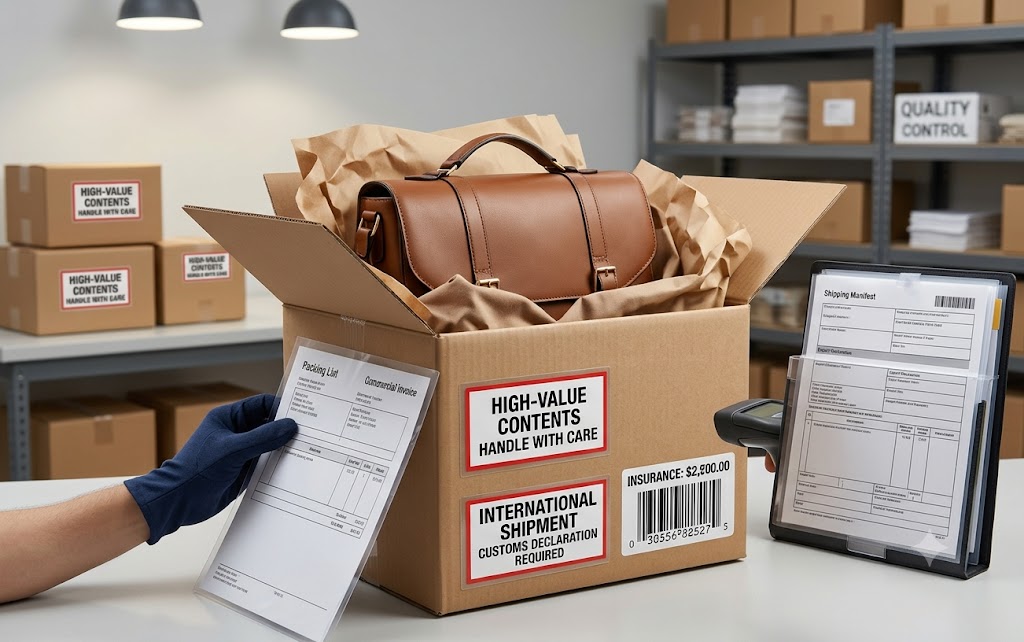
A low-cost item may be relatively simple to replace if it gets lost. A high-value handbag, watch, shoe, or designer garment may represent hundreds or thousands of dollars in merchandise.
Luxury shipments therefore require careful planning.
The seller needs to consider:
- Secure packaging
- Tracking
- Shipping insurance
- Delivery confirmation
- International customs
- Import duties
- Taxes
- Lost shipments
- Damaged products
- Return transportation
International orders create additional complexity because customs rules differ between countries.
A customer may also be surprised by unexpected duties or taxes if these costs were not clearly explained before purchase.
A transparent store should clearly communicate shipping terms and potential additional charges rather than leaving customers to discover them after placing an order.
Customs and International Selling
Luxury dropshipping often involves international transactions, which makes customs another important consideration.
Different countries have different rules for importing branded products. Some products may require specific documentation, and certain shipments may be inspected before delivery.
The seller needs to understand who is responsible for customs clearance, duties, taxes, and other import-related charges.
Incorrect declarations can create serious problems.
For example, if the declared value of an expensive product does not accurately represent its transaction value, the shipment could be delayed or investigated.
A professional operation should therefore maintain accurate invoices and shipping documentation.
Shopify Store Verification and Compliance
A Shopify store selling branded products should also be prepared to demonstrate that the products are legitimate.
The store owner may need to provide information about suppliers, invoices, authorization, or other documentation when questions about authenticity or brand rights arise.
This is especially important when using brand names, logos, photographs, descriptions, and other protected material.
A seller should never assume that simply uploading a product to an online store gives them permission to use a brand’s intellectual property.
Brand names and logos can be protected trademarks. Product photographs and marketing materials may also be protected by copyright.
Therefore, sellers should use only material they are legally permitted to use.
The Risk of Counterfeit Products
Counterfeit products are one of the most serious risks in luxury dropshipping.
The problem can begin with an unreliable supplier, but ultimately the customer sees the seller’s store as responsible for the purchase.
Imagine a customer orders a designer product and receives a counterfeit item. They may immediately request a refund and publish a negative review.
Other customers may then lose confidence in the store.
Repeated complaints can create even bigger problems. Payment providers, marketplaces, advertising channels, or ecommerce platforms may take action against businesses associated with counterfeit merchandise.
The financial impact can include refunds, chargebacks, lost advertising accounts, legal expenses, and damaged brand reputation.
This is why a seller should verify suppliers before accepting customer orders rather than trying to solve authenticity problems afterward.
Profit Margins Can Be Attractive, but They Need to Be Realistic
Luxury products can have attractive margins, and the discussion around luxury dropshipping mentions margins as high as 250%.
However, a claimed margin should never be accepted without understanding the actual cost structure.
The real calculation should consider:
Selling Price − Product Cost − Shipping − Duties/Taxes − Payment Fees − Returns − Customer Support − Marketing = Actual Profit
For expensive products, even a single return or damaged shipment can significantly affect profitability.
For example, a product may appear highly profitable when only the wholesale cost and selling price are compared. Once international shipping, insurance, payment costs, returns, taxes, and marketing are included, the actual profit may be considerably lower.
Therefore, sellers should calculate net profitability rather than relying on advertised margins.
Alternative Business Models
Traditional branded dropshipping is not the only option for someone interested in luxury ecommerce.
One alternative is to work with premium brands that actively support independent online retailers.
Instead of attempting to sell famous luxury brands without authorization, a seller can build relationships with smaller premium manufacturers or direct-to-consumer brands.
Another option is a white-label model.
In this approach, products are manufactured by a supplier but sold under the seller’s own brand. This gives the business greater control over branding and customer experience.
A made-to-order model can also reduce inventory requirements. Products are produced or prepared after an order is received, reducing the need to maintain large amounts of finished stock.
A hybrid model can combine these approaches with dropshipping. Some products can be fulfilled directly by suppliers while other products are stocked or produced according to demand.
These alternatives can provide a luxury positioning without creating the same level of dependency on established global brands.
Building Customer Trust
Trust is especially important when customers are spending significant amounts of money.
A luxury ecommerce store should provide clear information about product authenticity, sourcing, shipping, returns, and customer support.
Useful trust elements include:
- Clear product information
- Accurate product photographs
- Authenticity documentation where appropriate
- Transparent shipping information
- Clear return and refund policies
- Secure payment processes
- Responsive customer support
- Real customer reviews
- Accurate delivery estimates
The seller should avoid exaggerated claims.
For example, saying that a product is “100% authentic” without having reliable documentation behind the claim can create unnecessary risk.
Transparency is more valuable than aggressive marketing.
Working Directly With Premium Brands
For a long-term luxury ecommerce business, direct relationships can be more valuable than relying entirely on third-party suppliers.
A seller can approach premium brands and present a clear business proposal.
The proposal can explain the target market, sales channels, marketing strategy, geographic coverage, customer service capabilities, and ecommerce experience.
If the brand is interested, both sides can establish clear commercial terms.
Direct partnerships may take more time to establish, but they can provide greater control over product authenticity, pricing, inventory, and customer experience.
This approach also creates a stronger foundation for building a recognizable business rather than simply reselling products.
Influencers and Content Creators Can Have an Advantage
Luxury products are strongly influenced by presentation, storytelling, and social trust.
Creators and influencers may have an advantage because they can demonstrate products through styling videos, reviews, educational content, and personal recommendations.
However, transparency remains essential.
If a creator is promoting products through a commercial relationship, that relationship should be disclosed appropriately.
Luxury customers often care about the story behind a product as much as the product itself. Content explaining craftsmanship, materials, design, sourcing, and quality can help customers make informed decisions.
A Practical Way to Start
Someone considering luxury dropshipping should avoid immediately uploading hundreds of branded products.
A safer approach is to begin with a small selection.
First, identify a specific luxury category. Then research potential suppliers and verify their business credentials.
Next, request documentation proving the origin and authenticity of products.
After that, review the supplier’s shipping, returns, warranty, and customer-service processes.
Only once the supply chain is reliable should products be added to the store.
The seller can then place test orders where appropriate to evaluate packaging, delivery time, product quality, documentation, and overall customer experience.
This process may seem slower than simply importing a product catalog, but it can prevent much larger problems later.
Common Mistakes to Avoid
Several mistakes can make luxury dropshipping risky.
Choosing a supplier only because of low prices
Cheap products are not automatically good products. Extremely low prices may indicate quality, authenticity, or sourcing concerns.
Assuming every supplier is authorized
A supplier’s website or sales representative claiming to sell genuine products is not enough. Authorization and documentation should be verified.
Using brand images without permission
Product images and promotional material may have intellectual-property restrictions.
Ignoring shipping and customs
International luxury shipments require careful planning.
Making unsupported authenticity claims
Only make claims that can be supported with appropriate evidence.
Scaling before testing
Adding hundreds of products before testing suppliers can multiply problems.
Focusing only on profit margins
A high markup does not necessarily mean high net profit.
Final Takeaway
Selling branded or luxury products through dropshipping is possible in some circumstances, but it is considerably more complex than ordinary dropshipping.
The biggest challenge is not creating the online store. It is building a trustworthy and legally compliant supply chain.
A successful seller needs reliable sourcing, legitimate authorization, authentic products, proper documentation, secure fulfillment, accurate shipping information, and strong customer service.
The most important principle is simple: never build a luxury ecommerce business around uncertainty about where the products come from.
If the supply chain cannot clearly establish authenticity and the right to sell the products, the potential profit is not worth the risk.
For entrepreneurs who want to enter the premium market, authorized partnerships, carefully selected premium brands, white-label products, made-to-order products, or hybrid fulfillment models can provide more sustainable opportunities.
Luxury ecommerce can be profitable, but trust is the foundation. When customers spend significant amounts on branded products, they are not just buying an item—they are buying confidence that the product is genuine, properly sourced, and worth the price.
0 Comments