What Is the Difference and When Should You Use Each?
When a business needs to purchase products, hire a service provider, or start a new project, choosing the right supplier is an important decision. However, before selecting a supplier, the business needs to communicate what it requires and understand what different vendors can offer.
This is where two common procurement documents become useful: Request for Proposal (RFP) and Request for Quotation (RFQ).
Although these terms sound similar, they serve different purposes. An RFP is generally used when a business needs vendors to explain how they would solve a problem or complete a project. An RFQ is used when the business already knows exactly what it wants and needs suppliers to provide their prices.
Understanding the difference can help businesses save time, compare vendors more effectively, control purchasing costs, and make better decisions.
What Is an RFP (Request for Proposal)?
A Request for Proposal, commonly called an RFP, is a formal document that invites vendors or service providers to submit proposals for a particular project or business requirement.
An RFP is generally used when the buyer understands the problem or objective but needs external expertise to determine the best solution.
Instead of asking only how much a service will cost, the buyer asks vendors to explain:
- How they would approach the project
- What solution they recommend
- What services they will provide
- What experience they have
- How long the project will take
- What resources they will require
- What the estimated cost will be
- What results they expect to deliver
The purpose is to compare the overall value of different proposals rather than simply choosing the lowest price.
Example of an RFP
Imagine a company wants to develop a new ecommerce website.
The company knows that it needs an online store, but it has not finalized all the technical details, design requirements, customer features, or development approach.
It sends an RFP to several development agencies.
The document explains the business goals, target customers, expected features, budget expectations, and project timeline.
Each agency submits a proposal explaining its recommended design, development approach, technical capabilities, delivery schedule, maintenance services, and estimated price.
One agency may recommend a simple website with essential ecommerce features. Another may suggest a more advanced solution with inventory management, customer accounts, and additional integrations.
The company can compare these proposals based on experience, approach, functionality, timeline, support, and cost.
This makes an RFP particularly useful for projects where the solution needs to be evaluated before a final decision is made.
What Is an RFQ (Request for Quotation)?
A Request for Quotation, commonly called an RFQ, is a procurement document used when a buyer already knows what product or service is required and wants suppliers to provide their prices.
Unlike an RFP, an RFQ does not usually ask vendors to develop different solutions.
The buyer provides clear specifications, quantities, quality standards, delivery requirements, and other purchasing conditions.
Suppliers respond with quotations explaining how much they will charge to meet those requirements.
The main objective is to compare prices and purchasing terms for the same or substantially equivalent requirement.
An RFQ generally includes:
- Product or service description
- Required quantity
- Technical specifications
- Quality standards
- Delivery location
- Expected delivery date
- Payment terms
- Warranty requirements
- Quotation validity period
- Taxes and additional charges
The buyer then compares quotations and selects the supplier that offers the best combination of price, quality, delivery, and reliability.
Example of an RFQ
Imagine a company needs to purchase 50 office computers.
The company has already decided the required processor, memory, storage capacity, screen size, warranty period, and quantity.
It sends an RFQ to five suppliers with the same specifications.
Each supplier provides a quotation.
| Supplier | Quoted Price per Computer |
| Supplier A | ₹45,000 |
| Supplier B | ₹47,000 |
| Supplier C | ₹43,500 |
| Supplier D | ₹46,000 |
The company can compare the prices along with warranty, delivery charges, taxes, and delivery timelines.
If all suppliers meet the required specifications, the company can choose the most suitable quotation.
An RFQ makes this process easier because every supplier is responding to the same clearly defined requirement.
RFP vs RFQ: Key Differences
Both documents help businesses purchase products or services, but their purposes and evaluation methods are different.
| Comparison | RFP | RFQ |
| Full Form | Request for Proposal | Request for Quotation |
| Main Purpose | Find the best solution | Obtain competitive prices |
| Best Used For | Complex projects and services | Standard products and clearly defined services |
| Requirements | May allow vendors to suggest approaches | Usually clearly specified |
| Vendor Response | Detailed proposal and solution | Price quotation and commercial terms |
| Evaluation | Quality, approach, experience, timeline, and cost | Price, specifications, delivery, and terms |
| Complexity | Usually more detailed | Usually simpler |
| Time Required | Generally longer | Generally shorter |
| Buyer Focus | Overall value and suitability | Price and compliance with specifications |
The simplest way to remember the difference is:
RFP asks: “How would you solve this problem, and what would it cost?”
RFQ asks: “Here is exactly what we need. How much will you charge?”
When Should You Use an RFP?
An RFP is most appropriate when a business has a complex requirement and needs vendors to recommend a solution.
It is particularly useful when the buyer cannot evaluate suppliers based on price alone.
1. Complex Projects
Projects involving multiple stages, technical decisions, or specialized knowledge often require an RFP.
For example, developing a complete business management system may involve planning, design, development, testing, implementation, and ongoing support.
Different vendors may recommend different approaches, so comparing their proposals is important.
2. Strategy and Consulting Services
Businesses often need external experts to solve problems involving business strategy, operations, technology, or organizational improvement.
For example, a company may want to improve its customer acquisition process but may not know which marketing activities will be most effective.
An RFP allows agencies to explain their strategies, research methods, deliverables, and expected results.
3. Creative and Design Projects
Creative projects rarely have one standard solution.
A business planning a new brand identity, website redesign, or advertising campaign may want vendors to present their ideas and creative approaches.
An RFP helps evaluate creativity, experience, project understanding, and overall value.
4. Long-Term Service Agreements
If a business wants a service provider for ongoing IT support, software maintenance, or managed services, an RFP can help compare service quality, support arrangements, response times, and pricing structures.
Advantages of an RFP
- Better solutions: Vendors can recommend different approaches based on their expertise.
- Detailed comparison: Businesses can evaluate quality, experience, methodology, and cost.
- Improved decision-making: The buyer gets a clearer understanding of available options.
- Greater transparency: Defined evaluation criteria help make supplier selection more consistent.
- Suitable for complex projects: It allows businesses to assess the complete solution rather than focusing only on price.
Disadvantages of an RFP
- Time-consuming: Preparing and evaluating detailed proposals can take considerable time.
- More documentation: Vendors need to prepare detailed responses.
- Higher evaluation effort: The buyer must carefully review different approaches and assumptions.
- Potentially higher costs: Vendors may spend more time preparing proposals, and this effort may be reflected in their commercial pricing.
- Difficult comparisons: Different vendors may recommend very different solutions, making direct comparisons challenging.
When Should You Use an RFQ?
An RFQ is more suitable when the buyer has already defined the product or service requirements.
The buyer does not need vendors to suggest completely different solutions. Instead, the main objective is to obtain competitive prices for the same requirement.
1. Standard Product Purchases
Purchasing office supplies, computers, furniture, electrical equipment, or packaging materials is a common RFQ situation.
If specifications and quantities are already decided, suppliers can provide their prices directly.
2. Manufacturing Materials
Manufacturers regularly purchase raw materials, components, spare parts, and packaging materials.
An RFQ allows them to compare suppliers based on the same technical and quality requirements.
3. Bulk Purchasing
Businesses purchasing large quantities of products can use RFQs to negotiate better commercial terms.
For example, a company purchasing 1,000 units of a particular product can request quotations from multiple suppliers.
4. Clearly Defined Services
RFQs can also be used for services when the scope, deliverables, service levels, and pricing requirements are already standardized.
For example, a company may request quotations for a clearly specified equipment maintenance service.
Advantages of an RFQ
- Faster process: Suppliers can usually prepare quotations more quickly than detailed proposals.
- Easy price comparison: All suppliers respond to the same requirements.
- Better cost control: Businesses can identify competitive pricing.
- Less documentation: The process is generally simpler than an RFP.
- Useful for bulk purchases: Multiple suppliers can compete for clearly defined orders.
Disadvantages of an RFQ
- Limited creativity: Suppliers generally do not have much opportunity to suggest alternative solutions.
- Price-focused decisions: Buyers may concentrate too heavily on the lowest quotation.
- Less suitable for complex projects: It may not capture differences in methodology or technical expertise.
- Specification dependency: If the buyer provides incorrect or incomplete specifications, the quotations may not meet the actual requirement.
- Quality risks: Choosing the cheapest supplier without checking quality can create problems later.
How Do Timelines Differ Between RFP and RFQ?
The time required for an RFP and RFQ depends on the complexity of the purchase, the number of suppliers, and the organization’s approval process.
However, RFQs are generally faster because suppliers only need to provide quotations against defined requirements.
An RFP usually takes longer because vendors must understand the business problem, develop a solution, prepare a detailed proposal, and explain their approach.
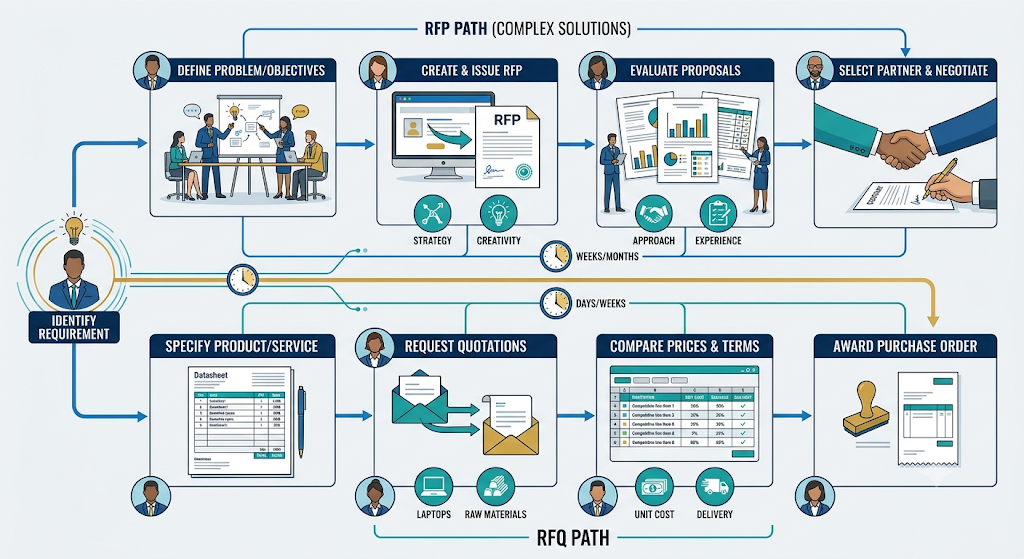
A typical process may look like this:
RFQ process:
- Define product specifications.
- Prepare and send the RFQ.
- Collect supplier quotations.
- Compare prices and terms.
- Select the supplier.
- Issue the purchase order or contract.
RFP process:
- Identify the business problem.
- Define project objectives and scope.
- Prepare and issue the RFP.
- Allow vendors time to develop proposals.
- Review technical and commercial submissions.
- Conduct presentations or discussions if required.
- Evaluate and shortlist vendors.
- Negotiate and finalize the agreement.
An RFQ may take days or a few weeks, while a complex RFP can take several weeks or longer. These are general expectations, not fixed timelines.
A Simple Decision-Making Framework
If you are unsure whether to prepare an RFP or RFQ, start by answering one question:
Do you already know exactly what you want to purchase?
If the answer is yes, an RFQ may be the right choice.
If the answer is no, and you need vendors to recommend how the requirement should be fulfilled, an RFP may be more appropriate.
Here is a simple decision guide:
Step 1: Are the requirements clearly defined?
- Yes: Consider an RFQ.
- No: Consider an RFP.
Step 2: Do you need vendors to suggest different approaches?
- Yes: Use an RFP.
- No: Consider an RFQ.
Step 3: Is price the primary comparison factor?
- Yes, provided quality and specifications are already defined: Use an RFQ.
- No, because expertise, methodology, and overall value matter: Use an RFP.
Quick Examples
| Business Requirement | Recommended Document |
| Purchasing 100 laptops with fixed specifications | RFQ |
| Developing a custom ecommerce website | RFP |
| Buying 500 office chairs | RFQ |
| Hiring a company for business transformation | RFP |
| Purchasing standard packaging materials | RFQ |
| Designing a new brand identity | RFP |
| Buying specific machinery | RFQ |
| Developing a customized software system | RFP |
These are practical guidelines rather than strict rules. For example, a complex machinery purchase may require an RFP if the buyer needs vendors to recommend different technical solutions.
Can a Business Use Both RFP and RFQ?
Yes. In some procurement situations, using both documents can create a more effective selection process.
Imagine a company wants to implement a new enterprise software system.
First, it issues an RFP to understand the technical solutions, implementation approaches, vendor experience, and service capabilities.
After evaluating proposals, the company shortlists two or three vendors.
It can then request detailed commercial quotations from the shortlisted vendors based on a common and clearly defined scope.
This approach helps the buyer evaluate the solution first and negotiate the price afterward.
It is particularly useful for large projects where selecting a supplier based only on the lowest price could create operational or technical problems.
Common Mistakes to Avoid
Businesses sometimes make procurement decisions without properly understanding the purpose of each document.
Here are some mistakes worth avoiding:
- Using an RFQ for an unclear requirement: If the buyer does not know what needs to be delivered, suppliers may provide quotations based on different assumptions.
- Using an RFP for simple purchases: Requesting detailed proposals for standard products can create unnecessary work.
- Comparing only the lowest price: A low quotation does not always represent the best value.
- Providing incomplete information: Missing specifications, deadlines, or service expectations can lead to misunderstandings.
- Ignoring evaluation criteria: Businesses should decide how vendors will be evaluated before reviewing their submissions.
- Forgetting contract terms: Payment schedules, warranties, delivery conditions, service levels, and responsibilities should be reviewed before final selection.
Final Takeaway
RFP and RFQ are both important procurement methods, but they are designed for different situations.
An RFP is best when a business needs expertise, ideas, and proposed solutions for a complex requirement.
An RFQ is best when the business already knows exactly what it needs and wants competitive quotations from suppliers.
The decision does not need to be complicated. Start by understanding the requirement, checking whether the specifications are clear, and deciding whether vendor expertise or price comparison is more important.
For straightforward purchases, an RFQ can save time and simplify supplier selection. For strategic, creative, technical, or complex projects, an RFP provides a better opportunity to compare complete solutions.
Ultimately, choosing the right procurement document helps businesses communicate clearly, evaluate vendors fairly, control costs, and make informed purchasing decisions.


0 Comments