In the world of eCommerce, one of the most difficult decisions for store owners is knowing what product to add next. Choosing the right products can increase revenue, improve customer satisfaction, and strengthen brand positioning. Choosing the wrong products can lead to dead inventory, wasted marketing spend, and unnecessary operational costs.
This challenge becomes even more important for Shopify merchants who are constantly trying to improve their catalog, increase average order value, and stay competitive in a crowded market.
This is where the idea of an AI-powered product gap detection app becomes interesting.
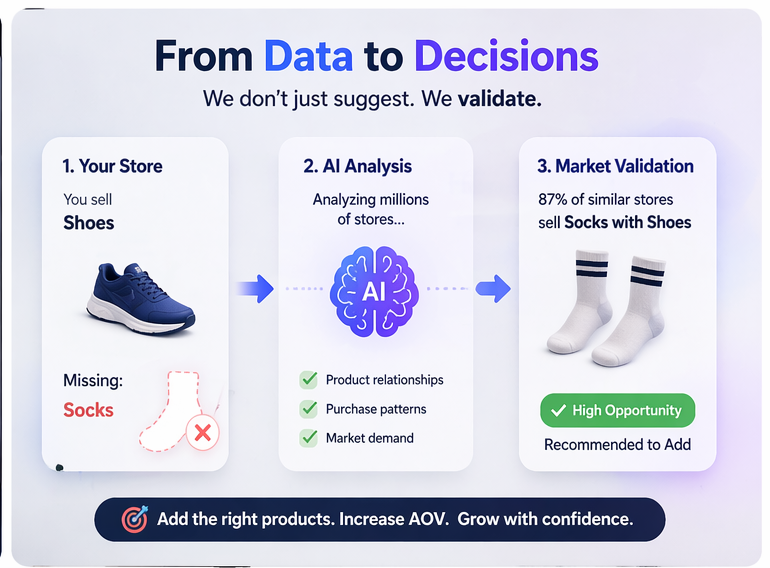
The concept is simple but powerful: the app analyzes a merchant’s current product catalog, identifies likely missing complementary products, and then validates those recommendations by checking whether successful stores commonly sell those products together.
For example, if a store sells shoes but does not sell socks, the app would identify socks as a potential missing product. It would then confirm this suggestion by analyzing broader selling patterns across other stores where shoes and socks are commonly sold together.
The big question is: Is this a real merchant problem worth solving?
The short answer is yes—but only if the problem is solved in a practical, reliable, and decision-focused way.
This article explores why this idea matters, the real pain points merchants face, how store owners currently decide what to add to their catalog, and whether this app could become a valuable solution.
Understanding the Core Problem
Most store owners do not struggle with launching a store—they struggle with growing it intelligently.
After the first set of products is live, the next challenge becomes:
What should I add next?
This is not a simple decision because adding products affects:
- Inventory investment
- Supplier relationships
- Marketing strategy
- Customer experience
- Profit margins
- Brand identity
A poor product decision creates long-term problems.
That is why product expansion is often slower and more stressful than product launch.
Why Product Selection Is So Difficult
Many merchants make product decisions based on guesswork.
They ask questions like:
- What is trending right now?
- What are competitors selling?
- What do customers keep asking for?
- What could increase average order value?
- What complements my current products?
The problem is that these decisions are often based on incomplete information.
Store owners may rely on:
- Manual competitor research
- Customer feedback
- Industry assumptions
- Trial and error
- Personal intuition
While these methods help, they are not always enough.
This creates a real opportunity for a smarter system.
Why the “Shoes Without Socks” Example Works
The shoes-and-socks example is simple, but it perfectly explains the problem.
If a merchant sells shoes but not socks, they may be missing:
- Cross-sell opportunities
- Repeat purchase opportunities
- Higher cart value
- Better customer convenience
Customers often expect related products to exist together.
When they do not, the store loses both revenue and customer satisfaction.
This applies across many industries.
Examples include:
- Phone cases without screen protectors
- Coffee machines without coffee accessories
- Skincare products without complementary routines
- Fitness products without resistance bands or mats
- Pet food without feeding accessories
These are not random suggestions—they are logical buying patterns.
An app that detects these gaps could create immediate value.
Is This a Real Merchant Pain Point?
Yes, especially for growing stores.
There are three major reasons why this matters.
1. Increasing Average Order Value (AOV)
Many merchants focus heavily on getting new customers but forget that increasing the value of each order is often easier and more profitable.
Selling complementary products helps:
- Increase basket size
- Improve upselling opportunities
- Reduce customer acquisition cost pressure
If someone buys shoes and also buys socks, revenue increases without needing a second customer.
This makes catalog expansion highly valuable.
2. Improving Customer Experience
Customers prefer convenience.
If they need to leave your store to buy complementary products elsewhere, you lose control of the customer journey.
A complete product ecosystem improves:
- Customer trust
- Purchase convenience
- Brand authority
- Repeat buying behavior
Customers feel your store understands their needs.
3. Smarter Inventory Decisions
Not every product should be added.
The challenge is knowing which products are worth it.
An app that validates demand before merchants invest helps reduce:
- Overstocking
- Slow-moving inventory
- Supplier waste
- Poor purchasing decisions
This makes the problem highly practical.
How Merchants Currently Decide What to Add
Right now, most store owners use a combination of manual methods.
Competitor Research
This is the most common approach.
Merchants study:
- What competitors sell
- Which bundles are promoted
- What product categories are expanding
This works, but it is slow and often incomplete.
It also assumes competitors are always making the right decisions.
Customer Feedback
Customers often reveal missing opportunities directly.
Examples include:
- “Do you also sell this?”
- “Can I buy matching accessories?”
- “Do you have a refill option?”
This is valuable, but reactive rather than proactive.
The merchant waits for customers to identify the gap.
Marketplace Trends
Some merchants use broader marketplaces to study demand patterns.
They look at:
- Bestseller sections
- Frequently bought together products
- Trending collections
This helps, but it requires manual interpretation.
Internal Sales Data
Existing purchase patterns reveal strong opportunities.
For example:
Customers buying Product A often ask about Product B.
This is useful but only works after enough sales exist.
New stores often lack enough data.
Gut Feeling and Experience
Many merchants still rely heavily on instinct.
Experienced operators can do this well—but intuition alone is risky.
This is where AI support becomes valuable.
Where Your App Could Win
The strength of this idea is not just suggesting products.
It is validating those suggestions using broader market behavior.
This creates stronger confidence.
Instead of saying:
“You should sell socks”
The app says:
“Stores similar to yours that sell shoes also successfully sell socks, and customers commonly buy them together.”
That feels more actionable.
Confidence drives adoption.
The Biggest Risk: Generic Recommendations
This is where many app ideas fail.
If the app gives obvious or generic suggestions, merchants will stop using it.
Bad examples:
- You sell T-shirts → sell pants
- You sell water bottles → sell cups
These are too obvious and not useful.
The app must provide:
- Smart recommendations
- Store-specific relevance
- Revenue-focused insights
It should feel like strategy, not basic automation.
The Best Version of This Product
The strongest version of this app would include:
Product Gap Detection
Identifying missing complementary products based on current catalog structure.
Validation Through Real Selling Patterns
Using broader store behavior to confirm whether those products are truly valuable.
Revenue Impact Prediction
Showing merchants:
- Potential AOV improvement
- Upsell opportunities
- Product bundle potential
This makes decisions stronger.
Competitor Comparison
Helping merchants see:
“What similar stores are selling that you are not”
This creates urgency and clarity.
Inventory Risk Awareness
Warning against products that may look attractive but have poor practical value.
This prevents bad expansion decisions.
Should This Be Built?
Yes—but not as a “product suggestion app.”
It should be positioned as:
A catalog growth intelligence tool
That framing matters.
Merchants do not want random ideas.
They want confident decisions.
That is the real product.
Who Would Benefit Most?
This app would be especially valuable for:
- Mid-sized Shopify stores
- Growing DTC brands
- Merchants trying to increase AOV
- Stores expanding product lines
- Sellers managing bundles and cross-sells
Very early beginners may not feel the pain yet.
Established growth-stage merchants are the strongest users.
The Real Validation Question
Instead of asking:
“Would merchants use this?”
Ask:
“Would merchants pay to reduce product decision mistakes?”
That answer is much stronger.
Because bad product decisions are expensive.
If your app helps prevent even one wrong inventory decision, it creates real financial value.
That is what makes it sellable.
Final Recommendation Before Building
Before development, validate manually first.
Talk to merchants and ask:
- How do you currently decide what to add?
- Have you ever added the wrong product?
- Do you struggle more with ideas or confidence?
- Would data-backed recommendations help?
This reveals whether the pain is strong enough.
Do not validate features.
Validate pain.
That is where successful apps begin.
Final Conclusion
Yes, this is a meaningful problem worth solving.
Choosing the next product is one of the most important decisions in eCommerce growth, and most merchants still handle it with incomplete data, manual research, and guesswork.
An AI-powered app that identifies product gaps and validates them using real store behavior could create serious value—if it goes beyond generic suggestions and becomes a true decision-support system.
The opportunity is not in telling merchants what products exist.
The opportunity is in helping them confidently decide what should come next.
That is a much bigger problem—and a much stronger business.
Final Thought
Store growth is rarely limited by effort.
It is limited by decision quality.
The merchants who win are not always the ones who add the most products.
They are the ones who add the right products.
If your app helps them do that, then yes—it is absolutely worth building.