Many businesses want to sell wholesale using Shopify, but one of the biggest challenges is the cost of Shopify Plus. While Shopify Plus offers advanced native B2B features, it is often too expensive for small and medium-sized businesses. This creates an important question for many store owners: Can you build a professional B2B-only wholesale store on standard Shopify plans without Shopify Plus?
The answer is yes—but it requires the right combination of apps, theme customization, customer management, and a clear strategy.
For businesses working with a limited monthly budget, such as an additional $25 per month, the goal is not to find one perfect app that does everything. Instead, the best solution is usually a smart combination of simple tools and lightweight customizations that work together.
This article explains how to create a B2B wholesale store on non-Plus Shopify, the best practical approaches, common limitations, and how to manage important features like customer approval, VAT handling, wholesale pricing, and PDF VAT invoices.
Understanding the Challenge of B2B on Standard Shopify
Shopify was originally designed with direct-to-consumer selling in mind. B2B wholesale selling has more specific requirements, such as:
- Customer approval before access
- Restricted pricing visibility
- Wholesale-only pricing rules
- VAT handling and tax exemptions
- Invoice generation
- Customer account management
Without Shopify Plus, these features are not fully available as native tools in the traditional setup, so merchants often rely on apps and small customizations.
However, recent updates suggest that Shopify has introduced more native B2B capabilities across plans in some cases, which creates some confusion. Still, for most stores—especially those with strict VAT and pricing rules—apps remain essential.
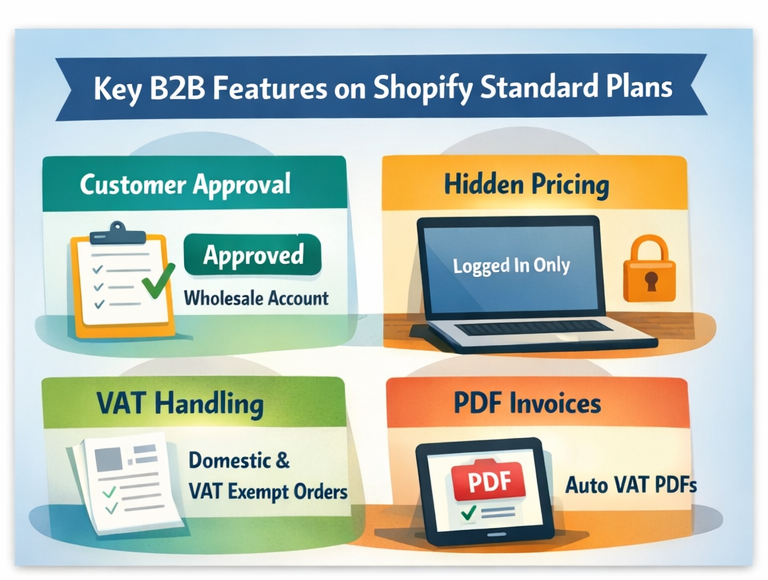
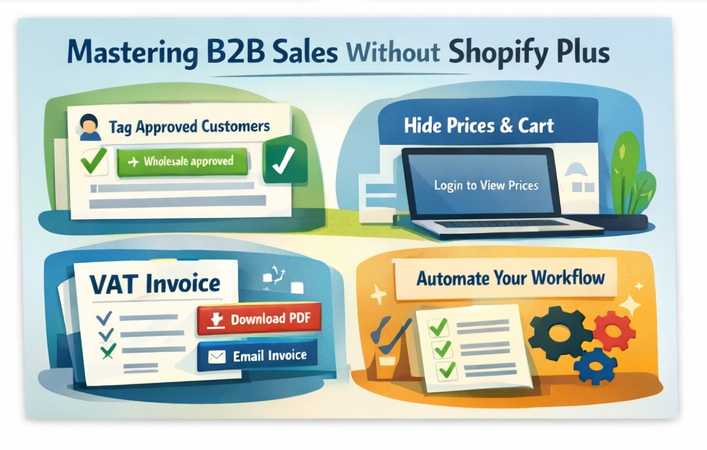
Feature 1: Registration Form with Customer Approval
One of the most important B2B requirements is controlling who can access your wholesale store.
Unlike regular B2C stores, not every visitor should be able to view prices or place orders. You need a system where customers apply first, and only approved buyers gain access.
How This Works
The standard workflow looks like this:
- Customer fills out a registration form
- They submit business details, VAT number, and company information
- You review the request
- If approved, the customer gets tagged in Shopify
- Access is granted to pricing and ordering
This approval process ensures that only verified wholesale buyers can shop.
Revoking Access
This is equally important.
If needed, you should be able to:
- Remove approval
- Revoke access instantly
- Hide pricing again
- Disable wholesale purchasing rights
This is usually done by removing customer tags or changing account permissions.
Feature 2: Show Add to Cart Only for Approved Customers
This is one of the most requested B2B features.
You want:
- Visitors to browse products
- But only approved logged-in customers to see pricing and Add to Cart buttons
This creates a true wholesale-only environment.
Practical Solution
This is commonly handled using:
- Customer tags
- Theme customization
- Visibility rules through apps
For example:
Non-approved visitor sees:
“Login to view prices”
Approved wholesale customer sees:
Prices + Add to Cart button
This method is highly effective and often does not require expensive apps.
Simple theme edits can handle much of this.
Feature 3: Showing Prices Including and Excluding VAT
VAT presentation is a major concern in B2B stores, especially for European businesses.
Some businesses need:
- Prices including VAT
- Prices excluding VAT
- Or both displayed together
This depends on the customer type and region.
The Challenge
Standard Shopify pricing is not always flexible enough for advanced VAT display rules.
Especially when selling internationally, tax handling becomes more complex.
Practical Approach
Most stores handle this using:
- Shopify tax settings
- Customer tags
- Invoice apps
- Custom display logic
For example:
Domestic customers → VAT included
Foreign business customers → VAT exempt
This creates a cleaner buying experience and supports legal compliance.
Feature 4: VAT Calculation for Domestic and Foreign Orders
This is often the most technically challenging part.
The goal is:
Domestic Orders:
VAT applied normally
Foreign Business Orders:
VAT excluded (VAT exempt)
This is especially common for EU B2B selling.
How It Usually Works
You need two things:
1. VAT Number Collection
Customers must provide their VAT ID during registration.
2. VAT Validation
You may need to verify whether the VAT number is valid before allowing tax exemption.
Shopify Limitation
Shopify can handle some tax rules, but full VAT ID validation and automatic exemption often require additional tools.
This is where invoice apps and form apps become useful.
Feature 5: Sending VAT Invoice PDF with Orders
Professional B2B stores must provide invoices.
Customers often expect:
- PDF invoice automatically sent
- VAT clearly displayed
- Company details included
- Tax breakdown shown correctly
This is not optional—it is often legally required.
Best Practical Solution
Invoice apps are commonly used for:
- Automatic PDF invoice generation
- VAT invoice formatting
- Email delivery after purchase
This is usually one of the most valuable app investments because it saves time and improves professionalism.
Best App Strategy Under a Limited Budget
Since the budget is around $25/month, the best strategy is to avoid expensive all-in-one enterprise apps.
Instead, focus on essential tools only.
Recommended Lightweight Setup
Option 1: Customer Approval + Tags
Use a registration form app for:
- Customer approval
- VAT number collection
- Customer tagging
This handles access control.
Option 2: Theme Customization for Price Hiding
Instead of paying for a full wholesale app:
Use simple theme edits to:
- Hide prices
- Hide Add to Cart
- Show login prompts
This saves monthly costs.
Option 3: PDF Invoice App
Use one reliable invoice app for:
- VAT invoices
- Automatic PDF generation
- Professional invoice delivery
This is worth the investment.
Should You Use Native Shopify B2B Features?
This is where opinions differ.
Earlier advice often said:
“Native B2B is Shopify Plus only”
But newer discussions suggest Shopify has expanded B2B functionality more broadly.
This means:
- Companies
- Catalogs
- Payment terms
may now be more accessible depending on store setup.
The Practical Recommendation
Even if native tools exist, start simple.
For a budget-conscious store:
First: Use native Shopify settings where possible
Then: Add small apps only where needed
This prevents overpaying for unnecessary features.
Common Mistakes to Avoid
Many store owners waste money because they:
- Install too many apps
- Pay for features they do not use
- Ignore theme customization possibilities
- Choose complex solutions too early
The goal should be:
Simple + scalable + cost-effective
Not complicated.
A Realistic Setup for Your Client
Based on your requirements, the most practical system would be:
Registration Form: Customer approval + VAT ID collection
Access Control: Customer tags + hidden pricing/Add to Cart
VAT Handling: Domestic VAT + foreign VAT exemption
Invoice System: Automatic PDF VAT invoices
Optional: Wholesale pricing app if discounts are complex
This setup is achievable without Shopify Plus.
Final Strategic Advice
Do not search for one app that does everything.
That usually leads to:
- Higher costs
- Over-complicated workflows
- Unnecessary features
Instead, build your B2B system like layers:
Layer 1: Customer approval
Layer 2: Access restriction
Layer 3: VAT logic
Layer 4: Invoice automation
This is more stable and affordable.
Final Conclusion
Yes, it is absolutely possible to run a professional B2B-only wholesale store on Shopify without Shopify Plus.
It requires:
- Smart use of customer tags
- Lightweight apps
- Theme customization
- Proper VAT handling
- Reliable invoice generation
The best solution depends on your exact business model, VAT requirements, and pricing structure.
For a store with a limited monthly budget, the goal should not be perfection—it should be functionality, stability, and cost efficiency.
A simple, well-structured setup often performs better than an expensive complicated one.
Final Thought
B2B selling on non-Plus Shopify is not about finding a magic app.
It is about designing a system that fits your workflow.
With the right strategy, even a standard Shopify plan can become a powerful wholesale platform.
You do not need Shopify Plus to build a strong B2B business—you need the right structure.