The print-on-demand business model has transformed the way entrepreneurs start and scale online stores. Instead of investing heavily in inventory, manufacturing equipment, or warehousing, sellers can offer customized products that are produced only after a customer places an order. This approach reduces upfront risk and makes it easier for small businesses and independent creators to enter the market.
Most print-on-demand businesses today focus on categories such as apparel, mugs, posters, phone cases, and accessories. However, a growing interest is emerging around more premium and creative product categories — especially wood and ceramic products.
The idea being explored is simple but interesting:
Create a print-on-demand service for wood and ceramic products that allows merchants to sell customized items without manufacturing them themselves.
At first glance, this sounds like a promising niche opportunity. Personalized home décor, handmade-style gifts, engraved wooden items, ceramic art, and customized kitchen products continue to grow in popularity. Consumers increasingly prefer products that feel personal, aesthetic, and unique instead of mass-produced.
However, before building such a business, several important questions need to be answered:
- Are merchants actually interested in selling wood and ceramic products?
- What concerns would stop them from trusting such a supplier?
- What type of customization workflow would merchants prefer?
- Would sellers want completely original designs or proven product concepts?
- How important are reliability, quality control, and shipping consistency?
The discussion remains open, but the concept touches an important shift happening in eCommerce:
the move from generic products toward personalized and emotionally valuable products.
Let’s explore this idea properly.
Why Wood and Ceramic Products Are Different From Standard Print-on-Demand
Traditional print-on-demand products are usually lightweight, easy to produce, and simple to ship.
Wood and ceramic products are different.
These categories introduce:
- Higher perceived value
- More craftsmanship appeal
- Stronger gifting potential
- Greater emotional connection
- More fragile logistics
This creates both opportunity and complexity.
Consumers often associate wood and ceramic products with:
- Handmade quality
- Artistic craftsmanship
- Premium home décor
- Personalized gifts
- Long-lasting keepsakes
Unlike fast-fashion products or low-cost accessories, wood and ceramic items often feel more meaningful and durable.
That emotional connection can become a major advantage.
Why Personalized Products Continue to Grow
One reason this idea has potential is because personalized commerce continues to expand rapidly.
Customers increasingly want products that:
- Reflect their identity
- Feel unique
- Carry emotional meaning
- Make memorable gifts
Examples include:
- Customized wooden signs
- Engraved cutting boards
- Personalized ceramic mugs
- Decorative ceramic plates
- Wooden wall art
- Family name décor
- Memorial or anniversary gifts
These products are not purchased only for functionality.
They are purchased for emotional value.
This makes personalization especially powerful in wood and ceramic categories.
The Appeal for Merchants
For many online sellers, offering wood or ceramic products without producing them personally could be attractive for several reasons.
1. Low Entry Barrier
Many merchants want to sell premium handmade-style products but lack:
- Manufacturing equipment
- Workshop space
- Design expertise
- Production knowledge
A print-on-demand system removes those barriers.
Sellers could focus on:
- Marketing
- Branding
- Product positioning
- Customer acquisition
without handling production themselves.
2. Access to Higher-Value Products
Wood and ceramic products often command higher prices than standard print-on-demand categories.
Consumers usually perceive these products as:
- More artistic
- More premium
- More gift-worthy
That creates stronger profit potential.
For example:
A personalized ceramic product may feel far more valuable than a basic printed T-shirt.
3. Expansion Into Home Décor and Gift Markets
Home décor and gifting are emotionally driven categories.
People buy:
- Housewarming gifts
- Wedding gifts
- Birthday presents
- Seasonal decorations
- Personalized keepsakes
Wood and ceramic products naturally fit these markets.
This gives merchants access to categories with strong emotional buying behavior.
The Biggest Challenge: Trust
One of the most important unanswered questions in the discussion is:
What would merchants need in order to trust a supplier?
This is critical.
Because wood and ceramic products introduce more operational risk than simple print-on-demand items.
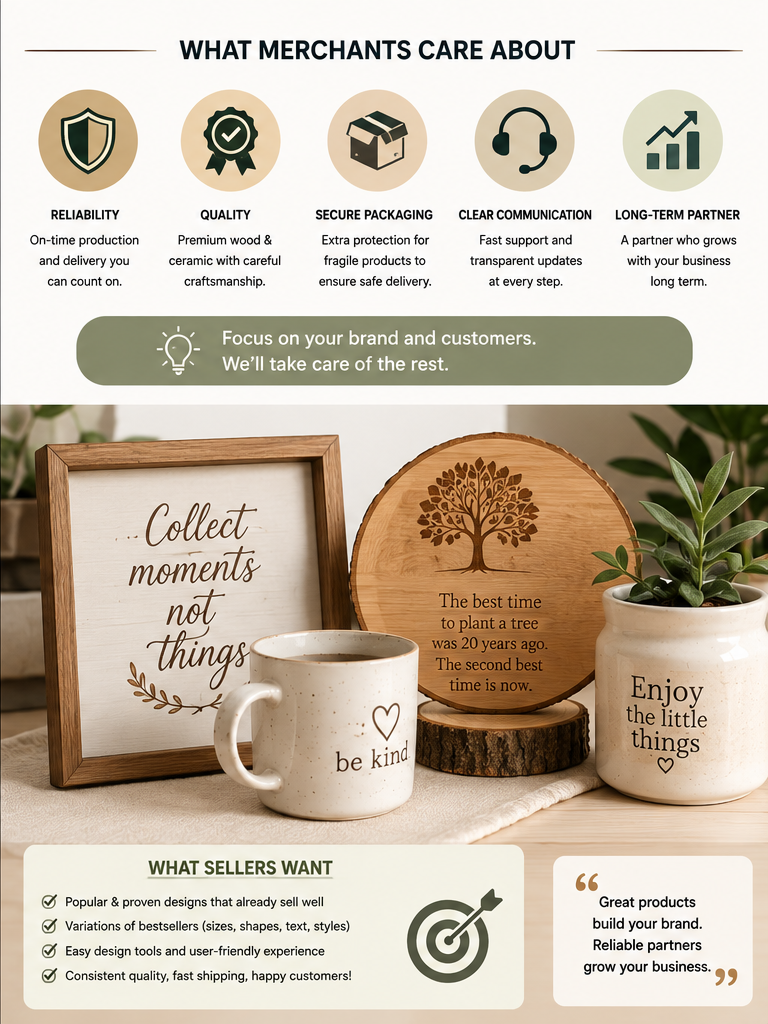
Merchants will worry about:
- Product quality
- Fragile shipping
- Consistency
- Packaging damage
- Production delays
- Customization accuracy
Trust becomes the foundation of the entire business model.
Reliability Is More Important Than Creativity
Many entrepreneurs focus heavily on product creativity when launching a new print-on-demand concept.
But merchants usually prioritize reliability first.
A seller may love beautiful products, but if:
- Orders arrive broken
- Shipping takes too long
- Colors are inconsistent
- Engravings are incorrect
then the merchant’s reputation suffers.
That means operational consistency matters more than aesthetics alone.
A supplier in this category must prove:
- Strong packaging standards
- Reliable fulfillment
- Consistent quality control
- Predictable delivery timelines
Without trust, merchants will hesitate to scale.
Why Fragility Changes Everything
Ceramic products create unique logistical challenges.
Unlike soft products:
- Ceramics can break
- Wood can scratch or warp
- Packaging quality becomes extremely important
This increases:
- Return risk
- Replacement costs
- Customer frustration
For merchants, damaged products directly impact:
- Reviews
- Refund requests
- Brand trust
This means shipping protection and packaging quality become part of the product experience itself.
Design Workflow Is a Major Strategic Decision
Another important discussion point is the preferred design system.
There are several possible approaches.
Option 1: Fully Custom Design Uploads
This allows merchants or customers to upload completely original artwork or personalization.
Advantages:
- Maximum creativity
- Highly personalized products
- Broad flexibility
Challenges:
- More production complexity
- Higher risk of poor-quality uploads
- Greater chance of design errors
This model works best for advanced sellers or custom gift businesses.
Option 2: Editable Templates
This approach provides structured templates where users can:
- Add names
- Change text
- Adjust colors
- Modify layouts
Advantages:
- Easier workflow
- Faster ordering
- More consistent production quality
Challenges:
- Less creative freedom
This may appeal more to beginner merchants or scalable operations.
Option 3: Ready-Made Catalog
The supplier provides pre-designed products ready for resale.
Advantages:
- Simple setup
- Fast launch
- Lower design effort
Challenges:
- Less uniqueness
- More competition
This model is easiest operationally but may feel less differentiated.
Which Approach Would Merchants Prefer?
The answer likely depends on the merchant type.
Beginners May Prefer Simplicity
New sellers often want:
- Easy setup
- Minimal design work
- Proven products
They usually prioritize convenience over creativity.
Established Brands May Want Customization
Experienced sellers may prefer:
- Unique designs
- Brand differentiation
- Greater creative control
They are more likely to invest in personalized branding.
This suggests the ideal system may need flexibility rather than a single workflow approach.
Proven Designs vs New Creative Ideas
Another interesting question raised is:
Would sellers prioritize new designs or proven products already performing well?
This is important because many merchants fear risk.
Most sellers prefer products with:
- Existing demand
- Proven market performance
- Familiar buying behavior
Especially beginners.
For example:
If a wooden engraved sign style already performs well in online marketplaces, merchants may prefer variations of that concept instead of completely experimental products.
This reduces uncertainty.
Why Marketplace Trends Matter
Online marketplaces strongly influence product demand.
When merchants see certain product styles repeatedly selling well:
- Confidence increases
- Product adoption becomes easier
- Risk perception decreases
This means market validation plays a major role in product selection.
A successful print-on-demand supplier may need to continuously:
- Track trends
- Introduce proven concepts
- Refresh seasonal products
- Adapt to changing aesthetics
The Emotional Power of Handmade-Style Products
Wood and ceramic products succeed partly because they feel human.
Customers increasingly value:
- Authenticity
- Craftsmanship
- Warm aesthetics
- Natural materials
Mass-produced products often feel generic.
Wood and ceramics create:
- Texture
- warmth
- artistic appeal
This emotional quality gives them long-term potential.
Why Branding Matters More in This Category
Wood and ceramic products are not purely transactional.
People often purchase them because they:
- Match a lifestyle
- Represent emotions
- Create atmosphere
This means merchants selling these products must focus heavily on:
- Storytelling
- Visual branding
- Photography
- Packaging presentation
The emotional presentation matters as much as the product itself.
The Real Opportunity Is Differentiation
One major challenge in modern eCommerce is saturation.
Many stores sell identical low-cost products.
Wood and ceramic customization could offer stronger differentiation because:
- Products feel more premium
- Personalization increases uniqueness
- Handmade aesthetics create emotional value
That creates room for stronger branding and customer loyalty.
The Biggest Risk: Operational Complexity
While the idea is attractive, it is not operationally simple.
Key risks include:
- Breakage during shipping
- Quality inconsistency
- Slow production times
- Customization errors
- Packaging costs
This means execution quality will determine success more than the concept itself.
Final Thought
The idea of offering print-on-demand wood and ceramic products is more than just another product category expansion.
It reflects a broader shift in eCommerce:
from mass-produced convenience toward personalized and emotionally meaningful products.
There appears to be genuine potential because:
- Personalized products continue to grow
- Home décor and gifting remain strong markets
- Merchants seek differentiation
- Consumers value customization and craftsmanship
However, success depends heavily on:
- Reliability
- Product quality
- Packaging standards
- Trust-building
- Operational consistency
Conclusion
A print-on-demand model for wood and ceramic products could become a valuable opportunity for merchants who want to offer personalized, premium-style products without handling production themselves.
The demand for customized home décor, gifts, and handcrafted-style products continues to grow, creating strong market potential.
But the real challenge is not simply creating attractive products.
It is building a system merchants can trust.
Because in categories like wood and ceramics, sellers are not only buying production services —
They are trusting a supplier to protect their brand reputation with every order shipped.