Growing an online store requires more than simply having attractive products and a well-designed website. Once the basic store structure is in place, one of the biggest challenges for merchants is attracting the right customers and converting those visitors into paying customers. This is why many store owners eventually look for an experienced marketing professional or agency to help them improve traffic, advertising performance, and overall sales.
The discussion centers on a store owner who has already made several improvements to their online store, including organizing collections, improving search visibility, and adding useful functionality. After making these changes, the owner is looking for professional marketing support to generate more qualified traffic and increase conversions.
The main areas of interest include social media advertising, search advertising, email marketing, conversion rate optimization, and retargeting. However, the responses to the discussion show that there is no single marketing strategy that works for every store. Some participants recommend hiring professionals to manage advertising and conversion strategies, while others believe merchants should first diagnose their existing problems and learn enough marketing themselves to make informed decisions.
The discussion ultimately raises an important question: Should a business immediately hire a marketing expert, or should it first determine exactly where the store is losing potential customers?
Understanding this distinction can save businesses significant time and money.
Why Marketing Becomes Important After Store Improvements
Many store owners initially focus on improving their website.
They may spend time:
- Organizing product collections
- Improving product descriptions
- Optimizing pages for search engines
- Adding useful features
- Improving navigation
- Updating product information
- Making the website look more professional
These improvements are important, but they do not automatically generate sales.
A well-built store still needs a reliable customer acquisition strategy.
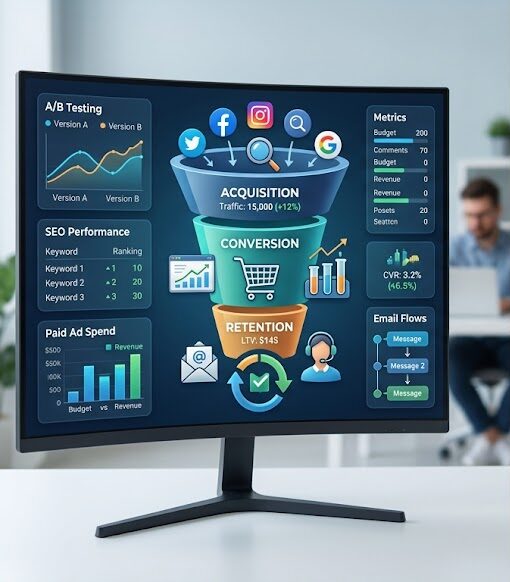
Marketing brings potential customers to the store, while conversion optimization helps turn those visitors into buyers.
Therefore, merchants need to consider both sides of the equation.
A business may have excellent traffic but poor conversions, or excellent conversion potential but insufficient traffic.
Identifying which problem exists is the first major step.
Traffic Versus Conversion: Finding the Real Problem
One of the most valuable perspectives in the discussion is the suggestion to determine whether the store’s primary problem is low traffic or low conversion.
These are two very different problems.
If a store receives very few visitors, the priority should be customer acquisition.
If thousands of relevant visitors arrive but very few purchase, increasing advertising may not solve the problem.
Instead, the business may need to improve:
- Product presentation
- Pricing
- Trust
- Shipping information
- Reviews
- Checkout experience
- Offers
- Product descriptions
This distinction is critical because marketing budgets can easily be wasted when advertising is increased before the store is ready to convert visitors.
The Importance of Qualified Traffic
Not all website visitors have equal value.
A store may receive large amounts of traffic while generating very few sales if the visitors are not genuinely interested in the products.
Qualified traffic means visitors who are more likely to:
- Need the product
- Understand its value
- Match the target customer profile
- Have purchasing intent
- Be comfortable with the price
For this reason, marketing should focus on attracting the right audience rather than simply maximizing visitor numbers.
A smaller number of highly relevant visitors can be more valuable than thousands of uninterested visitors.
Social Media Advertising
Social media advertising is one of the strategies mentioned in the discussion.
It can help businesses reach potential customers based on characteristics such as:
- Interests
- Demographics
- Location
- Online behavior
- Previous interactions
However, successful advertising requires more than simply creating an advertisement and increasing the budget.
Businesses need to test:
- Different audiences
- Different images
- Different videos
- Different headlines
- Different offers
- Different landing pages
Testing allows merchants to understand what attracts their ideal customers.
Search Advertising
Search-based advertising can be useful because it reaches people who are already looking for specific products or solutions.
Someone searching for a particular product may have stronger purchase intent than someone who encounters an advertisement while casually browsing social media.
However, search advertising can become expensive when businesses target highly competitive keywords.
Successful campaigns therefore require careful attention to:
- Search intent
- Keyword relevance
- Product margins
- Landing-page quality
- Advertising costs
- Conversion rates
The goal is not simply to generate clicks but to generate profitable customers.
Email Marketing as a Long-Term Strategy
Another major recommendation is email marketing.
Unlike paid advertising, email allows businesses to communicate with people who have already shown some interest in the brand.
Email can be used for:
- Welcome messages
- Product education
- Abandoned-cart reminders
- New product announcements
- Promotional campaigns
- Customer follow-ups
- Repeat-purchase campaigns
A well-planned email strategy can increase the value of existing customers instead of requiring the business to acquire new customers repeatedly.
This makes email especially useful for businesses selling products that customers may purchase more than once.
Retargeting Existing Visitors
Many visitors do not purchase during their first visit.
They may be:
- Comparing products
- Waiting for payday
- Researching alternatives
- Unsure about the purchase
- Distracted before completing checkout
Retargeting gives businesses an opportunity to reconnect with these visitors.
Instead of treating every non-buyer as lost forever, businesses can remind previous visitors about the product or brand.
Retargeting can be particularly effective when combined with:
- Customer reviews
- Product benefits
- Special offers
- Educational content
- Limited promotions
However, retargeting should be used carefully so customers do not feel overwhelmed by repetitive advertising.
Conversion Rate Optimization
Conversion rate optimization focuses on improving the percentage of visitors who complete a desired action.
For an ecommerce store, the primary goal is usually a purchase.
However, other actions may also matter, such as:
- Adding a product to the cart
- Starting checkout
- Joining an email list
- Requesting information
Small improvements can have a significant impact.
For example, if a store receives 10,000 visitors, increasing the conversion rate from 1% to 2% doubles the number of purchases without requiring additional traffic.
This is why improving conversion can sometimes be more profitable than simply increasing advertising spend.
Clear Product Benefits
One response in the discussion emphasizes the importance of clearly communicating product benefits.
Customers should quickly understand:
- What the product does
- Why they need it
- What problem it solves
- What makes it different
- Why they should choose it
A product page that only lists technical specifications may not be persuasive enough.
Effective communication connects product features to customer benefits.
Instead of simply explaining what a product contains, the store should communicate how it improves the customer’s situation.
Customer Reviews and Social Proof
Reviews are another important conversion factor.
New visitors may hesitate to purchase because they do not know whether the product or business can be trusted.
Authentic customer reviews help reduce this uncertainty.
Useful forms of social proof include:
- Customer reviews
- Product photographs from customers
- Testimonials
- Ratings
- Case examples
- Demonstrations
The key word is authentic.
Businesses should avoid misleading or fabricated reviews because long-term trust is more valuable than temporary increases in conversion.
Shipping and Return Information
Customers often hesitate when they cannot clearly understand what happens after placing an order.
Important information includes:
- Shipping costs
- Delivery estimates
- Return conditions
- Refund policies
- Exchange procedures
This information should be easy to find.
Hiding shipping or return details can create uncertainty.
A customer may leave the website simply because they do not know when the product will arrive or whether they can return it.
Transparency can therefore become an important conversion advantage.
Why Store Data Matters
One response takes a different perspective by emphasizing accurate store information and business data.
Marketing decisions depend on reliable information.
If product prices, inventory levels, product descriptions, or availability are inaccurate, advertising can create additional problems.
For example, promoting a product that is unavailable can waste advertising money and frustrate customers.
Marketing and store operations therefore need to work together.
Hiring an Agency Versus Learning Internally
The discussion includes different opinions about whether merchants should hire outside professionals.
One approach is to hire an experienced marketing specialist or agency.
This can provide access to people with experience in:
- Advertising
- Conversion optimization
- Search marketing
- Email strategy
- Retargeting
- Campaign analysis
The advantage is speed and expertise.
However, hiring outside help can become expensive, particularly for smaller businesses.
Another perspective suggests that merchants should learn marketing themselves through educational resources and practical experimentation.
This approach requires more time but allows the business owner to understand the fundamentals and maintain greater control.
Why Business Owners Should Understand Marketing
Even when an agency is hired, business owners should understand basic marketing principles.
They should know:
- What the target customer is
- What the main offer is
- Which metrics matter
- How much a customer is worth
- What advertising costs
- What conversion rate is acceptable
Without this knowledge, it can become difficult to determine whether an outside marketer is actually delivering results.
Understanding marketing also makes communication between the business owner and marketing team much easier.
Asking the Right Questions Before Hiring
A business should not hire a marketing expert simply because someone promises more sales.
Before working with a professional, merchants should understand:
- What exactly will be managed?
- Which marketing channels will be used?
- How will performance be measured?
- What information will the business need to provide?
- How frequently will results be reviewed?
- What is the expected testing process?
A professional should be able to explain their strategy clearly.
Vague promises should be treated carefully.
Start With a Diagnosis
One of the strongest lessons from the discussion is that marketing should begin with diagnosis.
Before increasing advertising budgets, businesses should examine the complete customer journey.
The process can include:
- Review current traffic.
- Identify where visitors come from.
- Examine product-page engagement.
- Check cart activity.
- Review checkout behavior.
- Evaluate customer feedback.
- Analyze existing conversion rates.
- Identify the biggest bottleneck.
- Test improvements.
- Scale only after positive results appear.
This approach reduces unnecessary spending.
Testing Instead of Guessing
Marketing decisions should be based on evidence whenever possible.
Businesses can test:
- Headlines
- Images
- Videos
- Offers
- Pricing
- Product descriptions
- Landing pages
- Calls to action
The purpose of testing is not to make everything perfect immediately.
Instead, businesses should discover which changes produce measurable improvements.
Building a Sustainable Marketing Strategy
A successful marketing strategy should not depend entirely on one channel.
A balanced approach may include:
- Paid customer acquisition
- Organic content
- Search visibility
- Email communication
- Customer retention
- Retargeting
- Conversion optimization
Using multiple channels creates a more stable customer acquisition system.
If one channel becomes expensive or less effective, the business has other sources of customers.
Conclusion
The discussion about finding a marketing expert highlights an important reality of ecommerce: increasing traffic is only one part of growing an online store. Businesses must understand whether their primary challenge is insufficient traffic, poor-quality traffic, or weak conversion performance before deciding where to invest.
Social media advertising, search advertising, email marketing, retargeting, and conversion optimization can all contribute to growth, but their effectiveness depends on the quality of the underlying store and the relevance of the audience being targeted.
Before increasing advertising budgets, merchants should make sure customers can clearly understand the product benefits, find genuine reviews, and easily access shipping and return information. The website should provide a trustworthy and straightforward buying experience.
Hiring an experienced professional can accelerate growth when the right expertise is needed, but business owners should still understand their basic marketing numbers and goals. Others may prefer learning marketing internally and gradually developing their own skills.
Ultimately, there is no universal marketing solution. The best strategy begins with identifying the actual bottleneck, testing practical improvements, measuring results, and scaling the approaches that consistently produce profitable customers. A strong combination of qualified traffic, compelling offers, customer trust, effective conversion strategies, and accurate business data provides a much stronger foundation for sustainable ecommerce growth than simply spending more money on advertising.