Running an online store and seeing only a few orders can be frustrating, especially after spending time on products, design, apps, and marketing. Many Shopify store owners face the same challenge in the beginning. The problem is often not just the products—it is usually a combination of trust, store structure, customer experience, and marketing strategy.
If your store is getting visitors but not enough sales, it means customers are interested enough to visit, but something is stopping them from completing the purchase. That “something” can be unclear branding, poor product focus, weak trust signals, confusing cart flow, or incorrect marketing targeting.
For a store like emirux.com, the goal should not be to change everything at once. The smartest approach is to identify the biggest problems first and improve them step by step.
The most important question is not “Why are orders low?” but rather:
What is preventing customers from trusting and buying from the store?
Let’s break this down properly.
1. First Impression Matters More Than You Think
When a customer visits your website for the first time, they make a judgment within seconds.
They immediately ask:
- Is this store trustworthy?
- What does this brand actually sell?
- Why should I buy from here instead of Amazon or Flipkart?
- Is this a real business or just another random store?
If the homepage does not answer these questions quickly, most visitors leave.
This is one of the biggest reasons stores get traffic but not sales.
2. Your Homepage Must Build Trust
Many new stores focus too much on products and not enough on trust.
Customers do not only buy products—they buy confidence.
Your homepage should clearly explain:
- Who your brand is
- What problem you solve
- Who your products are for
- Why your store is better than competitors
For example, instead of just showing products, explain:
“We provide carefully selected daily-use products designed for convenience, quality, and value.”
This creates identity.
Without a clear brand story, your store feels like a random product collection rather than a real business.
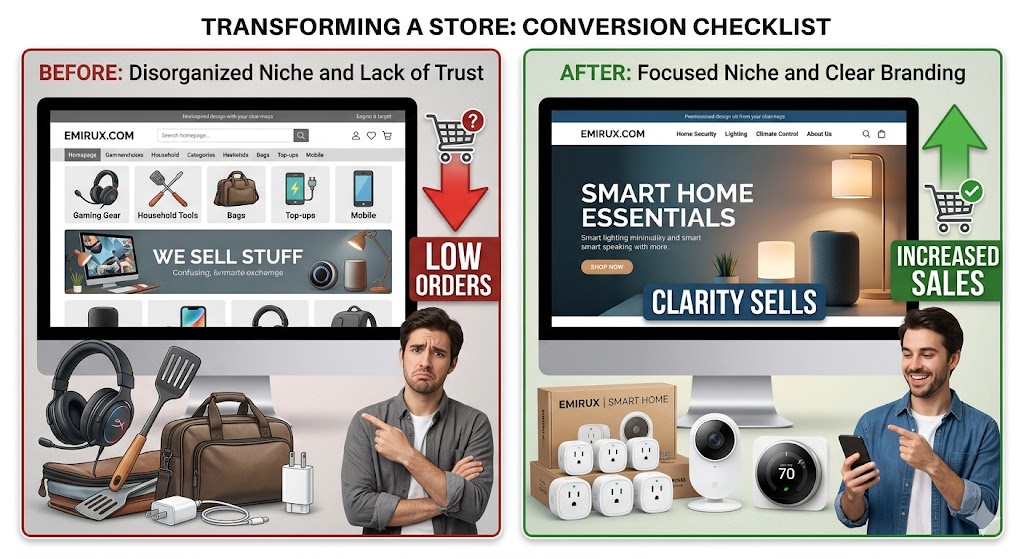
3. Your Product Selection Feels Too Random
One major issue many stores face is selling too many unrelated products.
For example:
- Gaming accessories
- Household tools
- Bags
- Mobile accessories
- Game top-ups
When customers see unrelated categories, they get confused.
They ask:
“What kind of store is this?”
This weakens trust immediately.
People trust specialized stores more than general stores.
A store focused only on smart home products feels stronger than a store selling everything.
4. Narrow Your Product Niche
Instead of trying to sell everything, focus on one strong category.
Choose a niche like:
- Home improvement products
- Gaming accessories
- Tech gadgets
- Travel accessories
- Fashion essentials
This helps in several ways:
- Stronger branding
- Better ad targeting
- Higher customer trust
- Easier product recommendations
- Better repeat purchases
Niche stores convert better because customers understand the value faster.
Clarity sells.
Confusion kills conversions.
5. Product Pages Need Better Selling Power
Even if your products are good, poor product pages reduce sales.
Customers need more than product images.
They need reasons to buy.
Your product pages should include:
- Clear product benefits
- Real use cases
- High-quality images
- Customer reviews
- Shipping details
- Return policy
- Guarantees
- Frequently asked questions
Do not just describe features.
Sell outcomes.
For example:
Bad:
“Wireless mouse with USB connection”
Better:
“Smooth wireless mouse designed for faster work, better comfort, and clutter-free productivity”
People buy benefits, not specifications.
6. Fix the Cart Experience
Another major issue is poor cart flow.
If customers click “Add to Cart” and are immediately redirected awkwardly, it breaks momentum.
A smoother experience helps significantly.
Recommended improvements include:
- Slide-out cart instead of page redirect
- Free shipping progress bar
- Cross-sell suggestions
- Upsell recommendations
- Quick checkout options
Example:
“Add ₹500 more for Free Shipping”
This increases average order value and keeps customers engaged.
A better cart experience directly improves conversions.
7. Do Not Overload the Store with Too Many Apps
Many store owners install too many apps hoping to fix problems quickly.
This often creates:
- Slow website speed
- Broken design consistency
- Confusing customer experience
- Higher monthly costs
Instead of multiple separate apps, use fewer powerful solutions that combine features.
Simple stores convert better.
Customers should feel clarity, not complexity.
8. Build Strong Trust Signals
People buy from stores they trust.
If trust signals are missing, even good products struggle.
Essential trust elements include:
- Contact page
- About Us page
- Refund policy
- Shipping policy
- Customer reviews
- Secure payment badges
- Social proof
- Business email address
- Professional branding
Many customers decide based on these details, especially for first-time purchases.
Trust reduces hesitation.
9. Marketing May Be the Real Problem
Sometimes the store is fine—but the wrong people are visiting.
You need qualified traffic, not just random visitors.
Important questions:
- Which country are you targeting?
- Where is your traffic coming from?
- How many daily visitors do you get?
- Are visitors leaving quickly?
- Are ads targeting the right audience?
Without the right audience, even a perfect store struggles.
Traffic quality matters more than traffic quantity.
10. Paid Ads Need Better Strategy
Many beginners run Facebook or Google ads too early without proper structure.
This leads to:
- Wasted budget
- Poor conversion rates
- Wrong customer targeting
Before scaling ads, make sure:
- Product pages are strong
- Homepage builds trust
- Checkout flow is smooth
- Store niche is clear
Then focus on:
- Facebook Ads
- Instagram Ads
- Google Shopping Ads
- Retargeting campaigns
Ads should bring the right people—not just more people.
11. Understand Whether the Problem Is Traffic or Conversion
This is critical.
There are two different problems:
Problem A: Low Traffic
Very few people visit the store.
Solution:
Focus on ads, SEO, influencer marketing, and social traffic.
Problem B: Low Conversion
Many visitors come, but few buy.
Solution:
Improve trust, design, product pages, and checkout experience.
Most people try to solve Problem B with more ads.
That usually wastes money.
First diagnose correctly.
12. Customer Psychology Is More Important Than Design
Beautiful design alone does not create sales.
Customers buy when they feel:
- Trust
- Need
- Urgency
- Confidence
- Convenience
Your store should answer:
“Why should I buy now?”
Use:
- Limited offers
- Free shipping thresholds
- Bundle discounts
- Social proof
- Customer testimonials
Emotional confidence drives purchases.
13. Review Competitor Stores
Look at successful stores in your niche.
Study:
- Their homepage
- Their product descriptions
- Their checkout flow
- Their offers
- Their trust signals
Do not copy.
Understand what makes them convert.
Learning from strong competitors saves time.
14. Long-Term Growth Requires Brand Identity
Many stores fail because they only focus on products, not the brand.
Products can be copied.
Brand trust cannot.
Ask yourself:
What does Emirux stand for?
If customers remember only the product and not the brand, long-term growth becomes difficult.
Build:
- A recognizable style
- Consistent messaging
- A clear promise
- A trustworthy customer experience
This creates repeat buyers.
Practical Priority List for Improvement
Do these first:
Step 1
Fix homepage trust and brand clarity
Step 2
Choose a stronger niche and remove unrelated products
Step 3
Improve product pages with stronger benefits and trust signals
Step 4
Improve cart flow and checkout experience
Step 5
Review traffic quality and marketing targeting
Step 6
Scale ads only after conversion issues are fixed
This order matters.
Do not spend heavily on marketing before fixing store experience.
Final Thought
Low orders do not always mean bad products.
Often, they mean customers are unsure.
Your store must remove doubt.
Customers should instantly understand:
- What you sell
- Why it matters
- Why they should trust you
- Why they should buy now
That is how sales happen.
Conclusion
For a store like emirux.com, success will not come from randomly changing products or adding more apps. It will come from improving clarity, trust, customer experience, and strategic marketing.
A strong homepage, a focused niche, better product pages, smoother cart flow, and qualified traffic can completely change store performance.
The goal is simple:
Turn visitors into confident buyers.
Because in eCommerce, people do not buy when they are interested.
They buy when they feel sure.
That is the real improvement your store needs.