Running both wholesale (B2B) and retail (B2C) from a single store is one of the most common but challenging situations for growing businesses. It becomes even more complex when the business has been operating as a wholesale-first model for many years and wants to introduce a retail offering without disrupting existing operations.
This is exactly the situation many long-established businesses face. A store built entirely for approved wholesalers now wants to add a small retail section for direct customers. The challenge is not simply adding a retail page—it is maintaining the existing wholesale structure while introducing separate pricing, customer experience, and access rules for retail buyers.
The biggest concern is clear:
How can you manage wholesale and retail pricing separately while keeping one inventory, without duplicating products, and without breaking the current wholesale system?
This is a strategic problem because inventory, pricing, customer permissions, and store design all connect together.
Let’s break down the best practical approach.
Understanding the Core Problem
The store has been operating for over 12 years as a fully wholesale business. The current setup is designed so that:
Only approved wholesalers can view products and prices
The product flow is built around wholesale buyers
Inventory is managed from one source
The client does not want duplicate inventory
The wholesale structure must remain untouched
Now, the business wants to introduce a small retail offering.
The initial plan was smart:
Create a dedicated Retail page
Create a Retail collection
Add retail-specific features like banners, popups, free shipping messages, and filters
Use the same products and same inventory
To avoid duplicate products, a separate retail catalogue was created with a 250% markup under the same market.
This worked for pricing—but a major limitation appeared:
The retail catalogue pricing cannot be displayed only on one specific retail page.
This creates the main problem.
Why Product Duplication Feels Like the Easy Solution
At first glance, duplicating products seems like the simplest answer.
You create:
Wholesale products
Retail products
Different pricing for both
Separate visibility rules
Dedicated retail page control
This solves pricing visibility quickly.
But it creates serious long-term problems.
Problems with product duplication:
Inventory becomes harder to manage
Stock syncing becomes risky
Overselling becomes more likely
Reporting becomes messy
Product maintenance doubles
Updates must be repeated
Human errors increase
For a business with years of wholesale operations, this is usually a bad long-term strategy.
That is why avoiding duplication is the smarter goal.
The Best Strategy: One Inventory with Customer-Based Pricing
The strongest solution is usually not product duplication—it is customer segmentation.
Instead of changing products, you change who sees what.
This means:
Retail customers see standard retail pricing
Approved wholesale customers see wholesale pricing
Both use the same product inventory
This keeps operations clean and scalable.
The store stays simple behind the scenes while the customer experience changes based on user type.
This is often the most professional solution.
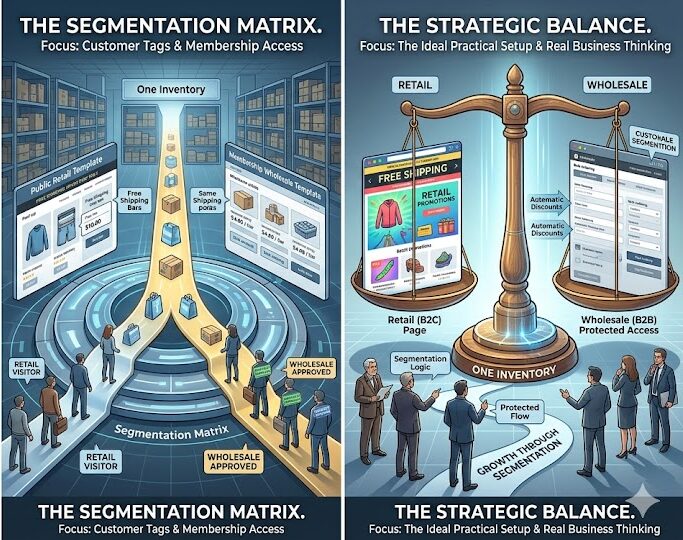
Customer Tags and Membership-Based Access
One of the most practical ways to manage this is through customer tags.
How it works:
Approved wholesale buyers receive a customer tag
Example:
Wholesale Approved
Retail visitors remain untagged
The system uses these tags to control:
Product visibility
Pricing visibility
Access to Add to Cart
Collection access
Special pages
Wholesale-only navigation
This keeps the wholesale flow protected while allowing retail visitors to shop normally.
It also avoids changing the product database.
One inventory stays intact.
Separate Pricing Without Duplicating Products
The real challenge is not access—it is pricing.
How do you show two different prices for the same product?
This can be handled using pricing logic rather than separate products.
Approaches include:
Wholesale customers receive special pricing after login
Retail visitors see public retail pricing
Automatic discounts apply to approved wholesale buyers
Special pricing rules based on customer groups
This allows:
Same product
Same inventory
Different visible pricing
No duplication
This is much cleaner than maintaining two separate product versions.
Retail-Specific Page Logic Can Still Work
One concern was:
Can retail-specific logic exist only on one page?
Yes—this is possible using page-specific theme customization.
For example:
Retail page can have:
Free shipping bar
Retail popup banners
Retail filters
Retail-focused promotions
Retail messaging
Wholesale pages remain unchanged.
This means the customer experience changes without changing the inventory structure.
The page design can be different even if the products are the same.
This solves a major part of the issue.
Why Separate Catalogues Have Limitations
Creating a separate retail catalogue with a markup sounds correct in theory.
And it often works for pricing internally.
But catalogue display rules can be restrictive.
The problem is:
Catalogue pricing is usually tied to customer access and market settings—not individual page display.
This means:
You cannot always show one catalogue only on one specific page while keeping the rest unchanged.
This is where many store owners get stuck.
Catalogues are powerful, but not flexible enough for page-specific retail-only pricing control.
That is why customer segmentation often works better.
Alternative Approach: Retail Product Templates
Another strong option is using separate product templates.
This does not mean duplicate products.
It means:
The same product uses a different visual template for retail presentation.
For example:
Retail template shows:
Public pricing
Free shipping messaging
Retail trust badges
Consumer-friendly layout
Wholesale template shows:
Wholesale-focused information
Bulk ordering structure
Restricted pricing visibility
Professional wholesale flow
This allows different selling experiences using the same inventory.
This is a powerful middle-ground solution.
Protecting Wholesale Access
The client’s biggest concern is preserving wholesale operations.
This must remain the top priority.
The solution should never weaken:
Wholesale buyer approval system
Restricted access
Existing navigation flow
Wholesale purchasing process
Long-term buyer relationships
Retail should be added without disturbing this foundation.
That means:
Wholesale-first structure remains
Retail becomes an additional layer—not a replacement
This is the safest business decision.
Why Automatic Discounts Can Help
Some stores simplify pricing by using automatic discounts for wholesale buyers.
Instead of showing low wholesale pricing publicly:
Retail price remains visible
Approved wholesale customers receive automatic price adjustments
This keeps pricing protected.
It also prevents public retail visitors from seeing wholesale rates.
For businesses that want pricing privacy, this is often very useful.
Especially when wholesale margins are sensitive.
Inventory Management Must Stay Centralized
One inventory is not just a preference—it is operationally important.
Benefits of one inventory:
Cleaner stock management
Accurate reporting
Lower overselling risk
Simpler product updates
Better forecasting
Faster fulfillment
Reduced admin work
Once products are duplicated, these benefits disappear quickly.
That is why maintaining one inventory should remain a core business rule.
Common Mistakes to Avoid
Many stores make mistakes during B2B to B2C expansion.
Avoid these:
Duplicating products too early
Changing the wholesale structure too aggressively
Creating too many manual pricing rules
Using inconsistent customer permissions
Making retail visible before trust systems are ready
Overcomplicating product management
The goal should always be:
Simple backend + controlled frontend experience
Complexity should never reach daily operations.
The Ideal Practical Setup
The strongest long-term setup usually looks like this:
One product inventory
One product database
Wholesale customers approved by tags or membership
Retail customers access dedicated retail page
Different pricing shown based on customer type
Retail-specific banners and UI only on retail pages
Wholesale flow remains unchanged
Automatic discounts or customer-based pricing for wholesale
This creates stability without duplication.
It protects both business models.
Real Business Thinking
This is not just a technical problem.
It is a business strategy decision.
Ask:
Which system will still work smoothly after 2 years?
Which solution reduces manual work?
Which protects customer trust?
Which supports growth without constant fixes?
Usually, the answer is not duplication.
It is controlled segmentation.
Good systems scale.
Quick fixes create future problems.
Final Recommendation
Based on the situation, duplicating products should be the last option—not the first.
The recommended path is:
Use customer-based access control
Use customer tags for wholesale approvals
Use one shared inventory
Use pricing rules for wholesale pricing
Keep retail pricing public
Use separate page logic for retail experience
Consider separate templates for stronger presentation control
Use automatic discounts if pricing privacy matters
This protects the wholesale-first business while introducing retail safely.
It is cleaner, smarter, and more scalable.
Conclusion
Managing wholesale and retail from one store without duplicating products is absolutely possible, but it requires the right strategy.
The biggest mistake is treating the problem as a product issue.
It is actually a customer access and pricing visibility issue.
By focusing on customer segmentation, page-specific experience, and controlled pricing rules, businesses can run B2B and B2C successfully from one inventory source.
For a wholesale-first business with a strong existing structure, preserving that foundation is critical.
Retail should be added as an extension—not as a disruption.
The best solution is not the easiest short-term fix.
It is the system that protects operations, supports growth, and keeps the business stable for years to come.
Because in eCommerce, smart structure always wins over temporary shortcuts.