Running an ecommerce store does not always mean choosing between traditional inventory management and dropshipping. Businesses can combine both fulfillment methods to create a flexible business model that allows them to sell different types of products without managing every order in the same way.
This approach is commonly known as hybrid dropshipping.
A hybrid dropshipping business keeps some products in its own inventory and fulfills those orders directly, while other products are shipped to customers by external suppliers. This model can be particularly useful for businesses selling gift baskets, personalized products, handmade items, and complementary products sourced from different suppliers.
For example, a gift store may prepare and package its own gift baskets while also selling candles, accessories, chocolates, or decorative products supplied directly by other businesses.
Although this model offers flexibility, it also creates operational challenges. Inventory needs to be tracked correctly, orders must be routed to the right fulfillment method, and customers need clear information about shipping timelines.
The good news is that hybrid dropshipping can work smoothly when products, inventory, and fulfillment processes are organized properly.
What Is a Hybrid Dropshipping Model?
A hybrid dropshipping model combines two fulfillment methods within the same online store.
The first method is self-fulfillment, where the business purchases or prepares products, stores them, packs orders, and ships them directly to customers.
The second method is dropshipping, where an external supplier stores the products and ships them directly to customers after receiving an order.
Instead of depending entirely on one method, the business chooses the most suitable fulfillment approach for each product.
For example, consider an online gift store selling:
- Handmade gift baskets
- Personalized gift boxes
- Decorative candles
- Greeting cards
- Plush toys
- Chocolates
- Home accessories
The business may prepare gift baskets in-house because they require careful assembly, customization, and packaging.
However, it may dropship decorative candles, plush toys, and home accessories because these products are already available through external suppliers.
This allows the business to offer a wider product range without purchasing and storing every item.
Why Businesses Choose Hybrid Dropshipping
There are several reasons why businesses prefer combining self-fulfillment with dropshipping.
1. Greater Product Variety
One of the biggest advantages is the ability to offer more products without maintaining a large warehouse.
A business can keep important products or gift-basket components in its own inventory while adding complementary products through external suppliers.
For example, a gift basket business may prepare its own birthday hampers but also offer additional products such as decorative items, accessories, or toys.
Customers get more purchasing options, while the business avoids investing heavily in every product.
2. Better Control Over Special Products
Some products require special attention before shipping.
Gift baskets are a good example because they may include multiple items arranged together with customized packaging, greeting cards, ribbons, or personalized messages.
If these products are fulfilled directly by an external supplier, the business may have less control over the final presentation.
Self-fulfillment allows the business to inspect components, maintain quality standards, and create a consistent customer experience.
3. Reduced Inventory Investment
Dropshipping helps businesses sell products without purchasing stock in advance.
This can reduce the amount of money tied up in inventory.
Instead of buying hundreds of accessories or decorative products, the business can work with suppliers who maintain their own stock.
At the same time, it can maintain a limited inventory of products that require direct preparation or assembly.
4. More Flexible Business Operations
A hybrid model allows businesses to choose fulfillment methods according to product requirements.
Products that require customization can be handled internally, while standard products can be shipped by suppliers.
This flexibility makes it easier to expand a product catalog without completely changing existing operations.
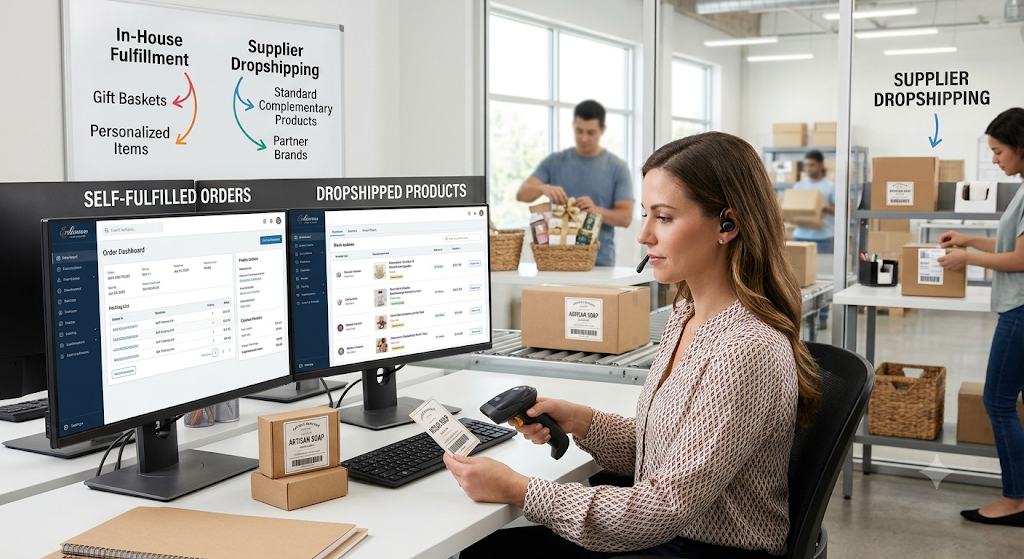
How to Separate Self-Fulfilled and Dropshipped Products
The most important part of managing hybrid dropshipping is clearly identifying which products belong to each fulfillment method.
Every product should have a defined fulfillment responsibility.
For example:
| Product | Fulfillment Method |
| Handmade gift basket | Self-fulfilled |
| Personalized gift box | Self-fulfilled |
| Custom greeting card | Self-fulfilled |
| Decorative candle | Dropshipped |
| Plush toy | Dropshipped |
| Home accessory | Dropshipped |
This separation prevents confusion when orders arrive.
A product should not be treated as both self-fulfilled and dropshipped unless the business has deliberately created a clear backup fulfillment process.
If the same product can be shipped from multiple locations without proper rules, staff may accidentally process it twice or send it through the wrong supplier.
A clear product-level fulfillment assignment makes daily operations much easier.
Inventory Management for Gift Baskets
Gift baskets require special inventory planning because they are often made using several individual components.
For example, a birthday gift basket may contain:
- One decorative basket
- Two chocolates
- One small toy
- One greeting card
- One ribbon
- One decorative wrapping material
Even though customers purchase the complete basket as a single product, the business needs to monitor the availability of its individual components.
Imagine the business has enough materials to prepare only ten gift baskets.
If the store continues accepting orders after those components are exhausted, customers may purchase products that cannot be fulfilled.
This creates overselling problems and can lead to cancellations, delays, and customer dissatisfaction.
The best approach is to track the components as actual inventory.
When a gift basket is sold, the available quantities of its components should be reduced accordingly.
For example, if one basket uses two chocolates, selling five baskets should reduce the chocolate inventory by ten units.
This helps the business understand its actual production capacity.
Managing Inventory for Dropshipped Products
Dropshipped products require a different inventory approach.
In this model, the supplier maintains the physical stock and fulfills orders directly.
The store therefore needs a reliable way to understand whether products are available.
There are two common approaches.
Supplier Stock Updates
The supplier may provide regular inventory updates through a product feed, file, or system connection.
These updates help the store reflect current product availability.
For example, if a supplier has 50 decorative candles available and later sells 20 through other channels, the store should receive updated stock information.
Frequent updates reduce the risk of accepting orders for unavailable products.
Untracked Inventory
For some suppliers, real-time stock information may not be available.
In such cases, the store may choose not to track inventory directly for those products.
However, this approach creates additional risk.
The business should have a reliable process for checking availability with the supplier before confirming fulfillment.
Untracked inventory should not mean ignoring stock availability. It simply means the store is not maintaining the supplier’s inventory quantity as its own physical stock.
Managing Orders With Different Fulfillment Methods
Another important challenge appears when customers purchase multiple products in a single order.
Consider a customer who purchases:
- One handmade gift basket
- Two decorative candles
- One plush toy
The gift basket is prepared and shipped by the store.
The candles and plush toy are shipped by the supplier.
This means the same order has two different fulfillment responsibilities.
The business needs a process that separates these items correctly.
Separate Fulfillment Workflows
The most practical solution is to create distinct workflows for each fulfillment method.
Self-fulfilled products should be assigned to the in-house team.
Dropshipped products should be assigned to the relevant supplier.
Staff should be able to identify these responsibilities without manually investigating every product.
Order tags, fulfillment locations, SKU prefixes, or internal product labels can help.
For example:
- SELF for products fulfilled internally.
- DROP for products fulfilled by suppliers.
A product with a SELF identifier goes to the in-house packing team.
A product with a DROP identifier follows the supplier fulfillment process.
If multiple suppliers are involved, additional identifiers can help distinguish which supplier is responsible for each product.
The main objective is to make fulfillment responsibilities clear and consistent.
Why SKUs Are Important
A Stock Keeping Unit (SKU) is a unique identifier assigned to a product or product variation.
In a hybrid fulfillment business, SKUs can help identify not only what a product is but also how it should be fulfilled.
For example:
| Product | SKU |
| Birthday Gift Basket | SELF-GB001 |
| Personalized Gift Box | SELF-GB002 |
| Decorative Candle | DROP-DC001 |
| Plush Toy | DROP-PT001 |
These identifiers make it easier for employees to recognize product responsibilities.
They also help prevent mistakes when the business processes multiple orders.
However, SKU naming alone is not enough. The fulfillment method should also be configured and documented in the store’s internal processes.
Handling Orders That Arrive in Separate Packages
One of the biggest customer experience challenges in hybrid dropshipping is split shipping.
When an order contains both self-fulfilled and dropshipped products, customers may receive multiple packages.
For example, a gift basket may arrive within two days, while a decorative candle shipped by another supplier may arrive four days later.
This is not necessarily a problem if customers understand what to expect.
However, if the store promises that everything will arrive together, separate deliveries may create confusion.
The business should communicate clearly that products in the same order may arrive in different packages and on different dates.
Important information to share includes:
- Whether an order may be split into multiple shipments
- Estimated delivery time for each product
- Whether separate tracking numbers will be provided
- Which products are shipped directly by suppliers
- How customers can contact support if a package is delayed
Clear communication reduces unnecessary support requests and improves customer confidence.
Shipping Costs and Delivery Expectations
Different fulfillment methods may also involve different shipping costs.
Self-fulfilled products may use the store’s regular shipping arrangements.
Dropshipped products may have shipping charges determined by the supplier.
When customers purchase products from both categories, the store needs to understand how shipping costs are calculated.
For example, a customer buying a gift basket and a dropshipped candle may receive two shipments.
The business should decide whether shipping charges will be:
- Combined into one customer-facing shipping charge
- Calculated separately for different fulfillment groups
- Included in product prices
- Offered free above a particular order value
The best approach depends on product margins, supplier agreements, and customer expectations.
The business should also avoid promising delivery dates that cannot be supported by its suppliers.
Quality Control and Supplier Management
Hybrid dropshipping gives businesses more flexibility, but it also means that product quality may be managed by different parties.
For self-fulfilled products, the business can inspect items before packing.
For dropshipped products, quality control depends heavily on the supplier.
This makes supplier selection important.
Before working with a dropshipping supplier, the business should check:
- Product quality and consistency.
- Actual inventory availability.
- Order processing time.
- Shipping methods and delivery estimates.
- Packaging standards.
- Return and refund procedures.
- Communication and support.
- Ability to handle increased order volumes.
It is also useful to place test orders before adding products to the store.
This helps the business understand the actual delivery experience and identify problems before customers encounter them.
Common Challenges in Hybrid Dropshipping
Although the model is workable, businesses should prepare for several operational challenges.
1. Inventory Confusion
If gift-basket components are not tracked correctly, the business may accept orders it cannot fulfill.
2. Incorrect Fulfillment Assignment
If products do not have clear fulfillment responsibilities, employees may send orders to the wrong supplier or process them internally by mistake.
3. Split Shipment Confusion
Customers may contact support when they receive only part of their order.
4. Supplier Stock Changes
A dropshipping supplier may run out of stock after a customer places an order.
5. Different Delivery Timelines
Products shipped from different locations may arrive on different dates.
6. Complicated Returns
Self-fulfilled and dropshipped products may have different return addresses and procedures.
These challenges can be managed through clear product assignments, regular inventory updates, supplier agreements, and transparent customer communication.
Best Practices for Running a Hybrid Dropshipping Store
Businesses can simplify operations by following a few practical rules.
Create separate product categories internally: Identify which products are self-fulfilled and which are dropshipped.
Assign unique SKUs: Use consistent identifiers to make fulfillment responsibilities clear.
Track gift-basket components: Maintain accurate inventory for every item used in assembled products.
Monitor supplier availability: Use stock updates where available and confirm availability when necessary.
Create separate fulfillment workflows: Ensure that each product reaches the correct team or supplier.
Communicate split shipments: Inform customers that different products may arrive separately.
Define return procedures: Establish clear processes for products handled internally and those fulfilled by suppliers.
Review operations regularly: Monitor delayed shipments, inventory errors, supplier issues, and customer complaints.
Final Takeaway
A hybrid dropshipping model can be an effective way to run an ecommerce store that sells both assembled products and supplier-fulfilled items.
It allows businesses to maintain control over special products such as handmade gift baskets while expanding their catalog through dropshipping.
The key to making this model successful is organization.
Every product should have a clearly assigned fulfillment method. Gift-basket components should be tracked as real inventory, while dropshipped products should follow a separate supplier inventory process.
Orders containing products from both fulfillment methods should be divided into the correct workflows, and customers should be informed when shipments may arrive separately.
The most important rule is to avoid ambiguity. A product should have a clear fulfillment responsibility, and employees should never have to guess who is supposed to ship it.
With proper SKU management, inventory tracking, supplier coordination, and customer communication, businesses can combine self-fulfillment and dropshipping without making daily operations unnecessarily complicated.
Hybrid dropshipping is not about managing two systems randomly. It is about creating one organized store with two clearly defined fulfillment processes.


0 Comments