Metaphysical products are becoming increasingly popular in online retail. Many people shop for crystals, meditation accessories, spiritual décor, incense holders, journals, tarot-related items, shells, feathers, gemstones, and other products connected to mindfulness, self-care, rituals, and personal expression.
For someone starting an online store in this category, one of the biggest questions is where to find reliable suppliers. Dropshipping can seem like an easy option because it allows a seller to list products online without buying large amounts of inventory upfront. When a customer places an order, the supplier ships the product directly to the customer.
However, sourcing metaphysical products requires more care than sourcing generic items. Customers may care deeply about product authenticity, material identity, quality, packaging, and the overall experience. A crystal customer may expect the stone to look similar to the product image. A meditation customer may expect natural materials, safe packaging, and accurate descriptions. If the product does not match expectations, the seller may face returns, complaints, and negative reviews.
The discussion focuses on finding dropshipping or wholesale suppliers for crystals, metaphysical items, meditation products, shells, feathers, and related accessories. Several supplier types are mentioned, including meditation and yoga product suppliers, international sourcing services, crystal wholesalers, and marketplace-based product sourcing options. The most important advice in the discussion is not simply to find a supplier, but to carefully verify product quality, reliability, shipping, and product claims before launching.
This article explains how to source metaphysical products online, what to check before choosing suppliers, how to avoid common risks, and how to build a more trustworthy store.
Understanding the Metaphysical Product Market
Metaphysical products can include a wide range of items.
Common categories include:
- Crystals and gemstones
- Meditation accessories
- Yoga-related products
- Incense holders
- Candles
- Journals
- Tarot accessories
- Spiritual décor
- Shells and feathers
- Mala beads
- Altar items
- Moon-themed décor
- Aromatherapy accessories
- Gift sets
Customers may purchase these products for different reasons.
Some may enjoy them as decorative items. Others may use them for meditation, self-care, journaling, gifting, spiritual practices, or personal rituals.
Because the category is connected to personal beliefs and emotions, product presentation matters greatly. Customers often want products that feel meaningful, beautiful, and authentic.
Why Supplier Choice Matters
The supplier has a major impact on the customer experience.
A good supplier can provide:
- Accurate product descriptions
- Clear material details
- Consistent product quality
- Reliable stock availability
- Secure packaging
- Reasonable delivery times
- Tracking information
- Responsive customer support
A poor supplier can create serious problems.
For example, customers may receive:
- Crystals that look very different from photos
- Damaged products
- Incorrect sizes
- Artificial materials described as natural
- Poor packaging
- Long shipping delays
- Missing orders
When this happens, customers usually blame the store, not the supplier.
This is why supplier research is one of the most important steps before launching.
Dropshipping Versus Wholesale Buying
Dropshipping allows sellers to start with lower upfront costs.
The seller does not need to purchase inventory before receiving orders. This can be helpful for testing product demand.
However, dropshipping also has limitations.
The seller may have less control over:
- Product quality
- Packaging
- Delivery speed
- Inventory updates
- Customer experience
Wholesale buying requires more upfront investment but gives the seller more control.
For example, a seller may buy a small batch of crystals, inspect them, photograph them, create custom packaging, and ship them directly to customers.
This can create a stronger brand experience.
The right option depends on the business goals.
Dropshipping may be useful for testing product categories. Wholesale may be better once the business knows which products customers prefer.
Types of Suppliers to Explore
There are several supplier types that may be useful for metaphysical products.
Meditation and Wellness Suppliers
Some suppliers focus on yoga, meditation, self-care, and wellness products.
Their catalogs may include:
- Meditation cushions
- Yoga accessories
- Incense holders
- Candles
- Journals
- Aromatherapy items
- Decorative accessories
These suppliers may be useful for stores that want to focus on mindfulness and lifestyle products rather than only crystals.
Crystal and Gemstone Wholesalers
Crystal wholesalers may offer products such as:
- Raw crystals
- Polished stones
- Crystal points
- Crystal towers
- Tumbled stones
- Gemstone jewelry
- Crystal gift sets
- Decorative mineral pieces
These suppliers may offer more variety, but sellers should carefully verify material identity and quality.
International Sourcing Services
International sourcing services can help sellers find products from manufacturers or wholesale markets.
They may offer:
- Product sourcing
- Quality checks
- Packaging options
- Order fulfillment
- Shipping support
- Product photography
This option may be useful for sellers who want more control over product selection and packaging.
However, communication, shipping timelines, and quality checks should be reviewed carefully.
Marketplace-Based Suppliers
Some online marketplaces allow sellers to search for products and connect them to their online stores.
These marketplaces may offer a wide range of metaphysical products, including crystals, jewelry, décor, and accessories.
They can be useful for product research, but sellers should not assume every listing is reliable.
It is important to compare sellers, review ratings, check product photos, and order samples.
The Importance of Product Authenticity
Authenticity is one of the biggest concerns in the metaphysical product category.
Customers may expect natural crystals, real gemstones, genuine shells, or responsibly sourced materials.
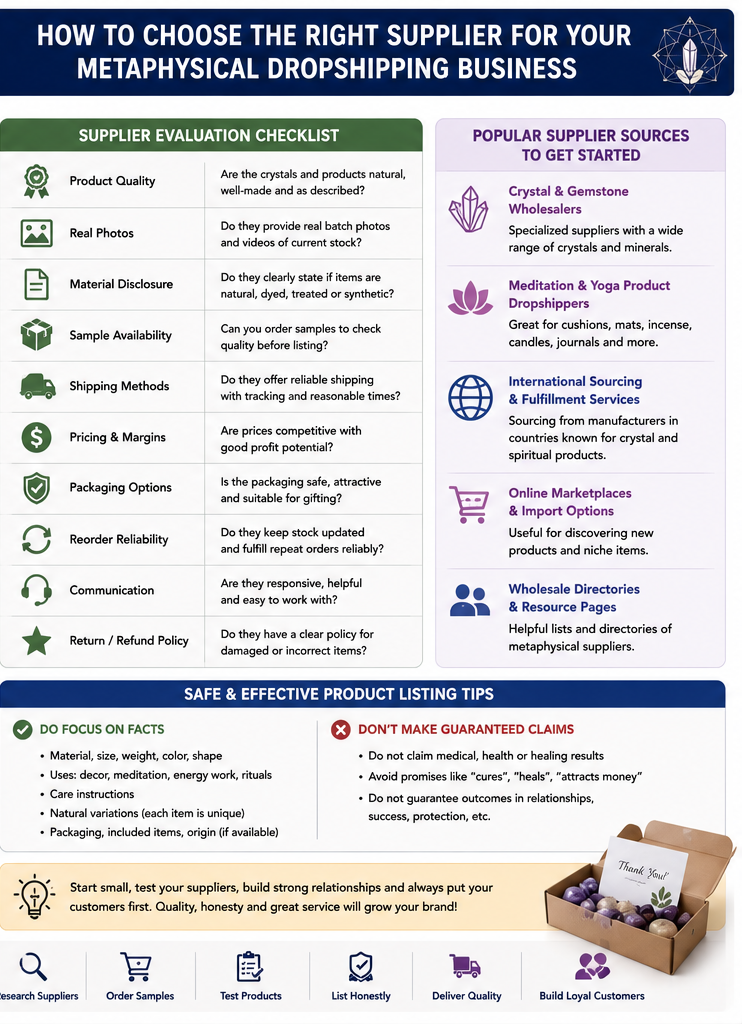
A supplier should clearly explain:
- Whether a stone is natural or dyed
- Whether a crystal is treated or enhanced
- Whether a product is handmade or factory-produced
- Where materials come from
- Whether the product contains synthetic materials
- Whether the item is polished, coated, or altered
For example, some brightly colored stones may be dyed. Some products may be glass or resin rather than natural crystal.
There is nothing wrong with selling artificial or decorative items if they are described honestly.
Problems happen when product descriptions are misleading.
Why Real Product Photos Matter
Supplier photos can sometimes be edited, reused, or inaccurate.
For metaphysical products, this can be especially risky because natural stones vary in color, shape, texture, and size.
A customer may expect a deep purple crystal but receive a pale or damaged item.
Before listing products, sellers should ask suppliers for:
- Real batch photos
- Videos of current stock
- Size comparisons
- Packaging photos
- Close-up images
- Material details
If possible, sellers should take their own product photos after ordering samples.
Original photos can make a store look more trustworthy and help customers understand what they are buying.
Ordering Samples Before Launching
Ordering samples is one of the best ways to reduce risk.
A sample order allows the seller to check:
- Product quality
- Material appearance
- Packaging
- Shipping speed
- Tracking quality
- Supplier communication
- Product consistency
For example, a seller may order several crystal products from different suppliers and compare them.
The seller can check whether the crystals are similar to the product images, whether they arrive safely, and whether the packaging feels professional.
A small sample investment can prevent larger problems later.
Checking Product Consistency
Natural products often vary.
Crystals, shells, feathers, wood, and handmade items may not look identical.
This is normal, but customers should be informed.
A product description can explain that each item may vary slightly in:
- Color
- Shape
- Pattern
- Texture
- Size
- Natural markings
This helps set realistic expectations.
However, variation should not become an excuse for poor quality.
A supplier should still provide products that match the general style, size range, and quality shown in the listing.
Packaging and Presentation
Packaging is important for metaphysical products.
Customers may buy these products as gifts, personal items, or meaningful purchases.
Simple but thoughtful packaging can improve the experience.
Suppliers should be asked about:
- Protective wrapping
- Gift packaging
- Branded inserts
- Product labels
- Care cards
- Breakage protection
Crystals and fragile items need strong packaging.
If a supplier does not package products safely, the seller may face frequent damage claims.
Shipping and Delivery Times
Shipping is another major factor.
Customers may be willing to wait for special products, but they still expect clear communication.
Sellers should ask suppliers:
- Where products ship from
- Which countries they deliver to
- Average delivery times
- Whether tracking is included
- How damaged items are handled
- Whether express shipping is available
- Whether shipping costs change by region
Long delivery times can lead to customer frustration.
It is better to be transparent about shipping timelines than to promise fast delivery that cannot be achieved.
Reorder Reliability
A product may sell well, but the supplier may not always have it in stock.
This can create problems if the seller promotes a popular item and then cannot fulfill future orders.
Before choosing a supplier, sellers should ask:
- How often stock is updated
- Whether best-selling items are regularly available
- Whether there are minimum order requirements
- Whether similar replacements are available
- Whether the supplier can reserve stock
Reliable reordering is especially important for gift sets, seasonal products, and popular crystal collections.
Avoiding Unsafe Product Claims
The discussion includes an important warning about product claims.
Metaphysical products should not be marketed with guaranteed health, medical, financial, or emotional outcomes.
For example, sellers should avoid claims that a crystal will cure illness, treat anxiety, guarantee wealth, or solve relationship problems.
These types of claims can create legal and ethical risks.
Safer product descriptions focus on factual details such as:
- Material
- Size
- Color
- Finish
- Style
- Packaging
- Care instructions
- Decorative use
- Meditation or journaling use
For example, instead of claiming that a product cures stress, a seller can describe it as a decorative stone often used in personal meditation spaces.
This keeps the description clear and responsible.
Creating Trustworthy Product Listings
A strong product listing should include:
- Clear product title
- Accurate material description
- Product size
- Weight if relevant
- Color information
- Product photos
- Care instructions
- Shipping information
- Return policy
- Natural variation notice
Customers are more likely to trust a store that provides detailed information.
Vague listings can create confusion and returns.
Choosing a Product Niche
The metaphysical market is broad.
A new store may benefit from focusing on a specific niche.
Possible niches include:
- Crystal décor
- Meditation accessories
- Spiritual gifts
- Moon-themed products
- Yoga and mindfulness items
- Natural gemstone jewelry
- Home altar accessories
- Self-care gift boxes
- Journaling and ritual supplies
A focused store is easier to market.
For example, a store focused on meditation gifts can create collections around relaxation, journaling, candles, and decorative items.
Building a Brand Instead of Only Listing Products
Many sellers make the mistake of simply listing products without creating a clear brand identity.
A stronger store has:
- A consistent visual style
- Clear product categories
- Helpful product descriptions
- Quality images
- Thoughtful packaging
- Customer support
- A clear store story
Customers may be more likely to purchase from a store that feels curated and trustworthy.
Starting With a Small Collection
New sellers should avoid adding hundreds of products immediately.
It is better to start with a small, carefully selected collection.
For example, a store may begin with:
- A few crystal types
- A small number of meditation accessories
- A few gift sets
- A few decorative items
This makes it easier to manage product quality, descriptions, customer questions, and supplier relationships.
Once the store learns what customers prefer, it can expand.
Conclusion
Finding suppliers for metaphysical products requires more than searching for the lowest price. Sellers need to consider authenticity, product quality, real photos, packaging, shipping, and reorder reliability.
Dropshipping can be a useful way to test products without buying large amounts of inventory. However, it also gives the seller less control over quality and fulfillment. Ordering samples, checking supplier communication, and reviewing real product details are essential steps before launching.
The safest approach is to begin with a small product collection, choose suppliers carefully, write honest product descriptions, and avoid unrealistic claims. By focusing on quality, transparency, and customer trust, sellers can build a more reliable and successful metaphysical product store.