Understanding Why a Dropshipping Store Isn’t Converting
Getting thousands of visitors to an online store can initially feel like a major achievement. Traffic is often one of the first things new ecommerce business owners focus on because more visitors should, in theory, create more opportunities to generate sales. However, receiving thousands of visitors without a single purchase can quickly become frustrating and confusing.
The discussion surrounding a dropshipping store with more than 3,000 visitors but zero sales highlights an important lesson: traffic alone does not guarantee revenue. A store can attract thousands of people and still fail to convert if the visitors are not the right audience, the products are not compelling enough, the pricing is uncompetitive, the website does not build trust, or the purchasing process creates friction.
In this case, the store owner explained that visitors were coming primarily through paid advertising on social media and search platforms. After the store URL was shared, participants suggested several possible reasons for the lack of sales. However, no single problem was confirmed because a proper diagnosis requires examining the advertising strategy, visitor behavior, product pages, pricing, checkout process, and overall customer experience.
The situation provides a useful example for anyone running a new dropshipping business. Instead of immediately spending more money on advertising, merchants should understand what visitors are doing once they arrive and identify exactly where the buying journey breaks down.
Traffic Is Not the Same as Demand
One of the biggest misconceptions among new ecommerce owners is that traffic automatically means demand.
A website can receive thousands of visitors without generating meaningful sales if those visitors are not genuinely interested in the products.
For example, an advertisement may receive many clicks because the image or headline is attractive. People may become curious and visit the store, but curiosity does not necessarily mean purchase intent.
This creates an important distinction between:
- Traffic
- Interest
- Purchase intent
- Conversion
A successful store needs all four stages to work together.
If advertisements generate large numbers of visitors but those visitors leave immediately, increasing advertising spend will not solve the underlying problem.
Are the Ads Reaching the Right People?
The first area that should be investigated is the quality of the traffic.
When advertisements are responsible for generating visitors, the business owner should examine whether the audience matches the intended customer.
A store selling jewelry, for example, may attract people who enjoy looking at fashion products but are not interested in purchasing them. Similarly, an advertisement may be shown to people who click because of curiosity, entertainment, or an attractive image rather than because they actually want the product.
Important questions include:
- Who is clicking the advertisements?
- What interests do these visitors have?
- What age groups are responding?
- Which locations generate the most traffic?
- Which advertisements produce the highest-quality visitors?
- How long do visitors stay on the website?
- Do visitors view multiple products?
A large number of inexpensive clicks may look impressive, but high-quality visitors are much more valuable than large volumes of irrelevant traffic.
The Difference Between Clicks and Customers
Advertising platforms often make it easy to measure clicks, impressions, and other engagement metrics.
However, these numbers do not necessarily indicate business success.
A campaign can generate thousands of clicks and still fail commercially.
The more important question is what happens after the click.
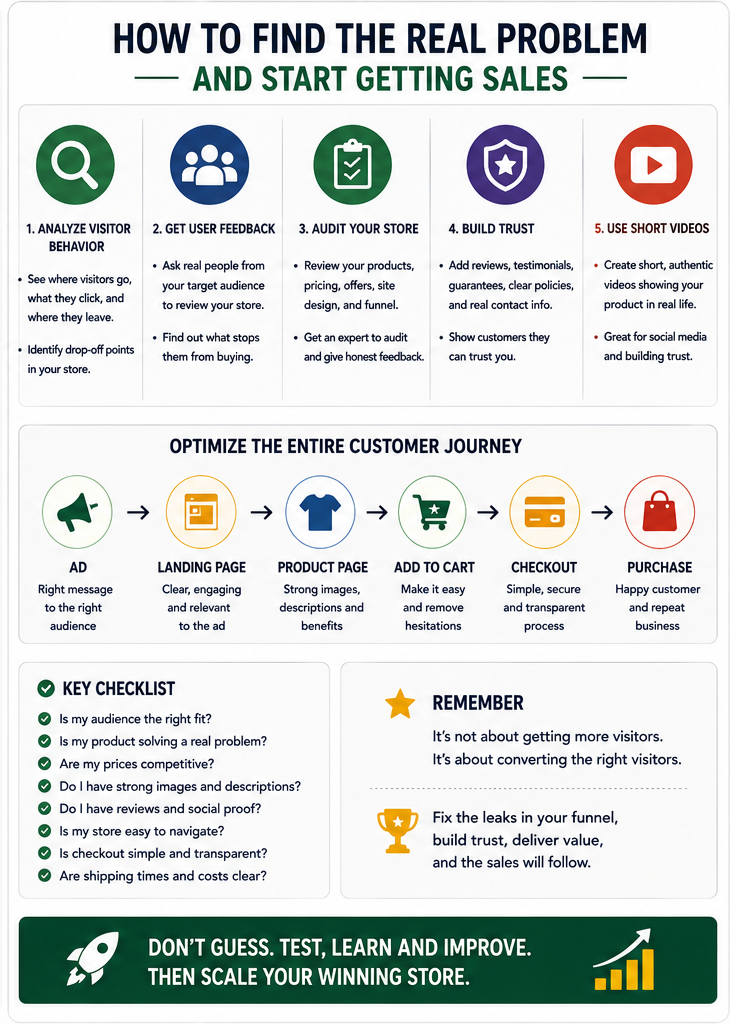
A useful customer journey looks something like this:
Advertisement → Product Page → Interest → Add to Cart → Checkout → Purchase
If visitors disappear between any of these stages, the business owner needs to identify why.
For example, if visitors arrive but immediately leave, the problem may be the landing page or audience.
If visitors view products but do not add them to the cart, the issue may involve pricing, product appeal, presentation, or trust.
If customers add products but abandon checkout, payment, shipping, unexpected costs, or checkout complexity may be responsible.
Product Selection Can Make or Break a Store
Another possible reason for zero sales is the product itself.
A product may look attractive to the store owner but fail to create enough value for customers.
Before investing heavily in advertising, merchants should ask:
- Does the product solve a real problem?
- Is it visually appealing?
- Is there enough demand?
- Is the price reasonable?
- Is the product different from competing products?
- Can customers easily find alternatives elsewhere?
Dropshipping stores often face intense competition because similar products may be available from many sellers.
If customers can find the same item from a recognized retailer at a similar or lower price, convincing them to purchase from an unfamiliar store becomes much more difficult.
Pricing Must Match Customer Expectations
Pricing is another major conversion factor.
A product can receive plenty of attention but still fail to sell because customers do not believe it is worth the asking price.
Customers naturally compare prices.
They may consider:
- Product cost
- Shipping charges
- Delivery time
- Product quality
- Brand reputation
- Return policy
A higher price can work if the store provides enough additional value.
That value could come from stronger branding, better packaging, faster shipping, excellent customer service, exclusive designs, or a compelling guarantee.
Without differentiation, a high price can become a major obstacle.
Product Descriptions Need to Sell the Product
A product page should do more than list specifications.
Customers need to understand why the product is worth buying.
A strong product description should explain:
- What the product is
- Who it is for
- What problem it solves
- Its main benefits
- Important specifications
- How it should be used
- What makes it different
Descriptions should also answer common customer questions before they become reasons not to purchase.
If customers have to search elsewhere for basic information, confidence may decrease.
Product Images Matter
Online customers cannot physically touch or inspect a product.
Images therefore become extremely important.
Poor-quality images can make a product look inexpensive, unreliable, or different from what the customer expects.
Strong product imagery should show:
- Multiple angles
- Product details
- Scale and dimensions
- Realistic usage
- Packaging where relevant
- Different variations
Consistency is also important.
If one product has professional images while another has low-quality supplier photographs, the store can appear unfinished.
Trust Is Essential for New Stores
A new dropshipping store faces an immediate disadvantage: customers may not know or trust the business.
Before entering payment details, customers often look for signals that the store is legitimate.
Trust can be strengthened through:
- Customer reviews
- Authentic testimonials
- Clear contact information
- Transparent shipping policies
- Straightforward return policies
- Secure payment presentation
- Professional product pages
- Consistent branding
- Genuine social proof
Without these elements, visitors may hesitate even when they like the product.
A customer may think:
“Will I actually receive this product?”
“Is this company legitimate?”
“What happens if something goes wrong?”
“Can I return the item?”
A successful store answers these questions before customers have to ask them.
The Checkout Experience Can Create Friction
Some stores successfully convince customers to purchase but lose them during checkout.
Potential problems include:
- Complicated forms
- Unexpected shipping costs
- Limited payment options
- Unexpected taxes
- Required account creation
- Unclear delivery dates
- Lack of reassurance
- Technical errors
A customer who has already decided to purchase should not encounter unnecessary obstacles.
The checkout process should be straightforward and transparent.
Unexpected costs are especially damaging because customers may feel that the business was not transparent about the final price.
Understanding Where Visitors Leave
One of the most important recommendations in the discussion is to examine visitor behavior rather than guessing.
Instead of simply looking at the total number of visitors, merchants should determine what those visitors actually do.
For example:
If 3,000 people visit the store and most leave within a few seconds, the problem may be the advertisement, landing page, or audience.
If visitors spend several minutes browsing but rarely view product pages, navigation or product presentation may be weak.
If many visitors view products but do not add anything to their carts, product value, pricing, or trust may be the problem.
If many visitors add products but do not complete payment, checkout or unexpected costs may be responsible.
This type of analysis transforms a vague problem into a specific one.
Direct User Feedback Is Extremely Valuable
Another recommended approach is asking real people from the target audience to review the store.
Business owners often become too familiar with their own websites.
They know where everything is located, understand their own products, and naturally assume that visitors will understand the same information.
New visitors do not have that knowledge.
User testing can reveal problems that the owner never noticed.
Participants can be asked:
- What do you think this store sells?
- Who do you think this product is for?
- Does the website look trustworthy?
- What would stop you from buying?
- Is the price reasonable?
- What information is missing?
- What concerns would you have before ordering?
Honest answers can reveal major conversion problems.
Avoid Increasing Advertising Spend Too Early
One of the biggest mistakes a struggling store can make is spending more money on advertising simply because sales are low.
If the existing traffic is not converting, more traffic may only increase the number of people who leave without buying.
The better approach is to identify the bottleneck first.
A store should be treated like a funnel.
If one stage is failing, improve that stage before increasing the volume entering the funnel.
Short-Form Content Can Build Confidence
Another recommendation is creating short product videos.
Videos can demonstrate:
- How a product looks in real life
- How it is used
- Product size
- Product features
- Packaging
- Customer experiences
Short-form content can also make the brand feel more authentic.
Customers often respond better to products being demonstrated naturally than to overly polished advertisements.
The goal is not simply to make attractive videos. The content should help customers understand the product and visualize themselves using it.
Social Proof Can Improve Conversion
People are more comfortable purchasing when they see evidence that others have already had positive experiences.
Social proof can include:
- Customer reviews
- Photos from customers
- Testimonials
- Product demonstrations
- Frequently purchased indicators
- Authentic user experiences
However, social proof should always be genuine.
Fake reviews may create short-term appearances of credibility but can seriously damage a business when discovered.
The Importance of a Professional Store
A successful store should look consistent across every page.
Important elements include:
- Clear navigation
- Consistent fonts
- Professional images
- Readable descriptions
- Strong product organization
- Visible policies
- Clear contact information
- Simple checkout
A professional appearance does not guarantee sales, but an unprofessional appearance can quickly destroy customer confidence.
A Better Way to Diagnose Zero Sales
Rather than changing everything at once, the store owner should investigate the customer journey step by step.
A practical process is:
- Examine the quality of advertising traffic.
- Determine which landing pages visitors reach.
- Study visitor behavior.
- Identify the most viewed products.
- Compare product pricing with competitors.
- Review product descriptions and images.
- Evaluate trust signals.
- Check shipping information.
- Examine cart abandonment.
- Review the checkout experience.
- Collect feedback from target customers.
- Make targeted improvements.
- Test again.
This approach makes it easier to determine which changes actually improve results.
What 3,000 Visitors Really Tell You
Receiving 3,000 visitors without sales is disappointing, but it is also valuable information.
It demonstrates that the business can generate attention.
The next challenge is converting that attention into genuine buying intent.
Instead of viewing the 3,000 visitors as wasted traffic, the owner can treat them as evidence that something in the conversion process needs investigation.
The goal should be to discover whether the problem is:
Audience → Product → Offer → Trust → Website → Checkout
Once the weak point is identified, improvements become much more focused.
Conclusion
A dropshipping store receiving thousands of visitors without generating sales is not necessarily a failure. It is a signal that something in the customer journey is preventing visitors from becoming buyers. The key is identifying that problem instead of simply increasing advertising expenditure.
The discussion highlights several possible causes, including poor audience targeting, weak product presentation, unsuitable pricing, insufficient trust signals, confusing website design, and friction during checkout. Each possibility requires investigation rather than assumptions.
The most effective approach is to study visitor behavior, collect honest feedback from potential customers, evaluate the store’s product pages and purchasing process, and improve the areas creating the greatest friction. Strong product images, persuasive descriptions, transparent policies, authentic social proof, professional branding, and useful short-form content can all contribute to a stronger customer experience.
Ultimately, successful ecommerce is not about getting the highest possible number of visitors. It is about attracting the right visitors and giving them enough value, confidence, and clarity to make a purchase. Once a store understands why visitors are leaving without buying, the path toward improving conversions becomes much clearer.