Supplier fulfillment speed is one of the most important operational factors in ecommerce. A store can have an attractive website, competitive prices, strong marketing, and good products, but customers can still have a poor experience if orders are not fulfilled on time.
For businesses that depend on suppliers to prepare and ship products, supplier performance directly affects the customer experience. A supplier that regularly takes too long to fulfill orders can create shipping delays, customer complaints, cancellations, refunds, negative reviews, and eventually lost customers.
The Shopify Community discussion behind this topic focuses on a simple but important question: Can store owners identify a supplier becoming slow before the problem becomes serious enough to affect customers?
A store operator created a system designed to monitor fulfillment activity and identify two different warning signs. The first is an order that remains unfulfilled for too long. The second is a supplier whose fulfillment performance becomes slower compared with its own normal history.
The creator says the system is already working from end to end and is now looking for feedback from store owners before deciding whether to charge for it.
This discussion is therefore less about a finished product and more about validating whether the problem is important enough for other merchants to pay to solve.
Why Supplier Fulfillment Speed Matters
When a customer places an order, they generally expect the store to process it within the timeframe communicated during checkout.
The customer usually does not care whether the store owns the inventory itself or relies on a supplier.
From the customer’s perspective, the store is responsible for the entire experience.
If an order is delayed because a supplier is slow, the customer will usually contact the store rather than the supplier.
This creates a difficult situation for businesses that rely on external fulfillment partners.
The store may have limited visibility into what is happening behind the scenes. An order can remain unfulfilled for several days before anyone notices that there is a problem.
By the time the merchant identifies the delay, the customer may already be asking for an update.
In some cases, the customer may cancel the order or decide not to purchase from the store again.
This makes supplier monitoring more than an operational issue. It can become a customer retention issue.
The Difference Between a Delayed Order and a Slow Supplier
One of the most interesting aspects of the discussion is that the system looks for two separate types of risk.
The first is an individual order that has remained unfulfilled for too long.
Imagine a store normally fulfills orders within one or two days. If one order has remained unfulfilled for five days, that order deserves attention.
This is an order-level warning.
The second type of warning looks at supplier behavior.
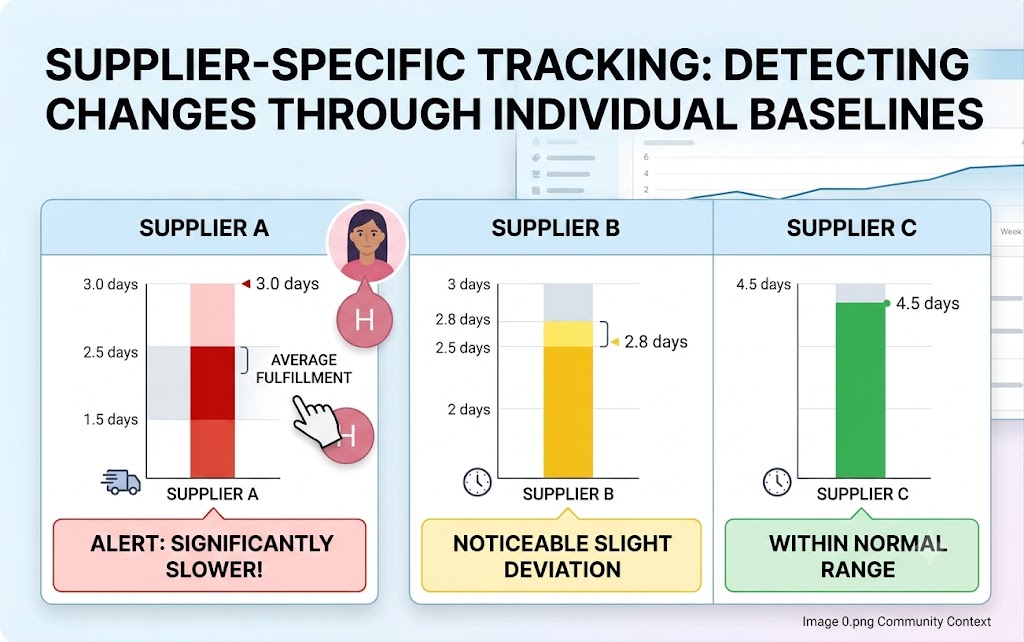
Suppose Supplier A normally fulfills orders within two days. Over several weeks, its average fulfillment time gradually increases to four or five days.
Even if no individual order has yet become extremely late, the supplier’s performance has clearly changed.
This is a supplier-level warning.
The difference is important because an individual delayed order could be an isolated problem.
A supplier becoming consistently slower may indicate a broader operational issue.
Why Historical Baselines Are Useful
Simply measuring whether a supplier is slow is not always enough.
Different suppliers can have different normal fulfillment times.
For example:
- Supplier A usually fulfills within one day.
- Supplier B usually fulfills within three days.
- Supplier C normally takes five days.
If all three suppliers take four days on a particular order, their situations are not necessarily the same.
Supplier A has become significantly slower than normal.
Supplier B is somewhat slower.
Supplier C may actually be performing faster than usual.
This is why comparing a supplier against its own historical baseline can provide more useful information than applying one universal threshold to every supplier.
The system described in the discussion attempts to identify exactly this type of change.
Instead of asking only, “Is this supplier slow?”
it asks:
“Is this supplier slower than it normally is?”
That distinction can make monitoring more relevant for stores working with multiple suppliers.
Detecting Problems Before Customers Complain
The biggest benefit of early detection is time.
Consider a typical sequence:
A customer places an order on Monday.
The supplier normally fulfills orders within two days.
By Wednesday, the order is still unfulfilled.
If nobody notices, Thursday passes.
On Friday, the customer contacts the store asking where the order is.
The store then investigates the issue and contacts the supplier.
At this point, the customer has already experienced a delay without receiving an explanation.
Now consider a different workflow.
The system identifies the unfulfilled order on Wednesday and alerts the store.
The merchant contacts the supplier before the customer complains.
The supplier explains that the product is temporarily unavailable.
The merchant can then contact the customer proactively, provide an updated timeline, or offer an alternative solution.
The underlying supplier problem may be the same, but the customer experience can be very different.
This is the value of early warning systems.
Monitoring Supplier Trends Instead of Individual Incidents
A store may have hundreds of orders every week.
Manually checking each order to determine whether fulfillment is progressing normally is difficult.
Even if an employee reviews unfulfilled orders every day, they may not notice gradual changes in supplier performance.
For example, a supplier might move from:
- 1.5 days average fulfillment time
- to 2 days
- then 2.5 days
- then 3 days
- and eventually 4 days
No single change may look dramatic.
But together, they indicate a clear trend.
The supplier is becoming slower.
A monitoring system can help surface this pattern so the merchant does not have to discover it manually.
Why Multiple Suppliers Make the Problem Harder
Supplier monitoring becomes more complicated as the number of suppliers increases.
A store working with one supplier may be able to maintain a close relationship and notice problems quickly.
A store working with 10, 20, or 50 suppliers has a very different operational challenge.
Each supplier may have:
- Different fulfillment times
- Different inventory levels
- Different working schedules
- Different shipping processes
- Different communication methods
- Different product categories
- Different reliability patterns
A single store-wide fulfillment threshold may therefore produce misleading results.
A supplier that normally takes four days should not necessarily be treated the same way as one that normally takes one day.
Supplier-specific monitoring can provide more useful context.
Unfulfilled Orders as an Operational Signal
Unfulfilled orders are an important source of information.
A growing number of unfulfilled orders may indicate:
- Supplier delays
- Inventory shortages
- Product availability problems
- Processing bottlenecks
- Communication failures
- Unexpected demand
- Internal fulfillment problems
Not every unfulfilled order is necessarily a problem.
Some orders may be intentionally delayed because the product is made to order or because the customer selected a later shipping date.
Therefore, the goal of monitoring should not simply be to identify every unfulfilled order.
The goal is to identify orders that appear abnormal based on the store’s expected fulfillment process.
This distinction helps reduce unnecessary alerts.
The Challenge of Too Many Alerts
An important consideration for any monitoring system is alert fatigue.
If a merchant receives warnings every time an order is slightly late, the alerts can quickly become overwhelming.
When too many warnings appear, people may start ignoring them.
That can defeat the purpose of the monitoring system.
A useful approach is to prioritize meaningful deviations.
For example, a store might want to know when:
- An order has exceeded the expected fulfillment window.
- A supplier’s average fulfillment time has increased significantly.
- A supplier’s performance has deteriorated consistently.
- A particular product is repeatedly associated with delays.
The goal is not to create more notifications.
The goal is to surface information that requires attention.
Turning Fulfillment Data Into Business Decisions
Monitoring supplier performance is useful only if the information leads to action.
Suppose a supplier’s fulfillment speed has declined.
The merchant might respond by:
- Contacting the supplier
- Asking about inventory availability
- Confirming whether the delay is temporary
- Moving selected products to another supplier
- Increasing safety stock
- Adjusting delivery expectations
- Temporarily removing certain products
- Changing the supplier for future orders
The monitoring system does not necessarily need to make these decisions automatically.
Its main purpose can be to give the merchant enough information to make the decision earlier.
This is particularly useful because supplier issues are often easier to solve when detected early.
Supplier Performance Can Affect Marketing
Supplier fulfillment is also connected to marketing.
A store may successfully acquire a customer through advertising, social media, search, or another marketing channel.
The customer completes a purchase.
But if the supplier takes too long to fulfill the order, the business may lose the customer despite having successfully completed the acquisition process.
This means the real cost of a slow supplier can extend beyond one delayed order.
A poor fulfillment experience can affect:
- Customer reviews
- Repeat purchases
- Refund rates
- Customer support workload
- Brand reputation
- Customer lifetime value
For businesses spending money to acquire customers, protecting the post-purchase experience is particularly important.
Why the Creator Is Asking for Merchant Feedback
The discussion is also an example of product validation.
The creator says the system is already working end to end but has not yet established whether enough merchants would find it useful to justify charging for it.
Instead of immediately launching a paid product, the creator is asking store owners about their operational situation.
Two questions are particularly useful:
How many suppliers do you manage?
and
How many unfulfilled orders do you typically have?
These questions help estimate how significant the problem is for different businesses.
A merchant with one supplier and very few unfulfilled orders may have little need for advanced monitoring.
A merchant managing dozens of suppliers and hundreds of pending orders may face a much greater operational burden.
This is why validation should focus not only on whether people say the idea is interesting but also on whether they experience the underlying problem frequently enough to care about solving it.
From Interesting Idea to Valuable Business Solution
An operational monitoring system becomes commercially valuable when it solves a problem that merchants experience frequently and that has a measurable cost.
For supplier monitoring, potential costs include:
- Lost sales
- Refunds
- Cancellations
- Support tickets
- Negative reviews
- Manual monitoring time
- Supplier management effort
- Customer retention problems
The more directly a system can help reduce these costs, the easier it may be for a merchant to understand its value.
However, the discussion does not establish that the product has achieved this level of validation yet.
The creator is still collecting feedback.
That means important questions remain open.
For example:
How frequently do merchants experience supplier delays?
How many suppliers are typically involved?
How much time do merchants spend monitoring fulfillment?
How quickly do merchants currently discover supplier problems?
How much does a delayed order typically cost?
Would merchants prefer notifications, dashboards, reports, or automated supplier performance summaries?
These questions can help determine whether the concept solves a widespread problem or mainly serves a narrower group of merchants.
What Store Owners Can Learn From This Discussion
The broader lesson is that ecommerce operations contain many problems that remain invisible until they affect customers.
A store may monitor sales, revenue, advertising performance, and conversion rates closely while paying less attention to fulfillment performance.
But the post-purchase experience is just as important to long-term customer relationships.
Supplier monitoring provides an example of how operational data can be used proactively.
Instead of waiting for a customer to report a problem, merchants can look for early signals.
Instead of judging every supplier using the same fixed standard, merchants can compare suppliers against their own normal performance.
Instead of manually checking every order, merchants can focus attention on exceptions.
These ideas can apply beyond supplier fulfillment as well.
Businesses can monitor unusual increases in refunds, customer complaints, delivery times, inventory shortages, or other operational metrics.
The principle is the same: identify meaningful changes early enough to act.
Conclusion
The Shopify Community discussion describes an early-stage solution designed to identify supplier fulfillment problems before they become serious customer-service issues.
The system focuses on two signals: individual orders that remain unfulfilled longer than expected and suppliers whose fulfillment speed becomes slower compared with their own historical performance.
This approach recognizes that supplier performance is relative. A fulfillment time that is normal for one supplier may be unusually slow for another.
The discussion is not yet a report of a completed product launch or a confirmed commercial solution. The creator is seeking feedback from store owners to understand how many suppliers they manage, how many unfulfilled orders they typically have, and whether this type of monitoring would solve a meaningful problem for them.
The larger ecommerce lesson is straightforward: proactive operational monitoring can help merchants identify problems before customers experience them.
For stores that depend heavily on external suppliers, understanding fulfillment trends can provide valuable visibility. Instead of discovering supplier problems only after complaints, cancellations, or refunds appear, merchants can use operational data to identify unusual behavior earlier and decide how to respond.
Ultimately, the usefulness of such a system depends on the merchant’s order volume, supplier count, fulfillment complexity, and the cost of delays. The ongoing community discussion is therefore an important part of validating whether supplier-performance monitoring is a problem that enough store owners need to solve.

0 Comments