In the world of eCommerce, understanding which products a store is actively promoting can reveal valuable business insights. Whether you are a store owner researching competitors, a marketer studying successful campaigns, or a product seller looking for market opportunities, recognizing promotion patterns helps you make smarter decisions.
Every online store pushes certain products more aggressively than others. These products may be bestsellers, high-margin items, seasonal products, new launches, or strategic items designed to attract more customers. Stores rarely promote everything equally. Instead, they focus attention on products that support their revenue goals and growth strategy.
The challenge is that stores do not always directly announce, “This is our most promoted product.” Instead, they leave clues through design, marketing behavior, pricing strategy, and customer engagement patterns.
The real question becomes:
How can you identify which products a store is currently pushing the hardest?
The answer lies in observing the right signals.
This article explains the most effective ways to understand which products an online store is actively promoting and why those signals matter.
Why Stores Push Certain Products More Than Others
Before identifying promoted products, it is important to understand why stores prioritize certain items.
Businesses usually promote products for specific reasons:
- Higher profit margins
- Seasonal demand
- Excess inventory clearance
- New product launches
- Fast-moving trends
- Customer acquisition offers
- Brand positioning strategy
- Complementary product sales
For example, a store may promote one low-cost product heavily because it attracts new customers, while profit actually comes from upsells and bundles.
Understanding this helps you think strategically rather than assuming the most visible product is simply the most popular.
Sometimes the most promoted product is not the bestselling product—it is the most strategic one.
1. Homepage Placement Is the Strongest Signal
The homepage is the digital storefront.
What appears first usually matters most.
If a product is placed:
- In the hero banner
- On the first fold of the homepage
- In featured product sections
- In promotional sliders
- In “Best Seller” or “Trending Now” sections
…it is likely being actively promoted.
Stores use homepage space very carefully because it receives the highest visibility.
Products placed there are usually:
- High-priority products
- Current campaign products
- Seasonal offers
- High-converting items
If the same product repeatedly appears across homepage sections, it is a strong signal of active promotion.
Visibility equals intention.
2. Featured Labels and Promotional Tags
Stores often use labels to guide customer attention.
Look for tags such as:
- Best Seller
- Trending
- Limited Edition
- Staff Pick
- New Arrival
- Hot Deal
- Editor’s Choice
- Most Popular
- Recommended
- Exclusive Offer
These labels are not random.
They are psychological selling tools used to direct customer focus.
A product with repeated promotional labeling is usually being pushed strategically.
Especially if multiple labels appear together, the store is clearly prioritizing visibility.
3. Discount Patterns Reveal Promotion Strategy
Promotions often follow pricing behavior.
Products receiving aggressive discounts are frequently part of active campaigns.
Watch for:
- Large percentage discounts
- Flash sales
- Bundle offers
- Buy One Get One offers
- Limited-time discounts
- Cart upsell offers
- Free shipping thresholds linked to specific items
If a store offers:
“Buy this product today and get 20% off”
…it is rarely accidental.
Pricing incentives are often direct evidence of active product promotion.
Discounts are one of the clearest commercial signals.
4. Product Position in Navigation Menus
Menu placement matters.
Products included in:
- Main navigation menus
- Top category links
- Featured collections
- Special landing pages
- Holiday campaign pages
are often strategic priorities.
For example:
Instead of hiding a product deep inside collections, stores place priority products directly in visible navigation paths.
This reduces friction and increases sales opportunities.
If a product has its own highlighted collection or menu tab, it is likely receiving strong promotional focus.
5. Repeated Appearance Across Multiple Pages
One product appearing everywhere is never accidental.
Check if the same product appears in:
- Homepage banners
- Product recommendations
- Blog content
- Pop-up promotions
- Checkout suggestions
- Email offers
- Exit-intent offers
This repetition shows coordinated promotion.
Stores use repeated exposure because familiarity increases conversion rates.
If customers see the same item multiple times, it becomes psychologically stronger.
Repetition is strategy.
6. Social Media Promotion Signals
Social media often reveals what stores are pushing most aggressively.
Check platforms like:
- TikTok
- YouTube Shorts
Look for:
- Frequent product mentions
- Repeated video demonstrations
- Influencer collaborations
- Product-focused reels
- Paid ad creatives
- Story promotions
- Sponsored customer testimonials
If one product dominates content repeatedly, it is usually part of the active sales strategy.
Social platforms often show promotion earlier than the website itself.
Especially for fast-moving products.
7. Paid Advertising Clues
Stores running paid promotions often prioritize only selected products.
Common signs include:
- Sponsored social media posts
- Search result advertisements
- Product landing pages built specifically for ads
- High-conversion offer pages
- Urgency-based campaign messaging
Ad-focused products usually have stronger product pages with:
- Better visuals
- Clearer messaging
- More testimonials
- Stronger offers
These are designed to convert paid traffic efficiently.
Products receiving advertising investment are almost always promotion priorities.
8. Product Reviews and Engagement
High review activity can indicate promotion momentum.
Look for:
- Recent review spikes
- Large review volume
- High engagement sections
- User-generated content
- Video reviews
- Customer photo uploads
While reviews can reflect older popularity, sudden recent activity often signals active marketing.
Stores promoting products strongly usually generate more customer engagement around them.
Especially when reviews are highlighted prominently.
9. Email Marketing and Newsletter Focus
Stores often reveal their priorities through email campaigns.
If you subscribe to newsletters, notice:
- Which products appear most often
- Which items receive exclusive offers
- Which launches get announcement emails
- Which products trigger abandoned cart reminders
Email marketing is highly intentional.
Businesses do not waste email space on low-priority items.
Frequent email promotion strongly indicates strategic importance.
10. Seasonal and Event-Based Campaigns
Timing matters.
Certain products become heavily promoted during:
- Festivals
- Holiday seasons
- Summer/Winter demand shifts
- Back-to-school periods
- Wedding seasons
- Black Friday campaigns
- New Year sales
For example:
Travel accessories during vacation periods
Fitness products in January
Gift bundles during festive seasons
Seasonal timing helps explain temporary promotion spikes.
Context matters as much as visibility.
11. Product Bundles and Cross-Sell Placement
Stores often use promoted products as “entry products.”
These products trigger additional purchases.
Look for:
- Frequently Bought Together
- Complete the Look
- Recommended Add-ons
- Bundle Discounts
- Checkout Upsells
If one product constantly appears as the center of bundles, it is likely a strategic revenue driver.
Sometimes stores push one hero product to sell three supporting products.
The promoted item becomes the gateway.
12. Blog Content and Educational Selling
Content marketing also reveals priorities.
Stores often write blogs around strategic products:
- Buying guides
- Product comparisons
- How-to articles
- Expert recommendations
- Problem-solving content
Example:
“How to Choose the Right Running Shoes”
This likely supports shoe promotion.
Content often works as hidden sales strategy.
Educational content sells without looking like direct selling.
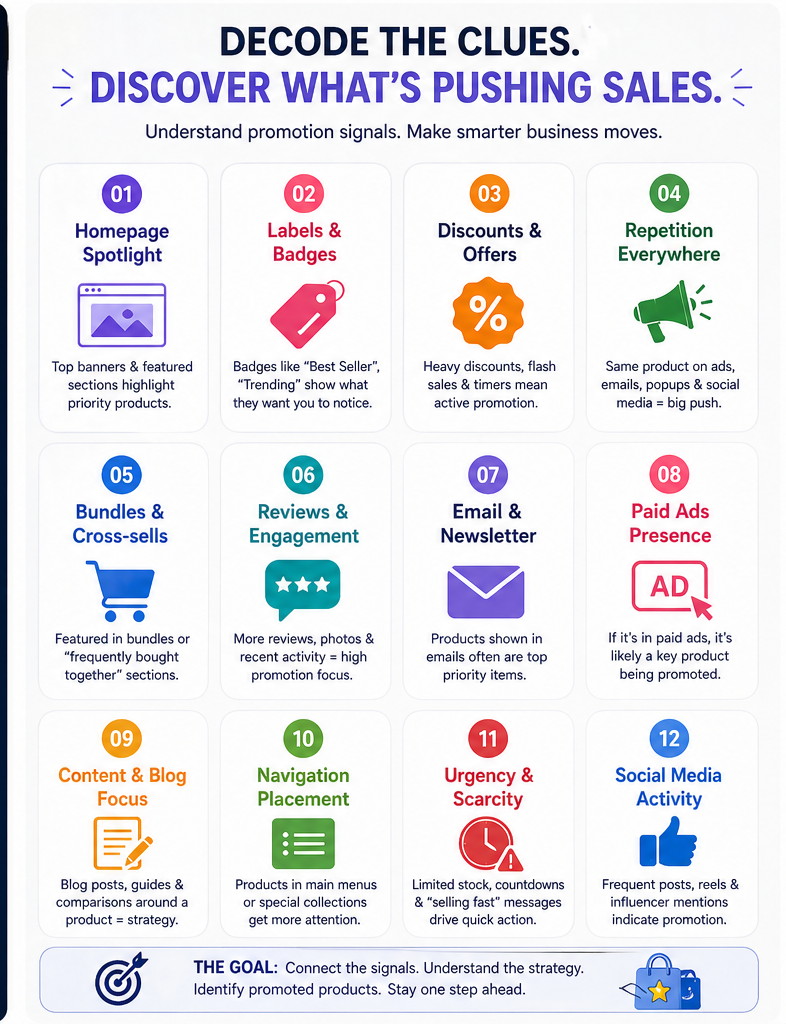
13. Inventory Messaging
Urgency messages often highlight active promotions.
Examples:
- Only 3 Left
- Selling Fast
- Limited Stock
- Popular This Week
- Back in Stock
These messages drive buying decisions.
While sometimes automated, repeated urgency around specific products often supports active campaigns.
Scarcity increases action.
14. Competitor Comparison Strategy
Some stores actively position products against competitors.
You may see:
- Comparison charts
- Why Choose Us sections
- Better Than Leading Brands messaging
- Alternative product targeting
This usually happens only for strategic products with strong commercial importance.
Stores rarely invest comparison effort into low-priority items.
Final Strategic Thinking
The goal is not just to find promoted products.
It is to understand:
Why those products are being promoted
That insight matters more.
Ask:
- Is this product solving a high-demand problem?
- Is it a seasonal campaign?
- Is it an entry-level product for upsells?
- Is it a high-margin strategic product?
- Is it part of brand positioning?
Understanding motivation creates stronger business decisions.
Observation without interpretation is incomplete.
Conclusion
Identifying which products an online store is actively promoting requires attention to patterns, not guesses.
Homepage placement, discounts, social media activity, repeated visibility, product labels, bundles, reviews, and marketing campaigns all reveal valuable clues.
Stores communicate priorities through behavior.
The products they push hardest are usually the products most important to their revenue strategy, customer acquisition, or long-term growth.
The smartest approach is to study these signals together—not individually.
Because one signal may suggest interest, but multiple signals reveal certainty.
In eCommerce, visibility is rarely accidental.
It is strategy.
And once you learn how to read that strategy, you gain a powerful competitive advantage.