In the early stages of building an eCommerce or product-based business, working with a single supplier often feels like the smartest and most practical decision. It keeps operations simple, communication clear, and quality control easier to manage. With one supplier, there is only one relationship to maintain, one lead time to track, and one production standard to monitor. For a growing business, this simplicity can be extremely valuable.
However, what starts as an operational advantage can eventually become a major business risk. Recent tariff-related disruptions and global supply chain instability have exposed a serious weakness in single-supplier sourcing: dependency. Many businesses that relied entirely on one supplier found themselves facing stockouts, delayed shipments, lost sales, and frustrated customers. A single disruption was enough to affect every sales channel at once.
This has forced many entrepreneurs to rethink their sourcing strategy and ask an important question: When does supplier diversification become necessary, and how can it be managed without creating operational chaos?
The answer is not based on one fixed revenue number or a universal rule. Instead, it depends on your business risk, product category, inventory dependency, and long-term growth strategy.
Why Single-Supplier Sourcing Makes Sense at the Beginning
Starting with one supplier is not a mistake. In fact, for most businesses, it is the right first step.
Simplicity in Operations
Managing one supplier is far easier than managing several. Communication is direct, purchase orders are simple, and there is less confusion in daily operations. This helps founders focus on more urgent priorities such as marketing, customer acquisition, and product validation.
Consistent Product Quality
When all inventory comes from one source, maintaining product consistency becomes easier. Customers receive the same quality standard every time, which helps build trust and reduce complaints.
Predictable Lead Times
One supplier means one production schedule and one delivery expectation. This makes planning inventory much more manageable.
Stronger Supplier Relationships
In the early stage, concentrating orders with one supplier can strengthen the business relationship. Suppliers may offer better pricing, faster responses, or priority production when they see consistent business.
For startups and small businesses, reducing complexity is often more important than building redundancy.
The Hidden Risk of Supplier Dependency
As the business grows, the same simplicity that once helped can turn into a dangerous weakness.
1. Single Point of Failure
The biggest problem with relying on one supplier is obvious: if they fail, your business suffers immediately.
This could happen because of:
- Shipping delays
- Factory shutdowns
- Tariff increases
- Political instability
- Raw material shortages
- Quality failures
When there is no backup source, operations stop completely.
2. Stockouts Across All Sales Channels
One delayed shipment can mean:
- Your website products go out of stock
- Marketplace listings stop performing
- Paid ads must be paused
- Customers lose trust
- Revenue drops instantly
This creates a chain reaction that affects much more than inventory.
3. Limited Negotiation Power
When you depend entirely on one supplier, they hold more control. Pricing, timelines, and flexibility often depend on their decisions, not yours.
Without alternatives, negotiation becomes difficult.
4. External Risks Are Increasing
Tariffs, shipping disruptions, and global supply chain issues have made supplier dependency riskier than ever before. Businesses can no longer assume stability.
The recent disruptions were not isolated events—they were warnings.
Is There a Revenue Threshold for Diversification?
Many business owners ask whether there is a specific sales volume or monthly revenue where diversification becomes necessary.
The truth is: there is no fixed number.
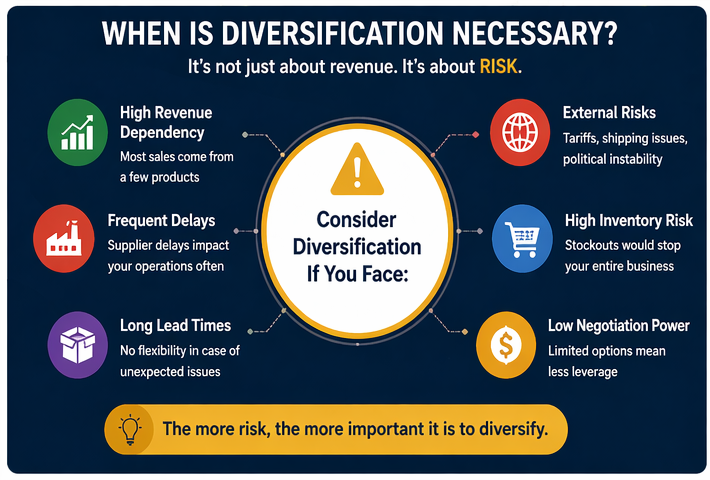
Diversification is not triggered by revenue alone. It depends more on how exposed your business is to risk.
The Real Indicators That Diversification Is Needed
1. Revenue Dependency on One Product
If a large percentage of your revenue depends on one or two products, supplier diversification becomes more urgent.
Because if that one product goes out of stock, the financial impact is immediate.
2. Inventory Risk
Ask yourself:
- Would one delayed shipment stop most of your sales?
- Do you have zero backup inventory?
- Do you have no second supplier ready?
If the answer is yes, diversification is already overdue.
3. Product Category Risk
Some products are too risky to single-source, regardless of business size.
High-Risk Categories Include:
- Trend-based products
- Seasonal products
- Fast-selling SKUs
- Long manufacturing products
- High-margin hero products
These products need stronger protection because delays hurt more.
Lower-Risk Categories Include:
- Stable evergreen products
- Easily replaceable items
- Locally available goods
In many cases, product category matters more than revenue.
Diversification Is About Risk, Not Size
This is the most important insight:
Supplier diversification is not about how big your business is. It is about how fragile your business is.
If one supplier controls your entire operation, your business is vulnerable.
Diversification is not a luxury—it is risk management.
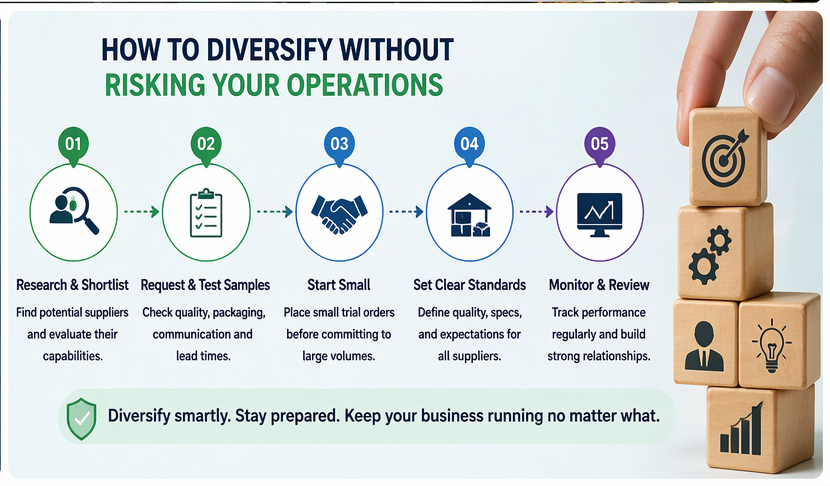
How to Diversify Without Creating Chaos
One common mistake is moving too fast.
Going from one supplier to five suppliers overnight creates:
- Confusion
- Quality inconsistencies
- Inventory management problems
- Communication overload
The smarter approach is gradual diversification.
Step 1: Add One Backup Supplier
Start simple.
Keep:
- One primary supplier
- One backup supplier
The backup supplier does not need to handle daily operations immediately. Their role is protection.
This creates resilience without unnecessary complexity.
Step 2: Test Before Trusting
Never assume a second supplier will match your standards.
Before shifting real volume:
- Order product samples
- Compare quality side by side
- Test packaging standards
- Check shipping timelines
- Evaluate communication speed
This prevents surprises later.
Step 3: Split Volume Gradually
Once the backup supplier proves reliable, start distributing orders strategically.
Example:
- 70% → primary supplier
- 30% → secondary supplier
This reduces dependency while maintaining stability.
It also keeps both supplier relationships active.
Step 4: Use Multi-Region Sourcing
Whenever possible, avoid having all suppliers in the same region.
Example:
- Supplier A in Asia
- Supplier B in Europe or local market
This protects against:
- Tariffs
- Port delays
- Country-specific disruptions
- Political instability
Geographic diversification matters.
Managing Quality Across Multiple Suppliers
This is usually the biggest concern.
“How do we maintain quality consistency without turning it into a full-time job?”
The answer is systems—not constant manual effort.
1. Create Standard Product Specifications
Build a detailed supplier document including:
- Materials
- Dimensions
- Weight
- Packaging standards
- Branding requirements
- Performance expectations
Every supplier must follow the same standards.
This removes ambiguity.
2. Compare Samples Carefully
Never skip sample testing.
Check for:
- Build quality
- Finish consistency
- Packaging quality
- Customer experience standards
Only approve suppliers that match your expectations.
3. Use a Supplier Quality Checklist
Track suppliers using measurable standards such as:
- Product consistency
- Delivery speed
- Communication responsiveness
- Defect rate
- Packaging quality
This makes evaluation objective.
4. Start with Small Orders
Do not shift large volume immediately.
Start with small batches, monitor customer feedback, and identify issues early.
This reduces expensive mistakes.
5. Consider Third-Party Inspections
For larger businesses, independent quality inspections before shipment can be extremely valuable.
This reduces risk without requiring constant internal monitoring.
Managing Operational Complexity
Yes, diversification adds complexity—but complexity can be controlled.
Simplify Supplier Roles
Assign clear responsibilities:
- Primary supplier → daily operations
- Secondary supplier → backup or overflow capacity
Avoid unclear overlap.
Maintain Safety Stock
Even a small inventory buffer can protect against short-term disruptions.
Safety stock creates breathing room.
Use Systems and Automation
Use inventory tools to:
- Track stock levels
- Sync supplier availability
- Manage reorder timing
Good systems reduce manual workload significantly.
Real-World Comparison
Scenario A: Single Supplier
Supplier delay: 10 days
Result:
- Stockout
- No sales
- Ads paused
- Customer complaints
- Revenue loss
Scenario B: Two Suppliers
Supplier A delayed
Supplier B still active
Result:
- Partial fulfillment continues
- Reduced revenue impact
- Operations continue
This is the difference between a fragile business and a resilient one.
When Diversification Becomes Non-Negotiable
You should diversify immediately if you notice:
- Frequent stockouts
- Heavy dependence on one supplier
- One product driving most revenue
- Inconsistent lead times
- Rising tariff or logistics risks
- Lost revenue from supply issues
If two or more of these are happening, waiting becomes dangerous.
Balancing Simplicity and Stability
| Strategy | Advantage | Risk |
| Single Supplier | Simple operations | High dependency |
| Multi Supplier | Greater stability | More management |
The goal is not maximum suppliers.
The goal is controlled resilience.
Final Recommendation
Do not stay fully dependent on one supplier.
But also do not create unnecessary complexity by adding too many suppliers too quickly.
The best strategy is:
- Add one strong backup supplier
- Test thoroughly
- Split volume gradually
- Standardize quality expectations
- Monitor supplier performance consistently
This creates protection without operational overload.
Final Thought
What you are experiencing is not a problem—it is a sign that your business is maturing.
You are moving from:
“How do I run this business?”
to
“How do I protect and scale this business?”
That is a major strategic shift.
There is no perfect revenue threshold where diversification suddenly becomes required.
The real answer is simple:
Diversification becomes essential when your business can no longer afford a single point of failure.
If one delayed shipment can stop your entire business, the time to diversify is now.
That is not complexity—it is survival.