Running a Shopify store successfully is not only about having good products or a well-designed website. Many store owners spend time improving collections, product pages, SEO, and store design, yet still struggle to generate enough traffic and sales. This is one of the most common challenges in eCommerce.
After refining the store structure, the next major step is growth—bringing the right visitors to the store and converting them into paying customers. This is where marketing strategy becomes critical.
Many store owners reach a point where they ask:
Should I hire a marketing expert or agency to help grow my Shopify store?
The answer depends on several factors, including traffic quality, conversion rate, ad budget, and the overall readiness of the store.
The goal should not simply be “more traffic.” The real goal is qualified traffic and better conversions.
Because thousands of visitors mean nothing if they do not buy.
This article explains how to approach Shopify growth properly, what to improve first, and how to choose the right marketing support for long-term success.
Why Store Improvements Alone Do Not Guarantee Sales
Many merchants believe that once they improve their store design, organize collections, and optimize SEO, sales should automatically increase.
Unfortunately, that is not how eCommerce works.
A well-designed store creates a strong foundation, but traffic and conversion strategy are what drive real revenue.
Think of it this way:
Your store is the shop.
Marketing brings people to the door.
Conversion strategy convinces them to enter and buy.
Without strong marketing, even the best store stays invisible.
Without strong conversion, traffic becomes wasted money.
Both must work together.
The First Question: Is the Problem Traffic or Conversion?
Before hiring any expert or agency, one important question must be answered:
Is the problem low traffic or low conversion?
These are two completely different issues.
Problem 1: Low Traffic
Very few people are visiting the store.
This means:
Low website sessions
Limited brand visibility
Weak audience reach
Poor ad performance
Low organic discovery
In this case, the focus should be:
Paid advertising
Search visibility
Social media growth
Influencer partnerships
Content marketing
Audience targeting
You need more qualified visitors.
Problem 2: Low Conversion
Many people visit the store, but very few buy.
This means:
Visitors leave quickly
Add-to-cart rates are low
Checkout abandonment is high
Sales remain weak despite traffic
In this case, the focus should be:
Product page optimization
Trust building
Customer reviews
Shipping clarity
Return policy visibility
Checkout flow improvement
Offer strategy
You need stronger buying confidence.
Most businesses try to solve conversion problems by buying more traffic.
This usually wastes money.
Diagnosis must come first.
Paid Advertising: Facebook, Instagram, and Search Ads
One of the most requested areas of support is paid advertising.
This includes:
Facebook ads
Instagram campaigns
Search-based advertising
Retargeting campaigns
Shopping ads
These channels can drive strong growth when used correctly.
But they can also destroy budgets quickly when managed poorly.
Many beginners launch ads too early without preparing the store first.
This leads to:
Poor conversions
Low return on ad spend
Wrong audience targeting
High customer acquisition costs
Frustration and budget loss
Paid traffic should only be scaled after the store is ready to convert.
Ads should amplify a strong system—not fix a weak one.
Qualified Traffic Is More Important Than More Traffic
Not all visitors are valuable.
The goal is not to get random traffic.
The goal is to attract people who are likely to buy.
For example:
10,000 random visitors are less valuable than 500 highly targeted visitors.
Qualified traffic means:
The right audience
The right buying intent
The right product-market match
The right messaging
This depends on:
Audience targeting
Creative strategy
Product positioning
Offer quality
Landing page relevance
A good marketing expert focuses on traffic quality, not vanity numbers.
Sales matter.
Not clicks.
Product Benefits Must Be Crystal Clear
Before scaling ads, product pages must answer one simple question:
Why should someone buy this?
Many stores describe features instead of benefits.
Example:
Bad:
“Waterproof travel bag with zipper compartments”
Better:
“Stay organized, travel lighter, and protect your essentials with a durable waterproof travel bag designed for stress-free trips.”
People buy outcomes, not specifications.
Your product pages should clearly show:
What problem is solved
Why this product is better
How life improves after buying
Emotional clarity increases conversions.
This is often more important than ad strategy itself.
Reviews Build Trust Faster Than Ads
Customers trust other customers more than brands.
Reviews are one of the strongest conversion tools.
They reduce hesitation.
They create confidence.
They answer unspoken buyer questions.
Strong trust signals include:
Customer reviews
Photo reviews
Video testimonials
Ratings
Before-and-after results
Social proof
Real customer experiences
Without trust, traffic does not convert.
No marketing campaign can fix a trust problem.
That is why review strategy should be treated as a priority.
Shipping and Return Policies Must Be Visible
Many stores lose sales because important information is hidden.
Customers want fast answers to questions like:
How long will shipping take?
What if I want a refund?
Is delivery free?
Can I trust this checkout?
If these answers are unclear, customers leave.
Simple visibility matters:
Clear shipping policy
Easy return policy
Contact information
Secure checkout reassurance
Guarantee messaging
These small details often decide whether a customer buys today or leaves forever.
Trust is built through clarity.
Email Marketing Is Still One of the Strongest Revenue Drivers
Many businesses focus only on ads and ignore email marketing.
This is a major mistake.
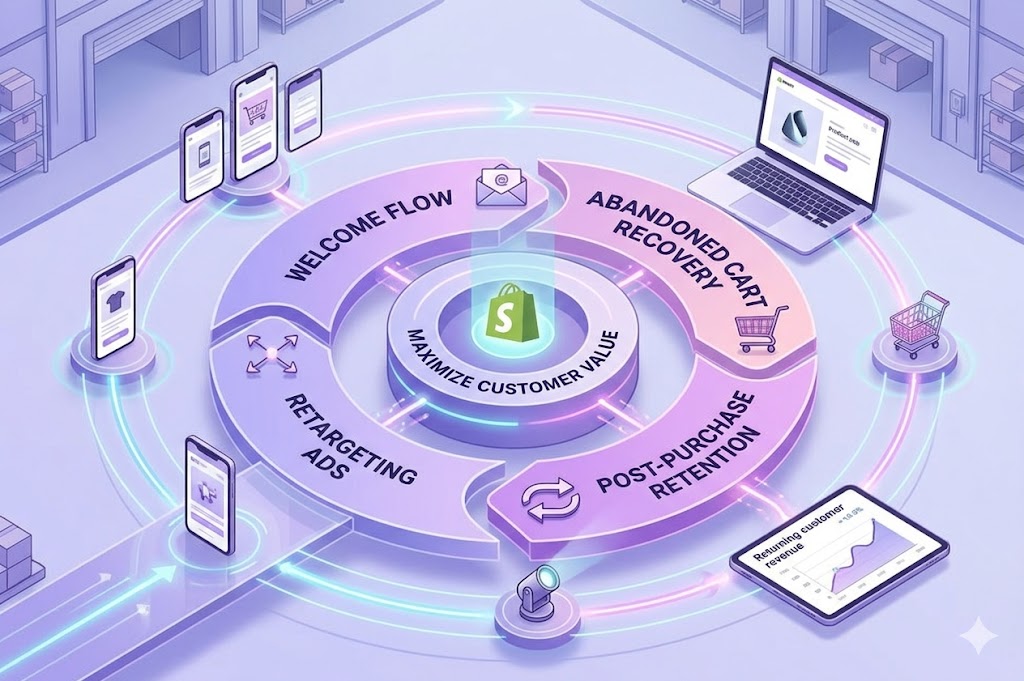
Email marketing helps with:
Welcome flows
Abandoned cart recovery
Post-purchase retention
Repeat customer sales
Product launches
Promotional campaigns
Customer nurturing
A customer who leaves today may buy tomorrow if followed correctly.
Email turns traffic into long-term value.
It is not just a sales tool.
It is a relationship tool.
Stores that ignore email leave money behind.
Retargeting Recovers Lost Sales
Most visitors do not buy on the first visit.
This is normal.
Retargeting helps bring them back.
Examples include:
Showing ads to past visitors
Cart reminder emails
Viewed-product reminders
Special return offers
Limited-time urgency messaging
Retargeting is powerful because it targets warm audiences.
These people already showed interest.
They are much easier to convert than completely new visitors.
Many businesses focus too much on finding new customers and forget to recover existing opportunities.
Retargeting fixes that.
Conversion Rate Optimization Is the Real Growth Multiplier
Conversion rate optimization means improving how many visitors turn into buyers.
This can include:
Stronger landing pages
Faster loading speed
Better product descriptions
Simpler checkout flow
Stronger trust signals
Improved mobile experience
Better offer placement
Free shipping thresholds
Upsells and cross-sells
Even small improvements create major revenue impact.
Example:
If 1% of visitors buy, and you improve to 2%, revenue can double without increasing traffic.
This is why conversion optimization is often more profitable than scaling ads.
Small changes create large results.
Should You Hire an Agency or Learn In-House?
This depends on budget, experience, and business stage.
Hiring an Expert or Agency
Best for:
Store owners with limited time
Businesses ready to scale faster
Merchants with advertising budgets
Stores needing advanced strategy
Businesses seeking faster execution
Advantages:
Professional expertise
Faster testing
Better campaign structure
Advanced growth systems
Stronger optimization processes
Challenges:
Higher cost
Choosing the wrong partner
Dependency risk
Not all agencies deliver real results
Hiring should be based on proven performance, not promises.
Learning Marketing In-House
Best for:
New stores with limited budgets
Founders wanting long-term control
Businesses testing early-stage offers
Merchants learning customer behavior
Advantages:
Lower cost
Better understanding of your own business
Long-term independence
Stronger decision-making ability
Challenges:
Slower growth initially
Steeper learning curve
More trial and error
This path takes patience but builds stronger internal knowledge.
Sometimes the best strategy is learning first, then outsourcing smarter later.
Ask About Budget Before Scaling
One important reply raised the right question:
What is your monthly ad spend?
This matters because strategy depends on budget.
A store spending ₹20,000 monthly needs a different plan than one spending ₹2,00,000 monthly.
Without understanding budget:
Advice becomes generic
Expectations become unrealistic
Growth planning becomes weak
Marketing must match financial reality.
Smart scaling is budget-aware.
Inventory and Pricing Accuracy Matter Too
Marketing cannot fix operational problems.
If pricing is wrong, stock is inaccurate, or delivery fails, advertising only increases customer complaints.
Before scaling traffic, make sure:
Inventory is accurate
Pricing is consistent
Stock availability is reliable
Offers match fulfillment capacity
Customer support is ready
Growth without operational control creates bigger problems.
Marketing should scale systems—not chaos.
How to Choose the Right Expert
Ask these questions:
Do they understand your niche?
Can they explain strategy clearly?
Do they focus on conversion, not just ads?
Do they ask about your current data first?
Do they talk about customer psychology?
Do they care about retention, not just acquisition?
Good experts diagnose before prescribing.
Bad experts sell ads before understanding the business.
Choose carefully.
Final Recommendation
The best path is usually:
Diagnose first
Fix conversion issues
Improve trust signals
Strengthen product pages
Clarify shipping and return information
Set up retention systems
Then scale qualified traffic
Only after this should heavy advertising begin.
Growth should be built on a strong foundation.
Not rushed through paid traffic alone.
Conclusion
Finding the right Shopify marketing expert is not about hiring someone to “run ads.”
It is about building a complete growth system.
Traffic matters.
Conversion matters more.
The smartest businesses first understand whether the problem is visibility or buying confidence.
Then they improve the store, strengthen trust, optimize customer experience, and finally scale traffic strategically.
Paid advertising, email marketing, retargeting, and conversion optimization all work best when the store is already prepared to convert.
The real goal is simple:
Bring the right people to the store and give them every reason to buy.
Because successful eCommerce is not built on more visitors.
It is built on better decisions.