Inventory management is one of the foundations of any successful retail business. Whether a merchant operates a single store or manages multiple sales channels, keeping track of inventory accurately is essential for maintaining healthy cash flow, meeting customer expectations, and making informed purchasing decisions. A reliable inventory system allows businesses to know what products are available, what needs to be reordered, and how much stock is moving over time.
The discussion above revolves around growing dissatisfaction among merchants regarding changes to Shopify’s inventory management capabilities following the removal of Stocky. Many merchants believe that important purchasing and inventory features they previously relied on have either disappeared or are no longer available without adopting additional paid solutions. For businesses that selected Shopify because of its integrated point-of-sale and ecommerce ecosystem, these changes have raised concerns about operational efficiency and long-term scalability.
Although the discussion does not reach a final resolution, it highlights several important challenges that retailers face when inventory management tools evolve or become less capable than expected.
Why Inventory Management Is Critical
Inventory represents one of the largest financial investments for most retail businesses.
Every product sitting on a warehouse shelf or inside a retail store has already required an investment of money. If inventory is not managed carefully, businesses risk carrying too much stock, running out of popular products, or tying up cash that could otherwise be invested elsewhere.
Strong inventory management helps businesses:
- Maintain accurate stock levels
- Reduce unnecessary purchasing
- Prevent stock shortages
- Improve cash flow
- Increase customer satisfaction
- Support better forecasting
Because inventory affects nearly every department within a business, reliable management tools become essential as companies grow.
Why Merchants Chose an Integrated System
Several participants explain that they originally selected Shopify because they wanted a unified environment for both online and physical retail operations.
Instead of managing separate systems for ecommerce and point-of-sale operations, merchants expected a single platform capable of handling:
- Product management
- Sales
- Inventory
- Purchasing
- Reporting
- Customer information
This integration reduces administrative work and minimizes the risk of inconsistent inventory records across multiple sales channels.
When important inventory functions change or disappear, businesses naturally question whether the unified approach still delivers the operational benefits they originally expected.
The Importance of Purchase Order Management
One of the largest concerns raised throughout the discussion involves purchase-order management.
Purchase orders play a central role in inventory replenishment.
They allow businesses to record:
- Products being ordered
- Supplier details
- Quantities
- Costs
- Delivery schedules
- Payment information
Without organized purchase-order management, inventory planning becomes significantly more difficult.
Businesses may lose visibility into incoming stock, making forecasting and purchasing decisions less accurate.
Why Purchase Order Exports Matter
Merchants specifically mention the loss of purchase-order export functionality.
Although exporting data may appear to be a simple feature, it supports many everyday business activities.
Exported purchase-order information may be used for:
- Financial reporting
- Supplier communication
- Accounting records
- Inventory analysis
- Internal documentation
Export capabilities allow businesses to integrate purchasing information into broader operational processes.
When this functionality is missing, merchants often resort to manual copying or alternative reporting methods that require additional effort.
Why Stock Takes Remain Essential
Another major concern discussed is the ability to perform stock takes.
A stock take is the process of physically counting inventory and comparing it with recorded inventory levels.
This process helps identify discrepancies caused by:
- Human error
- Damaged goods
- Theft
- Shipping mistakes
- Receiving errors
Accurate stock counts improve inventory reliability and reduce costly mistakes.
For businesses managing hundreds or thousands of products, stock-taking tools simplify an otherwise time-consuming task.
Understanding Invoice Status Tracking
The discussion also references invoice management.
Businesses regularly need to monitor whether supplier invoices have been:
- Paid
- Unpaid
- Partially paid
- Outstanding
Tracking invoice status helps companies manage supplier relationships while maintaining healthy cash flow.
Without clear invoice visibility, businesses may struggle to coordinate payments with purchasing activities.
Why Due Dates Are More Important Than They Appear
Purchase-order due dates help businesses understand when inventory should arrive.
Knowing expected delivery dates allows retailers to:
- Prepare promotions
- Forecast stock availability
- Plan purchasing cycles
- Communicate with customers
- Coordinate warehouse operations
If delivery dates are not managed effectively, businesses may experience unexpected stock shortages or delays.
For merchants working with multiple suppliers, due-date tracking becomes especially valuable.
The Challenge of Managing Backorders
Another feature merchants mention is backorder management.
Backorders occur when customer demand exceeds current inventory availability.
Managing backorders requires businesses to know:
- Which products are delayed
- Expected arrival dates
- Customer commitments
- Outstanding supplier orders
Without organized backorder management, communication with customers becomes more difficult.
Businesses also risk overselling products or creating unrealistic delivery expectations.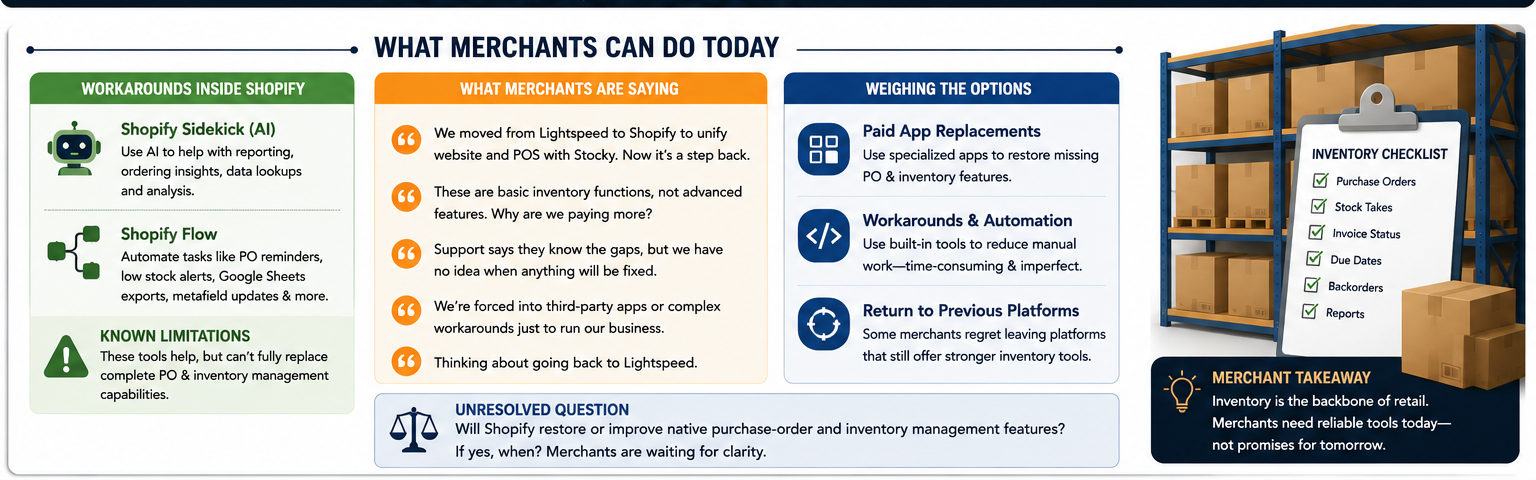
Why Inventory Reports Matter
Inventory reporting supports better business decisions.
Reports help merchants understand:
- Fast-moving products
- Slow-selling inventory
- Stock turnover
- Purchasing trends
- Seasonal demand
Accurate reports allow retailers to purchase inventory more efficiently while avoiding unnecessary expenses.
Many participants argue that reporting should be considered a basic operational capability rather than an advanced feature.
Why Businesses Feel Forced Toward Additional Costs
One recurring concern throughout the discussion is the financial impact of replacing missing functionality.
Several merchants explain that alternative inventory systems require additional monthly subscriptions.
Their frustration is not necessarily about paying for specialized software.
Instead, many believe they are now paying extra for functions they previously considered part of their normal workflow.
For small businesses operating with limited budgets, these additional expenses can significantly affect profitability.
Operational Complexity Increases
As businesses adopt multiple specialized systems, overall operational complexity increases.
Instead of managing inventory within one environment, merchants may now need separate solutions for:
- Purchasing
- Inventory
- Reporting
- Forecasting
- Supplier management
Every additional system requires:
- Training
- Maintenance
- Data synchronization
- Workflow adjustments
Over time, this complexity can reduce operational efficiency.
Why Workflow Consistency Matters
Businesses often spend years developing efficient operational processes.
Employees become familiar with existing workflows.
Documentation is built around current systems.
Daily operations depend on predictable routines.
When inventory systems change significantly, businesses must often redesign their workflows from the ground up.
Even relatively small software changes can create widespread operational disruption.
Comparing Previous Retail Experiences
Some participants compare their experiences with other retail management platforms.
These comparisons illustrate that inventory management often influences purchasing decisions just as much as ecommerce functionality.
Retail businesses evaluate platforms based on factors including:
- Inventory capabilities
- Purchasing workflows
- Reporting quality
- Ease of use
- Scalability
Changes to inventory features naturally lead merchants to reconsider those comparisons.
Why Growing Businesses Need Better Inventory Systems
Inventory management becomes increasingly important as businesses expand.
A small retailer with twenty products may manage inventory manually.
A business managing:
- Thousands of products
- Multiple suppliers
- Several warehouses
- Retail locations
requires much more sophisticated inventory processes.
Growth increases operational complexity.
Inventory systems must evolve alongside business expansion.
Forecasting Depends on Reliable Inventory Data
Successful purchasing decisions rely on accurate inventory information.
Businesses need to understand:
- Current stock levels
- Historical sales
- Seasonal demand
- Supplier lead times
- Purchasing trends
Forecasting helps reduce both overstocking and stock shortages.
When inventory information becomes less accessible, forecasting accuracy may decline.
Why Businesses Prefer Native Features
One major theme throughout the discussion is the preference for built-in functionality.
Merchants generally appreciate native capabilities because they offer:
- Better integration
- Simpler workflows
- Reduced maintenance
- Lower operational costs
Built-in solutions also eliminate concerns about compatibility between multiple software systems.
This preference explains why many merchants would rather see inventory features restored than replaced with external alternatives.
Balancing Platform Development and Merchant Expectations
Technology platforms constantly evolve.
Features improve.
Interfaces change.
Older systems are replaced with newer approaches.
However, merchants often prioritize stability over constant change.
Operational consistency allows businesses to develop reliable internal processes.
Platform providers must balance innovation with maintaining essential business functionality.
Finding that balance remains an ongoing challenge.
Adapting to Operational Change
Whenever software capabilities change, businesses face important decisions.
They may choose to:
- Adapt existing workflows
- Invest in replacement systems
- Modify inventory processes
- Reevaluate operational priorities
Each option involves trade-offs.
Successful adaptation requires careful planning rather than immediate reactions.
The Bigger Discussion Beyond Inventory
Although the conversation focuses primarily on inventory management, it reflects a broader issue.
Modern retailers increasingly expect commerce platforms to support complete business operations rather than simply facilitating online sales.
Merchants want integrated solutions capable of managing:
- Sales
- Inventory
- Purchasing
- Reporting
- Suppliers
- Warehousing
- Customer service
As businesses become more sophisticated, expectations naturally increase.
Conclusion
The discussion highlights growing concerns among merchants regarding changes to inventory management capabilities following the removal of Stocky. Many retailers feel that important purchasing and stock-control features—including purchase-order management, inventory reporting, stock takes, invoice tracking, due dates, and backorder management—were valuable components of their daily operations and should remain part of an integrated commerce platform.
While replacement solutions and workarounds exist, many merchants question whether businesses should be required to adopt additional systems and incur extra costs simply to regain functionality they previously relied upon. Others remain hopeful that future improvements will strengthen native inventory capabilities, although no confirmed timeline has been provided.
Ultimately, the conversation demonstrates that inventory management is far more than a technical feature. It is a fundamental business function that influences purchasing decisions, operational efficiency, customer satisfaction, and long-term business growth. As retailers continue to expand across online and physical sales channels, reliable inventory management will remain one of the most important factors in building sustainable retail operations.