Selling children’s products in the United States can create opportunities for online businesses, but it also introduces a much higher level of responsibility compared with selling general consumer goods.
The discussion above focuses on a common challenge faced by sellers of baby and children’s products:
What should a seller do when an overseas supplier cannot provide a Children’s Product Certificate (CPC)?
This question becomes even more important for businesses using fulfillment models where products are manufactured and shipped by third parties.
Many sellers assume that if they never physically touch inventory, compliance responsibility belongs entirely to the supplier.
However, children’s product regulations work differently.
The conversation highlights an important reality:
selling products intended for children often requires documented safety compliance regardless of fulfillment method.
The discussion does not reach a final resolution, but it points toward several practical paths and raises broader questions about responsibility, testing, supplier relationships, and risk management.
This article explains the topic in detail.
Why Children’s Product Compliance Matters
Children’s products receive additional regulatory attention because children are considered more vulnerable consumers.
Products used by children can involve:
physical contact
mouth contact
sleep environments
small components
chemical exposure
mechanical risks
Because of these factors, regulators often require additional safeguards before products enter the market.
Compliance requirements exist to reduce preventable risks.
What a Children’s Product Certificate Means
A Children’s Product Certificate is essentially documentation showing that a children’s product complies with applicable safety requirements.
The certificate itself is not simply paperwork.
It represents evidence that the product has been evaluated according to required standards.
The certificate typically relies on testing and supporting information.
Its purpose is to demonstrate that a product meets applicable requirements before being offered to consumers.
Why Determining Product Classification Is the First Step
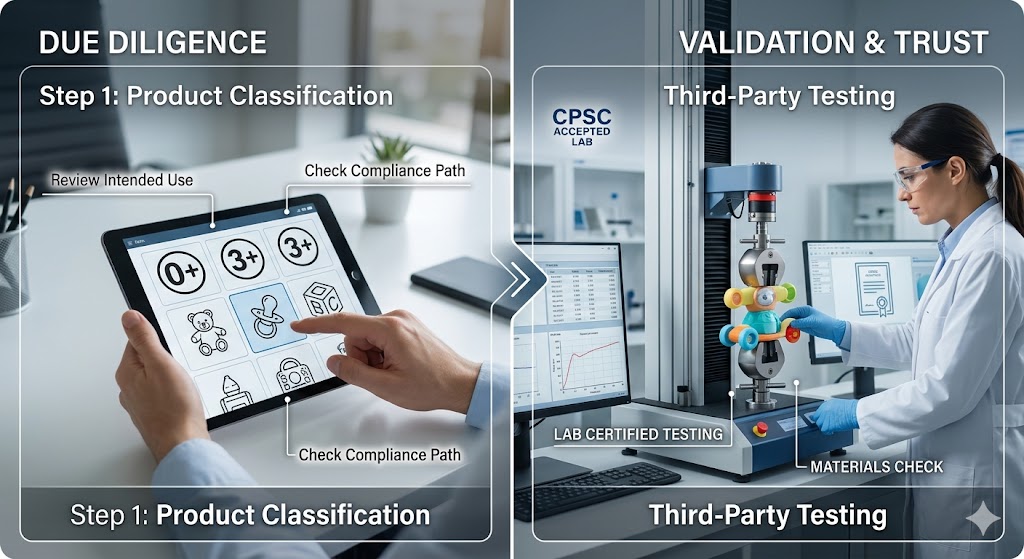
One of the first recommendations in the discussion was determining whether the product actually qualifies as a children’s product.
This distinction matters.
Not every product associated with families or babies automatically falls into the same category.
Classification often depends on intended use.
Questions businesses may ask include:
Who is the product designed for?
How is it marketed?
Who typically uses it?
How would a reasonable customer interpret it?
Correct classification determines next steps.
Why Different Product Categories May Follow Different Rules
The discussion mentioned that products not classified as children’s products may follow different certification pathways.
This matters because requirements often vary depending on:
intended age group
product function
risk profile
applicable standards
Starting with proper classification prevents unnecessary work.
Why Sellers Often Expect Suppliers to Handle Compliance
Many businesses entering ecommerce assume suppliers will manage compliance.
This expectation seems logical.
Suppliers manufacture products.
They often advertise production capabilities.
But responsibility does not always end with manufacturing.
Sellers frequently remain responsible for ensuring products entering a market meet requirements.
Why Overseas Suppliers Sometimes Cannot Provide Certificates
Suppliers may lack documentation for several reasons.
Examples include:
they sell globally with different requirements
they never completed testing
they do not understand destination market expectations
they focus only on manufacturing
they expect sellers to arrange compliance
This creates challenges for merchants.
Why Testing Documentation Becomes Important
The discussion repeatedly referenced testing.
Testing provides supporting evidence for product compliance.
Testing may help answer questions such as:
Does the product meet requirements?
Are materials compliant?
Do performance characteristics meet expectations?
Documentation creates accountability.
Why Third-Party Testing Creates More Confidence
Independent testing often increases credibility.
Third-party evaluation creates separation between:
manufacturing
verification
commercial selling
Independent review supports trust.
Why Existing Reports May Sometimes Help
One recommendation suggested requesting available testing documentation.
If testing already exists and remains applicable, it may simplify the process.
Businesses should carefully review:
scope
product match
relevance
validity
Testing should align with the exact product being sold.
Why Product Variations Can Complicate Compliance
A common misconception is that one test applies universally.
Small differences may affect applicability.
Examples include:
material changes
component substitutions
size adjustments
design modifications
Variation management becomes important.
Why Testing Costs Should Be Viewed Strategically
Testing introduces cost.
The discussion referenced approximate ranges.
While cost matters, businesses should evaluate testing as:
risk reduction
market access
brand protection
long-term investment
Compliance failures can become more expensive later.
Why Supplier Relationships Influence Compliance Success
Suppliers play an important role.
Good supplier relationships support:
documentation access
process transparency
testing coordination
issue resolution
Strong communication improves outcomes.
Why Cost Sharing Sometimes Becomes Necessary
Testing expenses may create tension.
Businesses sometimes negotiate shared responsibility.
This approach depends on:
volume
relationship strength
supplier incentives
commercial structure
Both parties benefit from reliable compliance.
Why Switching Suppliers May Become Necessary
The discussion acknowledged that some suppliers simply refuse participation.
Businesses then face difficult decisions.
Questions include:
Can the supplier support long-term growth?
Will documentation improve later?
Does the relationship increase operational risk?
Supplier selection affects scalability.
Why Dropshipping Does Not Remove Responsibility
One of the strongest themes in the discussion was that fulfillment structure does not eliminate compliance obligations.
This surprises many sellers.
Businesses often believe:
I never handled inventory.
The supplier shipped directly.
The factory made the product.
Operational responsibility may still remain broader than expected.
Why Import Responsibility Matters
Products entering a market usually involve accountability.
Businesses should understand:
who sells
who imports
who represents the brand
who manages customers
Responsibility may extend beyond fulfillment.
Why Print-on-Demand Models Face Similar Questions
The discussion also referenced personalized production.
Customization changes logistics but does not automatically remove compliance considerations.
Product modifications may introduce additional complexity.
Processes should remain structured.
Why Product Safety Impacts Brand Reputation
Compliance is not only regulatory.
Customer trust matters.
Parents and caregivers expect:
safe materials
reliable manufacturing
transparent information
Confidence supports long-term growth.
Why Documentation Supports Business Stability
Strong documentation creates operational advantages.
Examples include:
faster issue resolution
better supplier accountability
clear internal processes
reduced uncertainty
Documentation supports decision-making.
Why Preventive Compliance Is Usually Cheaper
Businesses sometimes delay compliance until problems appear.
Reactive approaches often cost more.
Prevention supports:
continuity
reputation
customer confidence
predictability
Why Sellers Should Build Compliance Into Operations
Instead of treating certification as a final step, businesses benefit from integrating it earlier.
Examples include:
supplier onboarding
product selection
quality checks
launch planning
Compliance becomes operational discipline.
Why Legal Advice Is Frequently Recommended
The discussion encouraged professional legal guidance.
This recommendation reflects complexity rather than fear.
Regulatory requirements can involve:
product category interpretation
documentation standards
market obligations
risk evaluation
Professional advice supports clarity.
Why Children’s Categories Require Extra Attention
Children’s products differ from general consumer goods because expectations are higher.
Businesses operating in these categories often benefit from stronger controls.
Safety becomes part of the brand experience.
Why Long-Term Thinking Matters
Compliance decisions influence:
supplier flexibility
market expansion
customer trust
operational confidence
Shortcuts may limit growth later.
The Bigger Lesson About Selling Regulated Products
This discussion is not only about obtaining a certificate.
It reflects a broader lesson:
modern ecommerce businesses are increasingly responsible for understanding the products they sell—not just marketing them.
Product responsibility extends beyond the storefront.
Final Thought
The conversation highlights a challenge many sellers eventually face.
Finding products and launching stores may feel straightforward.
Building a sustainable business requires more.
Children’s product compliance involves understanding:
classification
documentation
testing
supplier accountability
commercial responsibility
When uncertainty exists, slowing down and validating requirements often creates a stronger foundation than moving quickly without verification.
Because in regulated categories, compliance is not simply administration—
it becomes part of customer trust.
Conclusion
The discussion presents a practical roadmap for sellers navigating children’s product requirements.
Although no final resolution was reached, the core guidance remains consistent:
identify whether the product qualifies as a children’s product
request existing testing documentation
arrange testing if necessary
evaluate supplier cooperation
understand seller responsibilities
seek professional guidance for certainty
Businesses that treat compliance as a core operating function are often better positioned for sustainable growth and stronger customer confidence.