Selling products exclusively from one established brand can be an attractive business model for an online retailer. Instead of building a store around hundreds of unrelated products, a merchant can create a focused shopping experience around a single brand, its product range, and its values. This approach can make branding easier, simplify product selection, and help the retailer establish a clear identity in a specific market.
However, selling another company’s products requires more than simply adding those products to an online store. The retailer needs an appropriate commercial relationship with the brand, reliable access to product information, accurate inventory synchronization, a clear fulfillment process, and permission to use the brand’s images and marketing materials.
The discussion described a new online store owner who wants to sell products exclusively from an established brand called The Organic Company. The brand is already interested in collaborating, which is an important first step. The main challenge is determining the best partnership structure and the most efficient technical process for managing products, inventory, orders, and fulfillment.
Several possible arrangements can work, including authorized retail partnerships, wholesale relationships, reseller agreements, and supplier-fulfilled arrangements. The right choice depends largely on what the brand is willing and able to support.
Why a Single-Brand Store Can Be a Good Strategy
A store focused on one brand can create a much clearer identity than a general marketplace.
When customers enter the website, they immediately understand what the business represents. Instead of navigating through unrelated products, they can explore a carefully selected collection from one company.
A focused store can provide several advantages:
- Stronger brand positioning
- Easier product organization
- More consistent visual presentation
- Simpler marketing communication
- Better customer recognition
- Easier product research
- More focused advertising
This can be especially useful when the chosen brand already has an established reputation.
However, the retailer must make sure the relationship with the brand is clearly defined before launching.
Establishing an Official Partnership
The first step should always be discussing the commercial relationship with the brand.
There are several possible structures.
Authorized Retailer
An authorized retailer receives permission to sell the brand’s products.
The retailer purchases products from the brand or an approved distributor and sells them to customers at retail prices.
This model gives the retailer more control over:
- Pricing
- Customer relationships
- Product presentation
- Inventory
- Promotions
However, it generally requires purchasing inventory in advance.
Wholesale Partnership
A wholesale arrangement allows the retailer to purchase products at an agreed wholesale price and resell them.
The difference between the wholesale price and retail price creates the retailer’s gross margin.
Before accepting such an arrangement, the retailer should understand:
- Minimum order quantities
- Wholesale pricing
- Payment terms
- Shipping costs
- Return policies
- Damaged-product procedures
- Reordering requirements
A wholesale model can provide healthy margins but may require significant upfront investment.
Supplier-Fulfilled Selling
Another possibility is allowing the brand to maintain inventory and fulfill customer orders on behalf of the retailer.
In this model, the retailer operates the online storefront while the supplier handles much of the physical fulfillment process.
This reduces the need for the retailer to maintain inventory.
It can also reduce storage costs and simplify operations.
However, the retailer must understand exactly how orders are communicated, how shipping is handled, and how returns are processed.
Confirming What the Brand Can Support
The fact that a brand is willing to collaborate does not automatically mean that every selling arrangement is available.
The retailer should ask the brand about its existing systems and capabilities.
Important questions include:
- Do you offer wholesale pricing?
- Do you support retailer partnerships?
- Can you fulfill individual customer orders?
- Can inventory be shared electronically?
- Can product information be provided automatically?
- Are product images available for retailers?
- Can retailers use your descriptions?
- How frequently is inventory updated?
- How are returns handled?
- What countries can you ship to?
- Are there minimum order requirements?
These answers determine which technical and commercial setup will work best.
Why Inventory Synchronization Matters
Inventory accuracy is one of the biggest challenges when selling products supplied by another company.
Imagine that a retailer displays ten units of a product online while the supplier actually has only two units available.
If multiple customers purchase the product, the retailer may accept orders that cannot be fulfilled.
This can result in:
- Canceled orders
- Refunds
- Customer complaints
- Negative reviews
- Lost trust
For this reason, automated inventory synchronization can be extremely valuable.
The retailer’s store should ideally receive updated inventory information from the supplier regularly or in real time.
Product Information Synchronization
Inventory is not the only information that needs to remain accurate.
A single-brand retailer may need access to:
- Product names
- Descriptions
- Images
- Variations
- Prices
- Product specifications
- Availability
- Product identifiers
Manually entering this information for every product can consume significant time.
It also creates the possibility of errors.
If the supplier updates a product description or removes a discontinued item, the retailer needs a reliable way to reflect those changes.
Automated product synchronization can reduce this workload.
Managing Product Images and Branding
When selling another company’s products, brand presentation becomes especially important.
The retailer should confirm whether the brand permits the use of its:
- Logos
- Product photographs
- Marketing images
- Product descriptions
- Promotional materials
Permission should ideally be established in writing.
The retailer should also follow any brand guidelines regarding how products are presented.
This protects the brand’s identity and prevents inconsistencies between the manufacturer’s official communication and the retailer’s website.
Keeping the Store Consistent
Even though the products belong to another brand, the retailer still needs to create a professional shopping experience.
Product pages should be consistent in terms of:
- Layout
- Navigation
- Product information
- Image quality
- Pricing presentation
- Shipping information
A clean and organized website makes it easier for customers to explore the brand’s full product range.
Order Fulfillment
Order fulfillment is another major consideration.
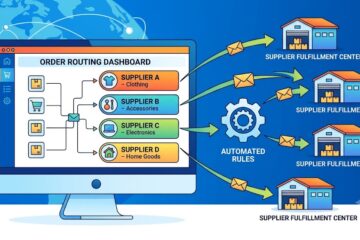
When a customer places an order, the retailer needs a clear process for communicating that order to the supplier.
There are several possibilities.
The order may be:
- Automatically transferred to the supplier.
- Sent through an electronic feed.
- Exported periodically.
- Manually communicated.
- Processed through an integrated fulfillment system.
Automation is generally preferable when order volume increases.
Manual order processing may work for a small number of orders, but it can become inefficient and error-prone as sales grow.
Shipping Responsibilities
The retailer should clarify who is responsible for shipping before launching.
Important questions include:
- Who pays the shipping cost?
- Who chooses the carrier?
- Where are products shipped from?
- What delivery times should customers expect?
- Are tracking numbers automatically provided?
- What happens when a package is delayed?
- Who handles lost shipments?
These details directly affect the customer experience.
If customers are promised fast delivery but the supplier takes several days to process orders, the retailer may receive complaints even though it does not physically handle the products.
Returns and Damaged Products
Returns should be discussed before the first customer order.
The retailer should understand:
- Return eligibility
- Return time limits
- Return shipping responsibility
- Refund procedures
- Exchange procedures
- Damaged-product policies
A clear agreement prevents confusion later.
For example, if a customer receives a damaged product, the retailer needs to know whether the supplier will replace it, issue a credit, or require the item to be returned first.
Pricing and Profit Margins
A single-brand store also needs a sustainable pricing structure.
The retailer should calculate the complete cost of selling each product.
This may include:
- Wholesale cost
- Supplier fulfillment fees
- Shipping
- Payment processing
- Advertising
- Returns
- Taxes
- Customer support
- Other operating expenses
The difference between the selling price and total costs determines the actual profitability.
A product with an attractive wholesale price may still produce a poor margin after shipping and marketing expenses are included.
International Expansion
The store owner may eventually want to expand beyond the initial market.
International selling introduces additional considerations.
The retailer may need to evaluate:
- Supported countries
- Shipping availability
- Currency requirements
- Taxes
- Import duties
- Delivery times
- Local consumer regulations
- Return logistics
The supplier’s ability to support international fulfillment is therefore extremely important.
A partnership that works well in one country may require a different structure for another market.
Automated Supplier Collaboration
Modern ecommerce businesses increasingly depend on automated connections between retailers and suppliers.
A strong connection can potentially synchronize:
- Products
- Inventory
- Prices
- Orders
- Fulfillment status
- Tracking information
This reduces repetitive administrative work.
It also minimizes the risk of outdated information being displayed on the retailer’s website.
For a store carrying products from only one brand, this can be particularly efficient because the entire catalog can potentially be managed through one supplier relationship.
What If Direct Integration Is Not Available?
Not every brand has an automated system.
If the preferred integration is unavailable, there are still alternative approaches.
The supplier may provide:
- Product spreadsheets
- Product feeds
- Inventory files
- Structured data exports
- Order files
- Direct technical access
The retailer can use these resources to maintain the online catalog.
For a small product catalog, manual updates may be acceptable initially.
For hundreds or thousands of products, however, automation becomes increasingly valuable.
Starting Small Before Scaling
The retailer does not necessarily need to launch the entire brand catalog immediately.
A smaller initial selection can make the process easier to test.
The retailer could begin with:
- Best-selling products
- Popular categories
- Products with reliable inventory
- Products with strong margins
- Products that are easy to ship
This allows the business to evaluate customer demand and operational performance before expanding.
Testing the Complete Customer Journey
Before launching publicly, the retailer should test the entire process.
A test order can reveal whether:
- The product appears correctly
- Inventory updates properly
- The order reaches the supplier
- Shipping information is correct
- Tracking is returned properly
- Customer emails are accurate
- Refunds can be processed
- The correct product is fulfilled
Testing is much easier and less expensive before a large number of real customers begin placing orders.
The Importance of a Written Agreement
A verbal agreement may not be sufficient for a long-term commercial relationship.
The retailer and brand should clearly document important terms.
These may include:
- Approved sales channels
- Wholesale pricing
- Retail pricing policies
- Product usage rights
- Inventory responsibilities
- Fulfillment responsibilities
- Shipping arrangements
- Return policies
- Payment terms
- Territory restrictions
- Marketing permissions
A written agreement protects both sides and creates a clear reference if disagreements arise.
The Best Approach for a Single-Brand Store
For a retailer selling products exclusively from one established company, the ideal setup is generally the one that minimizes manual work while maintaining accurate inventory and reliable fulfillment.
If the supplier already supports an automated retailer-to-supplier connection, that may be the simplest solution.
If not, a structured product feed or inventory file can be used.
If the brand requires wholesale purchasing, the retailer may need to maintain inventory independently.
If the brand can fulfill individual orders, the retailer may be able to operate with significantly less inventory.
The right choice therefore depends on the supplier’s capabilities rather than a single universal solution.
Final Takeaway
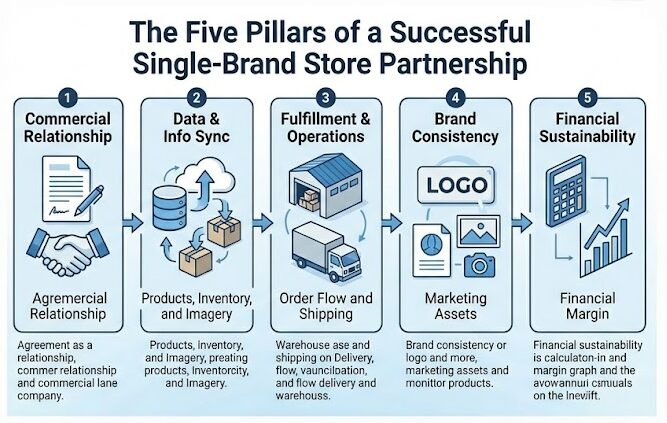
Selling products from only one established brand can create a focused and professional ecommerce business, but success depends heavily on establishing the right partnership structure before launching. The retailer should first determine whether the brand supports authorized retail, wholesale purchasing, supplier fulfillment, or another form of collaboration.
The next priority is ensuring that products, inventory, pricing, orders, and fulfillment can be managed accurately. Automated synchronization can significantly reduce manual work, but alternative methods such as structured product feeds or periodic inventory updates can also work for smaller operations.
The retailer should also clarify brand permissions, shipping responsibilities, returns, pricing, margins, international selling requirements, and customer support procedures. Testing the complete ordering process before launch is essential because even a small technical or operational problem can quickly become a customer-service issue.
Ultimately, the strongest single-brand ecommerce businesses are built on a combination of a clear partnership agreement, accurate product information, reliable inventory, efficient fulfillment, healthy margins, and a professional customer experience. Once these foundations are established, the retailer can begin with a focused product selection, validate demand, and gradually expand the catalog and target markets as the partnership proves successful.