Dropshipping from Europe can be an attractive opportunity for entrepreneurs who want to build an ecommerce business without purchasing and storing large quantities of inventory themselves. However, starting a successful dropshipping business requires more than simply finding products and putting them on an online store.
The Shopify Community discussion “How to effectively start dropshipping from Europe?” focuses on several important questions that new entrepreneurs face: how to find reliable European suppliers, whether to sell through marketplaces or an independent online store, how to choose the right niche, and how to make sure customers receive their orders quickly.
One of the biggest themes in the discussion is that supplier selection and product selection should work together. Instead of choosing a supplier first and then looking for products, it is generally better to identify a promising niche and target market before selecting the supplier that can support it.
For European dropshipping, factors such as warehouse location, delivery speed, product quality, returns, customer support, and payment preferences can have a major impact on the business.
Start With a Niche
One of the first decisions a new dropshipping entrepreneur needs to make is what type of products to sell.
Trying to sell everything can make a new store difficult to manage and difficult for customers to understand.
A focused niche gives the business a clearer identity and makes it easier to understand the target audience.
Possible niche directions could include:
- Home and garden
- Beauty and personal care
- Fitness
- Pet products
- Fashion accessories
- Electronics accessories
- Kitchen products
- Lifestyle products
- Furniture and home décor
- Travel accessories
The goal is not simply to find a category that looks popular.
A good niche should have enough demand, reasonable competition, healthy margins, and products that can be shipped efficiently.
The entrepreneur should also consider whether customers are likely to purchase multiple products from the same store.
For example, a store focused on home organization could eventually sell storage products, kitchen organization items, workspace accessories, and other related products.
This creates opportunities for repeat purchases and cross-selling.
Why Europe-Based Suppliers Matter
One of the biggest advantages of working with suppliers that have European warehouses is delivery speed.
Customers have become accustomed to relatively fast ecommerce deliveries. Long delivery times can create frustration, increase support requests, and lead to cancellations or negative reviews.
This is one reason why relying entirely on suppliers located far outside the target market can become difficult as a business grows.
A supplier with inventory already located within Europe may allow orders to reach customers faster.
This can provide several advantages:
- Shorter delivery times
- Easier returns
- Better customer experience
- More predictable shipping
- Reduced uncertainty
- Greater confidence when scaling advertising
However, simply seeing “European warehouse” is not enough.
A merchant should verify where the inventory is actually stored and whether the specific products being sold are available from those locations.
A supplier may have European warehouses but still ship certain products from elsewhere.
Therefore, warehouse location should be checked at the product level whenever possible.
Choosing the Right Supplier
Supplier selection is one of the most important decisions in a dropshipping business.
The cheapest supplier is not necessarily the best supplier.
A reliable supplier should be evaluated based on several factors.
Product Quality
The first concern should be quality.
A product may look attractive in photographs but feel completely different when the customer receives it.
Poor quality can result in:
- Returns
- Refunds
- Negative reviews
- Customer complaints
- Chargebacks
- Damage to the brand reputation
Whenever possible, merchants should order samples before listing products widely.
Delivery Speed
Delivery expectations should be realistic.
A supplier that consistently takes several weeks to deliver products may be unsuitable for a business targeting customers who expect faster service.
European warehousing can reduce delivery times, but the merchant should still verify actual shipping performance.
Inventory Availability
Nothing is more frustrating than receiving customer orders for products that are suddenly unavailable.
A good supplier should provide reasonably accurate inventory information.
Inventory synchronization becomes especially important when the store starts receiving a larger number of orders.
Customer Support
Problems will happen.
Packages can be delayed. Products can arrive damaged. Customers can request refunds. Shipments can occasionally go missing.
A supplier that responds quickly and helps resolve issues can make these situations much easier to manage.
European Supplier Options
The discussion mentions several supplier networks and marketplaces that can be considered by merchants looking for European fulfillment options.
These include Spocket, BigBuy, CJdropshipping, Syncee, eComZone, and dropXL.
Each can have different product categories, warehouse availability, shipping arrangements, pricing structures, and supplier coverage.
For example, dropXL is particularly relevant for merchants interested in categories such as home, garden, and furniture where European warehouse availability can be important.
However, merchants should not choose a supplier simply because it appears on a recommended list.
The right choice depends on the products being sold and the target market.
A supplier that is excellent for fashion accessories may not be ideal for furniture. A supplier suitable for lightweight products may not be suitable for large or fragile items.
The best supplier is the one that fits the specific product, customer, country, and business model.
Avoid Choosing Products Only Because They Are Trending
A common mistake among new dropshippers is searching for viral products and immediately building a store around them.
Trends can create opportunities, but they can also disappear quickly.
A product may receive enormous attention for a few weeks and then experience a significant decline in demand.
Instead of focusing only on trends, merchants should examine whether the product solves a real problem or provides a meaningful benefit.
A stronger product opportunity may have:
- Consistent demand
- A clear target customer
- Reasonable competition
- Healthy margins
- Easy shipping
- Low damage risk
- Low return rates
- Opportunities for related products
Long-term businesses are usually built around customer needs rather than short-lived trends.
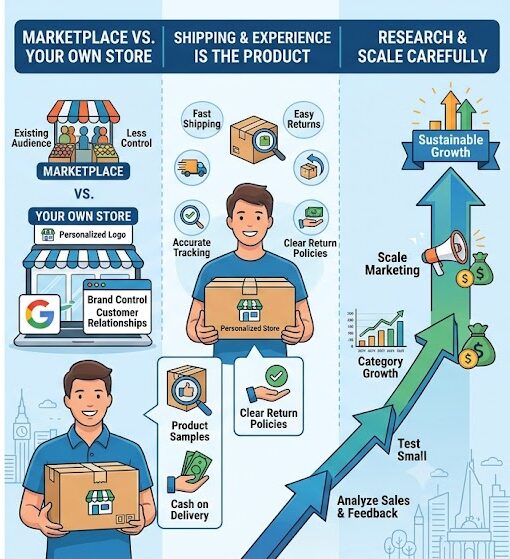
Marketplaces or Your Own Store?
Another important question raised in the discussion is whether beginners should start by selling through marketplaces or create their own independent ecommerce store.
Both approaches have advantages.
Marketplaces
Marketplaces can provide access to an existing customer audience.
This can be helpful for someone who is just starting and does not yet have a strong brand or marketing system.
Customers are already visiting these platforms, which can reduce some of the difficulty involved in attracting the first visitors.
However, marketplaces also come with limitations.
The merchant has less control over the customer experience, branding, and relationship with customers. Competition can also be intense because customers can easily compare multiple sellers.
Independent Store
An independent store provides much more control.
The merchant can decide:
- Brand identity
- Store design
- Product presentation
- Pricing
- Customer experience
- Marketing strategy
- Email communication
- Product bundles
- Loyalty programs
The downside is that the merchant is responsible for generating traffic.
A new store may look professional but still receive very few visitors if there is no marketing strategy behind it.
For this reason, choosing between a marketplace and an independent store depends on the entrepreneur’s goals and resources.
Some businesses may benefit from testing products in an existing marketplace environment while gradually building their own brand.
Eastern Europe Requires Special Consideration
The discussion also highlights an important point about Eastern European markets: Cash on Delivery can be an important payment option in some markets.
Customer payment preferences vary significantly across countries.
A payment method that works extremely well in one market may not be as effective in another.
For merchants targeting Eastern Europe, understanding local purchasing habits is therefore important.
Cash on Delivery can reduce the barrier for customers who are uncomfortable paying online in advance.
However, it also introduces additional operational considerations.
Orders may be rejected or not collected, which can increase return-to-sender costs.
Therefore, merchants should understand both the benefits and risks before making Cash on Delivery a major part of their strategy.
Shipping Is Part of the Product Experience
Dropshipping is often described as a business model where the supplier ships the product directly to the customer.
But from the customer’s perspective, they are not buying from the supplier.
They are buying from your store.
That means customers generally do not care which supplier caused the delay. If their order arrives late, they will associate the experience with your business.
This makes shipping one of the most important parts of the customer experience.
A good dropshipping business should clearly communicate:
- Estimated delivery times
- Shipping costs
- Tracking information
- Return policies
- Refund procedures
Avoid promising extremely fast delivery if the supplier cannot consistently provide it.
Honest expectations are better than unrealistic promises.
Product Quality and Returns
Returns can quickly turn an apparently profitable dropshipping business into an unprofitable one.
Suppose a merchant makes a good margin on a product, but a significant percentage of customers return it.
The business may have to absorb:
- Return shipping
- Refund costs
- Customer support
- Replacement costs
- Lost shipping fees
- Potential payment processing costs
This is why testing products before scaling is important.
A merchant should understand what customers actually receive before spending heavily on marketing.
Product samples can reveal issues that product photographs cannot show.
Researching Growing Categories
The discussion also raises questions about identifying high-growth product categories and measuring year-over-year growth.
This is an important part of product research.
Instead of asking only:
“What is popular right now?”
merchants should ask:
“Which categories are growing consistently?”
Category growth can be evaluated using several indicators.
These may include:
- Search interest
- Sales trends
- Customer demand
- Marketplace activity
- Competitor expansion
- Product review growth
- Social engagement
- Changes in consumer behavior
Year-over-year comparisons can be especially useful because they show whether interest is increasing compared with the same period in the previous year.
However, growth alone does not guarantee profitability.
A rapidly growing category can also have intense competition and rising advertising costs.
The merchant needs to consider the complete business opportunity.
Competitor Research
Competitor research can provide useful information about what is already working in the market.
Merchants can examine:
- Which products competitors highlight
- Their pricing
- Product descriptions
- Delivery promises
- Customer reviews
- Frequently promoted products
- Product bundles
- Customer complaints
Customer complaints are particularly valuable.
If customers repeatedly complain about poor quality, slow shipping, weak packaging, or limited product selection, those complaints may reveal opportunities for a new business.
The objective should not be to copy competitors.
Instead, competitors should help merchants understand what customers expect and where existing businesses may be leaving gaps.
Should You Hire Someone to Design the Store?
The discussion also asks whether someone should be hired to help with store design.
There is no single answer.
A beginner with a limited budget may be able to create a simple store independently.
The most important thing is not making the store extremely complicated.
A successful store should be:
- Easy to navigate
- Mobile-friendly
- Visually consistent
- Clear about products
- Transparent about shipping
- Easy to purchase from
- Trustworthy
A beautiful design cannot compensate for poor products, slow shipping, or unclear policies.
For a beginner, it may be better to focus first on product validation and customer experience rather than spending a large amount of money on advanced design.
Once sales begin to grow, professional assistance can become more valuable.
A Practical European Dropshipping Strategy
A beginner can approach European dropshipping in several stages.
Step 1: Choose the Market
Decide which European country or countries you want to target.
Do not assume that the entire European market behaves the same way.
Customer preferences, languages, payment methods, shipping expectations, and regulations can vary.
Step 2: Select a Niche
Choose a category with clear customer demand and reasonable business potential.
Step 3: Find Suitable Suppliers
Look for suppliers that can provide products from warehouses close to your target customers.
Step 4: Order Samples
Test quality, packaging, shipping speed, and the overall customer experience.
Step 5: Build a Simple Store
Focus on clarity and trust rather than unnecessary complexity.
Step 6: Test Products
Start with a limited number of products rather than uploading hundreds of items.
Step 7: Measure Results
Track sales, customer feedback, delivery performance, returns, and profitability.
Step 8: Scale Carefully
Increase marketing and inventory only after the product demonstrates genuine potential.
Final Thoughts
Starting a dropshipping business in Europe can be a promising opportunity, but success depends on more than finding a supplier and uploading products.
The most important decisions involve choosing the right niche, selecting reliable suppliers, verifying European warehouse availability, testing products, understanding local customer preferences, and providing a dependable delivery experience.
For beginners, starting small is generally safer than immediately building a huge catalog.
A focused store with a handful of carefully selected products can be easier to manage and improve than a large store filled with products that have never been tested.
European warehousing can provide a major advantage because faster delivery can improve customer satisfaction and reduce some of the problems associated with long international shipping times.
At the same time, merchants should not assume that every European supplier or product will automatically provide a good experience. Samples, supplier communication, inventory availability, shipping performance, and return policies should all be evaluated before scaling.
Ultimately, effective dropshipping is not about finding the largest number of products.
It is about finding the right products for the right customers, working with reliable suppliers, and creating a shopping experience that customers can trust.
Start with a niche, validate your products, understand your market, keep operations manageable, and scale only when the numbers support the decision. That approach gives a new European dropshipping business a much stronger foundation for sustainable growth.
Files, images, and data analysis are unavailable until usage resets at 3:01 PM. Continue chatting with text only, or upgrade for more access.


0 Comments