Buying vintage jewelry, estate-sale pieces, scrap gold, or second-hand jewelry can be an attractive way to source inventory for a jewelry business. These pieces may have significant resale value, unique designs, historical character, or collectible appeal. However, buying this type of inventory also comes with a major challenge: How do you know whether you are paying a fair price for the gold itself?
A seller may give you a price based on the appearance, age, brand, or perceived value of a piece. But if you are buying jewelry primarily because of its precious-metal content, you need an independent way to estimate what the gold is worth before agreeing to the purchase.
This is where the concept of gold melt value becomes useful.
Gold melt value provides an estimate of the raw gold value contained in a piece of jewelry. It does not necessarily represent the final resale price of the jewelry, but it gives a useful baseline for evaluating whether an inventory purchase makes financial sense.
The Shopify Community discussion on this subject describes a simple approach: determine the item’s weight, identify its gold purity, and compare the amount of pure gold it contains with the current market price of gold.
What Is Gold Melt Value?
Gold melt value is the estimated value of the actual gold contained in a piece of jewelry if the item were melted down and valued primarily as gold.
This is different from the retail value of the jewelry.
A gold ring, necklace, bracelet, or pair of earrings may be worth more than its melt value because of:
- Design
- Brand
- Craftsmanship
- Age
- Rarity
- Historical significance
- Gemstones
- Collectibility
- Customer demand
However, the melt value gives you a useful minimum economic reference point when evaluating the metal content.
For example, suppose a vintage gold bracelet has a melt value of ₹50,000. A seller asking ₹48,000 may be offering an attractive opportunity if the piece can be resold for considerably more.
But if the same bracelet is being offered for ₹90,000 and there is no significant design, brand, or collectible premium, the purchase deserves much more scrutiny.
The melt calculation helps you understand what you are actually buying.
The Basic Melt-Value Formula
The basic calculation can be expressed as:
Gold melt value = Gold weight × Gold purity × Current gold price
The important part is understanding each component.
Gold Weight
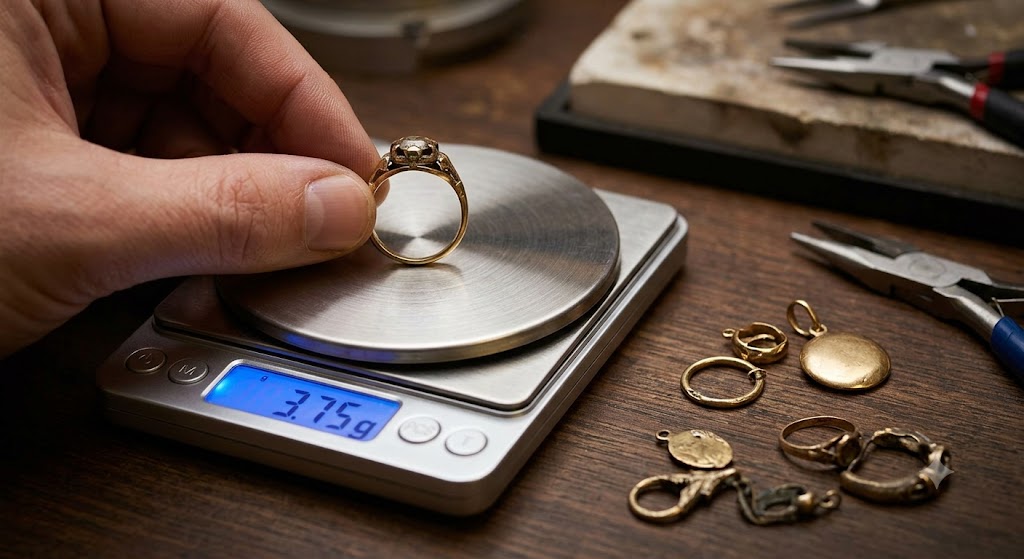
The first factor is the weight of the gold-containing item.
Jewelry is commonly weighed in grams, although other units may be used in different markets.
However, there is an important warning:
The total weight of a piece is not necessarily the weight of gold.
A piece may contain:
- Gemstones
- Glass
- Enamel
- Non-gold clasps
- Other metals
- Decorative materials
- Internal components
If a necklace weighs 20 grams, you cannot automatically assume that it contains 20 grams of gold.
The calculation needs to reflect the actual gold-bearing portion as accurately as possible.
Understanding Gold Purity
Gold jewelry is rarely made from 100% pure gold.
Instead, it is commonly mixed with other metals to improve strength, durability, color, or workability.
Purity is often expressed using karats.
Common examples include:
- 24K
- 22K
- 18K
- 14K
- 10K
The higher the karat number, the greater the proportion of pure gold.
For example:
24K is approximately 99.9% pure gold.
22K is approximately 91.7% pure gold.
18K is approximately 75% pure gold.
14K is approximately 58.3% pure gold.
10K is approximately 41.7% pure gold.
Therefore, two jewelry pieces with exactly the same weight can have very different gold values if their purity levels differ.
Why Karat Stamps Matter
Many jewelry pieces have markings that indicate their gold purity.
A stamp such as 14K or 18K can provide an initial indication of the metal’s purity.
For example, an 18K piece contains significantly more gold than a 14K piece of the same weight.
This makes purity identification an essential part of inventory evaluation.
However, a stamp should be treated as an important clue rather than unquestionable proof.
Vintage and second-hand jewelry can have:
- Worn markings
- Incorrect markings
- Altered components
- Repaired sections
- Mixed-metal parts
Therefore, higher-value purchases may require additional verification.
Example of a Melt-Value Calculation
Imagine you are evaluating an 18K gold bracelet.
Suppose:
- Weight = 20 grams
- Purity = 18K
- Gold purity = approximately 75%
The estimated pure gold content would be:
20 grams × 75% = 15 grams of pure gold
If the current market price of pure gold is ₹6,000 per gram, the theoretical melt value would be:
15 × ₹6,000 = ₹90,000
This does not necessarily mean that a buyer should pay ₹90,000 for the bracelet.
There may be additional considerations.
The seller may expect a premium. A refiner or dealer may pay less than the theoretical market value. The jewelry may include stones or other materials. There may also be costs involved in processing or reselling the metal.
The calculation is therefore best viewed as a baseline, not a guaranteed selling price.
Why Melt Value Is Useful for Negotiation
One of the most valuable uses of melt value is negotiation.
Without an independent calculation, a buyer may simply accept the seller’s valuation.
The seller might say:
“This is a valuable vintage gold piece.”
That may be true, but the buyer still needs to understand how much of the price comes from the gold itself and how much comes from other factors.
Knowing the approximate melt value gives the buyer a reference point.
For example:
- Estimated melt value: ₹40,000
- Seller’s asking price: ₹42,000
This may be reasonable depending on the piece.
But if:
- Estimated melt value: ₹40,000
- Seller’s asking price: ₹85,000
then the buyer should understand what justifies the additional ₹45,000.
Perhaps the piece is rare, branded, historically significant, or particularly desirable.
If there is no strong reason for the premium, the buyer may decide not to purchase it.
Melt Value Is Not the Same as Retail Value
This distinction is extremely important.
A jewelry business should not assume:
Melt value = resale price
These are different concepts.
Consider a beautifully designed vintage ring.
Its raw gold content might be worth ₹30,000.
But a jewelry customer may be willing to pay ₹50,000, ₹70,000, or more because of the design and uniqueness.
Conversely, a damaged piece might technically contain ₹30,000 worth of gold but sell for much less if the buyer is purchasing it primarily for scrap.
Therefore, melt value helps answer:
“What is the underlying metal worth?”
It does not answer:
“What will customers pay for this finished piece?”
Both questions are important for inventory sourcing.
Consider Gemstones and Non-Gold Components
Jewelry often contains materials that should not be included in the gold calculation.
For example, a ring may weigh 12 grams but contain a large gemstone.
If you use the entire 12 grams as gold weight, you could significantly overestimate its melt value.
Similarly, jewelry may contain:
- Steel springs
- Non-gold clasps
- Gemstones
- Ceramic elements
- Glass
- Other decorative materials
The more complicated the piece, the more carefully its gold content needs to be evaluated.
For expensive inventory purchases, guessing can create significant financial risk.
Why Independent Verification Matters
The discussion also emphasizes the importance of checking the value independently.
This is particularly important when buying from unfamiliar sellers, estate sales, auctions, private individuals, or dealers.
A seller has an incentive to maximize the price they receive.
That does not necessarily mean the seller is dishonest. They may genuinely value the item differently because of its design or history.
But the buyer should still perform their own calculation.
Independent verification helps prevent two opposite mistakes:
Overpaying:
The buyer pays much more than the underlying gold value without a strong reason.
Lowballing:
The buyer makes an unnecessarily low offer because they incorrectly estimate the gold content.
A reliable calculation creates a more informed negotiation.
Weight Should Be Verified Before Purchase
The discussion includes an important practical lesson: never assume the seller’s stated weight is automatically accurate.
A small difference in weight may not matter much for an inexpensive item.
But when purchasing high-value gold inventory, even a relatively small difference can affect the calculation.
For example, suppose a seller says a piece weighs 25 grams.
If the actual gold-bearing weight is 22 grams, the difference may become significant depending on purity and the current gold price.
Therefore, buyers should independently verify weight whenever practical.
This is particularly important when purchasing multiple pieces as a lot.
Gold Prices Change
Another important factor is that gold prices are not fixed forever.
The value of pure gold changes with market conditions.
Therefore, a melt-value calculation made several months ago may not accurately represent the current value.
This is why buyers should use a current gold price when evaluating a new purchase.
The basic process remains the same:
Determine weight → Determine purity → Calculate pure gold content → Use the current gold price → Estimate melt value
The calculation can then be repeated whenever market conditions change.
A Better Way to Evaluate Jewelry Inventory
Melt value should be only one part of the sourcing process.
A jewelry seller should ideally evaluate several factors.
1. Metal Value
How much gold or other precious metal does the item contain?
2. Purchase Price
How much is the seller asking?
3. Condition
Is the jewelry wearable and in good condition?
4. Design
Does the item have aesthetic appeal that customers are likely to value?
5. Brand
Does the jewelry come from a recognizable or desirable brand?
6. Rarity
Is it a common design or something difficult to find?
7. Gemstones
Are the stones valuable, desirable, or merely decorative?
8. Repair Costs
Will the item require cleaning, resizing, restoration, or repairs?
9. Resale Demand
Are customers actually interested in similar pieces?
10. Expected Margin
After all costs, is there enough potential profit to justify purchasing the inventory?
This broader evaluation helps prevent the seller from focusing too heavily on a single number.
Building a Repeatable Sourcing Process
If a jewelry seller regularly buys vintage or estate inventory, it can be useful to create a repeatable process.
Before purchasing a piece, record:
- Item description
- Weight
- Purity marking
- Estimated pure gold weight
- Current gold price
- Estimated melt value
- Seller’s asking price
- Expected resale price
- Repair or cleaning costs
- Other relevant details
This creates a consistent method for comparing opportunities.
Instead of making emotional decisions based on how attractive a piece looks, the seller can combine financial analysis with product appeal.
Avoid Making Decisions Based Only on Gold Content
There is also a danger in going too far in the other direction.
A beautiful vintage piece may have a high resale value even if its melt value is relatively modest.
For example, a collectible designer ring may be worth significantly more as jewelry than as raw metal.
If a buyer evaluates it only according to its gold content, they may misunderstand the opportunity.
Similarly, a piece with substantial gold content may have limited retail appeal if its design is outdated or damaged.
The best sourcing decisions consider both:
Intrinsic metal value
and
Potential customer value
A Simple Decision Framework
Before buying a piece, ask four questions.
Question 1: What is the approximate melt value?
Calculate the underlying gold value independently.
Question 2: How much am I paying?
Compare the asking price with the estimated melt value.
Question 3: Why is the piece worth more or less than melt value?
Consider design, brand, condition, gemstones, rarity, and demand.
Question 4: Can I make a reasonable profit?
Estimate your eventual selling price and subtract the purchase cost and other expenses.
If these four questions have reasonable answers, the purchase can be evaluated with much greater confidence.
Final Takeaway
Buying gold jewelry inventory without understanding its underlying metal value can expose a seller to unnecessary financial risk.
A simple melt-value calculation provides an independent baseline.
The basic principle is:
Weight × Purity × Current Gold Price = Estimated Gold Melt Value
However, this calculation should be used carefully.
The actual gold-bearing weight may be lower than the total weight of the jewelry. Purity should be verified as accurately as possible. Current gold prices should be used rather than outdated figures. Stones and non-gold components should not automatically be treated as gold.
Most importantly, melt value is a reference point, not necessarily the final market value of the jewelry.
A vintage or collectible item may deserve a significant premium because of its design, brand, rarity, condition, or customer demand. On the other hand, a damaged or unattractive piece may be worth closer to its raw metal value.
For jewelry sellers, the biggest advantage of understanding melt value is confidence. Instead of relying entirely on a dealer’s estimate or making a purchase based on appearance, the seller can perform an independent calculation and negotiate from an informed position.
The goal is not always to buy below melt value. The goal is to understand exactly what you are paying for and why the price makes sense.
For anyone sourcing vintage, estate-sale, or scrap gold inventory, that simple habit can make purchasing decisions more disciplined, transparent, and profitable.


0 Comments